IB Chemistry books 2026: Complete guide for students and teachers
Choosing the right IB Chemistry book is one of the most consequential academic decisions an IB Diploma student will make. The wrong textbook can leave you covering outdated content, missing key assessment criteria, or struggling to connect concepts the way the IB examiners actually expect. Drawing on years of experience at Times Edu supporting students across IGCSE, A Level, and IB programmes, this guide breaks down every major IB Chemistry textbook, compares them honestly, and shows you exactly how to use them to score at the top.
Whether you are just starting your IB Diploma journey or entering the final revision stretch before exams, this resource will help you invest your study time and money wisely.
- Best IB Chemistry books
- Oxford and Hodder IB Chemistry textbooks reviewed and compared
- IB Chemistry study guides vs full textbooks: Which do you actually need?
- Top IB Chemistry books for SL and HL students covering the full syllabus
- How to use an IB Chemistry book alongside past papers and internal assessment
- Where to buy IB Chemistry books at the best price online
- Free IB Chemistry resources vs investing in an authorised study book
- Frequently asked questions
Best IB Chemistry books
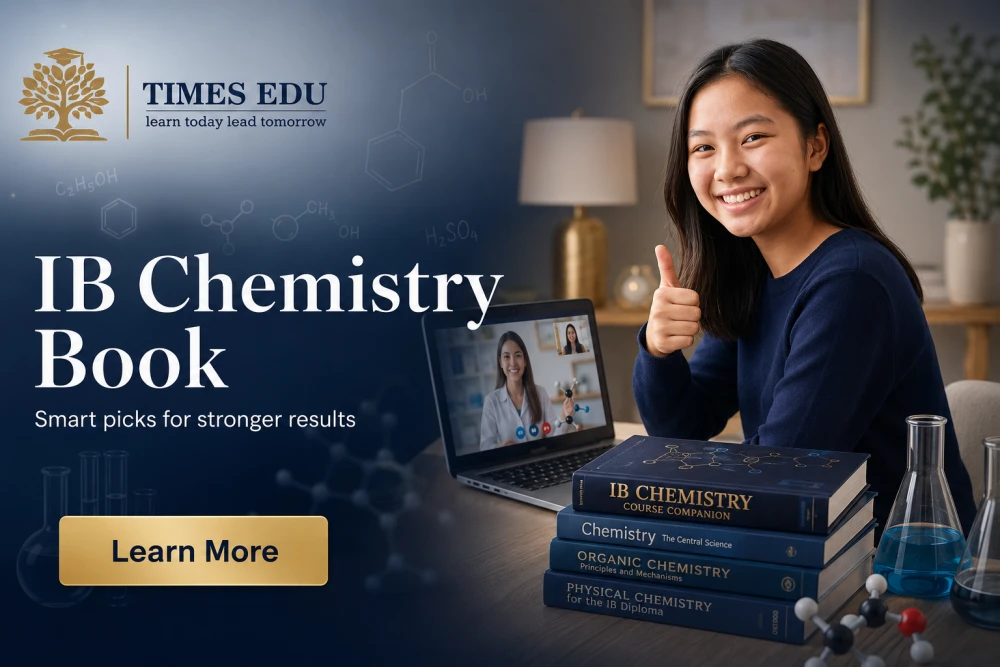
The IB Diploma Chemistry [1] course was significantly restructured in its most recent curriculum update. The new syllabus organises all content around two core pillars: Structure and Reactivity. This is a fundamental shift away from the older topic-by-topic model, and it has direct implications for which IB Chemistry textbook you should be using.
One critical detail often overlooked is that any IB Chemistry book published before 2023 will not align with this restructured syllabus. Students who continue using older editions risk preparing content that no longer maps to the examination questions or internal assessment criteria. Always verify the publication year before purchasing.
The three dominant publishers producing authorised or closely aligned IB Diploma Chemistry books are Oxford University Press, Pearson, and Hodder Education. Each targets slightly different learning styles, and understanding these differences will directly influence how efficiently you study.
>>> Read more: IB books 2026: The complete guide to study materials for the IB Diploma
Oxford and Hodder IB Chemistry textbooks reviewed and compared
Oxford IB Chemistry course companion
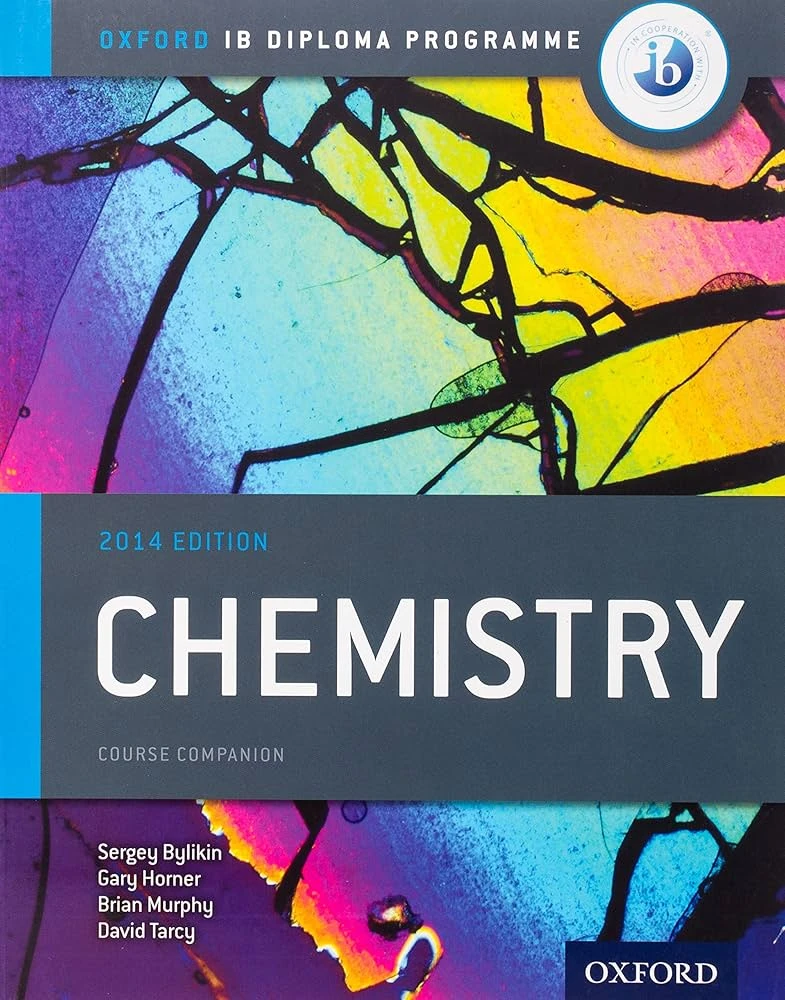
The Oxford IB Diploma Programme: Chemistry Course Companion, written by Sergey Bylikin, Gary Horner, and Elisa Jimenez-Miralles, is developed in direct cooperation with the IB Organisation. This makes it one of the closest things to an officially authorised Chemistry book IB students can access.
What sets this Oxford IB Chemistry textbook apart is its deliberate integration of Theory of Knowledge (TOK) connections and the Nature of Science (NOS) framework throughout every chapter. These are not added as afterthoughts but woven directly into the conceptual explanations. For students aiming for strong scores on the extended essay and TOK components alongside chemistry, this structure is genuinely valuable.
Purchases of the Oxford course companion typically include access to the Oxford digital learning platform, which provides interactive molecular simulations and auto-marked practice quizzes. This additional layer of digital support makes it one of the most complete IB Diploma science resources currently available from a single publisher.
Hodder IB Chemistry textbook
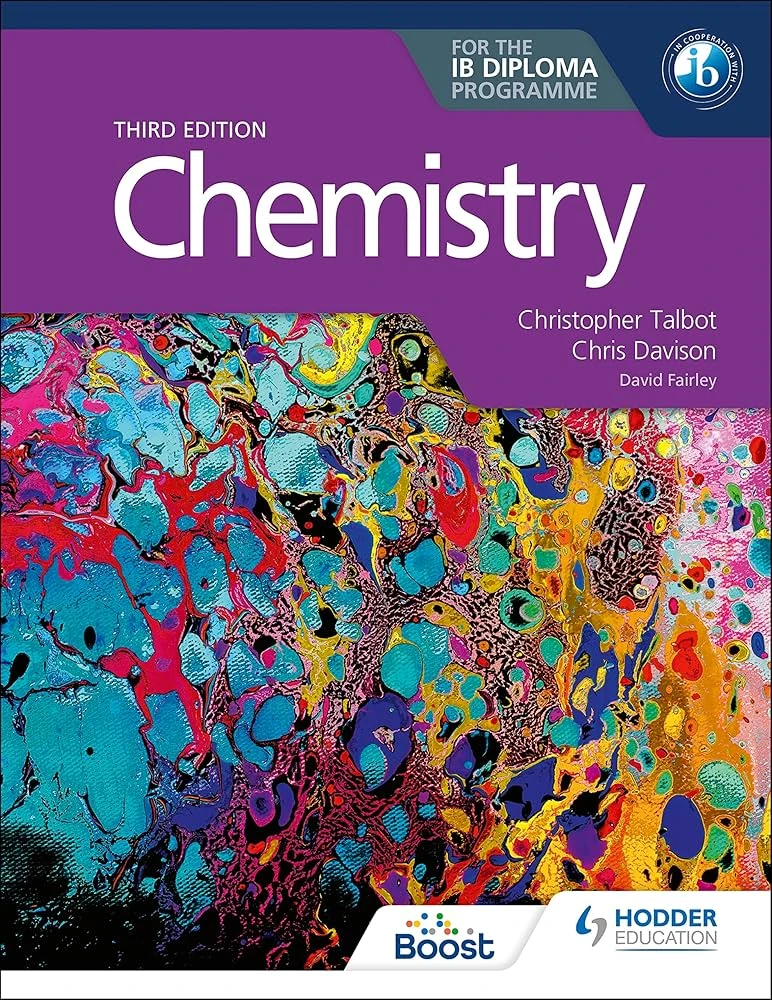
Chemistry for the IB Diploma by Christopher Talbot and Richard Harwood (Hodder Education) is consistently praised by experienced IB Chemistry teachers for one specific quality: its readability. The Hodder IB Chemistry book presents concepts in a clear, linear sequence that reduces cognitive overload, particularly for students who find chemistry abstract or intimidating at first.
Dedicated “Skills” sections within the Hodder textbook explicitly teach graphical analysis, treatment of uncertainties, and qualitative interpretation of spectra including NMR, IR, and mass spectrometry. These are competencies tested directly in both the written examinations and the Internal Assessment, and having them isolated in a structured feature makes revision significantly more efficient.
A common mistake we see is students underestimating how much spectroscopic interpretation appears at Higher Level. The Hodder book addresses this more deliberately than most competing texts, which gives HL students a measurable advantage in Paper 2 and Paper 3 style questions.
Quick comparison table
| Feature | Oxford IB Chemistry | Hodder IB Chemistry | Pearson IB Chemistry |
|---|---|---|---|
| IB co-development | Yes | No | No |
| TOK/NOS integration | Excellent | Moderate | Moderate |
| Clarity and readability | Good | Excellent | Very good |
| Mathematical walkthroughs | Good | Good | Excellent |
| IA support chapters | Moderate | Good | Excellent |
| Digital platform access | Yes | Limited | Limited |
| Best for | Conceptual learners | Linear/structured learners | Calculation-focused learners |
>>> Read more: IB English Paper 1 Evidence Selection 2026: How to Pick Quotes That Prove Your Argument
IB Chemistry study guides vs full textbooks: Which do you actually need?
This is a question Times Edu consultants receive from parents and students almost every enrolment cycle. The short answer: most students need both, but used at different stages of their preparation.
A full IB Chemistry textbook (Oxford, Hodder, or Pearson) is essential during the learning phase, roughly the first 18 months of the two-year Diploma programme. These books provide the explanatory depth, worked examples, and conceptual scaffolding you need to actually understand the material rather than merely memorise it.
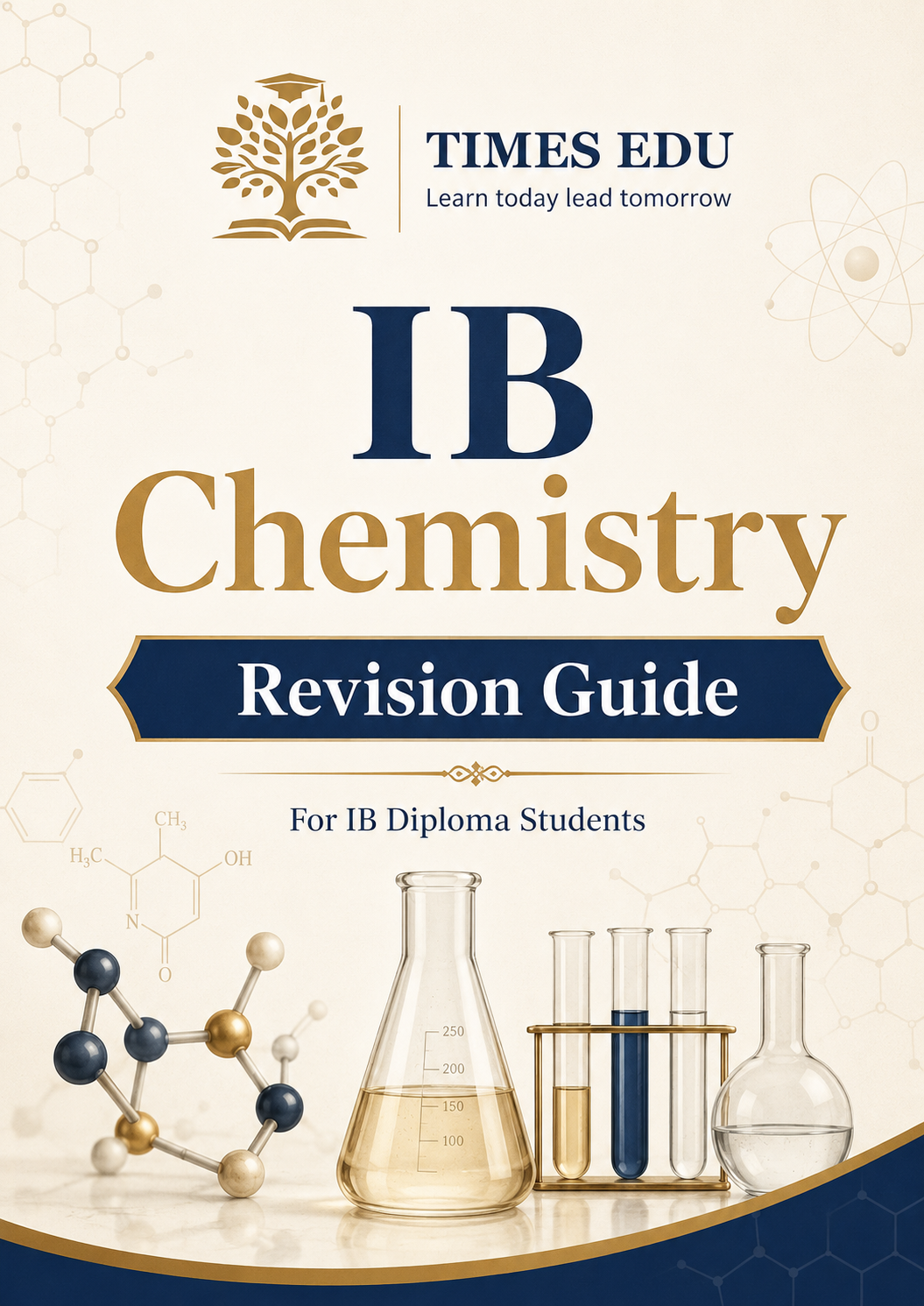
An IB Chemistry revision guide, by contrast, is a condensed reference tool designed for the final six to eight weeks before examinations. Revision guides strip away extended explanations and focus on key definitions, reaction pathways, formula summaries, and examiner tip boxes. Using a revision guide before you have completed your learning is a critical mistake that shortcuts understanding and typically produces a ceiling of around 4 to 5, not the 6 or 7 most ambitious students are targeting.
Recommended revision guides worth considering
- IB Chemistry Study Guide by Geoffrey Neuss (Oxford): compact, syllabus-aligned, ideal for active recall practice
- Topic summary booklets produced by experienced IB teachers and shared through platforms like RevisionVillage
- Past paper mark schemes, which are themselves one of the most underused IB Chemistry study resources available
>>> Read more: IB Chemistry Paper 1 vs Paper 2 : Key Differences + Strategy for Score 7
Top IB Chemistry books for SL and HL students covering the full syllabus
Pearson IB Chemistry: The calculation specialist
The Pearson Baccalaureate: Chemistry for the IB Diploma, written by Catrin Brown and Mike Ford, is arguably the strongest IB Chemistry SL HL textbook for students who struggle with the quantitative side of chemistry. Physical chemistry topics including stoichiometry, thermodynamics (enthalpy cycles, Hess’s Law, Born-Haber cycles), equilibrium constants, and electrochemical cell calculations are explained through step-by-step mathematical walkthroughs that are genuinely accessible.
In our experience working with international students, the most common reason for losing marks in IB Chemistry Paper 1 and Paper 2 is not misunderstanding concepts but rather making procedural errors in multi-step calculations. The Pearson book’s methodical approach to setting out working is directly transferable to examination technique.
The Pearson IB Chemistry book also includes dedicated Internal Assessment chapters that guide students through experimental design, data collection and processing, uncertainty analysis, and report writing. This level of explicit IA support is rare in a standard textbook and makes it particularly valuable for students who are tackling their IB Chemistry Internal Assessment without direct teacher guidance.
Covering organic chemistry HL IB content
Higher Level organic chemistry is an area where many students fall significantly behind. The organic chemistry HL IB content covers reaction mechanisms (nucleophilic substitution, electrophilic addition, elimination reactions), stereochemistry including chirality and optical isomers, and multi-step synthesis planning. These topics require visual thinking and pattern recognition rather than rote memorisation.
The Oxford course companion handles organic mechanisms through clean structural diagrams and curly arrow notation. The Hodder book provides the most explicit step-by-step guidance through mechanism drawing conventions. Pearson supports the topic with detailed 3D stereochemical diagrams. In practice, many HL students benefit from cross-referencing two books for organic chemistry alone.
One critical detail often overlooked is that examiner reports consistently flag stereochemistry and synthetic planning as the topics where candidates lose the most marks at HL. Dedicating proportionally more study time to these areas, supported by the right textbook, is a straightforward way to protect your grade.
>>> Read more: IB Chemistry HL Mistake Log 2026: How to Track Errors and Turn Them into Score Improvements
How to use an IB Chemistry book alongside past papers and internal assessment
Owning the right IB Chemistry book is only half the strategy. How you use it across a two-year programme determines whether it actually lifts your grade.
Phase 1: Concept building (Year 1, months 1-10)
Use your primary textbook (Oxford, Hodder, or Pearson depending on your learning style) to read each topic unit before or alongside your teacher’s lessons. Do not simply highlight text. Write margin notes, create concept maps connecting Structure and Reactivity themes, and attempt all in-chapter worked examples without looking at the solutions first.
Phase 2: Past paper integration (Year 1, month 11 onwards)
Begin introducing past papers once you have completed at least 60% of the syllabus content. Use the textbook to look up topics where you lose marks, identifying your specific weakness areas rather than re-reading everything. This targeted back-reference approach is far more time-efficient than passive re-reading.
Phase 3: Internal Assessment (Year 1, month 8 to Year 2, month 2)
Your IB Chemistry Internal Assessment is worth 20% of your final grade. Do not treat it as secondary to examination preparation. Use the IA support chapters in Pearson or Hodder to structure your report, paying specific attention to the Research Question, methodology, data processing, and evaluation sections. These are the four areas where the most marks are gained or lost.
Phase 4: Final revision (Year 2, months 9-12)
Switch from your full textbook to a dedicated IB Chemistry revision guide and your annotated past paper collection. Timed past paper practice under examination conditions is the most effective activity in this phase.
>>> Read more: IB Chemistry HL Study Plan for 2026: A Week-by-Week Schedule to Stay Ahead
Where to buy IB Chemistry books at the best price online
Students and parents frequently ask where to buy IB Chemistry books without paying inflated prices. Here are the most reliable options across different budget levels.
| Source | Price range | Reliability | Notes |
|---|---|---|---|
| Publisher websites (Oxford, Pearson, Hodder) | Full retail | Highest | Guaranteed latest edition, digital access codes included |
| Amazon (new) | Retail to slight discount | High | Check edition year carefully |
| Amazon (used/secondhand) | 30-60% lower | Moderate | Verify edition matches current syllabus |
| Book Depository | Retail, free shipping | High | Good for international buyers |
| IB student Facebook groups / Reddit | Very low | Variable | Risk of receiving outdated editions |
| School library borrowing | Free | Depends on school | Often older editions; supplement with personal copy |
One critical detail often overlooked when buying secondhand: The digital access codes included with new textbooks (particularly Oxford’s platform) are single-use and cannot be transferred. If digital resources are important to your study plan, purchasing new is the only guarantee.
>>> Read more: The Ultimate IB Diploma Program (IBDP) Guide 2026
Free IB Chemistry resources vs investing in an authorised study book
There is an abundance of free IB Chemistry content available online, from YouTube channels and PDF note compilations to past paper archives on the IBO’s official subject page. Students sometimes ask whether they can avoid purchasing a textbook altogether.
In our experience working with international students who attempt to self-study IB Chemistry entirely through free resources, the outcome is almost always a grade ceiling of 4 to 5. Free resources are excellent supplements but they rarely provide the sequential, syllabus-structured depth that the IB examinations actually require.
The IB Chemistry Internal Assessment in particular demands a level of methodological understanding, scientific writing skill, and assessment criteria literacy that free YouTube videos simply cannot provide to the same depth as a structured textbook chapter. Investing 60 to 90 USD in the right IB Chemistry book is one of the highest-return academic investments a student can make relative to its impact on the final grade.
Self-study IB Chemistry is achievable, but it requires a higher degree of discipline and strategic resource selection. Students pursuing self-study IB Chemistry should prioritise the Oxford course companion as their primary text (for its IB alignment and digital resources), supplement with Hodder for skills-based topics, and use RevisionVillage or a structured revision guide for examination practice. A personalised academic roadmap from a specialist consultant can significantly reduce the wasted time that most self-study students experience in their first year.
>>> Read more: IB Tutor 2026: How to Choose the Right Tutor for Better Grades and Less Stress
Frequently asked questions
Which IB Chemistry textbook is officially authorised by the IBO?
Is the Oxford IB Chemistry coursebook enough to score a 7?
What is the best IB Chemistry revision guide for last-minute exam preparation?
Which IB Chemistry book covers organic chemistry and HL extension topics most clearly?
Do SL and HL students need different IB Chemistry books?
Are older editions of IB Chemistry books valid for the new IB Chemistry syllabus?
Which IB Chemistry book is best for self-study IB Diploma students?
Conclusion
At Times Edu, we work directly with IB Diploma students and their families to build personalised academic roadmaps that go well beyond textbook selection. From structured tutoring in IB Chemistry SL and HL to Internal Assessment coaching and university application support, our consultants understand exactly what it takes to reach a 6 or 7 and build a compelling study-abroad profile. If you are unsure where your current preparation stands, booking a free academic consultation with a Times Edu specialist is the most efficient next step you can take.