AP Physics C: Syllabus, Exam Structure & Roadmap to an 5 in 2026
AP Physics C is one of the most rigorous and rewarding courses in the entire College Board AP program. Designed for students with a serious interest in engineering, physical sciences, or mathematics, it goes far beyond what any algebra-based physics course can offer. At Times Edu, we work with international students across IGCSE, A Level, IB, and AP curricula, and AP Physics C consistently stands out as a course that can dramatically strengthen a student’s university application, particularly for competitive programs in the United States.
This guide breaks down everything you need to know: What the course covers, how the exams work, how to prepare strategically, and which resources actually move the needle for students aiming for a score of 5.
- AP Physics C: What it covers and how it differs from AP Physics 1 and 2
- AP Physics C Mechanics: Core topics and calculus applications explained
- AP Physics C Electricity and Magnetism: Core topics explained
- How AP Physics C is assessed: Exam structure and scoring for each course
- Can you take AP Physics C Mechanics and E&M in the same year?
- How to prepare effectively and score a 5 in AP Physics C
- Best resources and prep books for AP Physics C students
- Frequently asked questions
AP Physics C: What it covers and how it differs from AP Physics 1 and 2
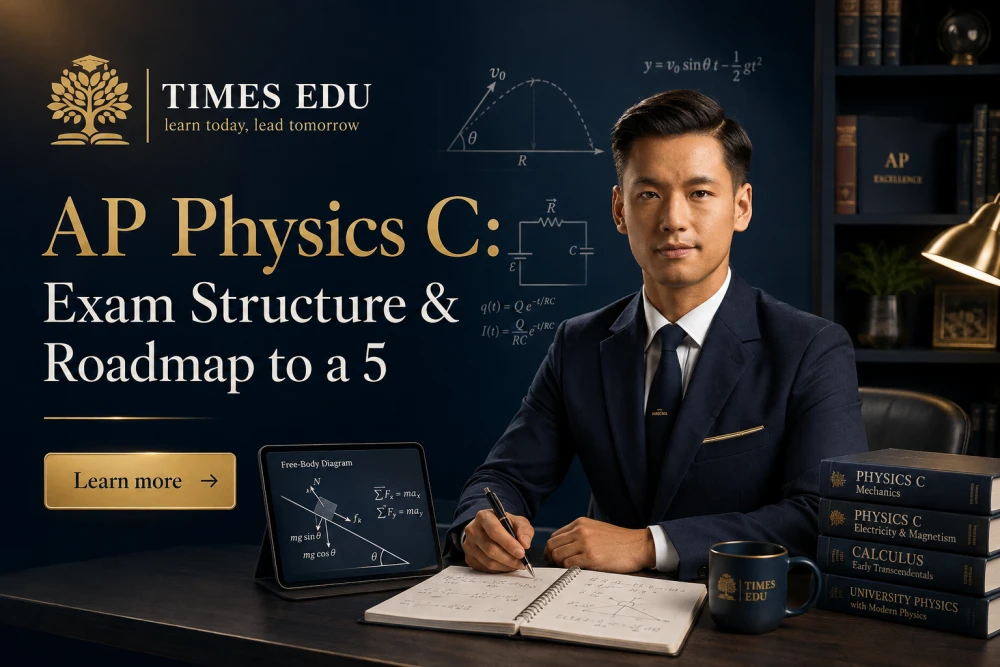
AP Physics C [1] is not a single course. It consists of two separate, independent, calculus-based physics courses offered by the College Board:
- AP Physics C: Mechanics
- AP Physics C: Electricity and Magnetism (E&M)
Each course has its own exam, its own syllabus, and can be taken independently. This is a fundamental point that many students and parents misunderstand at the start of their AP planning.
AP Physics 1 and AP Physics 2, by contrast, are algebra-based. They use equations and reasoning that do not require calculus. AP Physics C: Mechanics and AP Physics C: Electricity and Magnetism integrate calculus directly into the physics itself. Derivatives appear in kinematics. Integrals are used to calculate work, electric flux, and magnetic fields. Without calculus, solving AP Physics C problems correctly is simply not possible.
| Feature | AP Physics 1 & 2 | AP Physics C (Mechanics & E&M) |
|---|---|---|
| Math level | Algebra-based | Calculus-based |
| Exam difficulty | Moderate | High |
| Target students | General science interest | Engineering, physics majors |
| College credit potential | Limited at top universities | Widely accepted at top universities |
| Calculus required | No | Yes |
| Number of exams | 2 (separate courses) | 2 (separate courses) |
A common mistake we see at Times Edu is students choosing AP Physics 1 as a “safer” option when they are actually aiming for engineering at a competitive US university. Admissions officers at schools like MIT, Caltech, Georgia Tech, and UC Berkeley are far more impressed by strong performance in AP Physics C than a 5 in AP Physics 1. The signal sent by AP Physics C is that you are already working at a college physics level.
>>> Read more: AP books 2026: The complete guide to choosing the best AP exam prep materials
AP Physics C Mechanics: Core topics and calculus applications explained
AP Physics C: Mechanics covers classical mechanics at a level comparable to the first semester of a university physics course for science and engineering majors. The use of calculus throughout the course is what separates it from any high school physics you may have encountered before.
The core topic areas are:
- Kinematics: Position, velocity, and acceleration are treated as functions of time. Students use derivatives to find instantaneous velocity and acceleration, and integrals to determine displacement from velocity functions.
- Newton’s Laws of Motion: Force equations are set up and solved using differential equations in some cases, particularly for systems with variable forces such as air resistance or spring-driven motion.
- Work, Energy, and Power: Work is calculated as a line integral. The work-energy theorem is derived using calculus.
- Systems of Particles and Linear Momentum: Center of mass calculations using integration for continuous mass distributions.
- Rotation: This is where kinematics dynamics AP C becomes particularly demanding. Rotational inertia (moment of inertia) is calculated using integration. Torque, angular momentum, and rotational kinematics all appear.
- Oscillations: Simple harmonic motion is described using differential equations. Students derive the period of a spring-mass system and a simple pendulum.
- Gravitation: Newton’s law of gravitation, gravitational potential energy, orbital mechanics, and escape velocity.
One critical detail often overlooked is that rotational mechanics AP content typically accounts for a substantial portion of both the multiple-choice and free-response sections. Students who underinvest in rotation, angular momentum, and moment of inertia calculations routinely lose significant marks in the AP Physics C FRQ section. At Times Edu, our tutors specifically dedicate extra time to rotation because it is where the gap between a score of 3 and a score of 5 is most often decided.
The calculus applications in Mechanics are primarily single-variable: Derivatives with respect to time, definite and indefinite integrals, and basic differential equation setup. Students enrolled concurrently in AP Calculus AB will have enough mathematical foundation, though AP Calculus BC students will find the transition more natural.
>>> Read more: AP Physics FRQ Checklist 2026: What to Review Before You Submit Your Free-Response Answers
AP Physics C Electricity and Magnetism: Core topics explained
AP Physics C: Electricity and Magnetism is widely considered the harder of the two AP Physics C courses. It covers electrostatics, electric circuits, magnetic fields, and electromagnetic induction at a level that corresponds to the second semester of university physics for engineers.
The core topic areas include:
- Electrostatics: Coulomb’s Law, electric fields, electric potential energy, and electric potential. Students calculate fields and potentials due to continuous charge distributions using integration.
- Gauss’s Law: One of the most powerful tools in the course, Gauss Law AP problems require students to choose appropriate Gaussian surfaces (spherical, cylindrical, planar) to derive electric field expressions for symmetric charge distributions.
- Conductors, Capacitors, and Dielectrics: Behavior of conductors in electrostatic equilibrium, capacitance calculations, energy stored in capacitors, and the effect of dielectric materials.
- Electric Circuits: DC circuit analysis including Kirchhoff’s laws, RC circuits with time-dependent charging and discharging behavior described by exponential functions derived from differential equations. Electric circuits AP C is substantially more mathematically demanding than the circuit content in AP Physics 1.
- Magnetic Fields: The Biot-Savart Law, Ampere’s Law, and magnetic forces on moving charges and current-carrying conductors.
- Electromagnetism and Induction: Faraday’s Law, Lenz’s Law, inductors, RL circuits, and an introduction to Maxwell equations AP. Students are expected to understand how Maxwell’s equations unify electricity and magnetism conceptually, though a full derivation is beyond the scope of the exam.
Drawing on years of experience at Times Edu, we observe that students struggle most with the conceptual architecture of E&M. The mathematics is more multivariable in nature: Surface integrals for Gauss’s Law, line integrals for Ampere’s Law, and flux calculations. Students who have not developed strong spatial reasoning struggle to visualize field lines, equipotential surfaces, and three-dimensional current configurations.
Gauss’s Law is a specific area where structured practice matters enormously. The logic of choosing a Gaussian surface based on the symmetry of the charge distribution is a skill that must be practiced repeatedly, not just memorized.
>>> Read more: AP Physics 1 & C Common Mistakes in 2026: What Students Often Get Wrong and How to Avoid Them
How AP Physics C is assessed: Exam structure and scoring for each course
Each AP Physics C course has its own separate exam. Both exams follow an identical structure:
| Section | Format | Number of Questions | Time | Score Weight |
|---|---|---|---|---|
| Section I | Multiple-Choice | 35 questions | 45 minutes | 50% |
| Section II | Free-Response (FRQ) | 3 multi-part questions | 45 minutes | 50% |
The AP Physics C FRQ section is where top scores are earned or lost. Each free-response question is multi-part and tests a student’s ability to set up problems, derive equations, apply calculus, sketch graphs, and justify reasoning in writing. Partial credit is awarded generously, which means showing your work clearly and systematically is always the right strategy, even if you are unsure of the final answer.
One critical detail often overlooked is how the AP Physics C scoring scale works. The raw score is converted to a scaled score from 1 to 5. Historically, earning roughly 55 to 65 percent of available points is often sufficient for a score of 5 in AP Physics C: Mechanics, and a similar range applies for E&M, though the exact cutoffs vary by year. This means students do not need to answer every question perfectly to achieve the highest score.
The multiple-choice section does not have a penalty for wrong answers. Students should always provide an answer to every question, even when uncertain.
Score distributions for both exams tend to show higher percentages of 5s compared to other AP science exams, partly because the student population self-selects into these courses. In recent years, approximately 30 to 40 percent of test-takers have scored a 5 in AP Physics C: Mechanics, and a slightly lower percentage in E&M.
>>> Read more: AP Physics 1 & C FRQ Strategy for 2026: How to Answer Free-Response Questions More Effectively
Can you take AP Physics C Mechanics and E&M in the same year?
Yes, and many high-achieving students do exactly this. Because both exams are offered on the same day during the AP exam period (one in the morning and one in the afternoon), students can sit for both in a single exam session.
Taking both courses simultaneously is demanding. The combined workload requires:
- Solid calculus skills (concurrent AP Calculus BC is ideal)
- At least one prior year of physics at the algebra-based level
- Strong time management to keep up with two separate syllabi
- A structured study plan that separates the two courses clearly in weekly review sessions
In our experience working with international students at Times Edu, we recommend taking AP Physics C: Mechanics first (either as the sole AP Physics C course in junior year, or as the primary focus when taking both simultaneously), because it builds the physical intuition and mathematical habits that make E&M more approachable.
Students who have a strong A Level Physics or IB Physics HL background often find the transition to AP Physics C smoother, because conceptual familiarity with mechanics and electricity reduces the cognitive load when calculus is introduced as a new layer.
>>> Read more: AP Physics 1 or AP Physics C? Decision Guide for 2026
How to prepare effectively and score a 5 in AP Physics C
Scoring an AP Physics C score 5 requires a combination of calculus fluency, conceptual understanding, and deliberate exam technique. Here is a structured preparation approach that our tutors at Times Edu use with students:
Phase 1: Build the calculus foundation (before the course starts)
- Confirm fluency with derivatives (power rule, chain rule, product rule) and definite integrals
- Practice setting up integrals to calculate areas, distances, and accumulated quantities
- Review differential equations at a basic level (especially separable ODEs)
Phase 2: Master each topic systematically (during the course)
- Work through each major topic unit by unit, connecting every formula back to its calculus derivation
- Do not simply memorize formulas. Understand where they come from, because the FRQ section frequently asks students to derive results rather than apply memorized equations
- For Mechanics: Prioritize kinematics dynamics AP C, rotation, and oscillations
- For E&M: Prioritize Gauss Law AP, electric circuits AP C (RC circuits), and Faraday’s Law
Phase 3: Past paper practice (final 8 to 12 weeks before the exam)
- Work through AP Physics C past papers systematically, starting with free-response questions from the last five to eight years
- Time yourself strictly: 15 minutes per FRQ question
- Review College Board scoring guidelines for every past FRQ to understand exactly how points are awarded
- Identify recurring question types and practice those patterns explicitly
Phase 4: Score-maximizing exam technique
- In the FRQ section, always define variables, draw diagrams, and state the principle or law you are applying before writing equations
- Show all integration and differentiation steps explicitly
- If you cannot complete a calculation, write the setup and the method. Partial credit is real and significant.
- In multiple-choice, eliminate obviously wrong answers and do not spend more than 75 seconds on any single question
A common mistake we see is students practicing only multiple-choice and neglecting the FRQ section until exam week. The free-response section requires a very specific writing style that must be developed through repetition, not cramming.
>>> Read more: AP Physics 1 & C 2026 Study Plan: A Practical Way to Review Key Topics and Improve Your Score
Best resources and prep books for AP Physics C students
Selecting the right AP Physics C prep book and supplementary resources is an important strategic decision. Not all prep materials cover the calculus integration with sufficient depth.
| Resource | Best For | Calculus depth | Cost |
|---|---|---|---|
| Barron’s AP Physics C | Comprehensive content review | High | Paid |
| Princeton Review AP Physics C | Exam strategy and practice tests | Moderate | Paid |
| AP Classroom (College Board) | Official practice questions and FRQs | Official | Free with AP enrollment |
| Past FRQs (College Board website) | Authentic FRQ practice | Official | Free |
| Flipping Physics (YouTube) | Visual conceptual explanations | Moderate | Free |
| MIT OpenCourseWare 8.01 / 8.02 | University-level depth for advanced students | Very high | Free |
The single most valuable free resource is the official College Board AP Physics C past papers archive, which goes back many years. Working through these with scoring guidelines is the highest-return activity available to any student in the final preparation phase.
For students who want a structured, personalized approach, working with a specialist tutor who understands the calculus-based physics AP framework is the most efficient path. At Times Edu, our 1-on-1 tutoring sessions for AP Physics C are designed around each student’s specific weaknesses, whether that is the calculus mechanics of rotation, the conceptual architecture of E&M, or FRQ writing technique.
>>> Read more: AP Tutor 2026: How to Choose the Right Tutor and Improve Your AP Score
Frequently asked questions
What is the difference between AP Physics C and AP Physics 1 and 2?
AP Physics 1 and 2 are algebra-based and accessible to students without calculus. AP Physics C: Mechanics and AP Physics C: Electricity and Magnetism are calculus-based and designed for students planning to study engineering or physical sciences. AP Physics C offers significantly more college credit recognition at competitive universities.
Is AP Physics C calculus-based?
Yes, fully. Calculus is not a supplementary tool in AP Physics C; it is embedded in the derivations, formulas, and exam questions. Students must be enrolled in or have completed at least AP Calculus AB before taking either course.
Can you take both AP Physics C Mechanics and Electricity and Magnetism?
Yes. Both exams are offered on the same day, with Mechanics in the morning and E&M in the afternoon. Many serious physics and engineering students take both in the same year. It is a demanding combination but entirely manageable with proper planning.
How hard is AP Physics C compared to other AP science exams?
AP Physics C is generally considered one of the most difficult AP science courses, alongside AP Chemistry and AP Biology. The calculus requirement sets it apart. Students who are comfortable with calculus and have a solid physics foundation typically find it challenging but achievable.
What calculus knowledge is needed before taking AP Physics C?
Students need a working understanding of derivatives (including chain rule and product rule), definite and indefinite integrals, and a basic familiarity with separable differential equations. Concurrent enrollment in AP Calculus BC is ideal.
How do you score a 5 in AP Physics C Mechanics?
Scoring a 5 requires strong calculus fluency, deep understanding of rotational mechanics, oscillations, and energy methods, and consistent practice with AP Physics C past papers. Developing a clear FRQ writing process, including labeling steps, citing principles, and showing all calculus work, is essential.
Does AP Physics C give more college credit than AP Physics 1 or 2?
At most competitive universities in the United States, yes. AP Physics C: Mechanics typically earns credit for the first semester of university physics for engineers, and AP Physics C: E&M earns credit for the second semester. AP Physics 1 and 2 are less likely to be accepted for credit at highly selective institutions.
Conclusion
At Times Edu, we have helped students from across Asia, Europe, and the Middle East navigate the AP Physics C curriculum and achieve scores of 5 in both Mechanics and E&M. Whether a student is starting from an algebra-based physics background or transitioning from IB Physics HL, our 1-on-1 tutoring approach is designed to meet them exactly where they are and move them efficiently toward their target score.
If you are a student or parent ready to build a structured, personalized academic plan for AP Physics C or any other international curriculum course, we invite you to book a consultation with the Times Edu team. A focused conversation about your current level, your university goals, and your timeline is the most productive first step you can take.