IB English B: Syllabus, Exam Structure & Roadmap to an 7 2026
IB English B is one of the most strategically important subject choices a student can make within the International Baccalaureate Diploma Programme. It sits at the intersection of language acquisition, critical thinking, and intercultural literacy, making it a course that rewards students who approach it with genuine preparation rather than passive classroom attendance.
This guide, developed by the curriculum specialists at Times Edu, breaks down everything students and parents need to know: What the course actually covers, how it is graded, how to prepare for each assessment component, and how to decide whether English B or English A is the right fit for your academic profile.
- IB English B: What it covers and who it is designed for
- The difference between IB English B SL and HL
- Core themes and text types studied in IB English B
- How IB English B is assessed across all assessment components
- The Individual Oral in IB English B: How to prepare and perform well
- IB English B vs IB English A: Which course is right for you?
- Best resources and study strategies for IB English B students
- Frequently asked questions
IB English B: What it covers and who it is designed for
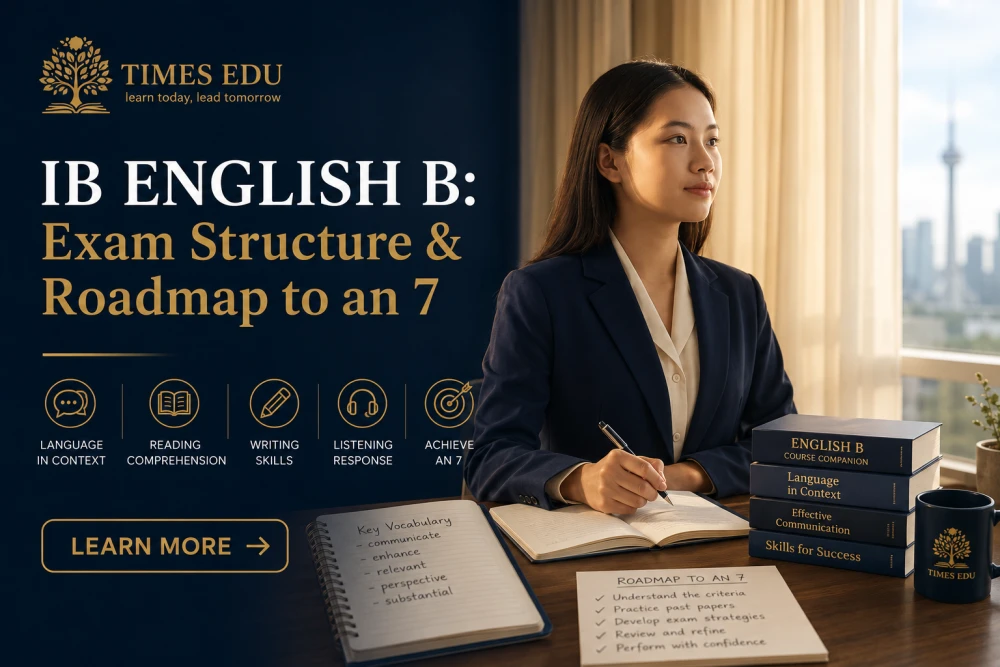
IB English B [1] is a language acquisition course within Group 2 of the IB Diploma [2]. It is designed for students between the ages of 16 and 19 who already have a working foundation in English but are not yet operating at the level of a native or near-native speaker. The official course descriptor from the International Baccalaureate Organization (IBO) positions it as a course focused on developing professional communication skills, intercultural understanding, and advanced literacy in English as an additional language.
The course is distinct from a simple ESL program. Students are not just learning vocabulary and grammar rules. They are analyzing authentic English-language texts, forming arguments about global issues, and producing writing that meets specific professional conventions.
In our experience working with international students at Times Edu, the most common misunderstanding about IB English B is that it is an “easy option.” In reality, Higher Level demands a level of linguistic precision and analytical depth that catches many students off guard, particularly in the Individual Oral and Paper 1 components.
>>> Read more: IB English A Language & Literature books 2026: Complete guide for students and teachers
The difference between IB English B SL and HL
Both SL and HL students sit the same four assessment components and study the same five global themes. The structural difference between the two levels lies in the depth of language expected and the addition of a literary study requirement at Higher Level.
| Feature | Standard Level (SL) | Higher Level (HL) |
|---|---|---|
| Paper 1 word count | 250 to 400 words | 450 to 600 words |
| Literary works | Not required | Two complete works in English |
| Individual Oral | Based on a visual stimulus | Based on a literary extract |
| Vocabulary expectation | Broad functional range | Idiomatic, nuanced, formal registers |
| Text complexity | Moderate | Abstract and extended |
One critical detail often overlooked is that HL students must read two full literary works written originally in English and then use extracts from those works during the Individual Oral. This means HL students are effectively managing a literary analysis component on top of their language acquisition workload.
Students targeting universities in the United Kingdom, Australia, Canada, or the United States often ask whether HL adds meaningful value to their application. The honest answer is yes, but only if the student can genuinely perform at HL depth. A strong 6 or 7 at SL will always outperform a weak 4 at HL.
>>> Read more: IB books 2026: The complete guide to study materials for the IB Diploma
Core themes and text types studied in IB English B
The IB English B curriculum is organized around five compulsory global themes. Every text, task, and discussion in the course connects back to at least one of these themes. Understanding them well is not optional: They form the backbone of Paper 2 reading comprehension, Paper 1 writing tasks, and the Individual Oral.
The five core themes are:
- Identities: Health, lifestyle, personal values, language identity, and subcultures
- Experiences: Travel, migration, customs, traditions, and rites of passage across cultures
- Human Ingenuity: Science, technology, media, entertainment, and the ethics of innovation
- Social Organization: Education systems, law and order, the workplace, and community structures
- Sharing the Planet: Environmental sustainability, globalization, human rights, and peace
Text types in IB English B are equally important and frequently tested in Paper 1. Students must be able to produce and identify texts including articles, formal letters, reports, blog posts, interviews, speeches, and brochures. Each text type carries specific layout conventions, and examiners award marks for using those conventions correctly.
A common mistake we see is that students write excellent content in Paper 1 but lose marks because their layout does not match the required text type. For example, a formal letter without a proper salutation, date, and sign-off will be penalized even if the argument itself is strong.
Drawing on years of experience at Times Edu, we recommend that students build a personal reference sheet for each text type, listing the mandatory layout features and the typical register (formal, semi-formal, or informal) expected for that format.
>>> Read more: IB English Paper 1 Evidence Selection 2026: How to Pick Quotes That Prove Your Argument
How IB English B is assessed across all assessment components
IB English B assessment is split equally between external examinations and an internal oral component. Each component carries 25 percent of the final grade, making it one of the most evenly distributed assessment structures in the entire Diploma Programme.
| Component | SL Weighting | HL Weighting | What it tests |
|---|---|---|---|
| Paper 1: Writing | 25% | 25% | Production of one written text in a specified format |
| Paper 2: Listening | 25% | 25% | Comprehension of authentic English audio across multiple accents |
| Paper 2: Reading | 25% | 25% | Comprehension of printed texts; HL includes literary excerpts |
| Individual Oral (IA) | 25% | 25% | Recorded spoken exam conducted with the class teacher |
Paper 2 at HL includes reading passages that may be drawn from literary sources, which is one reason why the HL literary works are not a separate assessment but feed directly into multiple components.
For Paper 1, students choose one writing task from a selection of options tied to the five global themes. The examiner assesses language, message and organization, and for HL, the range and precision of vocabulary. Students who memorize theme-specific vocabulary lists but cannot deploy them naturally in a cohesive argument consistently underperform.
The listening component uses recordings featuring a variety of authentic English accents, including British, American, Australian, and occasionally South Asian or African English. This is deliberate: The IBO Language B specification emphasizes intercultural communication, and that includes understanding diverse spoken English.
>>> Read more: IB English Paper 2 Essay Structure 2026: How to Build a Clear and Comparative Essay
The Individual Oral in IB English B: How to prepare and perform well
The Individual Oral is the single component that students at Times Edu consistently identify as the most anxiety-inducing part of IB English B. It is also the component where strong preparation delivers the clearest return.
For SL students, the oral is structured around a visual stimulus, typically a photograph or image connected to one of the five global themes. The student speaks for approximately three to four minutes in response to the image and then engages in a discussion with the teacher.
For HL students, the oral is built around an extract from one of the two literary works studied in class. The student presents a personal response to the extract and then discusses both the text and broader global themes with the teacher.
A step-by-step preparation framework that works for both levels:
- Know your themes deeply. Every Individual Oral will connect to at least one of the five global themes. Prepare a repertoire of ideas, arguments, and examples for each theme in advance.
- For HL, annotate your literary texts as you read. Identify key passages that connect to multiple themes, because you cannot predict which extract the teacher will select.
- Practise speaking for three to four minutes on a single image or extract without stopping. Use a timer. Most students underestimate how long three minutes of sustained speech actually feels.
- Record yourself. Listening back to your own performance is uncomfortable, but it is the fastest way to identify filler words, grammatical errors, or a lack of structure.
- Work on transition language. Phrases that signal comparison, contrast, cause and effect, or personal reflection make a spoken response sound more sophisticated and organized.
- Do not memorize a script. Examiners are trained to detect and penalize responses that sound rehearsed rather than spontaneous. Prepare ideas, not sentences.
One critical detail often overlooked is the discussion phase. Many students prepare for their opening statement but go into the teacher-led discussion underprepared. The teacher can redirect the conversation to any aspect of the theme or text, so students need to be able to think and respond flexibly, not just recite prepared material.
>>> Read more: IB English Paper 1 Planning: 4-Step Pre-Write Method for Score 7
IB English B vs IB English A: Which course is right for you?
This is one of the most frequent questions the consultants at Times Edu receive from families in the early stages of IB subject selection. The answer depends on three factors: The student’s current English proficiency, their intended university destination, and their overall diploma strategy.
| Criterion | IB English B | IB English A |
|---|---|---|
| Target learner | Students learning English as an additional language | Native or near-native English speakers |
| Core focus | Language acquisition and communication | Literary analysis and critical theory |
| Assessment style | Language skills across themes and text types | Essay-based literary and comparative analysis |
| Difficulty profile | Linguistically demanding at HL | Analytically demanding at both levels |
| University recognition | Recognized as English proficiency evidence at many universities | Expected for English Literature degrees |
A student who has spent most of their schooling in a non-English medium but is targeting a Business or Engineering degree in the UK can absolutely use a strong IB English B HL result as evidence of English language proficiency, and many universities will waive IELTS or TOEFL requirements on that basis.
However, a student targeting an English Literature or Journalism degree, or any program that requires sustained academic writing in English, will be better served by English A, even if it is more challenging. The analytical writing habits developed in English A transfer directly to university-level essay requirements in ways that English B does not fully replicate.
The IB English B vs English A decision is not about which course is harder. It is about which course builds the skills your next step actually requires.
>>> Read more: IB English Essay Structure 2026: A Clear Framework for Strong Thesis, Analysis, and Conclusion
Best resources and study strategies for IB English B students
Effective IB English B revision requires a combination of broad reading, deliberate writing practice, and systematic exam preparation. Passive revision, such as rereading notes or highlighting textbooks, consistently produces weaker results than active practice with timed tasks and real feedback.
Core study strategies that work:
- Use IB English B past papers from the IBO’s resource database or approved third-party platforms. Work through past Paper 2 reading and listening tasks under timed conditions from the start of Year 2, not just the weeks before exams.
- Build a vocabulary bank organized by theme. For each of the five global themes, maintain a running list of high-value vocabulary, collocations, and idiomatic expressions. Review this list weekly and practise using each item in a sentence.
- Write one Paper 1 practice task every two weeks throughout Year 2. Submit it for teacher feedback or peer review. Focus on text type conventions in early drafts and shift focus to language precision as the exam approaches.
- For listening practice, go beyond IB past papers. Podcasts, news broadcasts from the BBC, NPR, or ABC Australia, and documentary audio expose you to the range of accents and speech speeds tested in Paper 2.
- For HL students, read your literary works twice. The first reading is for plot and character understanding. The second reading is for annotation and thematic analysis. Do not attempt the Individual Oral preparation using texts you have only read once.
Drawing on years of experience at Times Edu, one of the highest-impact habits for IB English B students is weekly writing with structured feedback. Students who write regularly with a qualified tutor who marks against IB criteria improve their Paper 1 scores significantly faster than students who self-study. This is because IB marking rubrics reward specific qualities that are not always intuitive, and students need external calibration to understand where they are losing marks.
IB English B past papers are genuinely useful, but they are most effective when used diagnostically. After completing a past paper, students should identify which question types they consistently lose marks on and design their revision around closing those specific gaps, rather than simply repeating tasks they already do well.
>>> Read more: IB Tutor 2026: How to Choose the Right Tutor for Better Grades and Less Stress
Frequently asked questions
What is the difference between IB English B and IB English A?
Is IB English B suitable for students with intermediate English proficiency?
How many papers does IB English B have?
What themes are covered in IB English B?
How do you score a 7 in IB English B?
What is the listening component in IB English B SL?
Can strong IB English B results support a university application in an English-speaking country?
Conclusion
At Times Edu, our curriculum specialists and IB-trained tutors work with students across all four components of IB English B, from intensive Paper 1 writing sessions to Individual Oral mock exams conducted under authentic conditions. If you are unsure whether English B SL or HL is the right fit for your academic profile, or if you want a personalized study plan built around your specific exam timeline, book a one-on-one academic roadmap consultation with the Times Edu team. The earlier you build the right habits, the more confidently you will walk into every assessment.
Resources: