IGCSE Physics active recall 2026: The complete strategy guide for Cambridge 0625 students
IGCSE Physics active recall is a revision method that trains students to retrieve formulas, definitions, processes, and scientific explanations from memory instead of simply rereading notes. It is especially useful for Cambridge 0625 because the exam requires precise recall, correct terminology, and the ability to apply knowledge under timed conditions. Students can use techniques such as precision flashcards, blank-page brain dumps, worked-example replication, and spaced repetition to strengthen both memory and mark-scheme accuracy.
This guide explains how to build an active recall system for IGCSE Physics and apply it effectively across different topic and question types.
- IGCSE Physics active recall: Why it outperforms passive revision for physics content
- What is active recall and how does it apply to IGCSE Physics?
- Active recall techniques that work best for IGCSE Physics topics
- How to use flashcards for formulas and definitions in IGCSE Physics
- Spaced repetition combined with active recall for IGCSE Physics
- Active recall for calculation methods and physics processes in IGCSE Physics
- How to measure whether active recall is improving your IGCSE Physics performance
- Frequently asked questions
IGCSE Physics active recall: Why it outperforms passive revision for physics content
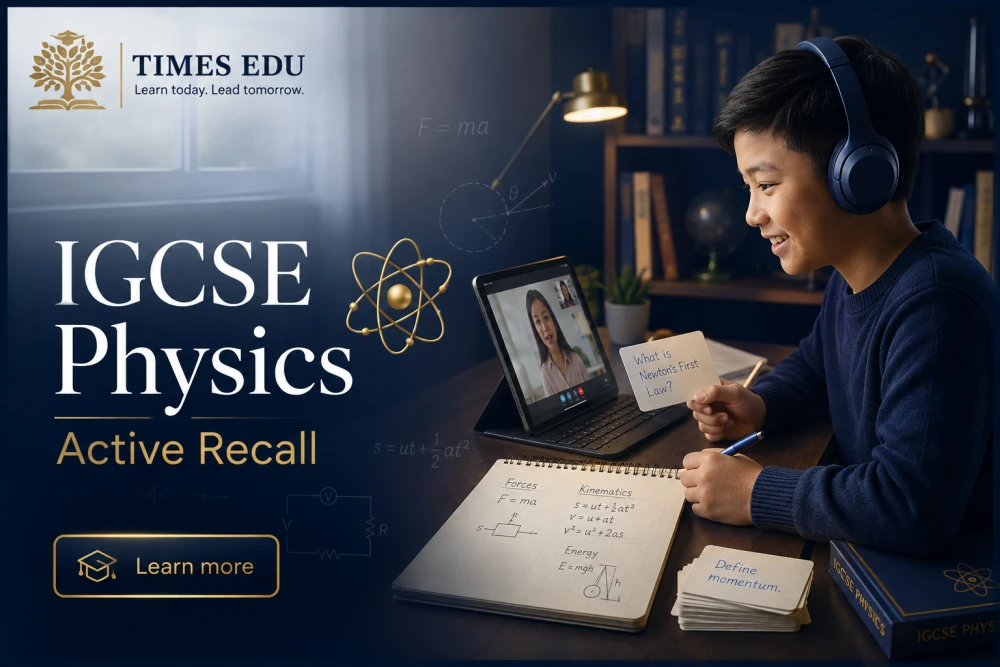
Passive revision feels productive. Highlighting a paragraph, reading a chapter twice, or watching a YouTube explanation of electromagnetic induction all create a sensation of learning. Cognitive psychologists call this the fluency illusion, where the ease of processing familiar information is mistaken for genuine understanding.
The problem is that Cambridge examiners do not ask you to recognise information. They ask you to retrieve it, apply it, and express it using precise scientific language under timed conditions. Passive revision trains a completely different cognitive skill than what the exam actually tests.
IGCSE Physics [1] active recall, by contrast, forces your brain to reconstruct information from scratch each time you practise. This retrieval effort is uncomfortable, and that discomfort is precisely the mechanism that builds durable, exam-ready memory. Every time you struggle to recall a definition or a formula without looking at your notes, you are strengthening the neural pathway that will serve you in the exam room.
>>> Read more: IGCSE Physics one-month revision plan 2026: A complete week-by-week guide
What is active recall and how does it apply to IGCSE Physics?
Active recall, also described in research as retrieval practice, is the practice of deliberately testing yourself on material rather than reviewing it passively. Instead of asking “do I understand this?”, you ask “can I reproduce this without any prompts?”.
For IGCSE Physics specifically, active recall must be calibrated to the exact demands of the Cambridge 0625 mark scheme. A common mistake we see is students who can explain a concept in their own words but cannot reproduce the specific trigger words that Cambridge requires for full marks. The mark scheme for a question on moments, for example, awards a mark specifically for the word perpendicular. A student who writes “the distance from the pivot” rather than “the perpendicular distance from the pivot to the line of action of the force” scores zero on that definition, regardless of their conceptual understanding.
Effective recall techniques for Cambridge Physics therefore need to target two distinct layers: Conceptual understanding (can you explain the process?) And mark-scheme precision (can you reproduce the exact language and numerical steps the examiner expects?).
>>> Read more: IGCSE Physics specimen vs past paper 2026: The complete strategy guide for smarter revision
Active recall techniques that work best for IGCSE Physics topics
Different topics in the IGCSE Physics syllabus demand different recall strategies. The table below maps the most effective active learning techniques to the topic categories that appear most frequently in 0625 examinations.
| Topic category | Example topics | Best active recall technique |
|---|---|---|
| Explanation and mechanism topics | Convection currents, terminal velocity, electromagnetic induction | Blank page brain dump |
| Definition and terminology topics | Moments, pressure, specific heat capacity | Precision flashcards |
| Formula application topics | Kinetic energy, wave speed, transformer ratio | Formula recall drills |
| Multi-step calculation topics | Resistor networks, density problems, momentum | Worked example replication |
| Graph interpretation topics | V-I characteristics, cooling curves | Self-drawn diagram recall |
The blank page brain dump
This technique is the most powerful active recall method for explanation-heavy topics in IGCSE Physics. Close every resource you have, write a single prompt at the top of a blank sheet of paper, and spend five minutes writing down every step, formula, boundary condition, and keyword you can recall.
After the five minutes, open your mark scheme or model answer and use a contrasting coloured pen to physically write in every keyword or step you missed. This colour-coded correction stage is not optional. It forces your attention toward the exact gaps in your knowledge rather than allowing you to skim over your mistakes.
Repeat the same prompt 48 hours later without reviewing your correction notes. The combination of retrieval effort and delayed repetition is what drives long-term retention for topics like nuclear fission, the action of a thermistor circuit, or the process of electromagnetic induction.
The Feynman technique adapted for Cambridge Physics
Explain a concept aloud, in spoken English, to an imaginary student who knows nothing about physics. One critical detail often overlooked is that this technique only works if you enforce a strict rule: You must use technical scientific language, not everyday approximations. Saying “the thing gets hotter so the electrons move around more” is not a valid explanation. The moment you find yourself using vague language, you have identified a knowledge gap.
Return to your notes, address that specific gap, and repeat the spoken explanation from the beginning until it flows clearly, sequentially, and uses the correct terminology. This technique is particularly effective for topics like the photoelectric effect, nuclear decay, or the operation of a transformer.
>>> Read more: IGCSE Physics self-marking past papers 2026: The complete guide to revising smarter and scoring higher
How to use flashcards for formulas and definitions in IGCSE Physics
Flashcards IGCSE Physics revision is extremely common, but most students use them incorrectly. Generic question prompts like “What is pressure?” Or “What is the formula for power?” Do not target the specific failure points that Cambridge examiners document in their reports year after year.
Effective formula recall Physics IGCSE flashcards are designed around the exact traps that cost students marks. The following structure is recommended for every flashcard you create for Cambridge 0625.
Front of card: State the exact definition of [concept], including every word required by the Cambridge mark scheme.
Back of card: Write the full definition, underline the critical keywords (perpendicular, resultant, directly proportional), and note the specific mark allocated in the mark scheme.
For formula cards, always include the required SI units for every variable on the back of the card, because Cambridge regularly deducts marks for incorrect or missing units.
| Flashcard front | Flashcard back | Common error |
|---|---|---|
| Definition of the moment of a force | The product of the force and the perpendicular distance from the pivot to the line of action of the force | Writing “distance from the pivot” without “perpendicular” |
| Formula for kinetic energy + SI units | KE = ½mv², mass in kg, velocity in m/s, KE in Joules (J) | Using grams for mass or omitting units entirely |
| Definition of specific heat capacity | The energy required to raise the temperature of 1 kg of a substance by 1°C (or 1 K) | Omitting “per unit mass” or “per degree” |
| Wave equation + units | v = fλ, v in m/s, f in Hz, λ in metres | Confusing frequency and wavelength positions in the formula |
Both Anki 0625 Physics decks and Quizlet IGCSE Physics sets are widely used by Cambridge students. Anki is preferable if you intend to combine flashcard review with a spaced repetition algorithm, because its scheduling system automatically surfaces cards you find difficult more frequently. Quizlet is more accessible for students who are new to digital flashcards and want a lower-friction starting point.
>>> Read more: IGCSE Physics question types 2026: A complete guide to every format you will face
Spaced repetition combined with active recall for IGCSE Physics
Spaced repetition is the scheduling principle that makes active recall dramatically more efficient over time. Rather than studying the same content on consecutive days, spaced repetition Physics IGCSE schedules your review sessions at increasing intervals: One day after initial learning, then three days, then a week, then a fortnight, and so on.
The logic is grounded in the spacing effect, one of the most replicated findings in cognitive psychology. Revisiting material just before you are about to forget it produces a stronger memory trace than revisiting it when it is still fresh. In practical terms, this means that a student who reviews 20 flashcards across five spaced sessions over three weeks will retain significantly more than a student who reviews the same 20 cards for five consecutive evenings.
For IGCSE Physics, the most time-efficient implementation is to use Anki with a custom 0625 Physics deck. Create your cards using the precision format described above, then allow Anki’s algorithm to determine when each card reappears based on how confidently you recalled it. Cards you struggle with reappear sooner; cards you recall confidently are scheduled further into the future.
A practical spaced repetition schedule for the 10 weeks before a Cambridge examination session might look like this:
| Week | Focus activity | Active recall method |
|---|---|---|
| Weeks 1 to 3 | Build flashcard deck for all 0625 topics | Anki daily reviews, 20 to 30 new cards per day |
| Weeks 4 to 5 | Blank page brain dumps on explanation topics | One topic per day, mark-scheme correction in red pen |
| Week 6 | Feynman technique on mechanism topics | Spoken explanations, no notes permitted |
| Weeks 7 to 8 | Past paper practice combined with recall drills | Immediate self-marking against mark scheme |
| Week 9 | Targeted review of weak areas flagged by Anki | Repeat brain dumps on lowest-scoring topics |
| Week 10 | Mixed recall review, timed full papers | Focus on speed of recall and precision of language |
>>> Read more: IGCSE Physics how to get full marks 2026: The complete strategy guide
Active recall for calculation methods and physics processes in IGCSE Physics
Calculation topics in IGCSE Physics require a slightly different active recall approach than definition or explanation topics. The goal is not simply to remember a formula, but to recall the entire sequence of steps that Cambridge expects, including selecting the correct formula, substituting values with correct units, and presenting working in the order the mark scheme rewards.
In our experience working with international students, the most effective method for calculation topics is worked example replication. Take a solved example from your textbook or a past paper mark scheme, study it until you believe you understand every step, then close the book and reproduce the full solution on a blank sheet of paper.
The critical difference between this and simply re-doing exercises is the verification step. After reproducing the worked example, compare your version line by line against the original. Any step you skipped, any unit you omitted, or any formula you misremembered is marked in your correction pen and added as a new flashcard.
For multi-step topics such as resistor networks, transformer calculations, or nuclear decay equations, this process should be repeated a minimum of three times over spaced intervals before you attempt unseen exam questions on the same topic.
>>> Read more: IGCSE books 2026: The complete guide to choosing the right study materials
How to measure whether active recall is improving your IGCSE Physics performance
Many students apply recall techniques for several weeks without a clear way to assess whether they are actually improving. Without measurement, it is easy to practise the topics you already know well and avoid the ones where active recall is most uncomfortable, which is precisely where it would be most beneficial.
Three concrete metrics are worth tracking throughout your IGCSE Physics revision:
Flashcard confidence ratings in Anki. Anki assigns a difficulty score to each card based on your responses. After four weeks of daily review, your percentage of “easy” or “good” rated cards should be rising. If a cluster of cards remains in the “again” category after multiple sessions, those cards represent specific knowledge gaps that need targeted attention.
Blank page brain dump scores. After completing a brain dump and comparing it to the mark scheme, count how many mark-scheme keywords you included versus how many you missed. Record this score each time you attempt the same topic. A rising score over repeated attempts confirms that your recall is strengthening.
Past paper topic scores. Every three to four weeks, attempt a set of past paper questions on topics you have been actively recalling. Compare your marks against the mark scheme and track them in a simple spreadsheet. This provides the most direct evidence of whether your study methods IGCSE Physics practice is translating into exam performance.
A common mistake we see is students who measure only their final past paper score, without diagnosing which specific keywords or steps they are still missing. The mark scheme is your most valuable feedback tool. Use it at the granular level, not just as a score-checker.
>>> Read more: IGCSE Tutor 2026: How to Choose the Right One
Frequently asked questions
What is active recall and why is it effective for IGCSE Physics revision?
Active recall is the practice of retrieving information from memory without looking at your notes, rather than reviewing material passively. It is effective for IGCSE Physics because Cambridge examiners test your ability to produce precise definitions, recall exact formulas with correct units, and describe processes using specific scientific terminology. Passive reading trains recognition; active recall trains the retrieval skill that the exam actually demands.
How do you use active recall for formula-heavy topics in IGCSE Physics?
For formula recall Physics IGCSE, create precision flashcards that include the formula, every required SI unit, and a note about the most common error for that formula. Practice reproducing worked examples from memory, comparing your version step by step against the mark scheme. Space your repetitions using Anki’s algorithm rather than reviewing all formulas in one session.
What is the best flashcard app for active recall in IGCSE Physics?
Anki is the strongest choice for students who want to combine flashcards with a spaced repetition algorithm, because it automatically schedules harder cards more frequently. Quizlet IGCSE Physics is a more user-friendly option for students who are new to digital flashcard systems. Both platforms are effective, but Anki’s scheduling system gives it a significant advantage for long-term retention over a full exam cycle.
How does spaced repetition enhance active recall for IGCSE Physics?
Spaced repetition Physics IGCSE determines when you revisit each piece of information based on how confidently you recalled it. By spacing reviews at increasing intervals, your brain must work harder to retrieve information each time, which strengthens the memory trace more effectively than massed practice on consecutive days. Combined with active recall, spaced repetition dramatically reduces the total time needed to achieve durable retention of the full 0625 syllabus.
How often should you do active recall sessions for IGCSE Physics?
Daily short sessions of 20 to 30 minutes are more effective than weekly marathon sessions. For Anki flashcard review, daily sessions of 15 to 20 minutes are sufficient to keep up with the algorithm’s scheduling. For blank page brain dumps and Feynman technique sessions, one to two sessions per week on targeted topics is a realistic and effective frequency during the main revision period.
Can active recall replace past paper practice in IGCSE Physics revision?
No. Active recall and past paper practice serve different functions and both are necessary. Active recall builds the memory traces that allow you to retrieve information quickly and precisely. Past paper practice trains you to apply that knowledge under timed conditions, manage question types you have not seen before, and calibrate your answers to the mark scheme’s exact language. The ideal approach is to use active recall techniques throughout your revision cycle and integrate past papers from approximately six weeks before the examination.
Which IGCSE Physics topics benefit most from active recall techniques?
Explanation and mechanism topics benefit most from blank page brain dumps: Convection, terminal velocity, electromagnetic induction, and nuclear processes. Definition-heavy topics respond best to precision flashcards: Moments, pressure, specific heat capacity, and wave definitions. Calculation topics are best addressed through worked example replication with spaced repetition. In our experience working with international students, thermal physics and electricity are the two sections where targeted active recall produces the fastest measurable improvement in past paper scores.