IGCSE Physics formula sheet 2026: What is given and what you must memorise
Cambridge IGCSE Physics does not provide a dedicated formula sheet in the 0625 examination, so students are expected to recall the required equations from memory. Although individual questions may provide specific constants or data values, the formulas themselves must be known and applied correctly, together with the appropriate SI units. This makes formula recall, rearrangement, and accurate substitution essential parts of exam preparation.
This guide provides a topic-by-topic overview of the key IGCSE Physics formulas and explains how students can build and memorise their own revision sheet effectively.
- Does IGCSE Physics provide a formula sheet in the exam?
- Formulas that Cambridge provides in the IGCSE Physics exam paper
- Formulas you must memorise for IGCSE Physics that are not given
- Topic-by-topic formula checklist for IGCSE Physics students
- How to create your own IGCSE Physics formula revision sheet
- Active recall techniques for memorising IGCSE Physics formulas
- Frequently asked questions
Does IGCSE Physics provide a formula sheet in the exam?
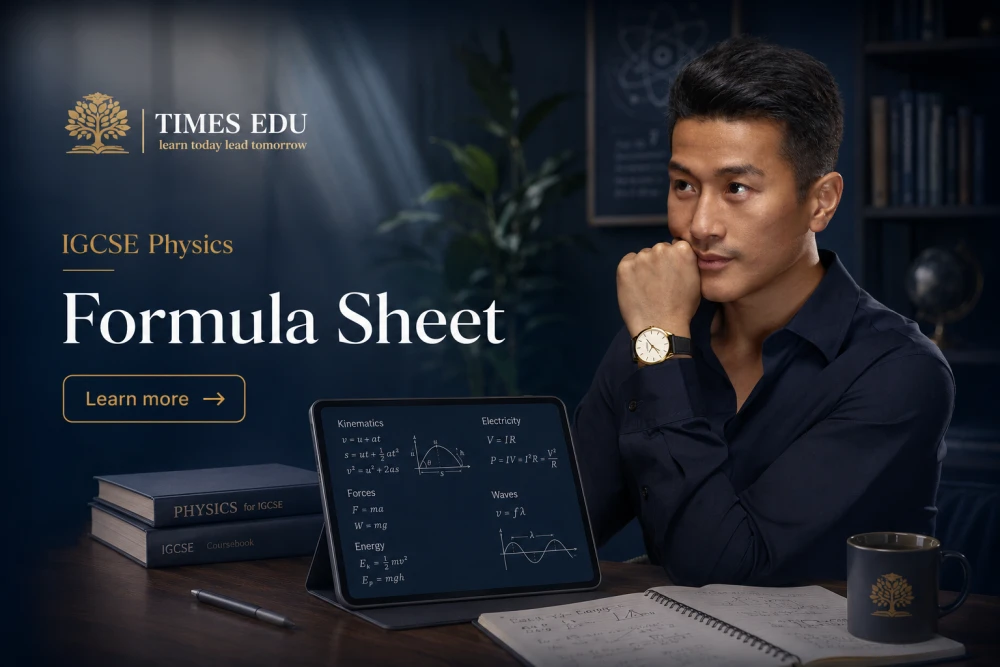
The short answer is no. Cambridge does not provide a dedicated IGCSE Physics [1] formula sheet inside the examination hall for the 0625 syllabus. Unlike some other subjects, where key data tables or formula booklets are supplied, IGCSE Physics candidates are expected to recall every equation from memory during Paper 2 (Core and Extended multiple choice) and Paper 4 (Extended theory).
A common mistake we see at Times Edu is students who have practised extensively with formula reference lists open beside them, then freeze when they realise those resources do not exist during the actual exam. Building formula recall into your revision routine from the very beginning of the course is not optional — it is a fundamental examination requirement.
>>> Read more: IGCSE Physics experimental errors 2026: How to identify, explain and suggest improvements
Formulas that Cambridge provides in the IGCSE Physics exam paper
Cambridge does print a small number of constants and specific values directly within individual question stems when they are required for that particular calculation. For example, the speed of light in a vacuum, certain gravitational field strength values, or the Hubble constant may appear as part of a question’s given data.
However, these are contextual data points embedded in specific questions, not a comprehensive formula reference. They will not appear unless the question itself demands them. You cannot rely on question wording to reconstruct the core equations you need across all six topic areas.
The distinction here is critical: Cambridge may give you a value, but it will never give you the formula. Knowing that g = 9.8 N/kg means nothing if you cannot recall that W = mg or that p = rgh.
>>> Read more: IGCSE Physics experiment planning 2026: How to design valid investigations for full marks
Formulas you must memorise for IGCSE Physics that are not given
Every equation used in the core topic areas of the 0625 syllabus must come from your own memory. This applies to both Core and Extended tier candidates, though Extended students carry a heavier memorisation load due to additional content including electricity, electromagnetism, and space physics.
Drawing on years of experience at Times Edu working with IGCSE students across Vietnam, Singapore, and Hong Kong, we have identified the equations that appear most frequently in Paper 4 mark schemes. The list below covers the complete set of formulas you are responsible for.
One critical detail often overlooked is that memorising a formula is only half the task. Cambridge mark schemes award separate marks for correct SI units, so a student who writes the correct equation but attaches the wrong unit to their answer will still lose marks.
>>> Read more: IGCSE Physics Alternative to Practical 2026: What Paper 6 covers and how to prepare
Topic-by-topic formula checklist for IGCSE Physics students
The following tables organise every testable formula by syllabus topic, using a consistent layout that shows the physical quantity, the formula itself, and the SI units for each variable. Study each table as a self-contained unit and test yourself on it before moving to the next topic.
Topic 1: Motion, forces, and energy (mechanics)
| Physical Quantity | Formula | SI Units for Variables |
|---|---|---|
| Average speed | v = d / t | v [m/s], d [m], t [s] |
| Acceleration | a = (v – U) / t | a [m/s²], v and u [m/s], t [s] |
| Weight | W = mg | W [N], m [kg], g = 9.8 or 10 N/kg |
| Density | rho = m / V | rho [kg/m³], m [kg], V [m³] |
| Hooke’s Law | F = kx | F [N], k [N/m], x [m] |
| Newton’s Second Law | F = ma | F [N], m [kg], a [m/s²] |
| Moment of a force | Moment = F × d | Moment [N·m], F [N], d [m] |
| Momentum | p = mv | p [kg·m/s], m [kg], v [m/s] |
| Impulse | Delta p = F × Delta t | Delta p [kg·m/s], F [N], t [s] |
| Kinetic energy | Ek = (1/2)mv² | Ek [J], m [kg], v [m/s] |
| Gravitational potential energy | Delta Ep = mgh | Ep [J], m [kg], g [N/kg], h [m] |
| Work done | W = F × d | W [J], F [N], d [m] |
| Power | P = W / t | P [W], W [J], t [s] |
| Efficiency | Eff = (Useful Energy Output / Total Energy Input) × 100% | Expressed as a percentage or decimal |
| Solid pressure | P = F / A | P [Pa], F [N], A [m²] |
| Liquid pressure | p = rho × g × h | p [Pa], rho [kg/m³], g [N/kg], h [m] |
Topic 2: Thermal physics
| Physical Quantity | Formula | SI Units for Variables |
|---|---|---|
| Boyle’s Law | p1V1 = p2V2 | p [Pa], V [m³], at constant temperature |
| Specific heat capacity | Q = mc × Delta T | Q [J], m [kg], c [J/kg·°C], Delta T [°C] |
| Specific latent heat | Q = mL | Q [J], m [kg], L [J/kg] |
Topic 3: Waves
| Physical Quantity | Formula | SI Units for Variables |
|---|---|---|
| Wave equation | v = f × lambda | v [m/s], f [Hz], lambda [m] |
| Frequency and period | f = 1 / T | f [Hz], T [s] |
| Refractive index (Snell’s Law) | n = sin i / sin r | n [no unit], i [angle in air], r [angle in denser medium] |
| Refractive index (speed ratio) | n = vair / vmedium | n [no unit], v [m/s] |
| Critical angle (TIR) | sin c = 1 / n | c [degrees], n [refractive index] |
Topic 4: Electricity and magnetism
| Physical Quantity | Formula | SI Units for Variables |
|---|---|---|
| Electric current | I = Q / t | I [A], Q [C], t [s] |
| Ohm’s Law | R = V / I | R [Ohm], V [V], I [A] |
| Electrical power | P = IV = I²R = V²/R | P [W], I [A], V [V], R [Ohm] |
| Electrical energy | E = IVt | E [J], I [A], V [V], t [s] |
| Resistors in series | R_total = R1 + R2 + R3 | All values in Ohms |
| Resistors in parallel | 1/R_total = 1/R1 + 1/R2 | Invert the result to find R_total |
| Transformer voltage ratio | Vp / Vs = Np / Ns | V [V], N = number of turns |
| Ideal transformer power | Ip × Vp = Is × Vs | I [A], V [V] |
Topic 6: Space physics
| Physical Quantity | Formula | SI Units for Variables |
|---|---|---|
| Orbital speed | v = 2(pi)r / T | v [m/s], r [m], T [s] |
| Hubble’s Law | v = H0 × d | v [km/s], H0 [s⁻¹], d [Mpc or m] |
| Age of universe | t = 1 / H0 | t [s] |
Note that Topic 5 (Nuclear physics and radioactivity) does not carry a significant set of calculation formulas in the 0625 syllabus. The key relationships in that topic are largely descriptive, though students should be familiar with how to interpret half-life graphs and decay tables quantitatively.
>>> Read more: IGCSE Physics improve accuracy 2026: How to stop losing avoidable marks and reach your target grade
How to create your own IGCSE Physics formula revision sheet
Building a personalised IGCSE Physics formula sheet from scratch is one of the most effective revision techniques available to any student. The act of writing and organising the equations yourself creates stronger memory encoding than simply reading a pre-made list.
Follow these steps when constructing your own sheet:
- Step 1: Work through the official Cambridge 0625 syllabus document and highlight every equation mentioned by topic number.
- Step 2: Write each formula using the F-S-S-U format: Formula name, Symbol equation, Substituted example, Units for each variable.
- Step 3: Leave a blank column beside each formula. Cover the equation and test yourself from memory at least once per day during the final six weeks before your exam.
- Step 4: Colour-code by topic. Mechanics in one colour, thermal in another, and so on. This builds visual memory associations that are useful under exam pressure.
- Step 5: Create a separate “danger list” of formulas you consistently get wrong or confuse with each other, such as liquid pressure versus solid pressure, or electrical power variants.
In our experience working with international students, those who construct their own formula reference sheet within the first month of Year 10 or Year 11 consistently outperform those who only begin active memorisation in the final weeks.
>>> Read more: IGCSE books 2026: The complete guide to choosing the right study materials
Active recall techniques for memorising IGCSE Physics formulas
Passive reading of formulas does not work under exam conditions. The brain needs to retrieve information under pressure, and the only way to train that retrieval is through active recall practice. Here are the techniques that produce measurable results.
Blank page testing: Close all resources and write out every formula from one topic on a blank sheet. Check your answers against the table, mark any errors in red, and retry the incorrect ones immediately. Repeat this cycle every 48 hours until you achieve a clean run.
Formula triangle cards: For equations with three variables (such as v = d/t or P = IV), draw a physical triangle on a small card with each variable in one corner. Cover one corner and solve. These are particularly useful for mechanics and electricity formulas where rearrangement is frequently tested.
Spaced repetition with digital flashcards: Applications like Anki allow you to create digital flashcard decks where the algorithm automatically schedules reviews based on how well you remembered each formula. This is especially efficient for students preparing for multiple IGCSE subjects simultaneously.
Teach-back method: Explain each formula to a study partner or record yourself on video explaining what each variable means, what units it carries, and what a typical exam question looks like. One critical detail often overlooked is that explaining a formula in plain language forces you to confront gaps in understanding that passive reading hides entirely.
A common mistake we see is students who can write a formula correctly in isolation but cannot apply it to an unfamiliar question context. The solution is to practise formula application across multiple past paper question types, not just to write out the equation in a vacuum.
>>> Read more: IGCSE Tutor 2026: How to Choose the Right One
Frequently asked questions
Does Cambridge provide a formula sheet in the IGCSE Physics exam?
No. Cambridge does not supply a formula booklet or reference sheet for IGCSE Physics 0625. All equations must be recalled from memory during the examination. Individual question stems may include specific data values when required, but the formulas themselves are never provided.
Which formulas are printed on the IGCSE Physics exam paper?
No formulas are printed on the exam paper as a standing reference. If a question requires a particular constant (such as a specific value of the speed of light or Hubble’s constant), that value may appear within the question text. This is limited to values, not the equations that use them.
Which Physics formulas must you memorise that are not given in 0625?
Every formula in the tables above must be memorised. This includes all mechanics equations, the three thermal physics equations, five waves equations, eight electricity equations, and the three space physics equations. Extended tier candidates are responsible for the full set across all topics.
How many formulas do you need to know for IGCSE Physics Extended?
Based on the full 0625 syllabus, Extended tier students should be confident with approximately 35 to 40 distinct equations. This includes all Core formulas plus the additional Extended content in electricity, electromagnetism, and space physics. The exact count varies slightly by how you categorise formula variants such as the three power equations.
What is the best way to memorise Physics formulas for IGCSE?
The most reliable approach combines three elements: Active recall through blank-page testing, spaced repetition to reinforce long-term memory, and applied practice through past paper questions. Students who only read formulas without testing themselves regularly will underperform relative to those who use structured retrieval practice.
Are the formulas given in IGCSE Physics the same for Core and Extended?
Core and Extended students draw from the same pool of base equations, but Extended candidates have a larger total set to memorise. Extended papers also test more complex formula applications and multi-step calculations, meaning that rearranging equations fluently is a required skill beyond simple substitution.
Where can I find a complete formula list for IGCSE Physics 0625?
The most authoritative source is the Cambridge Assessment International Education (CAIE) syllabus document for 0625, which is freely available on the Cambridge website. The topic-by-topic tables in this article reflect the complete set of calculation-based formulas across the current syllabus, organised for efficient revision.
Resources: