A Level Computer Science 9618 books 2026: Complete guide for students and teachers
Choosing the right A Level Computer Science book is one of the most consequential academic decisions a student can make before sitting Cambridge, AQA, or OCR examinations. The wrong textbook wastes months of study time by covering topics out of scope, using outdated terminology, or failing to match the exact assessment style your board uses. This guide cuts through the confusion by reviewing the most widely used, officially endorsed titles, explaining how to use them effectively, and helping students and parents build a smart, board-specific study plan from day one.
- Cambridge and AQA endorsed A level Computer Science textbooks reviewed
- Cambridge International AS & A Level Computer Science Coursebook (Cambridge University Press)
- A level Computer Science revision guides vs full textbooks: What do you need?
- Top A level Computer Science books for Cambridge, AQA and OCR specifications
- How to use an A level Computer Science book alongside programming practice
- Where to buy A level Computer Science books at the best price online
- Free A level Computer Science resources vs investing in a dedicated study book
- Frequently asked questions
Cambridge and AQA endorsed A level Computer Science textbooks reviewed

The two most authoritative publishers for the Cambridge A level CS 9618 [1] specification are Cambridge University Press and Hodder Education. Both have invested heavily in producing titles that align precisely with the current syllabus structure, and both are formally endorsed by Cambridge Assessment International Education.
>>> Read more: A Level Write To Mark Scheme 2026: How to Match Examiner Expectations and Score More Marks
Cambridge International AS & A Level Computer Science Coursebook (Cambridge University Press)
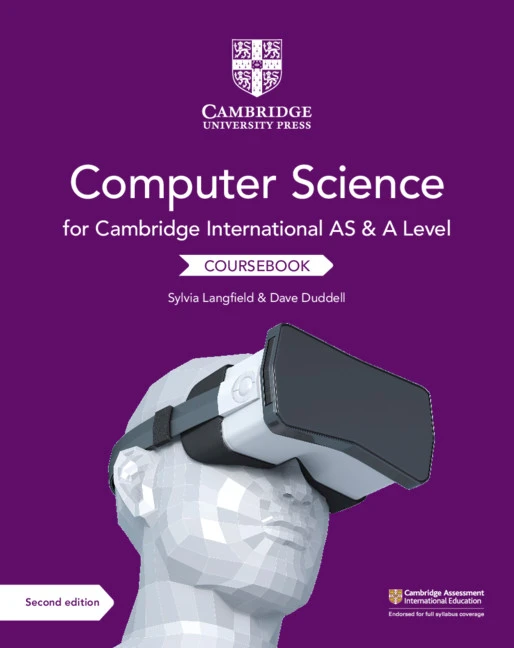
Written by Sylvia Langfield and Dave Duddell, this is the most comprehensive single-volume A level Computer Science textbook available for the 9618 course. Its strength lies in the depth of conceptual coverage: chapters on Object-Oriented Programming (OOP), Big O notation, and abstract data types are presented with worked examples, annotated pseudocode, and trace tables that mirror actual Paper 3 questions. Students who access the digital edition via the Cambridge GO platform gain complete code files in Python and other languages, alongside auto-marked quizzes that provide instant feedback.
One detail often overlooked by students is that the Cambridge GO platform is not optional. The physical coursebook alone omits several interactive exercises and programming files that are specifically designed to prepare students for Paper 4, the live coding examination.
Cambridge International AS & A Level Computer Science Student’s Book (Hodder Education)

The Hodder A level CS title, authored by David Watson and Helen Williams, takes a different but equally effective pedagogical approach. Where the Cambridge University Press coursebook prioritises breadth, the Hodder edition excels in structured progression through hardware, networking, and low-level programming. Its breakdown of assembly language instruction sets and logic gate arrays is genuinely superior to most competing titles.
A common mistake we see at Times Edu is students choosing one book based on cover design or price alone, then discovering mid-year that the book they selected does not cover a specific subtopic in enough depth. For the 9618 syllabus, holding both titles is a serious strategic advantage.
AQA and OCR endorsed titles
For AQA Computer Science A level, the two dominant texts are published by Hodder Education (the AQA Computer Science for A Level series by PM Heathcote and RSU Heathcote) and Oxford University Press. The AQA specification places greater emphasis on computational thinking and theoretical problem-solving than Cambridge does, so students should verify that their chosen book includes dedicated sections on Boolean algebra, Turing machines, and regular expressions.
For OCR A Level Computer Science, the OCR-endorsed series by Kevin Bond and Sylvia Langfield (published through Hodder) is the primary recommended resource. The OCR A level Computer Science course has a distinct structure: Component 01 covers computer systems; Component 02 covers algorithms and programming; Component 03 is the Programming Project (NEA). Each component requires a different type of preparation, and a single textbook rarely handles all three with equal depth.
>>> Read more: A Level Weekly Study System: 7-Day Template for A* Across 3 Subjects
A level Computer Science revision guides vs full textbooks: What do you need?
A full A level Computer Science textbook and a revision guide serve fundamentally different purposes. Students frequently purchase only one and then underperform in the specific area the other type of resource would have addressed.
| Resource type | Best used for | Typical page count | Suited to exam stage |
|---|---|---|---|
| Full coursebook | Building foundational understanding | 500-700+ pages | Year 1 and Year 2 study |
| Revision guide | Consolidating key points before exams | 150-250 pages | Final 8-10 weeks before exams |
| Past paper booklet | Practising exam technique | Variable | Ongoing from mid-Year 1 |
| Programming reference | Language-specific syntax and algorithms | 200-400 pages | Concurrent with coursebook |
The A level CS revision guide published by Cambridge University Press is structured to mirror the Paper 1 and Paper 3 mark scheme logic. For students with fewer than three months until their examination, this is the single most efficient study tool available. It strips away the extended explanations found in the full coursebook and replaces them with bullet-pointed summaries, key terms, and examiner tips.
Drawing on years of experience at Times Edu supporting students through Cambridge AS and A Level examinations, one consistent finding is that students who rely exclusively on revision guides from September perform markedly worse than those who use a full textbook throughout the academic year and transition to a revision guide only in the final term.
>>> Read more: A Level Past Paper Progression in 2026: How to Use Practice Papers Step by Step to Improve Faster
Top A level Computer Science books for Cambridge, AQA and OCR specifications
Below is a curated comparison of the leading titles across all three major A Level boards, with notes on specific strengths relevant to syllabus components.
| Book title | Publisher | Board alignment | Standout feature |
|---|---|---|---|
| Cambridge International AS & A Level CS Coursebook | Cambridge University Press | Cambridge 9618 | Digital code files via Cambridge GO |
| Cambridge International AS & A Level CS Student’s Book | Hodder Education | Cambridge 9618 | Hardware and networking depth |
| AQA Computer Science for A Level Year 1 & AS | Hodder Education | AQA | Boolean algebra, Turing machines |
| AQA Computer Science for A Level Year 2 | Hodder Education | AQA | OOP, functional programming |
| OCR A Level Computer Science | Hodder Education | OCR | NEA programming project guidance |
| Oxford A Level Computer Science for OCR | Oxford University Press | OCR | Algorithms and data structures clarity |
| Computer Science for Cambridge International AS & A Level (Revision Guide) | Cambridge University Press | Cambridge 9618 | Compact, exam-focused summaries |
One critical detail often overlooked by teachers advising students is that the Oxford A Level Computer Science series for OCR handles algorithms and data structures with exceptional clarity. If a student is consistently losing marks on questions involving tree traversal, graph theory, or sorting algorithm complexity, the Oxford series is worth acquiring specifically for those chapters, even if the student is primarily using another textbook.
>>> Read more: A Level Mock Exam Improvement Plan 2026: A Realistic Strategy to Raise Your Grades
How to use an A level Computer Science book alongside programming practice
Having the best A level Computer Science book means very little if a student reads it passively without writing and testing code. Paper 4 for Cambridge 9618 is a live programming examination conducted in an IDE. Students must write, debug, and refine code under timed conditions. No textbook reading, however thorough, replaces actual coding time.
A structured weekly approach that Times Edu recommends for Cambridge 9618 students:
- Monday and Wednesday: Read one chapter from the coursebook. Complete all end-of-chapter questions in writing.
- Tuesday and Thursday: Implement the pseudocode or algorithms from that chapter in Python (or Java, depending on school preference) and test edge cases.
- Friday: Attempt one past Paper 2 question (programming problem solving) under timed conditions. Review mark scheme afterward.
- Weekend: One full Paper 1 or Paper 3 under timed conditions every two to three weeks, rotating based on current topic.
In our experience working with international students preparing for A Level examinations, the students who treat their programming book A level content as a starting point for coding sessions rather than a reading list consistently outperform their peers by a full grade boundary.
For Python Java A level book resources specifically, the Coding Club series and the separate Cambridge-authored programming supplements available through Cambridge GO offer language-specific exercises that map directly to 9618 syllabus pseudocode conventions. Students using Java should note that Cambridge pseudocode syntax differs from Java in several structural ways, and the coursebook traces this explicitly.
>>> Read more: A level books 2026: The complete guide to choosing, using, and getting the most from your study resources
Where to buy A level Computer Science books at the best price online
For families deciding where to buy A level CS book copies, the price differential between platforms is meaningful, particularly when purchasing multiple volumes across both AS and A2.
| Platform | Typical discount vs RRP | Shipping to Asia/Middle East | Key advantage |
|---|---|---|---|
| Amazon (global) | 10-30% | Available, variable cost | Widest stock, fastest delivery |
| Book Depository | 0-15% | Free worldwide shipping | No shipping cost for international buyers |
| Cambridge University Press (direct) | 0-10% | Available | Official source, digital bundles available |
| Hodder Education (direct) | 5-15% | Available | Access to teacher-level digital content |
| Local educational suppliers | Variable | N/A | Immediate availability, inspect before purchase |
A common mistake we see among international students, particularly those studying in Vietnam, Indonesia, Singapore, and the UAE, is purchasing secondhand copies of older editions without checking the edition year. A Level specifications are updated periodically, and an outdated A level Computer Science textbook may include content no longer assessed while omitting newly added topics.
For the Cambridge 9618 syllabus specifically, ensure any purchased coursebook references the current syllabus version valid from 2021 onward. The Sylvia Langfield and Dave Duddell Cambridge University Press Coursebook was updated to align with the revised specification. Older printings reference the 9608 specification, which has different paper structures.
>>> Read more: A Level Computer Science 9618: Exam Structure & Roadmap to an A* in 2026
Free A level Computer Science resources vs investing in a dedicated study book
The internet offers an enormous volume of free A level CS content: YouTube channels, GitHub repositories, open-source textbooks, and past papers published by Cambridge directly. Students on a tight budget sometimes ask whether purchasing a dedicated A level Computer Science book is genuinely necessary.
The honest answer is: for structured self-study over a two-year A Level programme, a formally endorsed textbook is indispensable. Free resources are excellent for supplementing specific topics or filling gaps, but they rarely provide the systematic, syllabus-aligned progression that a full coursebook delivers. When preparing for self-study A level Computer Science, the absence of a teacher makes a high-quality, well-sequenced textbook even more critical.
Free resources that genuinely add value alongside a main textbook:
- Cambridge past papers and mark schemes: Free from the Cambridge Assessment website. Essential from Year 1.
- Craig’n’Dave on YouTube: One of the most respected free channels for AQA A Level CS content, with structured playlists aligned to the specification.
- Revisionworld and Computer Science Field Guide (NZ): Useful for reinforcing foundational concepts in data representation and algorithms.
- GitHub repositories: For language-specific algorithm implementations to compare against your own code.
Drawing on years of experience at Times Edu, a consistent observation is that students who attempt self-study A level Computer Science using only free resources tend to develop uneven knowledge: very strong in the areas covered by popular YouTube videos, but dangerously weak in the niche Paper 3 topics that carry significant marks, such as declarative programming or processor pipelining.
Frequently asked questions
Which A level Computer Science textbook is best for Cambridge, AQA or OCR?
Do I need both a coursebook and a revision guide for A level Computer Science?
What is the best A level Computer Science revision guide for last-minute exam prep?
Which A level Computer Science book covers algorithms and data structures most clearly?
Do I need a separate programming reference book alongside the main A level CS textbook?
Are older editions of A level Computer Science textbooks valid for current specifications?
Which A level Computer Science book is best for the NEA programming project?