A Level Mathematics 9709 books 2026: Complete guide for students and teachers
Choosing the right A level Mathematics book is one of the most consequential academic decisions a student can make before sitting Cambridge, Edexcel, AQA, or OCR examinations. The wrong textbook wastes months of study time. The right one builds the mathematical fluency and exam confidence that top universities demand.
This guide draws on years of experience at Times Edu supporting international curriculum students across Vietnam, Singapore, Hong Kong, and beyond. It covers every major endorsed A level Mathematics textbook, breaks down how to use each one strategically, and helps parents and students make a fully informed purchase decision.
- Best A level Mathematics books
- Cambridge and Edexcel endorsed A level Mathematics textbooks reviewed
- A level Mathematics pure vs applied books: what do you need for each exam board?
- Top A level Maths books for AQA, Cambridge, Edexcel and OCR specifications
- How to use an A level Mathematics book alongside past papers for best results
- Where to buy A level Mathematics books at the best price online
- Free A level Maths resources vs investing in a quality endorsed study book
- Frequently asked questions
Best A level Mathematics books
The A level Mathematics [1] market is crowded, and not every book sold online is genuinely fit for purpose. Three publishers dominate the space for students following the Cambridge International AS and A Level Mathematics (9709) syllabus: Cambridge University Press, Hodder Education, and Oxford University Press.
Each produces a distinct series with a different pedagogical philosophy. Understanding those differences before buying is essential, particularly for self-study students who will not have a teacher filtering the content for them.
A common mistake we see is students purchasing a general “A level Maths revision guide” when they actually need the full specification-aligned textbook series. Revision guides are summaries. They are not substitutes for a complete A level Mathematics textbook that develops concept from first principles.
| Publisher | Series name | Best suited for |
|---|---|---|
| Cambridge University Press | Cambridge International AS & A Level Mathematics | Students wanting paper-by-paper modular depth |
| Hodder Education | Hodder A level Mathematics | Students who need logical, confidence-building progression |
| Oxford University Press | Complete Mathematics for Cambridge International AS & A Level | Students prioritising visual clarity and exam readiness |
>>> Read more: A Level Maths Past Paper Strategy for 2026: How to Practice Effectively for Better Results
Cambridge and Edexcel endorsed A level Mathematics textbooks reviewed
Cambridge University Press Mathematics series (9709)
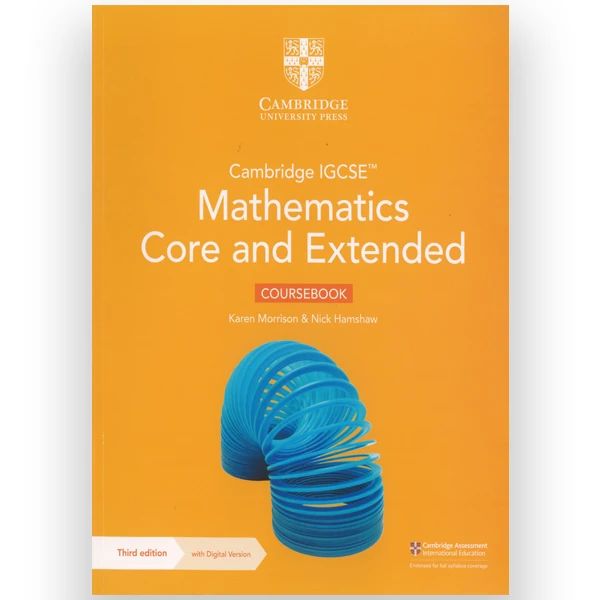
The Cambridge University Press series for Cambridge A level Maths 9709 is authored by Sue Pemberton, Julian Gilbey, and Dean Chalmers, a team with substantial examining experience. Each volume maps directly to a specific exam paper, meaning the Pure Mathematics 1 book covers exactly Paper 1 content, the Mechanics book covers Paper 4, and so on.
This paper-by-paper structure is a significant advantage. Students and tutors can assign targeted chapters without navigating irrelevant content in the middle of exam preparation season.
Digital access through the Cambridge GO platform adds interactive graphing tools and full worked solutions. For self-study A level Maths students, the ability to check step-by-step solutions independently is a genuine academic asset.
Hodder A level Mathematics series

The Hodder Education series, written by Roger Porkess and Sophie Goldie, is particularly well-regarded for its linear progression logic. Each chapter builds directly on the last, which reduces the “conceptual gaps” that trip students up in the transition between Year 1 and Year 2 content.
One critical detail often overlooked is the Hodder series’ dedicated sections on mathematical reasoning and proof structure. Cambridge examiners consistently award marks for rigorous logical justification, not just correct numerical answers. This series trains students explicitly in that skill.
The end-of-module past-paper question banks are among the most comprehensive available in any single A level Mathematics textbook. This makes the Hodder books particularly valuable for the final six to eight weeks before examinations.
Oxford University Press Complete Mathematics
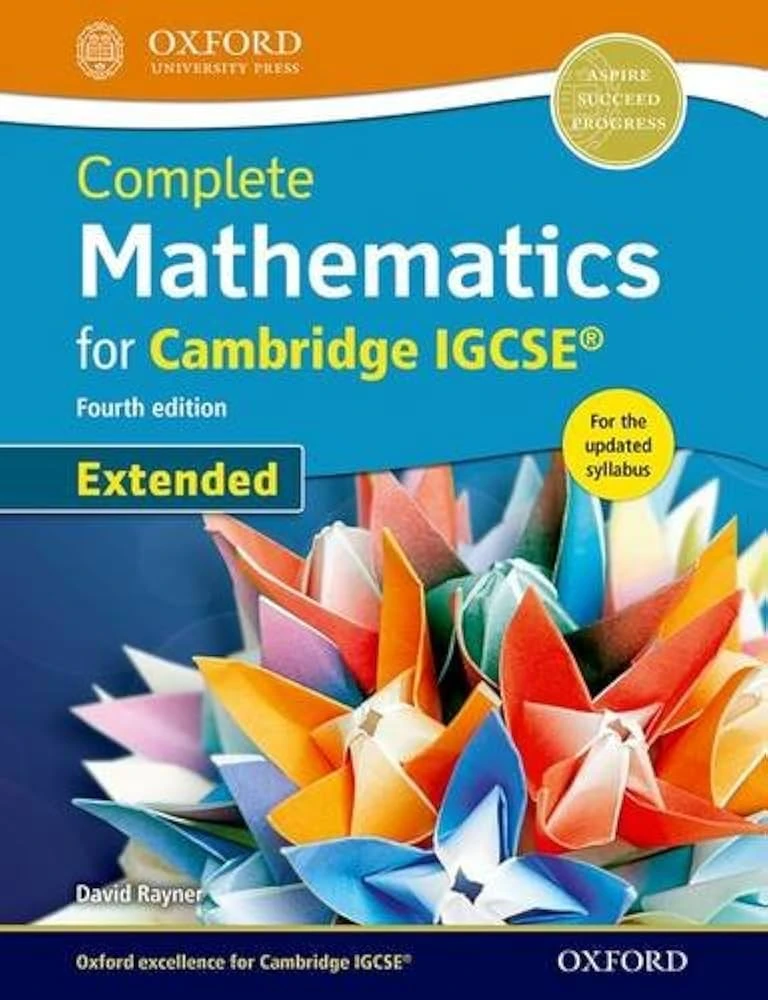
The Oxford A level Mathematics book by David Rayner, Jean Linsky, and Brian Williams prioritises visual clarity above all else. Summary boxes, formula sheets, and scannable layouts make this the fastest book to revise from under time pressure.
In our experience working with international students who are managing three or four A level subjects simultaneously, the Oxford series reduces cognitive overload during revision season. The clean layout means students can retrieve key formulas quickly rather than hunting through dense prose.
Comprehensive online drill resources supplement the printed content, which is valuable for calculus statistics A level practice where repetition is critical.
>>> Read more: A Level Maths Topic Order 2026: What to Study First for Smarter Revision
A level Mathematics pure vs applied books: what do you need for each exam board?
A level Mathematics is never a single subject in terms of content structure. It divides into pure mathematics and applied mathematics, with the applied strand covering both statistics and mechanics. The exact balance of pure to applied content varies by exam board.
A common mistake we see among new A level students is underestimating the applied components. Statistics and mechanics are not lighter than pure mathematics. They require a completely different problem-solving mindset and, in many cases, separate dedicated study time.
Pure mathematics content overview
Pure mathematics at A level covers: algebra (including logarithms, polynomials, and modulus functions), coordinate geometry, trigonometry, sequences and series, differentiation, integration, vectors, differential equations, and complex numbers (at A2 level).
Every endorsed A level Mathematics textbook devotes the majority of its pages to pure content for good reason. Pure mathematics underpins everything. A student who cannot handle calculus fluently will struggle even in the statistics and mechanics papers.
Applied: statistics and mechanics
The pure statistics mechanics book split is handled differently across publishers. Cambridge University Press publishes separate, standalone volumes for Mechanics and for Probability and Statistics 1 and 2. Hodder Education follows a similar modular approach.
| Paper | Content area | Cambridge 9709 book to use |
|---|---|---|
| Paper 1 | Pure Mathematics 1 | Pure Mathematics 1 (CUP or Hodder) |
| Paper 2 | Pure Mathematics 2 | Pure Mathematics 2 & 3 (CUP or Hodder) |
| Paper 3 | Pure Mathematics 3 | Pure Mathematics 2 & 3 (CUP or Hodder) |
| Paper 4 | Mechanics | Mechanics standalone volume |
| Paper 5 | Probability & Statistics 1 | P&S 1 standalone volume |
| Paper 6 | Probability & Statistics 2 | P&S 2 standalone volume |
>>> Read more: A Level Maths Mark Scheme Tips: How to Self-Mark Like an A* Student
Top A level Maths books for AQA, Cambridge, Edexcel and OCR specifications
Cambridge International (9709)
The clear first recommendation for Cambridge A level Maths 9709 students is the Cambridge University Press series, supplemented by Hodder Education volumes for proof and reasoning practice. These are the only series with official Cambridge endorsement.
Edexcel A level Mathematics
For students sitting the Pearson Edexcel A level Mathematics specification, the Pearson Edexcel A level Mathematics series (authored by Greg Attwood and others) is the primary endorsed text. Year 1 Year 2 Maths books are available separately, which aligns with the two-year teaching structure most schools follow.
One critical detail often overlooked by Edexcel students is that the Year 1 content (AS level) is assessed again within the full A level papers. Buying only the Year 2 book is a mistake many students make in the second year of their course.
AQA Mathematics A level
AQA endorses the Hodder Education AQA A level Mathematics series as its primary textbook. The A level Maths revision guide published by CGP is widely used alongside the main Hodder textbook for AQA students, particularly as a condensed reference during final revision.
Drawing on years of experience at Times Edu, students following AQA Mathematics A level benefit significantly from pairing the Hodder textbook with Oxford Revise or Philip Allan revision materials to cover the broad statistical content that AQA emphasises more heavily than other boards.
OCR A level Maths
OCR A level Maths students have two specifications to consider: OCR A and OCR B (MEI). The Oxford University Press OCR A level Mathematics series covers OCR A, while MEI students often use the Hodder MEI series. The MEI specification is more demanding in certain areas of pure mathematics and is frequently chosen by students targeting competitive STEM university courses.
>>> Read more: Avoid These A Level Maths Mistakes to Get an A 2026
How to use an A level Mathematics book alongside past papers for best results
Owning a quality A level Mathematics textbook is only half the equation. The other half is structured practice using Cambridge, Edexcel, AQA, or OCR past papers. Without this combination, even the best book produces limited results.
The approach we recommend at Times Edu follows a three-phase model:
Phase 1: Concept building (weeks 1 to 20)
- Read each chapter of the endorsed A level Mathematics textbook in full before attempting any questions.
- Complete all tier-graded exercises within the chapter, starting from the easier problems.
- Use the Cambridge GO step-by-step solutions (or Hodder online answers) to self-assess before moving on.
Phase 2: Integration and application (weeks 21 to 35)
- Revisit completed chapters using the past-paper question banks at the back of each Hodder module or through the Cambridge School Support Hub.
- Identify specific topic weaknesses by tracking which question types generate errors.
- Allocate extra revision time specifically to calculus statistics A level questions, which are consistently among the highest-mark items on Cambridge and Edexcel papers.
Phase 3: Examination simulation (final 8 weeks)
- Sit full past papers under timed, examination-accurate conditions.
- Use the Oxford University Press formula summary sheets for quick pre-paper review.
- Cross-reference every error with the relevant chapter in the endorsed textbook to close gaps before the real examination.
One critical detail often overlooked is the Cambridge 9709 rule prohibiting algebraic or graphing calculators. Students must practise all algebraic manipulations, coordinate geometry plots, and matrix inversions entirely by hand. Every endorsed textbook for Cambridge A level Maths 9709 is designed with this constraint in mind, but students who have used graphing calculators at IGCSE level often do not retrain their habits quickly enough.
>>> Read more: A level books 2026: The complete guide to choosing, using, and getting the most from your study resources
Where to buy A level Mathematics books at the best price online
Students and parents asking where to buy A level Mathematics book editions face a genuinely complex market. Prices vary significantly between retailers, and older editions can introduce specification misalignment risks.
Recommended purchasing channels
- Cambridge University Press online store: sells the full Cambridge A level Maths 9709 series directly, often bundled with Cambridge GO digital access codes.
- Amazon: widely available for all Hodder A level Mathematics, Oxford, Pearson Edexcel, and AQA endorsed titles. Check edition dates carefully.
- Pearson’s official website: best source for current Edexcel A level Mathematics Year 1 and Year 2 books with guaranteed edition accuracy.
- Waterstones and WHSmith: useful for UK-based students, often offering student discount codes.
- Times Edu resource recommendations: students enrolled in Times Edu programmes receive a curated book list aligned precisely to their exam board and paper selection, which removes purchasing uncertainty entirely.
| Retailer | Best for | Edition accuracy risk |
|---|---|---|
| Cambridge University Press | 9709 series + digital access | Low |
| Pearson official site | Edexcel A level textbooks | Low |
| Amazon | All boards, competitive pricing | Medium (check edition) |
| Second-hand platforms | Budget purchasing | High |
A common mistake we see is students purchasing second-hand copies of endorsed textbooks published before the most recent specification update. The Cambridge 9709 syllabus was updated for first examination in 2020, and any textbook published before 2018 will contain topics that are no longer assessed and will be missing content that now carries examination marks.
>>> Read more: A Level Maths Start Guide : 6-Week Foundation Plan for Year 12 Students
Free A level Maths resources vs investing in a quality endorsed study book
The internet provides enormous quantities of free A level Maths content, from YouTube channels to free PDF worksheets. The question is whether these resources can genuinely replace an endorsed A level Mathematics textbook.
In our experience working with international students, free resources serve a valuable supplementary role but consistently fail as primary study tools for several reasons.
First, free resources are rarely structured sequentially in a way that builds foundational understanding before introducing advanced topics. A student watching a calculus statistics A level video on YouTube is exposed to solved examples without the conceptual progression that a well-authored textbook delivers chapter by chapter.
Second, self-study A level Maths students who rely on free resources typically lack a mechanism for identifying gaps in their understanding. Endorsed textbooks include graded exercise banks specifically designed to surface these gaps before they become examination problems.
Third, Cambridge, AQA, Edexcel, and OCR regularly update their mark schemes and question styles. Endorsed textbooks are updated by publishers in close collaboration with examining bodies. Random online resources are not.
Free resources that genuinely add value alongside an endorsed textbook include:
- Cambridge School Support Hub: official past papers, mark schemes, and examiner reports.
- Desmos: free graphing tool for visual concept checking (not for examination use under Cambridge 9709 rules, but valid for learning).
- Physics and Maths Tutor (PMT): high-quality free topic notes and categorised past-paper questions for all UK A level boards.
- Wolfram Alpha: useful for checking manual calculation results during self-study sessions.
The recommended approach is to treat a quality endorsed A level Mathematics textbook as the anchor of all study activity, and to use free resources as supplementary drill and verification tools rather than primary learning sources.
>>> Read more: A-Level Tutor 2026: How to Choose the Right Tutor and Improve Grades Faster
Frequently asked questions
Which A level Mathematics textbook is best for AQA, Cambridge or Edexcel?
Do I need separate pure and applied A level Mathematics books?
What is the best A level Mathematics revision guide for last-minute exam preparation?
Which A level Maths book covers calculus and statistics most clearly?
Do I need separate A level Mathematics books for Year 1 and Year 2 content?
Are older editions of A level Mathematics textbooks valid for current specifications?
Which A level Mathematics book is best suited for self-study students?
Conclusion
At Times Edu, our curriculum specialists work with each student to build a personalised academic roadmap that integrates the right endorsed textbook choices, a realistic self-study schedule, and expert 1-on-1 tutoring support. If you are preparing for Cambridge, Edexcel, AQA, or OCR A level Mathematics and want a structured plan built around your specific examination papers, contact us today to book a personalised consultation with our team.