IGCSE Chemistry self marking past papers 2026
IGCSE Chemistry self-marking past papers is most effective when students go beyond simply checking right or wrong answers. After completing a paper under timed conditions, students should apply the official Cambridge mark scheme carefully, identify exactly why marks were lost, and record those errors for targeted revision. A strong self-marking routine also uses examiner reports, error logs, and score tracking to distinguish between knowledge gaps, application mistakes, and exam-technique issues.
This guide explains how to turn every past paper into a practical tool for improving accuracy, exam technique, and overall Chemistry performance.
- Why self-marking Chemistry past papers improves exam performance
- How to choose the correct past paper and mark scheme
- Complete the paper under timed exam conditions first
- How to apply the IGCSE Chemistry mark scheme accurately
- How to interpret alternative answers in a mark scheme
- When your answer is scientifically correct but different from the mark scheme
- How to mark Chemistry calculation questions
- How to mark explain and describe questions
- How to record mistakes in a Chemistry error log
- How to classify knowledge, application and exam-technique errors
- How to use examiner reports after marking a past paper
- How to turn incorrect answers into active recall questions
- When to repeat a Chemistry past paper
- How to track your scores across multiple past papers
- Frequently asked questions
Why self-marking Chemistry past papers improves exam performance
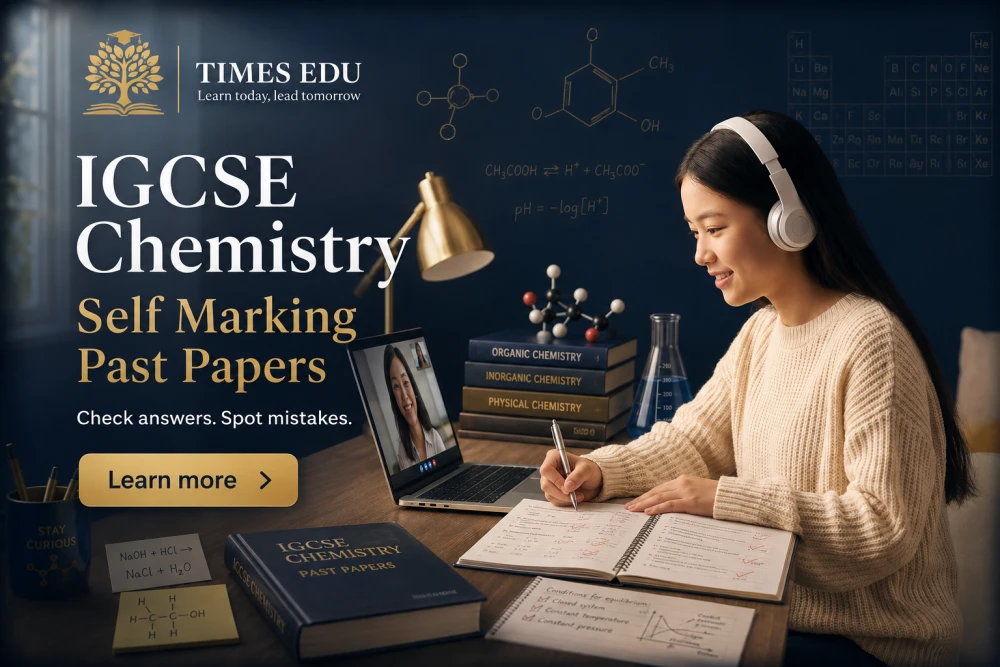
The act of marking your own work forces you to engage with the mark scheme as a document, not just a set of answers. When you read why a point is awarded or denied, you build a mental model of how Cambridge International examiners think.
Research in cognitive science consistently shows that self-assessment dramatically strengthens retrieval strength, the ease with which your brain recalls a fact under pressure. Every time you check your answer against a Cambridge Chemistry mark scheme, you are practising the same skill you need on exam day: Converting chemical knowledge into mark-worthy language.
Students who skip self-marking often discover their knowledge gaps only during the actual exam. Students who self-mark rigorously discover them weeks earlier, when there is still time to close them.
>>> Read more: IGCSE Chemistry question types explained 2026
How to choose the correct past paper and mark scheme
Cambridge IGCSE Chemistry [1] is administered under syllabus code 0620 for Cambridge International students and 0971 for Cambridge nationals. Always confirm which code your school follows before downloading any paper.
Match every paper to its exact mark scheme by year and session. A 2019 May/June mark scheme cannot be applied to a 2019 October/November paper. Even minor differences in acceptable answers can skew your self-marked score.
| Paper | Component | Total marks | Skills tested |
|---|---|---|---|
| Paper 2 | Multiple Choice (Core) | 40 | Recall, application |
| Paper 4 | Extended Theory | 80 | Analysis, calculation, explanation |
| Paper 6 | Alternative to Practical | 40 | Experimental design, data handling |
Work chronologically backward through available years if you are close to the exam, starting with the most recent papers. Earlier papers (pre-2016) used a slightly different mark scheme format and may not perfectly reflect current examiner expectations.
>>> Read more: IGCSE Chemistry how to get full marks in the exam 2026
Complete the paper under timed exam conditions first
Never open the mark scheme before you finish the paper. This sounds obvious, yet a common mistake we see at Times Edu is students who peek at the mark scheme after a difficult question, then convince themselves their original answer was “almost right.”
Set a timer for the exact allowed time: 45 minutes for Paper 2, 75 minutes for Paper 4, and 60 minutes for Paper 6. Remove your notes, close your textbook, and use only the materials permitted in the real exam, which for Chemistry means a calculator and a pencil for graphs.
Write out every answer in full sentences for explain and describe questions. Students who write bullet fragments during timed practice carry that habit into the exam, where incomplete answers lose marks systematically.
>>> Read more: IGCSE Chemistry answer structure 2026: The complete exam technique guide
How to apply the IGCSE Chemistry mark scheme accurately
Opening a Cambridge Chemistry mark scheme for the first time can feel confusing. The notation is precise, and misreading it is one of the most common self-marking errors students make.
Core notation you must memorise:
| Symbol | Meaning | Self-marking rule |
|---|---|---|
| ; (semicolon) | Separates individual marking points | Each semicolon = one mark |
| / (slash) | Alternative acceptable answer | Either word earns the mark |
| ( ) (brackets) | Optional content | Does not need to appear, but must not be contradicted |
| Underlined word | Compulsory term | Must appear exactly or no mark awarded |
| ora | Or reverse argument | Opposite statement is also acceptable |
| ecf | Error carried forward | Correct method using wrong earlier number still earns mark |
Apply these codes exactly as Cambridge examiners do. If the mark scheme shows the word exothermic underlined, and you wrote releases heat, check whether releases heat appears as an alternative after a slash. If it does not, award yourself zero for that point.
>>> Read more: IGCSE Chemistry examiner reports 2026: What every student must know before their exam
How to interpret alternative answers in a mark scheme
The slash notation is the most misunderstood feature of Cambridge Chemistry mark schemes. When a mark scheme reads alkali / base, either word earns the mark. When it reads alkali, with no alternative listed, only that word earns the mark.
One critical detail often overlooked is that the alternatives listed are the only alternatives Cambridge will accept. Students sometimes reason that their answer is “essentially the same thing” and award themselves the mark. That reasoning is incorrect and inflates your score.
When in doubt, apply the examiner’s perspective: If your phrasing does not appear in the mark scheme and is not a recognised synonym in IGCSE Chemistry, do not award the mark. This strictness will feel harsh during practice, but it protects you from a false sense of readiness.
>>> Read more: IGCSE Chemistry examiner tips 2026: How to stop losing marks you already know
When your answer is scientifically correct but different from the mark scheme
This situation creates genuine confusion for students and parents. The answer may be chemically accurate at university level but outside the expected knowledge boundary of Cambridge IGCSE Chemistry 0620.
In our experience working with international students, the safest approach is this: If your answer is correct but absent from the mark scheme, still award yourself a provisional mark, then flag the question in your error log for review. Bring those questions to your teacher or a specialist tutor who can confirm whether Cambridge examiners would accept the phrasing in practice.
Do not make a habit of awarding yourself marks for answers that are not on the mark scheme. Over time, even small scoring generosity adds up to a gap between your practice scores and your real exam performance.
>>> Read more: IGCSE books 2026: The complete guide to choosing the right study materials
How to mark Chemistry calculation questions
Calculation questions in Paper 4 use a different marking logic from descriptive questions. Most multi-step calculations award marks for both the correct method (working marks) and the correct final answer (answer marks).
Key rules for calculation marking:
- If your final answer is wrong but your method is correct, award yourself the working marks and lose only the answer mark.
- If you make an arithmetic error in step one but apply the correct formula in step two using your wrong number, the ecf rule means you still earn the step-two mark.
- Units are critical. If the unit is printed on the answer line in the exam paper, you do not need to write it. If the unit is not printed, you must include it or lose the mark, even if your numerical answer is correct.
Check your significant figures. Cambridge mark schemes typically accept answers within a stated range, such as 0.667 to 0.668. If your answer falls outside that range due to premature rounding, do not award the mark.
>>> Read more: IGCSE Tutor 2026: How to Choose the Right One
How to mark explain and describe questions
These questions carry the highest mark allocations on Paper 4 and are where students most often lose points unnecessarily. The mark scheme lists specific marking points, and each point is separated by a semicolon.
Count the number of marks available first. A four-mark explain question requires four separate, distinct marking points. Check each sentence of your answer against each marking point systematically.
Apply the contradictory answer rule without mercy. If the mark scheme awards a mark for the rate of reaction increases and you wrote the rate of reaction increases and decreases, you receive zero for that point. A correct statement cancelled by an incorrect statement on the same line scores nothing.
How to record mistakes in a Chemistry error log
An error log is a structured document where you record every question you answered incorrectly or partially. Without it, past paper practice becomes a passive exercise that produces little long-term improvement.
A basic Chemistry error log entry should include:
- Paper code, year, and question number
- The topic and subtopic (e.g., rates of reaction, collision theory)
- Your answer, written out in full
- The correct marking points from the mark scheme
- The category of error (knowledge, application, or exam technique)
- The date you reviewed it and the date you plan to revisit it
Keep this log in a single spreadsheet or notebook. Review it every week, not just before the exam. Spaced repetition, returning to mistakes at increasing intervals, is far more effective than massed revision in the final days before the paper.
How to classify knowledge, application and exam-technique errors
Not all wrong answers have the same root cause, and treating them identically wastes revision time. Classify every error into one of three categories so you know exactly what to study.
| Error type | Definition | Correct response |
|---|---|---|
| Knowledge gap | You did not know the fact or concept | Return to the textbook or class notes and re-learn the content |
| Application error | You knew the concept but applied it incorrectly to the question | Practise similar questions with focused attention on how the concept is applied |
| Exam technique error | You knew the answer but lost marks due to formatting, units, or phrasing | Drill mark-scheme language and review the examiner report for that topic |
In our experience, most students assume their errors are knowledge gaps when a large proportion are actually exam technique errors. A student who knows what a catalyst does but writes “speeds up the reaction” instead of “lowers the activation energy” is not missing knowledge; they are missing examiner language.
How to use examiner reports after marking a past paper
Cambridge publishes an examiner report for most paper sessions. These documents are written by the chief examiner and describe exactly what high-scoring candidates wrote and what low-scoring candidates wrote for each question.
Drawing on years of experience at Times Edu reviewing these reports with students, the most valuable sections are the question-by-question commentaries. When a question on your error log appears in the examiner report, read the report entry carefully. Examiners often describe the precise misunderstanding that caused widespread mark loss.
Download the examiner report for every paper session you practise. Read it after marking, not before. Use it to validate or challenge your classification of errors in your log.
How to turn incorrect answers into active recall questions
Every wrong answer is a future active recall question waiting to be created. Active recall, the practice of retrieving information from memory without looking at notes, is the most evidence-backed revision technique available for factual and conceptual content.
For every error log entry, write one question on the front of a flashcard and the complete Cambridge-approved answer on the back. The question should mirror the exact style of the exam question, not just ask “what is X.”
For example, if you lost marks on a question asking why a higher temperature increases the rate of a reaction, your flashcard question should read: Explain, using collision theory, why increasing temperature increases the rate of reaction (3 marks). The back should list three complete marking points in mark-scheme language.
When to repeat a Chemistry past paper
Repeating a past paper you have already marked is a legitimate strategy, but the timing matters. Doing it the day after you first completed it produces little learning because the answers are still in short-term memory.
Wait at least three weeks before repeating a paper. By that point, you should have studied the topics flagged in your error log, and the paper will test whether that revision has actually transferred into exam performance.
One critical detail often overlooked is that you should track your scores separately for first attempts and repeat attempts. If your repeat score is not meaningfully higher than your first-attempt score, your revision method between attempts needs to change.
How to track your scores across multiple past papers
A score tracker converts isolated practice sessions into a visible trend line. Without tracking, students have no reliable way to know whether their performance is improving or plateauing.
Recommended score tracker columns:
| Date | Paper code | Session | Raw score | Total marks | Percentage | Estimated grade | Error categories flagged |
|---|---|---|---|---|---|---|---|
| 01/09/2025 | 0620/42 | M/J 2023 | 54 | 80 | 67.5% | B | Application x3, Technique x4 |
Use the actual grade thresholds published by Cambridge for each specific session, not a generic percentage boundary. For Paper 4 Extended, an A typically requires approximately 70 to 75 percent of raw marks, not the 80 percent that many students assume from school grading systems. For Paper 2, an A usually requires 85 to 90 percent, reflecting the straightforward nature of multiple-choice recall.
Review your tracker every two weeks. If your score in a specific topic category is not improving, escalate the intensity of your revision on that topic or seek targeted 1-on-1 support.
Frequently asked questions
How do you mark your own IGCSE Chemistry past papers?
Should I use the mark scheme while doing a Chemistry past paper?
How strict should I be when self-marking IGCSE Chemistry?
What should I do after marking an IGCSE Chemistry past paper?
How many IGCSE Chemistry past papers should I complete?
Should I redo Chemistry questions I got wrong?
How can I tell if my past-paper scores are improving?
Conclusion
At Times Edu, we work with IGCSE, A Level, IB, and AP students through personalised 1-on-1 tutoring sessions that integrate exactly this kind of mark-scheme-led past paper analysis. If your child is preparing for Cambridge IGCSE Chemistry and you want to ensure their revision is producing real score gains rather than false confidence, reach out to our team for a personalised academic roadmap consultation.