IGCSE Chemistry question types explained 2026
IGCSE Chemistry question types range from multiple-choice and short factual responses to calculations, explanations, data interpretation, and experimental planning. Each type requires a different approach, so understanding command words such as state, describe, explain, suggest, compare, and calculate is essential for earning full marks. Students also need to know how question styles vary across Papers 1 to 6, from recall-focused tasks to practical and application-based questions.
This guide explains the main Cambridge IGCSE Chemistry 0620 question types and how to approach each one effectively.
- What types of questions appear in IGCSE Chemistry?
- Multiple-choice questions in IGCSE Chemistry
- State, give and name questions
- Describe questions and how to answer them
- Explain questions and scientific reasoning
- Suggest and predict questions
- Compare questions and how to structure differences
- Calculation questions and showing working
- Chemical equation and formula questions
- Data interpretation and graph questions
- Qualitative analysis and observation questions
- Experimental planning and evaluation questions
- Particle-level and bonding explanation questions
- How question types differ across Chemistry papers
- How to practise each IGCSE Chemistry question type
- Frequently asked questions
What types of questions appear in IGCSE Chemistry?
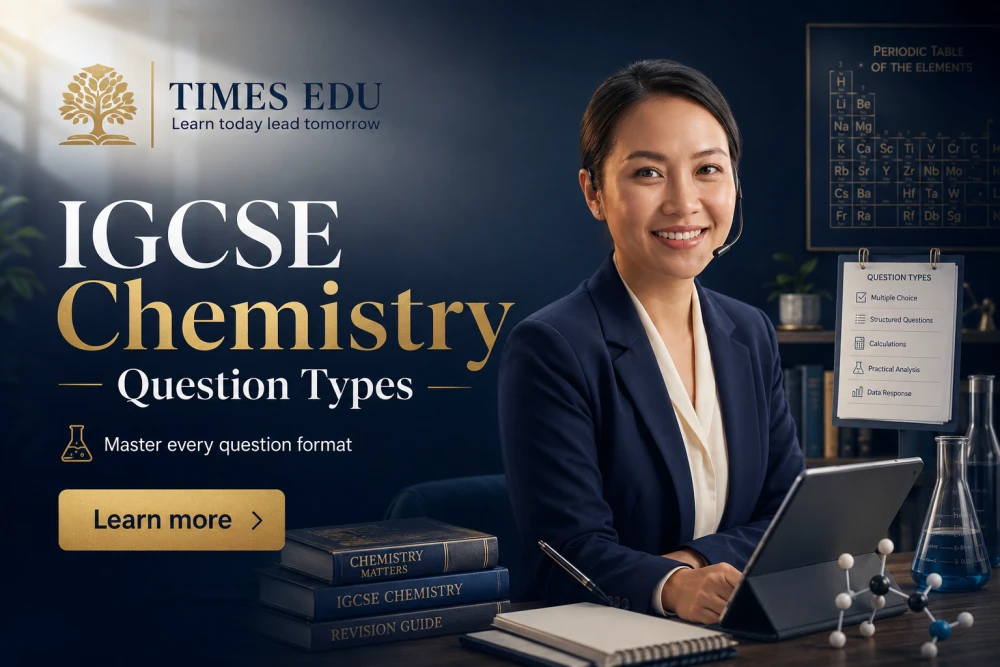
Cambridge IGCSE Chemistry [1] uses a range of question formats designed to test different cognitive skills, from straightforward recall to complex scientific reasoning. These formats are distributed across the different papers depending on whether a student is sitting Core or Extended tier.
The command words printed at the start of each question, words like state, give, name, define, describe, explain, suggest, predict, deduce, compare, calculate, and determine, are not decorative. Each one signals a specific type of response with its own structure and level of depth.
A common mistake we see at Times Edu is students who write two full paragraphs in response to a “state” question, or conversely, write a single-sentence answer to a four-mark “explain” question. Both errors cost marks unnecessarily.
>>> Read more: IGCSE Chemistry 0620 books 2026: Complete guide for students and teachers
Multiple-choice questions in IGCSE Chemistry
Paper 1 (Core) and Paper 2 (Extended) are both multiple-choice papers. Paper 1 contains 40 questions and Paper 2 also contains 40 questions, with Extended questions covering more demanding content. Each question has four options labelled A through D.
The key strategy for multiple-choice questions in IGCSE Chemistry is elimination, not guessing. Work through each option systematically and rule out the ones that are clearly incorrect before choosing between the remaining two.
One critical detail often overlooked is that there are no marks deducted for wrong answers on Cambridge multiple-choice papers. If you are genuinely unsure, always make an educated guess rather than leaving the question blank.
| Paper | Tier | Number of MCQs | Time Allowed |
|---|---|---|---|
| Paper 1 | Core | 40 | 45 minutes |
| Paper 2 | Extended | 40 | 45 minutes |
Students often make the mistake of spending too long on a single multiple-choice question. Set a pace of approximately one minute per question and move on if you are stuck, returning later if time allows.
>>> Read more: IGCSE Chemistry Past Paper Strategy for 2026: Smart Ways to Practice for Better Results
State, give and name questions
These three command words are the most common short-answer question types found in IGCSE Chemistry exam questions. They require factual recall with minimal elaboration.
- State: Give a concise fact, often a definition, property, or chemical observation.
- Give: Provide a specific piece of information, such as a formula, symbol, or name.
- Name: Identify a substance, element, compound, or process by its correct chemical name.
Drawing on years of experience at Times Edu, we consistently advise students to treat one mark as one piece of information. If a question says “State two properties of ionic compounds,” write two separate, clearly distinct points, one per line.
A frequent error is adding unnecessary explanation. If the question uses “state,” adding “because” or “therefore” is wasted writing that earns no additional marks and can sometimes introduce contradictions that cost you the mark you already had.
>>> Read more: IGCSE Chemistry “Explain” Questions 2026: How to Write Clear, High-Scoring Answers
Describe questions and how to answer them
“Describe” questions ask you to give an account of something, usually an observation, a process, or a trend. They are commonly found in Paper 4 (Extended Theory) and Paper 6 (Alternative to Practical).
When answering describe questions, focus on what happens rather than why it happens. For example, if asked to describe the trend in ionisation energy across Period 3, you should state that ionisation energy generally increases from left to right, with a dip between Group 2 and Group 3, and another between Group 5 and Group 6.
The distinction between describe and explain trips up many students. Describe tells the story of what occurs. Explain provides the mechanism or reasoning behind it. Mixing the two is one of the most common thinking traps we see in Cambridge Chemistry papers.
>>> Read more: IGCSE Chemistry Mistakes 2026: Common Errors Students Make and How to Avoid Them
Explain questions and scientific reasoning
“Explain” questions are the most mark-heavy question type in IGCSE Chemistry and the primary differentiator between students scoring in the B range and those achieving A or A*. These questions demand a logical chain of scientific reasoning, not just a list of facts.
A strong explain answer in IGCSE Chemistry follows a cause-and-effect structure. For example, if asked to explain why increasing temperature increases the rate of reaction in terms of particles:
- Increasing temperature gives particles more kinetic energy.
- Particles move faster and collide more frequently.
- A greater proportion of collisions have energy equal to or greater than the activation energy.
- The rate of reaction therefore increases.
Each linked point addresses a separate step in the reasoning chain. In our experience working with international students, those who write bullet points for explain answers match the number of marks allocated far more reliably than those who write unstructured paragraphs.
>>> Read more: IGCSE Tutor 2026: How to Choose the Right One
Suggest and predict questions
These command words indicate that there is no single definitive answer memorised from the syllabus. Instead, the examiner wants you to apply your scientific understanding to an unfamiliar or novel situation.
“Suggest” questions often appear when a scenario is introduced that you have not studied directly. For example: “Suggest why substance X has a higher melting point than substance Y.” You are expected to reason from principles you know, such as bond strength, intermolecular forces, or lattice energy.
“Predict” questions ask you to use a pattern or trend to forecast a result. A common type of predict question in Cambridge IGCSE Chemistry asks students to predict the product of a reaction based on a series of data, or to predict how a physical property changes down a group. Always justify your prediction with one brief sentence of reasoning, even if the question does not explicitly ask for justification, as this earns the mark in borderline cases.
Compare questions and how to structure differences
“Compare” questions require students to identify both similarities and differences between two substances, processes, or properties. A critical detail often overlooked is that simply describing one thing and then the other is not comparing. Comparison requires direct, parallel statements.
Use linking language such as “whereas,” “in contrast to,” or “both… However…” To make the comparison explicit. For example: “Both diamond and graphite are forms of carbon, but diamond has a giant covalent structure with four bonds per carbon atom, whereas graphite has a layered structure with only three bonds per carbon atom, leaving one free electron per atom.”
Each mark in a compare question typically corresponds to one valid comparative point. Aim to make each statement self-contained so that the examiner can clearly credit each point independently.
Calculation questions and showing working
Quantitative questions are a core component of IGCSE Chemistry across Paper 3, Paper 4, and occasionally Paper 6. They range from relative formula mass and percentage composition to moles, gas volumes, titration calculations, and percentage yield.
The method that works consistently across all types is what we refer to at Times Edu as the step-down approach:
- Write the formula you are using.
- Substitute in the values with units.
- Show the arithmetic step clearly.
- State the final answer with the correct unit.
Cambridge examiners award “error carried forward” (ECF) marks, which means that even if you make an arithmetic error in step two, you can still earn marks in steps three and four if your method is correct. Students who skip steps lose these marks entirely. Never write only a final numerical answer for a multi-step calculation.
Chemical equation and formula questions
Writing and balancing chemical equations is a recurring skill tested across IGCSE Chemistry papers. Questions may ask you to write word equations, symbol equations, ionic equations, or half-equations for electrolysis and redox reactions.
Common mistakes include forgetting state symbols when they are specifically requested, writing incorrect formulae for common compounds, or failing to balance an equation correctly while still applying conservation of mass. State symbols, (s), (l), (g), and (aq), are frequently worth a dedicated mark.
In our experience working with international students, one of the most reliable revision habits is memorising the formulae for common acids, bases, salts, and gases. If you write the wrong formula, the equation cannot be balanced correctly, and you lose all marks for that equation regardless of your method.
Data interpretation and graph questions
Data analysis and graph questions appear across multiple papers and test whether you can extract meaning from presented information rather than from memorised content. These questions may involve reading values from a graph, identifying a trend, calculating a gradient, or explaining an anomaly.
When calculating a gradient from a graph, always draw a large triangle using clearly marked coordinates from the line itself, not from data points that may not lie exactly on the line. Show the rise-over-run calculation explicitly.
A common mistake we see is students who describe a graph trend too vaguely by writing “as X increases, Y increases.” A better response uses specific values from the axes: “Between 0 and 40 seconds, the volume of gas produced increases rapidly, then levels off after 60 seconds as the reactant is used up.” Precision earns the mark; vagueness does not.
Qualitative analysis and observation questions
Observation and identification questions test your knowledge of chemical tests, colour changes, precipitate formation, gas tests, and flame tests. These are heavily featured in Paper 6 (Alternative to Practical) and Paper 5 (Practical).
The golden rule for observation questions is to write only what you would physically see, hear, or smell, never the name of the chemical being produced. For example, if asked what you observe when dilute hydrochloric acid is added to sodium carbonate, write “effervescence is seen” or “colourless gas bubbles are produced,” not “carbon dioxide is produced.”
Drawing on years of experience at Times Edu, we recommend students compile a dedicated revision table of all qualitative analysis tests on the Cambridge IGCSE Chemistry 0620 syllabus, including the test, the observation, and the conclusion. This table is one of the highest-yield revision tools available.
Experimental planning and evaluation questions
Paper 6 typically ends with a six-mark experimental planning question. This is the most open-ended question type in IGCSE Chemistry and the one where students lose the most marks through poor structure.
Structure your response using the following subheadings consistently:
- Apparatus: List all equipment needed with specific sizes or capacities where relevant.
- Variables: Identify the independent variable (what you change), the dependent variable (what you measure), and at least two controlled variables (what you keep constant).
- Method: Write a numbered, step-by-step procedure with specific quantities, such as exact volumes in cm3 or masses in grams.
- Data processing: Explain how you will use your results to reach a conclusion, including any calculations needed.
Evaluation questions, which ask you to assess reliability, accuracy, or sources of error, require you to identify specific weaknesses in a method and suggest realistic improvements. General comments such as “be more careful” earn no marks. Specific improvements such as “use a burette instead of a measuring cylinder to measure volumes more precisely” earn the mark.
Particle-level and bonding explanation questions
These questions ask students to explain physical or chemical properties in terms of the particles, forces, or structure involved. They are among the most intellectually demanding IGCSE Chemistry question types and frequently appear in Paper 4.
Common topics include explaining why ionic compounds have high melting points (strong electrostatic forces between oppositely charged ions require large amounts of energy to overcome), why graphite conducts electricity (delocalised electrons move freely between layers), and why metals are malleable (layers of positive ions can slide over each other without breaking the metallic bond).
One critical detail often overlooked is the phrase “in terms of particles” in the question wording. If this phrase is present, your answer must reference particles, ions, electrons, or molecules explicitly. An answer written only in macroscopic terms will not earn full marks even if every fact stated is correct.
How question types differ across Chemistry papers
Understanding which question types appear on which paper helps you prepare strategically for each component of the Cambridge IGCSE Chemistry 0620 assessment.
| Paper | Tier | Main Question Types | Key Skills Tested |
|---|---|---|---|
| Paper 1 | Core | Multiple-choice | Recall, elimination |
| Paper 2 | Extended | Multiple-choice | Application, reasoning |
| Paper 3 | Core | Structured, short-answer | Describe, calculate, state |
| Paper 4 | Extended | Structured, multi-mark | Explain, calculate, compare |
| Paper 5 | Both | Practical | Observation, data analysis |
| Paper 6 | Both | Alternative to Practical | Experimental planning, evaluation |
Students taking the Extended tier sit Papers 2 and 4, while Core students sit Papers 1 and 3. Paper 5 or Paper 6 is taken by all students depending on whether their school has a practical component or not.
How to practise each IGCSE Chemistry question type
Effective preparation requires targeted practice, not just reading through notes. The following approach is what we use with students at Times Edu to build confidence across all IGCSE Chemistry question types.
- Use past papers from Cambridge International (available from 2012 onward for 0620) and sort questions by command word, not just by topic.
- Build a personal mark scheme vocabulary list. For each command word, write the exact phrasing Cambridge uses to award marks and practise replicating that structure.
- Time yourself on Paper 4 questions at a rate of approximately one mark per minute. A four-mark explain question should take no more than four to five minutes.
- For Paper 6, practise writing experimental plans from scratch without looking at mark schemes first. Then compare your structure against the official mark scheme and identify what subheadings or specific details you missed.
- For calculation questions, do every step on paper, even if the arithmetic feels straightforward. The habit of showing working protects you from losing ECF marks.
In our experience working with international students across IGCSE, A Level, and IB programmes, the students who improve most rapidly are those who practise questions by type first, then by topic, building both familiarity with the format and confidence with the content simultaneously.
Frequently asked questions
What question types are in IGCSE Chemistry?
IGCSE Chemistry includes multiple-choice questions (Papers 1 and 2), structured short-answer and multi-mark questions (Papers 3 and 4), and practical or alternative-to-practical questions (Papers 5 and 6). Each paper tests different skills, from recall and calculation to experimental planning and data interpretation.
What are the command words in IGCSE Chemistry?
The key command words used in Cambridge IGCSE Chemistry exam questions include state, give, name, define, describe, explain, suggest, predict, deduce, compare, calculate, determine, and identify. Each word signals a specific type of response and level of detail required.
How do you answer explain questions in IGCSE Chemistry?
Write a logical chain of cause-and-effect reasoning, linking each scientific fact to the next. Use bullet points to match the number of marks available. Always use particle-level language if the question specifies “in terms of particles.”
What calculation questions come up in IGCSE Chemistry?
Calculation questions include relative formula mass, moles, empirical and molecular formulae, percentage yield, atom economy, titration calculations, gas volume calculations at r.t.p., and concentration calculations. Always show every step of working, as partial marks are available through error carried forward.
Does IGCSE Chemistry have multiple-choice questions?
Yes. Paper 1 (Core) and Paper 2 (Extended) are both dedicated multiple-choice papers, each containing 40 questions to be answered in 45 minutes. No marks are deducted for incorrect answers.
What practical questions appear in IGCSE Chemistry?
Paper 5 is the practical assessment conducted in a laboratory setting. Paper 6 is the Alternative to Practical, which tests the same skills through written questions covering experimental planning, observation, data analysis, evaluation of methods, and identification of sources of error.
What is the difference between describe and explain in IGCSE Chemistry?
Describe means giving an account of what happens, focusing on observable facts, trends, or steps in a process. Explain means giving the scientific reasoning behind what happens, addressing the mechanism or cause. Mixing these two in an answer is one of the most penalised errors in Cambridge IGCSE Chemistry marking.