Hiếu Đào - Times Edu - Page 31 of 42
Vietnamese

IGCSE Physics 0625 Mistakes: 10 Errors That Cost A* in 2026
IGCSE Physics Mistakes: Common Errors Students Make and How to Avoid Them

IGCSE physics mistakes most often come from avoidable exam-technique slips rather than weak content knowledge. The highest-impact issues are calculation errors (wrong substitutions, early rounding), poor unit consistency (missing or incorrect SI units), confusion between vector vs scalar quantities, and incorrect significant figures or standard form. Many students also lose marks through inaccurate circuit diagrams and … Read more

IGCSE Physics Study Plan for 2026: A Simple Revision Guide for Better Exam Preparation

IGCSE Physics Study Plan: A Simple Revision Guide for Better Exam Preparation

An effective IGCSE Physics study plan (Cambridge Syllabus 0625) targets an A/A* by combining concept mastery, a clear formula sheet, and relentless past-paper practice. Start with Mechanics and core measurement skills, then move through Thermal Physics and Wave properties, before consolidating Electromagnetism and Space Physics. Use active recall and spaced repetition to prevent forgetting while you progress. Finish with timed, full-paper practice … Read more

IGCSE Chemistry 0620 Command Words: Decode Exam Questions for A*

IGCSE Chemistry Command Words: How to Understand Exam Questions More Accurately

IGCSE Chemistry command words are the action verbs in exam questions—such as state, define, describe, explain, calculate, suggest, and deduce—that tell you exactly what the examiner wants and how marks are awarded. Mastering these instructions helps you match your response to the marking scheme, the relevant assessment objectives, and the expected level of chemical terminology. The … Read more

IGCSE Chemistry 0620 Topic Order: Best Sequence for A* Revision

IGCSE Chemistry Topic Order: What to Study First for Smarter Revision

A proven IGCSE Chemistry topic order (Cambridge Syllabus 0620/0971) is to start with States of Matter and Experimental Techniques, then build Atoms/Elements/Compounds and Bonding before moving into Stoichiometry and calculations. Next, study Chemical energetics, Rates, and Reversible reactions, followed by Acids, Bases and Salts, Electrolysis, and Redox reactions. Finish with the content-heavy blocks (Periodic Table, Metals, Air/Water, Organic Chemistry) and consolidate … Read more

IGCSE Chemistry Time Management: How to Use Your Exam Time More Effectively in 2026

IGCSE Chemistry Time Management: How to Use Your Exam Time More Effectively

IGCSE Chemistry time management means using a mark-per-minute pacing plan to finish every section within the exam duration while protecting easy marks. Prioritize high-yield topics, practice timed past papers, and apply strict checkpoints so you do not overspend time on any one question. In Paper 4 Extended, write in mark-scheme style and use a single-pass … Read more

IGCSE Chemistry Mock Improvement Plan for 2026: Practical Steps to Improve After Every Mock Exam

IGCSE Chemistry Mock Improvement Plan: Practical Steps to Improve After Every Mock Exam

An IGCSE Chemistry mock improvement plan is a structured 4–6 week revision system designed to raise your mock score by using gap analysis to pinpoint why you lost marks and weakness mapping to prioritize the topics and skills that matter most. It combines targeted remedial action, high-yield past paper practice, and exam-technique training (timing, command words, method marks) … Read more

IGCSE Chemistry Past Paper Strategy for 2026: Smart Ways to Practice for Better Results

IGCSE Chemistry Past Paper Strategy: Smart Ways to Practice for Better Results

An effective IGCSE Chemistry past paper strategy is to practice Paper 2 MCQ and Paper 4 Theory under strict timed conditions (about 1 minute per mark), then mark with official schemes to learn the exact keywords examiners reward. Use Classified papers to fix weak topics, add Specimen papers to match current exam style, and track recurring errors in a log … Read more

IGCSE Chemistry “Explain” Questions 2026: How to Write Clear, High-Scoring Answers

IGCSE Chemistry “Explain” Questions: How to Write Clear, High-Scoring Answers

IGCSE Chemistry “explain” questions are best answered by showing clear chemical reasoning: State the key concept, describe the particle-level mechanism, then justify the observable result using precise scientific terminology. High-scoring responses consistently link kinetic theory and collision theory to reaction rates, connect molecular structure and intermolecular forces to properties, and explain periodic trends through shielding and nuclear attraction. For multi-mark items, … Read more

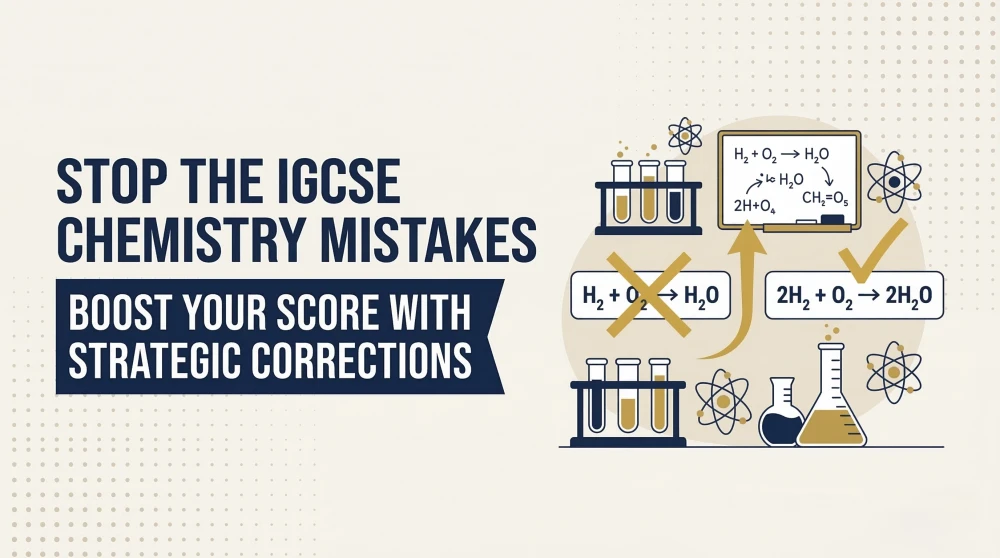
IGCSE Chemistry Mistakes 2026: Common Errors Students Make and How to Avoid Them

IGCSE Chemistry Mistakes 2026: Common Errors Students Make and How to Avoid Them

IGCSE Chemistry mistakes most often come from avoidable patterns: Calculation errors (units, rounding, missing method), unbalanced equations, and forgotten state symbols. Students also lose marks by confusing key concepts such as empirical formula vs molecular formula, writing incorrect ionic equations, and mixing up covalent bonding ideas. In practical-style questions, qualitative analysis and titration errors—misreading apparatus, reporting … Read more

Zalo