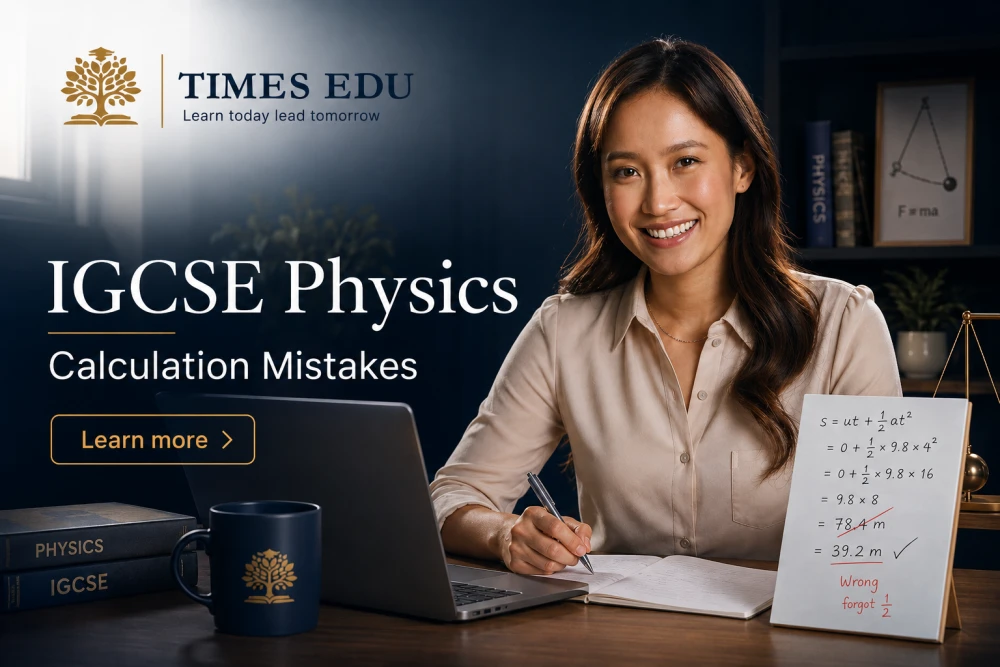
IGCSE Physics Study Plan for 2026: A Simple Revision Guide for Better Exam Preparation
An effective IGCSE Physics study plan (Cambridge Syllabus 0625) targets an A/A* by combining concept mastery, a clear formula sheet, and relentless past-paper practice.
Start with Mechanics and core measurement skills, then move through Thermal Physics and Wave properties, before consolidating Electromagnetism and Space Physics.
Use active recall and spaced repetition to prevent forgetting while you progress.
Finish with timed, full-paper practice plus a strict error-corrections log to turn weaknesses into predictable marks on exam day.
- The Ultimate IGCSE Physics Study Plan (Syllabus 0625) For An A Grade
- Mastering General Physics And Mechanics Principles First (Mechanics)
- Structuring Your Revision For Thermal Physics And Waves (Thermal Physics, Wave properties)
- Allocating Time For Electricity Magnetism And Atomic Physics (Electromagnetism, Space Physics)
- Using Active Recall For Physics Formulae And Definitions (Formula sheet, Spaced repetition)
- Grade Boundaries, Marking Reality, And How To Set Targets
- Choosing Subjects Strategically For International University Applications
- A Practical 4–12 Month IGCSE Physics Study Plan (Syllabus 0625)
- Frequently Asked Questions
The Ultimate IGCSE Physics Study Plan (Syllabus 0625) For An A Grade

An A/A* in IGCSE Physics is rarely about “working harder.” It is about sequencing the syllabus intelligently, training exam-specific skills early, and turning formulas into automatic tools under time pressure.
Based on our years of practical tutoring at Times Edu, the highest-achievers follow a plan that does three things consistently: (1) concept clarity, (2) formula fluency, (3) past-paper pattern recognition. That combination is what converts effort into marks.
A critical detail most students overlook in the 2026 exam cycle is that Cambridge notes changes to the layout and formatting of question papers from March 2026 to increase accessibility, which can affect how students scan data, diagrams, and command words under time constraints.
What you are actually preparing for (so your study plan is realistic)
Cambridge IGCSE Physics 0625 requires three papers. For Extended entry (the route for grades A*–G), candidates sit Paper 2 (MCQ Extended, 30%), Paper 4 (Theory Extended, 50%), and Paper 5 or Paper 6 (Practical/Alternative, 20%).
Your study plan must therefore include:
- MCQ stamina and precision (fast recall + unit sense).
- Structured explanation and calculations (showing method, not just answers).
- Practical skills (variables, graphs, uncertainties, planning, data handling).
A planning rule that prevents burnout
Use one of these timelines:
- 12 Months (steady, low stress): Ideal for international school workload + co-curriculars.
- 6–8 Months (standard): Best balance of concept depth and past-paper volume.
- 4 Months (intensive): Workable only with disciplined weekly routines.
- 3 Months (crash): Possible, but only if you prioritize exam patterns and your weakest topics first.
>>> Read more: A Level Physics Problem Solving 2026: A Step-by-Step Method to Boost Your Marks
Mastering General Physics And Mechanics Principles First (Mechanics)
Mechanics is the engine room of Syllabus 0625. It also drives your marks in other topics because it trains you to think in models (forces, energy transfers, momentum) rather than isolated facts.
From our direct experience with international school curricula, students who delay Mechanics often struggle later with Electricity and Waves because they have not built the habits of diagramming, defining systems, and tracking units.
The topic order that produces faster progress
Start with “General Physics + Mechanics” before anything else:
- Physical quantities, measurement, units, vectors, scalars.
- Motion graphs and kinematics.
- Forces, moments, pressure, density.
- Work, energy, power, efficiency.
- Momentum and simple collisions.
This order matches how Paper 4 questions chain ideas together, especially with multi-step calculations and graph interpretation.
Common misconceptions that quietly lose marks
These are “silent” errors that repeatedly appear in examiner expectations:
- Confusing mass and weight (and forgetting the unit difference).
- Treating speed-time graph gradient as “speed” instead of acceleration.
- Writing formulas without stating what each symbol represents in context.
- Using mixed units (cm with m, g with kg) and expecting correct final answers.
- Assuming friction always “opposes motion” without defining the direction of motion.
Misconception-to-mark strategy table (use this weekly)
| Misconception (Mechanics) | Correct model | What the examiner rewards |
|---|---|---|
| “Heavier objects fall faster” | Same gravitational acceleration (ignoring air resistance) | Clear statement of assumption + correct use of gg |
| “Pressure is force” | p=FAp=AF and depends on area | Correct formula + unit (Pa) + interpretation |
| “Energy is used up” | Energy is transferred / dissipated | Precise language in explanations |
Keep this table beside your workspace and add to it after every past paper session.
A weekly structure for Mechanics (high yield)
The pedagogical approach we recommend for high-achievers is a 3-part weekly loop:
- Concept lesson (2–3 sessions): Short notes + worked examples.
- Retrieval practice (2 sessions): Closed-book recall + flashcards.
- Topical past-paper set (1–2 sessions): Timed, marked, corrected.
Your aim is not “finishing notes.” Your aim is being able to do a new question cold.
>>> Read more: Choosing IGCSE Subjects: Your Path to Top Universities
Structuring Your Revision For Thermal Physics And Waves (Thermal Physics, Wave properties)

Thermal Physics and Wave properties are where many strong students underperform because they rely on memory instead of mental models. These chapters reward clean definitions, correct graph reading, and accurate use of terms like “rate,” “transfer,” and “net.”
Thermal Physics: The scoring focus areas
Thermal questions often test whether you can separate:
- Temperature vs internal energy.
- Heating vs temperature rise.
- Conduction, convection, radiation as mechanisms, not synonyms.
- Specific heat capacity vs specific latent heat (and the graph features that reveal each).
A practical study plan move: Build one-page summaries with:
- Key definitions in your own words.
- A mini “equation bank” (for your Formula sheet).
- Two graph sketches: Heating curve and cooling curve.
Waves: How to make it exam-friendly
Waves becomes easy when you treat it as three linked skills:
- Wave relationships: V=fλv=fλ.
- Wave behaviors: Reflection, refraction, diffraction.
- Optics: Rays, images, lens rules, total internal reflection.
Wave properties questions often look simple but punish vague writing. Train yourself to state conditions precisely (for example, diffraction increases when gap size is comparable to wavelength).
A 2-month block plan (Thermal + Waves)
Use a predictable rhythm so you do not “half-learn” everything.
| Week | Focus | Output you must produce |
|---|---|---|
| 1–2 | Thermal basics + energy transfer | 30 flashcards + 2 topical sets |
| 3–4 | SHC/SLH + graphs | 1 full Formula sheet page + graph drills |
| 5–6 | Wave properties (core relationships) | 40 MCQs timed + corrections log |
| 7–8 | Light and sound applications | 2 Paper 4 sections timed + error analysis |
Spaced repetition is what makes this stick. Review your Thermal and Waves flashcards on a 1–3–7–14 day cycle, even while you move forward.
>>> Read more: Struggling with IGCSEs? How to Improve Grades Fast 2026
Allocating Time For Electricity Magnetism And Atomic Physics (Electromagnetism, Space Physics)
Electricity and Electromagnetism tend to be “late syllabus” content, so students compress them and then panic. That approach fails because circuits and electromagnetism require progressive skill-building, not last-minute memorization.
Space Physics, by contrast, is concept-heavy with fewer calculations, so it benefits from structured explanation practice and careful command-word training.
Electricity and Electromagnetism: What drives grades
Treat this as two layers:
- Layer 1: Circuit fundamentals
Current, voltage, resistance, series/parallel, power and energy, safety. - Layer 2: Fields and induction
Magnetism, electromagnets, motors/generators, electromagnetic induction.
From our direct experience with international school curricula, the most common reason students drop marks in circuits is not “hard content.” It is a sloppy technique: Missing units, unclear diagrams, and failing to state which law they are using.
Practical papers: Build them into the timetable early
All candidates take one practical paper (Paper 5 or Paper 6).
If you ignore practical skills until the final month, your score ceiling drops because:
- Graphing and gradient tasks require routine,
- Uncertainty and significant figures must become automatic,
- Experimental design questions reward structured reasoning.
Space Physics: A smart approach (Space Physics)
Space Physics in Syllabus 0625 includes structured content on the Solar System and basic cosmology concepts.
Train for Space Physics with:
- Short-definition drills (closed book),
- Diagram labeling practice,
- “Explain” answers that use precise causal language (because Paper 4 rewards clarity over length).
>>> Read more: Ultimate IGCSE Physics 0625 Revision Guide
Using Active Recall For Physics Formulae And Definitions (Formula sheet, Spaced repetition)
Your Formula sheet is not just a revision aid. It is a diagnostic tool that reveals what you do not truly understand.
Build a Formula sheet the examiner would respect
Include:
- The formula.
- The meaning of each variable.
- The SI unit for each variable.
- One “typical trap” (for example, mixing grams and kilograms).
Example format:
- KE=12mv2KE=21mv2
mm in kg, vv in m/s, KE in J
Trap: Using km/h without converting.
Active recall protocols that work for Physics
Use these methods in rotation:
- Blank-page retrieval: Write everything you know about a topic from memory in 5–7 minutes, then correct in a different color.
- Exam-style teaching: Explain a concept aloud as if to a younger student, using one diagram.
- Flashcards with “why” prompts: Not just definitions, but “why does this happen” and “what changes if…”.
Spaced repetition is not optional if you want an A/A*. It is how you keep earlier topics alive while you move into later ones.
Past papers: The non-negotiable schedule
Your plan should progress in three stages:
- Topical past papers (early): Build competence per chapter.
- Mixed-topic practice (middle): Simulate Paper 4 switching.
- Full papers timed (late): Train speed, accuracy, and endurance.
Reliable revision platforms and banks commonly used by students include Save My Exams and Physics & Maths Tutor for topic practice and past papers.
>>> Read more: IGCSE Tutor 2026: How to Choose the Right One
Grade Boundaries, Marking Reality, And How To Set Targets
Students often misunderstand grade boundaries because they treat them as fixed. Cambridge grade thresholds change each session based on paper difficulty and statistical outcomes.
A useful way to use grade boundaries is as a targeting tool, not a prediction tool. For example, Cambridge publishes grade thresholds by option code and component combination; in June 2025, several option combinations show A* thresholds in the mid-140s to mid-150s out of 200 after weighting.
How this changes your study plan
Set targets that are stable across sessions:
- Paper 2: Aim for clean accuracy, not speed-only guessing.
- Paper 4: Aim to secure method marks even when you cannot finish.
- Paper 5/6: Aim for consistent graph and variables marks, because these are “repeatable” skills.
Based on our years of practical tutoring at Times Edu, a realistic A/A* target profile is:
- Few “concept” losses (definitions and explanations are tight).
- Very few unit losses (units are checked line-by-line).
- Strong consistency in practical questions (graphs, planning, analysis).
Choosing Subjects Strategically For International University Applications
Physics is not only an exam grade. It is a signal of quantitative maturity, which matters for STEM and increasingly for economics and data-driven fields.
From our direct experience with international school curricula, the students with the strongest overseas outcomes treat subject selection as a coherent story:
- Physics + Mathematics supports engineering, CS, economics, architecture.
- Physics + Chemistry supports medicine-adjacent pathways (biomed, pharmacology) and materials science.
- Physics + Computer Science signals applied problem-solving and suits tech pathways.
A simple subject-combination guide (planning beyond IGCSE)
| Intended pathway | Recommended subject signal | Why it helps |
|---|---|---|
| Engineering | Physics + Math (strong) | Required foundation and credibility |
| Computer Science | Physics + Math + CS | Shows modeling + quantitative thinking |
| Medicine/Biomed | Physics + Chemistry + Biology | Broad science base for later specialization |
| Economics | Math + Physics (or strong quantitative science) | Signals analytical strength |
If you are unsure, Times Edu can map your subject choices to your target country and university system, then build a timeline that aligns grades, tests, and extracurricular evidence into one plan.
A Practical 4–12 Month IGCSE Physics Study Plan (Syllabus 0625)
Use this table to choose your pacing. The content sequence stays similar; only the intensity changes.
| Timeline | Weekly hours | Best for | Core focus |
|---|---|---|---|
| 12 months | 3–5 | Heavy school workload | Deep understanding + steady spaced repetition |
| 6–8 months | 5–7 | Most students | Balanced topic coverage + early past papers |
| 4 months | 8–12 | Exam-focused term | Aggressive practice + strict error correction |
| 3 months | 12–16 | Emergency catch-up | Past-paper driven + weakest-topic first |
A weekly timetable template (repeat every week)
| Session type | Frequency | What you do | How you measure success |
|---|---|---|---|
| Concept + examples | 2–3 | Learn one subtopic and solve 6–10 guided questions | You can explain it without notes |
| Active recall | 2 | Flashcards + blank-page retrieval | You recall definitions and steps accurately |
| Topical past paper | 1–2 | Timed set + marking + corrections log | Error rate drops each week |
| Practical skills | 1 | Graphs, variables, planning, uncertainties | Cleaner graphs, fewer method losses |
The corrections log is mandatory. If you do not track errors, you repeat them.
Frequently Asked Questions
How do I start studying for IGCSE Physics?
Is 3 months enough to finish the IGCSE Physics syllabus?
Yes, but only if your plan is exam-driven and you accept trade-offs. The fastest route is to prioritize the highest-frequency Paper 4 patterns (Mechanics, Electricity, Waves), build a tight Formula sheet, and complete topical questions daily before moving to full timed papers in the final 3–4 weeks.Based on our years of practical tutoring at Times Edu, a 3-month plan succeeds when students do two disciplined things: Spaced repetition every week (to prevent forgetting) and a corrections log after every paper (to stop repeating the same errors).
What are the most important chapters in IGCSE Physics?
How can I memorize all the Physics formulas easily?
How many hours a day should I spend on Physics revision?
Should I focus more on theory or numerical problems?
What are the best online resources for IGCSE Physics 0625?
Conclusion
Two students can follow the same “IGCSE Physics study plan” and get different outcomes because their bottlenecks are different: Weak algebra, slow reading speed, missing practical skills, or shaky concept models.
Based on our years of practical tutoring at Times Edu, the most efficient next step is a short diagnostic that identifies your top 5 mark-loss patterns, then turns them into a week-by-week plan tied to Syllabus 0625 and your exam series.
If you share your target exam month, your current predicted grade, and which paper combination you are taking (Paper 5 or Paper 6), I will propose a tailored 4–12 month timetable with topic sequencing, spaced repetition cadence, and past-paper milestones aligned to your goals.