IB Mathematics AA Extended Essay 2026: How to write a high-scoring mathematics EE
The IB Mathematics AA Extended Essay is an independent research project that allows students to investigate a focused mathematical question in much greater depth than the standard course assessment. Unlike the IA, it requires a more formal academic approach, with a clearly defined research question, advanced mathematical reasoning, engagement with external sources, and sustained critical analysis. Strong essays typically move beyond routine syllabus techniques into areas such as advanced modelling, number theory, graph theory, differential equations, or proof.
This guide explains how to choose a suitable Mathematics Extended Essay topic, structure the investigation, meet the assessment criteria, and avoid common mistakes.
- What is the IB Extended Essay in Mathematics and how does it differ from the IA?
- How to choose a strong research question for your IB Mathematics Extended Essay
- How to structure and write an IB Mathematics Extended Essay effectively
- How the IB Mathematics Extended Essay is assessed and graded
- Common mistakes students make in IB Mathematics Extended Essays
- How an IB Mathematics Extended Essay can complement your IB Mathematics AA course
- Frequently asked questions
What is the IB Extended Essay in Mathematics and how does it differ from the IA?
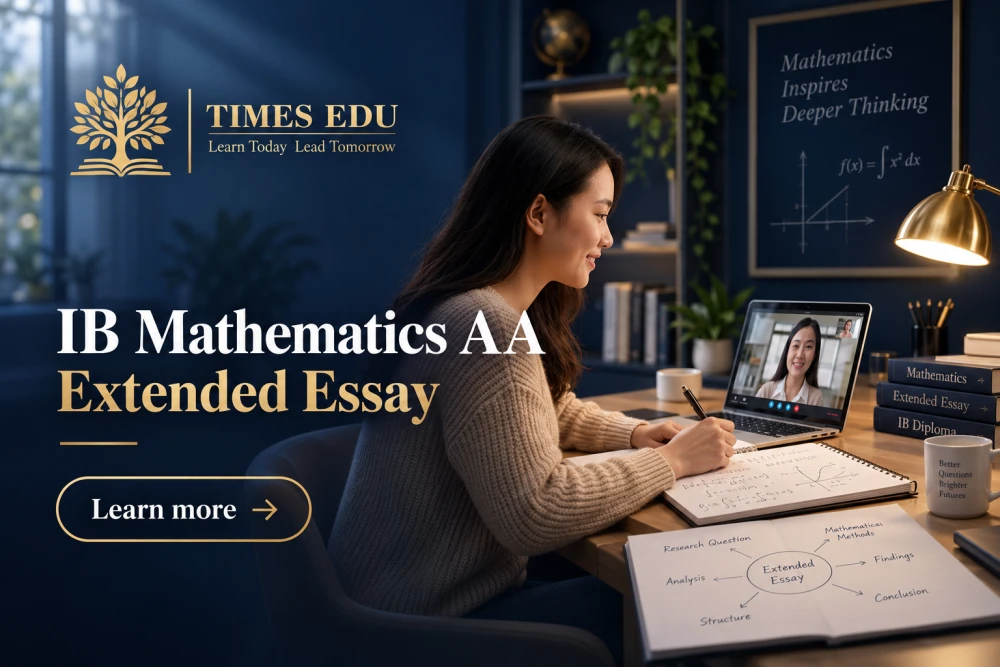
The IB Extended Essay (EE) is a 4,000-word independent research paper that every IB Diploma student must complete. When written in Mathematics, it falls under Category 1 of the subject groups, meaning the student investigates a mathematical concept or model on its own terms, rather than using mathematics as a secondary tool for another subject like Economics or Physics.
The essay must be accompanied by a formal 300-word academic abstract and a full bibliography. It is submitted alongside a Reflections on Planning and Progress Form (RPPF), which documents the student’s intellectual journey with their supervisor.
Understanding the difference between the IB EE vs IA Mathematics [1] is essential before a student begins planning.
| Feature | Internal Assessment (IA) | Extended Essay (EE) |
|---|---|---|
| Word count | 12 to 20 pages (no strict word limit) | 4,000 words maximum |
| Abstract required | No | Yes, 300 words |
| Scope | Personal exploration of a mathematical idea | Formal research paper with literature review |
| External review | Internally moderated | Externally assessed by IBO examiners |
| Academic sources | Encouraged but not mandatory | Required and formally cited |
| Grade weight | Part of overall Mathematics grade | Contributes to IB Diploma bonus points |
One critical detail often overlooked is that the EE is not a longer version of the IA. IB examiners specifically flag papers that read like a “super IA,” and those submissions are consistently capped at lower grades regardless of mathematical quality.
>>> Read more: IB Mathematics AA exam technique 2026: The complete guide to scoring higher
How to choose a strong research question for your IB Mathematics Extended Essay
The EE research question in Mathematics is the single most important decision a student makes in the entire process. A weak or poorly scoped question will undermine every hour of effort invested afterward.
Drawing on years of experience at Times Edu, we consistently see students choose topics that are either too broad (such as “an investigation into calculus”) or too applied in a surface-level way (such as using a basic linear regression to model a social trend). Both approaches fail to meet the IBO’s expectations for a Category 1 investigation.
A strong EE topic in Mathematics must satisfy three conditions simultaneously:
- The question must be answerable through mathematical reasoning, not opinion or qualitative description.
- The mathematics involved must go meaningfully beyond the standard IB Mathematics AA syllabus.
- The scope must be narrow enough that a 4,000-word paper can genuinely analyze, prove, or model the answer with rigor.
There are three main investigative pathways a student can choose from:
Path 1: Pure abstract mathematics. This pathway explores a mathematical theory, theorem, or system that exists independently of the physical world. Topics include graph theory, number theory, topology, or abstract algebra. The student must present existing advanced mathematical systems through original logical deduction and a coherent narrative structure.
Path 2: Applied mathematical modeling. This pathway involves building a rigorous mathematical framework to analyze a complex real-world phenomenon. Topics include fluid dynamics, epidemiological models, or orbital mechanics. The key requirement is that the modeling must use differential equations, higher-level calculus, or advanced probability, not simplified statistics.
Path 3: The history of mathematics. This pathway traces the historical evolution of a mathematical idea or proof. Topics include the development of non-Euclidean geometry or the evolution of prime number theorems. Critically, this is not a history essay. The student must actively reproduce and analytically evaluate the mathematical proofs within the paper itself.
Here are five strong EE topic examples that consistently perform well under the IBO assessment criteria:
| Topic Area | Example Research Question |
|---|---|
| Graph Theory | An analytical investigation into the efficiency of Dijkstra’s Algorithm versus the A* Search Algorithm in complex coordinate grid pathfinding |
| Fluid Dynamics | Modeling the structural optimization of a rocket nozzle using the Method of Characteristics and differential calculus |
| Number Theory | An investigation into the distribution density of Gaussian Primes within bounded coordinate planes of the complex field |
| Chaos Theory | Using Lorenz System differential equations to evaluate stability thresholds in simple aerodynamic systems |
| Game Theory | An analytical evaluation of Nash Equilibrium parameters within non-cooperative game spaces under asymmetrical information |
Each of these questions is tightly scoped, uses advanced mathematics, and generates a clear analytical thread that can sustain 4,000 words of rigorous commentary.
>>> Read more: IB Mathematics AA command terms 2026: What they mean and how to respond correctly
How to structure and write an IB Mathematics Extended Essay effectively
The Extended Essay structure for Maths follows a formal academic format. Students who approach this casually, without understanding the structural expectations, consistently underperform on the Communication and Critical Thinking criteria.
A recommended structure for a high-scoring IB Mathematics EE is as follows:
1. Title page. Include the research question, subject (Mathematics: Analysis and Approaches), candidate number, school name, and word count.
2. Abstract (300 words exactly). This section summarizes the research question, the mathematical methodology used, and the key findings. It is written last but placed first.
3. Table of contents. Required for a formal academic paper of this length.
4. Introduction (300 to 400 words). Introduce the mathematical problem, explain why it is worth investigating, and state the research question clearly. The introduction must also contextualize the topic within the broader mathematical landscape.
5. Literature review and background theory (400 to 600 words). This is the section most commonly missing from weak EE submissions. A genuine IB Mathematics EE requires the student to demonstrate engagement with external peer-reviewed sources, advanced university textbooks, or published mathematical papers. This is not a Wikipedia summary. It is a structured synthesis of existing mathematical knowledge that frames the investigation.
6. Mathematical investigation and analysis (1,800 to 2,200 words). This is the core of the essay. Every mathematical derivation, proof, or model must be surrounded by explicit analytical commentary. A common mistake we see at Times Edu is students submitting pages of equations with minimal explanation, expecting the mathematics to speak for itself. IB examiners assess the student’s ability to communicate and interpret, not just calculate.
7. Conclusion (300 to 400 words). Summarize the findings, evaluate the limitations of the investigation, and suggest directions for future research. The conclusion must directly answer the research question stated in the introduction.
8. Bibliography. Every source must be cited using a consistent referencing style, either APA or Harvard. This includes textbooks, academic journals, and any mathematical software documentation used.
One practical note on the IB Mathematics EE word count: Mathematical equations, matrices, and graphs do not count toward the 4,000-word limit. However, a paper built entirely of calculations without analytical narrative will fail the Communication criterion. The target balance is approximately 2,500 words of analytical commentary surrounding the mathematical derivations.
>>> Read more: IB Mathematics AA exam format 2026: A complete guide to papers, timing and structure
How the IB Mathematics Extended Essay is assessed and graded
The IBO EE assessment in Mathematics uses five core criteria, each weighted to reflect different aspects of academic quality.
| Criterion | What It Assesses | Marks Available |
|---|---|---|
| A: Focus and Method | Clarity of research question, methodology choice | 6 |
| B: Knowledge and Understanding | Depth of subject knowledge, use of sources | 6 |
| C: Critical Thinking | Analysis, argument quality, evaluation of results | 12 |
| D: Presentation | Structure, abstract, bibliography, formatting | 4 |
| E: Engagement | Intellectual curiosity, personal voice in RPPF | 6 |
| Total | 34 |
The IB Mathematics EE grade is assigned on a scale from A to E based on the total marks achieved across all five criteria. A Grade A requires approximately 28 or more marks out of 34, reflecting consistently high performance across every dimension, not just strong mathematical content.
Criterion C, Critical Thinking, carries the highest weight at 12 marks. This is where the essay is won or lost. Students who produce sophisticated mathematics but fail to critically evaluate their own methodology, acknowledge limitations, or connect findings back to the research question will not reach the top grade band.
In our experience working with international students at Times Edu, Criterion E (Engagement) is frequently underestimated. The RPPF must reflect genuine intellectual growth across the three formal reflection sessions. Generic statements do not score well. Students need to document specific moments of difficulty, methodological adjustments, and evolving understanding.
>>> Read more: IB Math AA HL Topic Priority List 2026: 10 Topics Worth 70% of Marks
Common mistakes students make in IB Mathematics Extended Essays
The EE mistakes in Mathematics IB that examiners consistently flag are predictable and avoidable with proper planning.
Mistake 1: Writing a “super IA.” The EE must have an explicit academic literature review and a formal research structure. Submitting a paper that reads like an extended IA, without external sources or formal academic framing, will immediately cap the grade under Criterion B.
Mistake 2: Choosing a topic that requires only syllabus-level mathematics. A question that can be answered entirely using standard IB Mathematics AA content is not suitable for an EE. The investigation must reach into university-level mathematics to demonstrate the depth required for Criterion C.
Mistake 3: Presenting mathematics without analytical commentary. Every equation, proof step, and model parameter must be accompanied by a sentence explaining what it represents, why it was chosen, and what the result implies. Unannotated calculation pages are a direct route to low Communication scores.
Mistake 4: Using informal mathematical notation. Calculator shorthand such as x^2, asterisks for multiplication, or raw spreadsheet screenshots are immediate disqualifiers for top-tier marks under Criterion D. All mathematical notation must be formatted using LaTeX or a professional equation editor.
Mistake 5: Ignoring the abstract. Many students treat the 300-word abstract as an afterthought. It is formally assessed. It must concisely state the research question, describe the methodology, and summarize the key finding, all within exactly 300 words.
Mistake 6: Choosing a topic that is too broad. A question like “an investigation into the applications of differential equations” gives the examiner no clear thesis to evaluate. Narrow the scope to a specific system, model, or theorem to create a focused and assessable investigation.
>>> Read more: IB Math AA SL Daily Routine: 30-Min Habit That Builds Score 7
How an IB Mathematics Extended Essay can complement your IB Mathematics AA course
An IB Maths AA Extended Essay, when chosen strategically, does more than satisfy a Diploma requirement. It builds a student’s academic profile in a way that resonates strongly with university admissions offices, particularly for programs in mathematics, physics, computer science, economics, and engineering.
Universities such as Imperial College London, ETH Zurich, and MIT review the Extended Essay as part of the application context. A mathematics EE that investigates a topic adjacent to a student’s intended major signals genuine intellectual depth and self-directed academic capability, qualities that are difficult to demonstrate through exam scores alone.
A well-executed IB Mathematics EE in areas like graph theory or differential equations also develops skills that directly transfer to first-year university coursework: Formal proof writing, academic source engagement, structured argumentation, and independent research management.
One insight from our consultants at Times Edu: Students who align their EE topic with their intended university major tend to write stronger personal statements, because the EE gives them a concrete and sophisticated intellectual experience to draw from. This alignment is a strategic decision, not an accident.
>>> Read more: IB Math AA HL Paper 3 Tips 2026: How to Tackle Unfamiliar Questions with More Confidence
Frequently asked questions
Can you write an IB Extended Essay in Mathematics if you are taking IB Mathematics AA?
Yes. In fact, IB Mathematics AA (Analysis and Approaches) is particularly well-suited to the EE because its emphasis on rigorous mathematical reasoning and proof aligns directly with what Category 1 Extended Essays demand. Students taking IB Mathematics AI (Applications and Interpretation) can also write a Mathematics EE, but the analytical depth required is the same regardless of which course the student is enrolled in.
How is an IB Mathematics Extended Essay different from the IA exploration?
The IA is a personal mathematical exploration without strict word limits or requirements for external academic sources. The EE is a formal 4,000-word research paper with a mandatory abstract, a literature review, external citations, and IBO external assessment. The EE requires a deeper engagement with advanced mathematics and a formal academic structure that the IA does not.
How long should an IB Mathematics Extended Essay be?
The maximum word count is 4,000 words. Mathematical equations, graphs, and matrices are excluded from this count. The realistic target for the analytical commentary portion is approximately 2,500 words, with the remaining space occupied by mathematical derivations and supporting diagrams.
What makes a strong research question for an IB Mathematics Extended Essay?
A strong research question is specific, mathematically rigorous, and answerable through a defined investigative methodology. It must require mathematics that goes beyond the standard IB syllabus and must generate a clear analytical thread that can sustain a 4,000-word investigation. Questions built around pure proof, advanced modeling, or historical mathematical analysis tend to perform best under IBO criteria.
How is the IB Mathematics Extended Essay graded and what grade descriptors are used?
The essay is graded across five criteria: Focus and Method (6 marks), Knowledge and Understanding (6 marks), Critical Thinking (12 marks), Presentation (4 marks), and Engagement (6 marks), for a total of 34 marks. Grades range from A to E. A Grade A requires consistent high performance across all criteria, with particular strength in Critical Thinking, which carries the highest individual weighting.
What are the most common mistakes in IB Mathematics Extended Essays?
The most frequently flagged issues are: Treating the EE as a longer IA without a literature review, choosing topics that rely only on syllabus-level mathematics, presenting equations without analytical commentary, using informal notation, writing a vague or generic abstract, and selecting a research question that is too broad to investigate rigorously within 4,000 words.
How do you reference mathematical sources correctly in an IB Mathematics Extended Essay?
All sources must be cited using a consistent academic referencing style, with APA and Harvard being the most commonly accepted formats. Sources should include advanced university textbooks, peer-reviewed mathematical journals, and relevant academic papers. Online sources must be cited with the access date and full URL. Mathematical software documentation, if used, must also be referenced formally. Bibliography formatting is assessed under Criterion D and contributes to the student’s overall Presentation score.