IB Mathematics AA exam format 2026: A complete guide to papers, timing and structure
The IB Mathematics AA exam format differs between Standard Level and Higher Level, with SL students sitting two external papers and HL students sitting three. Paper 1 is completed without a calculator, Paper 2 requires a graphing display calculator, and HL candidates also take Paper 3, which focuses on extended problem solving in unfamiliar mathematical contexts. External examinations contribute 80% of the final grade, while the Mathematical Exploration (IA) contributes the remaining 20%.
This guide explains the structure, duration, weighting, and key demands of each IB Mathematics Analysis and Approaches paper.
- Overview of all IB Mathematics AA papers for SL and HL candidates
- Paper 1: Non-calculator paper in IB Mathematics AA explained
- Paper 2: Calculator paper in IB Mathematics AA explained
- Paper 3: HL only problem-solving paper in IB Mathematics AA explained
- How marks are distributed across IB Mathematics AA papers and the exploration
- How the IB Mathematics AA exam format should shape your revision strategy
- Frequently asked questions
Overview of all IB Mathematics AA papers for SL and HL candidates
The IB Mathematics AA assessment [1] model divides your final grade between external examinations and one internal assessment component. The external exams account for 80% of your total grade, while the Mathematical Exploration (also called the IA) contributes the remaining 20%.
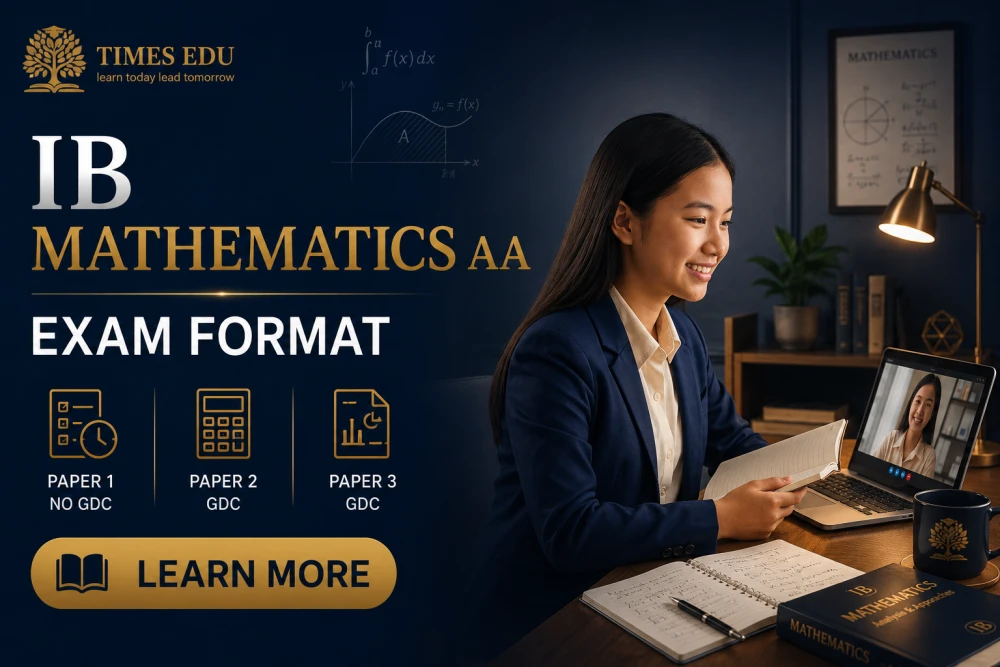
At Standard Level, candidates sit two exam papers for a combined total of three hours. At Higher Level, candidates sit three papers for a combined total of five hours. This difference is not merely about volume; the HL exam introduces a third paper that tests a completely different kind of mathematical thinking compared to Papers 1 and 2.
The table below gives a side-by-side overview of every assessed component for both levels.
| Component | Level | Calculator | Duration | Marks | Grade Weighting |
|---|---|---|---|---|---|
| Paper 1 | SL | No | 90 minutes | 80 | 40% |
| Paper 2 | SL | Yes (GDC) | 90 minutes | 80 | 40% |
| Internal Assessment | SL | N/A | N/A | N/A | 20% |
| Paper 1 | HL | No | 120 minutes | 110 | 30% |
| Paper 2 | HL | Yes (GDC) | 120 minutes | 110 | 30% |
| Paper 3 | HL | Yes (GDC) | 60 minutes | 55 | 20% |
| Internal Assessment | HL | N/A | N/A | N/A | 20% |
One detail worth noting immediately is that at HL, the weighting of Papers 1 and 2 drops from 40% each to 30% each, precisely because Paper 3 absorbs a 20% share. This means HL candidates cannot afford to underestimate Paper 3 simply because it is shorter.
>>> Read more: IB Mathematics AA books 2026: Complete guide for students and teachers
Paper 1: Non-calculator paper in IB Mathematics AA explained
Paper 1 is the non-calculator paper, and it applies to both SL and HL candidates, though with different time allocations and mark totals.
At SL, Paper 1 lasts 90 minutes and is worth 80 marks. At HL, it lasts 120 minutes and is worth 110 marks. In both cases, the paper is structured into two distinct sections that test different levels of mathematical fluency.
Section A consists of short-response questions. These are typically worth between 5 and 7 marks each and require concise, accurate responses. The mathematical content here spans the breadth of the syllabus, so candidates need to be comfortable moving quickly across topics.
Section B contains extended-response questions worth approximately 13 to 16 marks each. These require more sustained working, and they often involve multi-step reasoning within a single context. Partial credit is available throughout, which means showing clear, logical working is essential even when a final answer is incorrect.
A common mistake we see among students preparing for Paper 1 is that they underestimate the importance of algebraic fluency. Because no calculator is permitted, you must be able to manipulate expressions, differentiate and integrate by hand, work with exact values in trigonometry, and solve equations without technological assistance. Students who rely heavily on their graphing display calculator during practice sessions consistently struggle when Paper 1 conditions are applied.
Drawing on years of experience at Times Edu coaching IB Mathematics candidates, we find that the highest-performing students treat Paper 1 as a test of mathematical literacy, not just mathematical knowledge. The ability to set out working clearly, use correct notation, and communicate reasoning precisely is just as important as reaching the correct numerical answer.
>>> Read more: IB Maths AA : Syllabus, Exam Structure & Roadmap to an 7
Paper 2: Calculator paper in IB Mathematics AA explained
Paper 2 mirrors the structure of Paper 1 in terms of question format. It has the same Section A and Section B layout, the same mark totals (80 marks at SL, 110 marks at HL), and the same time allocations (90 minutes at SL, 120 minutes at HL). The critical difference is that a Graphing Display Calculator (GDC) is mandatory.
This does not mean Paper 2 is easier. It means the questions are designed with the assumption that students have access to technology, and the difficulty shifts accordingly. Examiners will set problems that require statistical analysis, graph interpretation, numerical methods, or solving equations that are impractical to handle purely algebraically.
One critical detail often overlooked is that GDC proficiency is its own skill set. Having a calculator does not automatically translate into correct answers. Students need to know how to enter functions correctly, read intersection points accurately, use statistical features efficiently, and cross-check results for plausibility. A wrong calculator input that produces a confidently written wrong answer earns no marks.
In our experience working with international students at Times Edu, Paper 2 is the paper where time management errors most commonly occur. Because the GDC can handle complex computations quickly, students sometimes spend too long exploring one question graphically and then rush the extended-response questions at the end. Practicing under timed exam conditions with a GDC from the beginning of your revision cycle is not optional; it is essential.
>>> Read more: IB Math AA HL Topic Priority List 2026: 10 Topics Worth 70% of Marks
Paper 3: HL only problem-solving paper in IB Mathematics AA explained
Paper 3 is unique to the Higher Level pathway and represents a fundamentally different style of mathematical assessment. It lasts 60 minutes, carries 55 marks, and a GDC is permitted throughout.
The paper contains exactly two questions. Each question is an extended, multi-step investigation worth approximately 25 to 30 marks. These questions introduce mathematical contexts that may be unfamiliar to candidates, and they guide you through a structured sequence of parts that build toward a broader mathematical conclusion, such as a proof, a derivation, or a general result.
The purpose of Paper 3 is to assess whether you can think mathematically in new situations, not merely recall and apply memorized techniques. You will be given context, and you will need to read it carefully, identify what is being asked, and reason through each step methodically.
A common mistake we see is that HL students arrive at Paper 3 expecting it to resemble Papers 1 and 2. It does not. The questions are longer, more narrative in structure, and explicitly designed to stretch beyond the boundaries of the standard syllabus content. The IB uses Paper 3 to reward mathematical curiosity, logical persistence, and the ability to construct arguments, not simply to compute answers.
Drawing on years of experience at Times Edu working with HL Mathematics students, the most effective preparation for Paper 3 involves regular exposure to unseen problem-solving tasks, past Paper 3 questions from the IB question bank, and practice in writing mathematical reasoning clearly and concisely. Students who only revise for Papers 1 and 2 typically find Paper 3 disorienting under exam conditions.
>>> Read more: IB Math AA SL Daily Routine: 30-Min Habit That Builds Score 7
How marks are distributed across IB Mathematics AA papers and the exploration
Understanding the grade weighting of each component helps you make strategic decisions about where to invest your revision time, particularly if you are managing multiple subjects simultaneously.
For SL candidates, the distribution is straightforward. Papers 1 and 2 each contribute 40% of the final grade, and the Mathematical Exploration (IA) contributes 20%. If you perform equally on both papers, your exam performance alone determines 80% of your outcome.
For HL candidates, the distribution is more nuanced. Papers 1 and 2 each contribute 30%, Paper 3 contributes 20%, and the IA contributes 20%. This means a strong IA and a strong Paper 3 performance together account for 40% of your grade, equal to the weight of either Paper 1 or Paper 2 alone.
The table below summarizes the grade weighting for clarity.
| Component | SL Weighting | HL Weighting |
|---|---|---|
| Paper 1 | 40% | 30% |
| Paper 2 | 40% | 30% |
| Paper 3 | N/A | 20% |
| Internal Assessment (IA) | 20% | 20% |
The Mathematical Exploration is assessed on a 20-point rubric that covers personal engagement, mathematical communication, use of mathematics, reflection, and presentation. One critical detail often overlooked is that the IA is marked by your teacher and then moderated by the IB, which means the quality of your school’s internal marking can influence your outcome. Understanding the rubric criteria early and getting feedback on drafts is a strategic advantage, not just good practice.
>>> Read more: IB Math AA HL Paper 3 Tips 2026: How to Tackle Unfamiliar Questions with More Confidence
How the IB Mathematics AA exam format should shape your revision strategy
Knowing the structure of the IB Mathematics AA exam format should directly inform the architecture of your revision plan, not just the topics you cover but the conditions under which you practice.
Here is a framework that our consultants at Times Edu consistently recommend to IB Mathematics AA candidates.
Build topic mastery before exam simulation. Before attempting full past papers, ensure you have covered each syllabus topic with sufficient depth. For AA, this includes calculus, functions, algebra, trigonometry, statistics and probability, and (for HL) complex numbers, further calculus, and graph theory adjacent content in Paper 3 contexts.
Separate your non-calculator and calculator practice. Do not allow yourself to reach for your GDC when working on Paper 1 style questions. Create strict practice conditions from the beginning of your revision. This builds the algebraic fluency that Paper 1 specifically demands and prevents dependency.
Practice Paper 3 separately and regularly at HL. Treat Paper 3 as its own subject within the subject. Use past Paper 3 questions and attempt them without looking at mark schemes first. Then review where your reasoning diverged from the expected approach. This metacognitive habit is what separates candidates who score 6 from those who score 7.
Time yourself from the start of your final revision phase. At SL, you have 90 minutes per paper. At HL, you have 120 minutes for Papers 1 and 2, and 60 minutes for Paper 3. Running out of time on extended-response questions is one of the most preventable causes of lost marks.
Use mark schemes analytically, not just to check answers. When you review a past paper, study the mark scheme to understand what specific steps were awarded marks and why. This teaches you IB marking logic, which is its own skill distinct from mathematical ability.
In our experience working with international students across multiple exam sessions, the candidates who consistently achieve level 6 or 7 in IB Mathematics AA are not necessarily the most naturally gifted mathematicians. They are the students who understand the assessment format deeply and prepare with precision.
>>> Read more: IB Math AA HL Revision for 2026: A High-Impact Study Plan for Papers 1, 2, and 3
Frequently asked questions
How many exam papers are there in IB Mathematics AA SL and HL?
How long is each IB Mathematics AA exam paper?
What is Paper 3 in IB Mathematics AA HL and how does it differ from Paper 1 and 2?
Is a GDC calculator allowed in all IB Mathematics AA papers?
How much is the exploration worth in the final IB Mathematics AA grade?
What is the difference between IB Mathematics AA SL and HL exam formats?
What types of questions appear in IB Mathematics AA Paper 1 and Paper 2?
Conclusion
At Times Edu, we have supported IB Mathematics candidates across SL and HL since 2018, helping students build not only content knowledge but the exam-specific skills that determine whether preparation translates into results. Understanding the format is the first step. Knowing how to prepare for each component with the right methods and the right support is what ultimately makes the difference.
If you are an IB Mathematics AA student or a parent planning your child’s academic roadmap, we invite you to speak with one of our senior consultants. A personalized session with our team can help identify exactly where your preparation needs to strengthen and how to build a structured plan toward your target grade.