IB Physics books 2026: Complete guide for students and teachers
A reliable IB Physics textbook gives students the conceptual depth, mathematical support, and exam practice needed to succeed at both SL and HL. This guide reviews the major IB Physics resources available, explains how each one supports syllabus learning, Internal Assessment development, and exam preparation, and highlights the most effective ways to build a complete study system without wasting time on outdated or poorly matched materials.
- Best IB Physics books
- Oxford and Hodder IB Physics textbooks reviewed and compared
- IB Physics study guides vs full textbooks: Which do you actually need?
- Top IB Physics books for SL and HL students covering the full new syllabus
- How to use an IB Physics book alongside past papers and Internal Assessment
- Where to buy IB Physics books at the best price online
- Free IB Physics resources vs investing in an authorised study book
- Frequently asked questions
Best IB Physics books

The IB Physics [1] syllabus was substantially restructured for first examination in 2025. Any student still relying on a pre-2023 edition is essentially studying the wrong course. One critical detail often overlooked is that the new syllabus organises all learning across five thematic strands rather than the old numbered topic system, which means the chapter structure of older books no longer maps to assessment objectives.
The three publishers that have responded to this restructure with authorised or closely aligned materials are Oxford University Press, Pearson Baccalaureate, and Hodder Education. Each takes a fundamentally different pedagogical approach, and selecting between them should be a deliberate strategic choice rather than a default to whichever title your school happens to stock.
A common mistake we see at Times Edu is students purchasing whichever IB Physics textbook appears first in a search result, without checking the publication date or confirming whether it covers the updated five-theme framework. That one oversight can cost a student an entire grade boundary.
>>> Read more: IB books 2026: The complete guide to study materials for the IB Diploma
Oxford and Hodder IB Physics textbooks reviewed and compared
Oxford IB Diploma Programme: Physics Course Companion
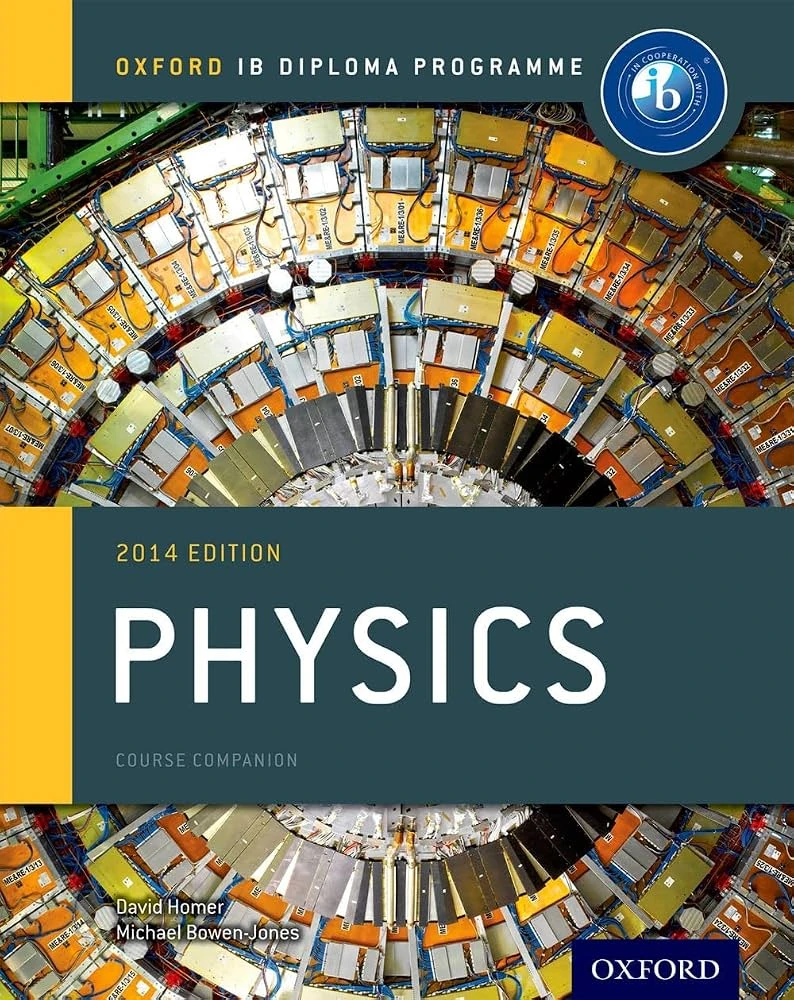
Written by David Homer and Michael Bowen-Jones, the Oxford IB Physics title is developed in direct cooperation with the International Baccalaureate Organisation. That relationship matters because the conceptual framing inside the book mirrors the exact language examiners use when writing mark schemes.
The Oxford course companion is exceptional for students who prioritise Theory of Knowledge connections, Nature of Science framing, and the IB Learner Profile attributes. It integrates these elements throughout rather than treating them as bolt-on extras. Purchases also unlock access to the Oxford digital platform, which provides interactive physics simulations and data-analysis tools that are genuinely useful for Internal Assessment preparation.
Where the Oxford book is slightly weaker is in step-by-step mathematical derivations. Students who need detailed algebraic walkthroughs for HL topics such as electromagnetic induction or special relativity may find the explanations move too quickly between conceptual grounding and final equations.
Pearson Baccalaureate: Physics for the IB Diploma (Hamper and Ord)

The Hamper IB Physics series, now co-authored with Keith Ord, has been a globally trusted resource for over a decade. Its greatest strength is mathematical rigour. Every complex kinematics sequence, wave mechanics derivation, and quantum calculation is broken down step by step in a way that supports students who are building technical problem-solving fluency from scratch.
The Internal Assessment chapters in this IB Physics SL HL textbook are among the most practically useful of any resource currently available. They walk students through experimental design, error analysis, and data presentation with structured templates and worked examples drawn directly from the sciences.
For HL extension Physics IB topics, particularly thermal physics, rigid body mechanics, and alternating currents, the Pearson Baccalaureate edition provides depth that genuinely prepares students for the most demanding exam questions at the top of the mark range.
Physics for the IB Diploma (Hodder Education, Allum and Talbot)

The Hodder IB Physics book is the choice most frequently recommended by experienced classroom teachers for one specific reason: layout clarity. The scannable, logically sequenced presentation makes it far easier to locate specific content during revision, and the dedicated Skills features teach graphical analysis, uncertainty quantification, and scientific data plotting as integrated competencies rather than afterthoughts.
John Allum and Christopher Talbot write with the kind of precision that rewards careful readers. Every definition is exact. Every diagram is purposeful. For students who learn well from linear reading rather than jumping between resources, this IB Diploma science book builds understanding in a systematic way that reduces cognitive load across a two-year course.
Side-by-side comparison
| Feature | Oxford (Homer & Bowen-Jones) | Pearson (Hamper & Ord) | Hodder (Allum & Talbot) |
|---|---|---|---|
| IBO cooperation | Yes, officially authorised | Closely aligned | Closely aligned |
| Mathematical depth | Moderate | High | Moderate to high |
| HL extension coverage | Good | Excellent | Good |
| Internal Assessment support | Good | Excellent | Good |
| TOK/NOS integration | Excellent | Moderate | Moderate |
| Digital resources | Yes (Oxford platform) | Limited | Limited |
| Layout and scannability | Standard | Standard | Excellent |
| Best suited for | Conceptual learners | Mathematical/technical learners | Linear systematic learners |
>>> Read more: IB Past Paper Mistake Library 2026: Turn Your Errors Into Your Biggest Mark Booster
IB Physics study guides vs full textbooks: Which do you actually need?
A full IB Physics textbook runs to 600 or more pages. An IB Physics revision guide typically covers 150 to 250 pages and is designed for consolidation rather than initial learning. Treating a revision guide as your primary resource is one of the most common and damaging mistakes students make across the two-year course.
The correct sequencing is: use a full textbook as your primary learning resource during Year 1 and the first half of Year 2, then layer in a revision guide during the final 10 to 12 weeks before exams. The Tsokos IB Physics study guide remains a popular choice for final-stage consolidation, offering compact summaries and practice question banks that work well alongside past paper drilling.
In our experience working with international students at Times Edu, those who score 6 or 7 in IB Physics almost universally have both: a textbook they know deeply and a revision guide they have annotated heavily in the final examination period.
>>> Read more: IB Physics HL Mixed Practice Sets 2026: The Smart Way to Master Exam-Style Questions
Top IB Physics books for SL and HL students covering the full new syllabus
The five thematic strands of the updated IB Physics syllabus each demand specific types of resource support. Understanding which books serve which themes most effectively allows students to build a targeted rather than generic study library.
Theme A: Space, time, and motion covers kinematics, forces, momentum, energy, and Galilean relativity at HL. The Pearson Hamper edition handles this mechanics waves fields IB Physics content with the clearest mathematical scaffolding.
Theme B: The particulate nature of matter includes thermal energy, greenhouse physics, gas laws, and thermodynamics at HL. Both Oxford and Hodder handle the conceptual content well. For HL thermodynamic cycles, the Pearson edition provides the most complete derivations.
Theme C: Wave behaviour encompasses simple harmonic motion, travelling waves, standing waves, the Doppler effect, diffraction, and interference at HL. The Oxford digital platform is particularly valuable here because wave behaviour is one area where animated simulations accelerate understanding more rapidly than static diagrams.
Theme D: Fields covers gravitational, electric, and magnetic fields, induction at HL, and alternating currents at HL. This is where HL extension Physics IB content becomes genuinely demanding. Pearson’s field diagrams and mathematical treatments are the most detailed of the three publishers.
Theme E: Nuclear and quantum physics includes radioactive decay, fission, fusion, quantum physics at HL, and special relativity at HL. One critical detail often overlooked is that special relativity, while conceptually approachable, carries a high density of calculation-based exam marks at HL. The Hamper IB Physics edition dedicates more worked examples to this strand than either Oxford or Hodder.
>>> Read more: IB Physics HL Explain Questions: PEE Method for Long Answer Marks
How to use an IB Physics book alongside past papers and Internal Assessment
Owning the best IB Physics textbook available is only half the equation. The other half is knowing how to integrate it with your examination preparation system. At Times Edu, we use a three-layer approach with every student enrolled in our IB Physics tutoring programme.
Layer 1: Concept acquisition from the textbook. Read the relevant chapter section. Summarise the key equations, definitions, and conceptual links in your own words. Do not move forward until you can reproduce the main ideas without looking at the page.
Layer 2: Past paper application. Immediately after studying a chapter section, locate 5 to 8 past paper questions that target exactly those concepts. Do not wait until the end of term to attempt past papers. Real examination questions reveal gaps that textbook exercises systematically conceal.
Layer 3: Internal Assessment integration. The IB Physics Internal Assessment requires students to design and execute an individual investigation scored against a specific set of criteria. Use the dedicated IA chapters in the Pearson Baccalaureate edition to understand what examiners are looking for in experimental design, data processing, and conclusion writing.
The Collaborative Sciences Project, a compulsory interdisciplinary science project introduced in the updated syllabus, also benefits from the structured planning frameworks found in the Pearson and Oxford editions. Students who map their project methodology against textbook guidance before submitting consistently produce stronger work than those who draft from scratch.
>>> Read more: IB TOK Exhibition Choose Prompt 2026: How to Pick a Prompt That Fits Your Ideas and Objects Well
Where to buy IB Physics books at the best price online
When students and parents search for where to buy IB Physics book options, the primary platforms are the publishers’ own websites, Amazon, Book Depository (where available), and regional academic booksellers. Prices for new editions typically range from USD 45 to USD 80 per title depending on format and region.
A few practical points worth noting:
- Always confirm the edition year before purchasing. The phrase “new syllabus” or “for first examination 2025” should appear on the cover or product description.
- eBook versions are available for Oxford and Pearson titles and are typically 20 to 30 percent cheaper than print. The Oxford digital platform access comes bundled with both print and digital purchases.
- Second-hand copies of books published before 2023 should be avoided entirely for the reasons discussed earlier in this guide. The structural mismatch with the current syllabus makes them more confusing than useful.
- School libraries sometimes hold class sets of the latest editions. Confirm with your IB Physics teacher before purchasing if your school has a subscription arrangement with Oxford or Pearson.
>>> Read more: How to Write a Perfect IB Extended Essay Research Question 2026
Free IB Physics resources vs investing in an authorised study book
The internet contains a significant volume of free IB Physics content: YouTube channels, revision websites, PDF notes, and community-shared resources. None of these replaces a structured IB Physics textbook, and treating free resources as equivalent is a false economy that consistently shows up in mid-range exam scores.
Free resources are best used to supplement specific areas of weakness. If you are struggling with a particular HL derivation or a specific Internal Assessment skill, a targeted YouTube explanation can accelerate understanding in 15 minutes. But free resources almost never provide the systematic curriculum coverage, the structured assessment practice, or the IA guidance that an authorised Physics book IB provides across the full two-year programme.
Drawing on years of experience at Times Edu, students who rely primarily on free resources tend to have patchy content knowledge, inconsistent examination technique, and significantly weaker Internal Assessment outcomes than students who anchor their study to a quality IB Diploma Physics book. The investment in one or two quality textbooks, combined with expert 1-on-1 tuition where needed, is one of the highest-return academic decisions a student can make.
>>> Read more: The Ultimate IB Diploma Program (IBDP) Guide 2026
Frequently asked questions
Which IB Physics textbook is officially authorised by the IBO?
Is the Oxford IB Physics coursebook enough to score a 7?
What is the best IB Physics revision guide for last-minute exam preparation?
Which IB Physics book covers HL extension topics and Option topics most clearly?
Do SL and HL IB Physics students need different textbooks?
Are older editions of IB Physics books valid for the new IB Physics syllabus?
Which IB Physics book is best suited for self-study IB Diploma students?