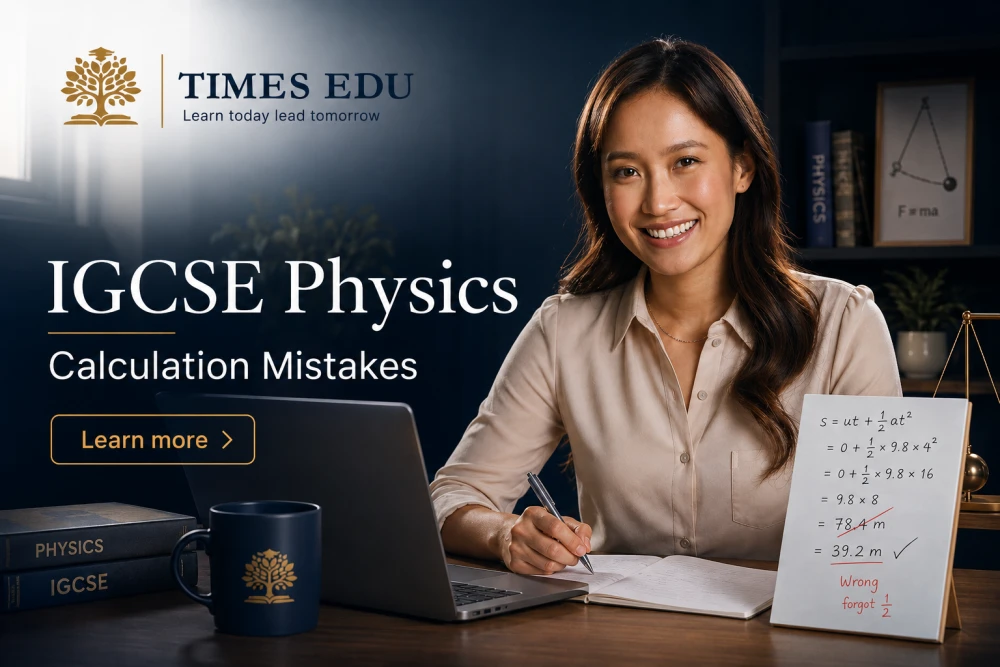
IGCSE Physics examiner tips 2026: What the people marking your paper want to see
IGCSE Physics examiner tips focus on one key principle: students earn marks by making their physics knowledge clear, precise, and easy for the examiner to credit. High-scoring answers show complete calculation working, use correct units and significant figures, respond accurately to command words, and build clear cause-and-effect explanations. Examiner reports also highlight recurring mistakes in mechanics, electricity, waves, thermal physics, and Paper 6 practical questions.
This guide brings together the most useful Cambridge IGCSE Physics 0625 examiner advice to help students avoid common errors and secure more marks consistently.
- How Cambridge examiners assess calculation and written answers in IGCSE Physics
- Examiner tips for mechanics and forces questions in IGCSE Physics
- Examiner tips for electricity and magnetism questions in IGCSE Physics
- What examiners say about waves and thermal physics answers in IGCSE Physics
- How to write answers that match exactly what IGCSE Physics examiners expect
- Examiner tips drawn from official Cambridge examiner reports for IGCSE 0625
- Frequently asked questions
How Cambridge examiners assess calculation and written answers in IGCSE Physics

Cambridge Physics [1] marking advice begins with a fundamental principle: Examiners are trained to award marks wherever they can, not to deduct them. That means every piece of correct physics you write down has a chance of earning credit, provided it is clear and appropriately structured.
The formula-first rule for calculations
Drawing on years of experience at Times Edu, the single most reliable technique for calculation questions is to write the relevant formula on the first line before substituting any numbers. This secures method marks in the mark scheme, even when a student makes an arithmetic slip in the final answer.
For example, if a question asks for the pressure exerted by a block:
- Write: P = F / A
- Substitute: P = 120 / 0.04
- Solve: P = 3000 Pa
If step 3 contains an arithmetic error, the examiner can still award the method mark for step 1 and the substitution mark for step 2. Skipping directly to the answer eliminates that safety net entirely.
Written explanation answers
A common mistake we see across all levels is treating “explain” questions as if they are “state” questions. Cambridge examiners assess explanation answers by looking for a chain of reasoning: A cause, a physical mechanism, and a consequence. A one-line answer to a 3-mark explain question will almost never achieve full marks regardless of its accuracy.
The examiner expectation for IGCSE Physics explanation answers is a linked sequence of statements, not a list of isolated facts.
>>> Read more: IGCSE Physics exam technique 2026: The complete guide to scoring higher in 0625
Examiner tips for mechanics and forces questions in IGCSE Physics
Mechanics is the highest-weighted topic in many IGCSE Physics papers, and it is also the section where Cambridge 0625 examiner reports most frequently highlight preventable errors.
Vectors versus scalars: A persistent source of lost marks
One critical detail often overlooked is the distinction between vector and scalar quantities. The mark scheme for Physics Cambridge will often specifically require students to state that velocity, acceleration, momentum, and weight each have both magnitude and direction, whereas speed and mass do not.
| Quantity | Type | Why it matters on the mark scheme |
|---|---|---|
| Velocity | Vector | Must include direction to be fully correct |
| Speed | Scalar | Magnitude only; direction is irrelevant |
| Acceleration | Vector | Sign or direction required in many contexts |
| Weight | Vector | Acts downward; direction is part of the definition |
| Momentum | Vector | Direction of motion must match sign convention |
| Mass | Scalar | No direction component |
Students who write “velocity is the speed of an object” without referencing direction consistently lose marks that are straightforward to secure.
Force diagrams and free-body diagrams
Examiners frequently note in the Cambridge 0625 examiner reports that students draw force arrows of incorrect relative length or omit labels entirely. Every arrow must be labelled with both the name of the force and, where applicable, its magnitude. A diagram with unlabelled arrows receives no credit even if the forces themselves are correctly identified.
>>> Read more: IGCSE Physics 0625 books 2026: Complete guide for students and teachers
Examiner tips for electricity and magnetism questions in IGCSE Physics
In our experience working with international students, electricity questions produce the widest range of marks within a single cohort. Students who understand circuits intuitively often lose marks because they describe rather than explain.
Circuit calculations: Show the logical chain
When calculating resistance in a parallel circuit, do not jump straight to the final answer. Write out the reciprocal formula, evaluate each fraction, add them, and then take the reciprocal again. Each of those steps is a potential mark in the Cambridge mark scheme Physics.
A common mistake we see in electricity answers is using the word “current” when the question asks about “charge.” These are related but distinct quantities, and examiners will not accept one in place of the other.
Magnetism and electromagnetic induction
Examiner feedback 0625 consistently highlights that students confuse the direction of a magnetic field with the direction of a force on a conductor. Use Fleming’s Left-Hand Rule for motor effect and Fleming’s Right-Hand Rule for generator effect, and state explicitly which rule you are applying. Examiners credit the identification of the rule as part of a complete response.
| Error type | What examiners see | What they want instead |
|---|---|---|
| Using “current” instead of “charge” | “More current flows” | “More charge flows per unit time” |
| Vague field description | “The magnetic field goes around the wire” | “Magnetic field lines form concentric circles around the wire, direction found by right-hand grip rule” |
| Missing units on EMF | “EMF = 12” | “EMF = 12 V” |
>>> Read more: IGCSE Physics Units and Significant Figures 2026: How to Avoid Easy Marks Lost in Exams
What examiners say about waves and thermal physics answers in IGCSE Physics
Thermal physics: The language of conduction and convection
Drawing on years of experience at Times Edu, we have noticed that thermal physics is where students most often lose marks for incomplete scientific language rather than conceptual misunderstanding.
For conduction in metals, the examiner expectation for IGCSE Physics is explicit: You must state that free electrons gain kinetic energy and transfer that energy to neighbouring atoms or electrons as they move through the material. Writing “heat passes through the metal” is scientifically vague and will not secure the mark.
For convection, the sequence must include:
- The fluid near the heat source warms and expands.
- Expansion causes a decrease in density.
- The less dense fluid rises and is replaced by cooler, denser fluid.
- This creates a convection current.
Omitting the density change is the single most commonly penalised gap in convection answers, according to Cambridge Physics marking advice in past examiner reports.
Radiation rules that examiners test repeatedly
The Cambridge 0625 examiner advice on radiation is consistent across multiple years of reports. Dull, matt black surfaces are the best emitters and absorbers of infrared radiation. Shiny, white, or polished surfaces are the poorest emitters and absorbers.
Students who write the reverse, or who cannot explain why surface type matters, lose marks that require no additional content knowledge to secure. This is purely a memorisation and recall task.
Waves: The difference between transverse and longitudinal
What examiners want in Physics IGCSE wave questions is precision. For transverse waves, state that particles oscillate perpendicular to the direction of energy transfer. For longitudinal waves, state that particles oscillate parallel to the direction of energy transfer. The words “perpendicular” and “parallel” are often required verbatim by the mark scheme.
>>> Read more: IGCSE Physics Command Words 2026: How to Understand Questions and Answer More Accurately
How to write answers that match exactly what IGCSE Physics examiners expect
Match the number of marks to the number of points
One of the clearest pieces of Cambridge Physics marking advice is this: The number of marks a question is worth tells you the minimum number of distinct points your answer needs to contain. A 3-mark question requires three separate, credit-worthy statements.
A common mistake we see is students who write one detailed sentence and assume it covers multiple marks. Examiners are trained to identify and credit individual marking points, not overall impressions of an answer.
Command word precision
| Command word | What the examiner expects |
|---|---|
| State | A brief, direct factual answer; no explanation needed |
| Explain | A logical cause-and-effect chain |
| Describe | An account of what happens, without requiring a reason |
| Calculate | Full working, formula, substitution, and unit with the answer |
| Sketch | A clearly labelled diagram; accuracy of shape matters |
| Suggest | An application of physics knowledge to an unfamiliar context |
Treating “explain” as “describe” is one of the most consistent sources of mark loss flagged in examiner report 0625 tips across multiple examination series.
Units and significant figures
Examiner feedback 0625 is unambiguous on units: A correct numerical answer without the correct SI unit will not receive full marks. This applies to intermediate steps in multi-part calculations as well as final answers.
On significant figures, the Cambridge guidance states that answers should match the precision of the data given in the question. If the question gives values to 2 significant figures, an answer given to 4 significant figures risks a significant figures penalty. In our experience working with international students, this single rule costs more marks per year than almost any other technical error.
>>> Read more: IGCSE Physics Study Plan for 2026: A Simple Revision Guide for Better Exam Preparation
Examiner tips drawn from official Cambridge examiner reports for IGCSE 0625
Paper 6 (alternative to practical): The most underestimated paper
The alternative to practical paper is often treated as a secondary concern by students focusing on Papers 2 and 4. Examiner report 0625 tips consistently show this is a strategic error. Paper 6 is highly structured and rewards students who know its conventions.
Gradient calculations: Draw a triangle that spans at least half the length of the plotted line. A small triangle introduces larger percentage errors and may not earn the accuracy mark. Label the coordinates of the two points used clearly on your graph.
Experimental limitations: Never write “human error” as an answer. The Cambridge mark scheme Physics does not credit this phrase because it is not specific. Instead, identify the precise source of uncertainty:
- Parallax error when reading a scale at an angle
- Zero error on an ammeter or voltmeter
- Heat loss to surroundings during thermal experiments
- Reaction time affecting timing measurements
Reducing errors: When asked how to improve an experiment, a reliable answer that examiners credit is to take repeated readings and calculate a mean. This demonstrates understanding of random error reduction and is a standard marking point in the mark scheme Physics Cambridge.
What Cambridge examiner reports reveal about student performance
The examiner reports for IGCSE 0625, published by Cambridge after each examination series, are one of the most underused resources available to students. They contain direct commentary on which questions were answered poorly and why.
One critical detail often overlooked by students and even some tutors is that examiner reports explicitly state the language and level of detail that was and was not credited. Reading three or four consecutive years of these reports builds a clear picture of recurring examiner expectations for IGCSE Physics that no textbook alone can provide.
At Times Edu, our tutors incorporate these reports directly into lesson planning, using them to identify the specific phrasing and reasoning structures that Cambridge examiners respond to.
>>> Read more: Ultimate IGCSE Physics 0625 Revision Guide
Frequently asked questions
What do IGCSE Physics examiners say are the most common student mistakes?
How do Cambridge Physics examiners award marks for calculation working?
What level of detail do IGCSE Physics examiners expect in explain answers?
What do examiners say about units and significant figures in IGCSE Physics?
How do IGCSE Physics examiners handle answers with correct method but wrong arithmetic?
Where can I find official Cambridge examiner tips for IGCSE Physics?
What are the most praised and most criticised student responses in IGCSE 0625?
Conclusion
At Times Edu, our 1-on-1 tutors have guided students through this exact process since 2018, working directly from Cambridge examiner reports, past paper mark schemes, and structured feedback cycles. If you want a personalised academic roadmap that applies these examiner insights to your specific weaknesses and target grade, reach out to the Times Edu team for a consultation. The difference between the marks you are getting and the marks you are capable of earning is, in most cases, a matter of technique, and technique is entirely teachable.
Resources: