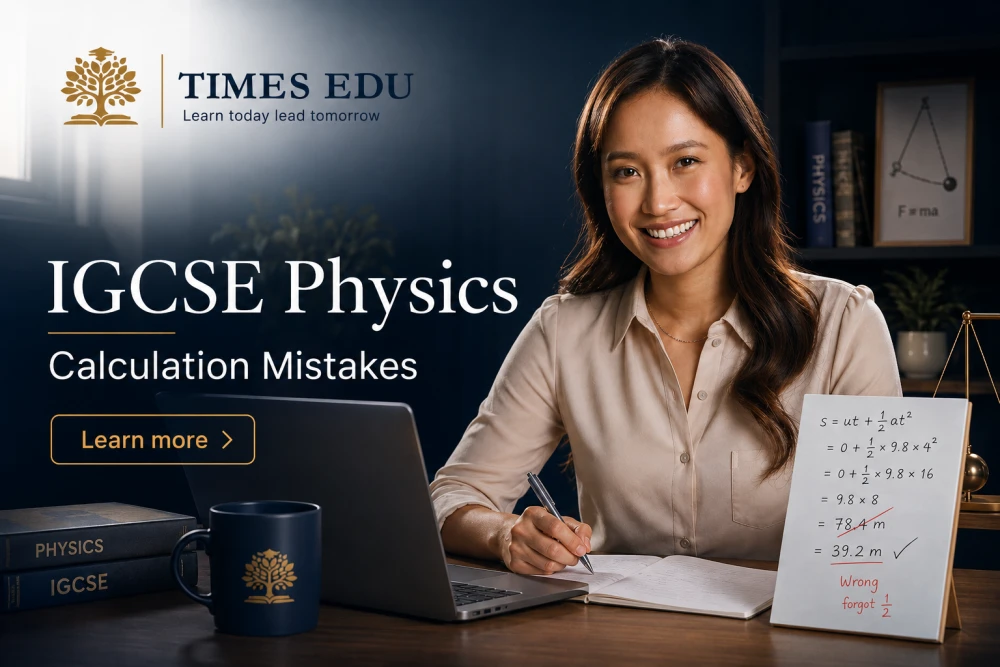
IGCSE Physics mark scheme 2026: How to read and use it effectively
The IGCSE Physics mark scheme is the official Cambridge guide that shows how marks are awarded for each question, including accepted answers, calculation methods, alternative wording, and numerical tolerances. It helps students understand that marks are often awarded for individual stages of working, not just the final answer, so clear calculations and precise scientific language are essential. Used alongside past papers, the mark scheme can reveal exactly where marks are being lost and which answer structures Cambridge expects.
This guide explains how the Cambridge IGCSE Physics 0625 mark scheme works and how students can use it to improve their exam performance.
- What is an IGCSE Physics mark scheme and how does it work?
- Understanding M marks, A marks and B marks in IGCSE Physics
- How the own figure rule works in IGCSE Physics mark schemes
- How mark schemes handle alternative methods in IGCSE Physics calculations
- How to self-mark IGCSE Physics past papers using the mark scheme accurately
- How studying mark schemes raises your score in IGCSE Physics
- How IGCSE Physics mark schemes differ between Core and Extended papers
- Where to download official IGCSE Physics mark schemes
- Frequently asked questions
What is an IGCSE Physics mark scheme and how does it work?

The Cambridge IGCSE Physics mark scheme (syllabus code 0625) [1] is an official document published by Cambridge Assessment International Education after each examination session. It provides the full set of accepted answers, acceptable alternative phrasings, and numerical tolerances for every question on the paper.
Critically, the mark scheme does not simply list correct answers. It tells examiners how much credit to give at each stage of a response, which means a student who writes a wrong final answer can still receive partial marks, while a student who writes the correct final answer without showing method can receive zero. This is the first major conceptual shift students must make when approaching the Cambridge marking Physics system.
The mark scheme is released for all three papers in the 0625 series: Paper 2 (Core multiple choice), Paper 3 (Core theory), Paper 4 (Extended theory), Paper 5 (Core practical), and Paper 6 (Extended practical/alternative to practical). Each paper has its own document, and the Core Extended mark scheme Physics distinction matters significantly, which is discussed in a dedicated section below.
>>> Read more: IGCSE Physics exam technique 2026: The complete guide to scoring higher in 0625
Understanding M marks, A marks and B marks in IGCSE Physics
The single most important thing any student can learn about the Cambridge 0625 mark scheme is the four-mark-type system. A common mistake we see at Times Edu is students treating every mark as equivalent — in reality, each mark type operates under different rules.
M marks (method marks)
An M mark is awarded when a student demonstrates the correct method or formula for a calculation. Think of it as credit for knowing how to approach the problem, regardless of whether the arithmetic is right. If you fail to earn an M mark, any marks that depend on it (called dependent marks) are automatically lost, even if your subsequent working is correct.
A marks (accuracy marks)
An A mark rewards the correct final numerical answer. The critical rule is that A marks are almost always dependent on the corresponding M mark. Write the right number without showing the method, and the A mark is withheld. This is why the calculation mark scheme IGCSE structure punishes students who skip steps.
B marks (independent marks)
B marks are standalone. They are awarded for factual statements, correct definitions, correct labels on diagrams, or specific observations in practical questions. A B mark does not depend on any other part of the answer, which means you can earn it even if you got every other part of the question wrong.
C marks (compensatory marks)
C marks reward correct intermediate steps in multi-step calculations. Even if the final answer is wrong, a correct intermediate formula or substitution can still earn a C mark. This is why writing every step of a calculation, even one you are unsure about, is always the right strategy.
| Mark type | What it rewards | Dependent on other marks? | Key student action |
|---|---|---|---|
| M mark | Correct method or formula | No (but A marks depend on it) | Always write the formula before substituting |
| A mark | Correct final answer | Yes, depends on M mark | Show full working to protect this mark |
| B mark | Standalone fact, definition, label | No | Memorize definitions word-for-word |
| C mark | Correct intermediate step | No | Write every sub-step, even in complex problems |
One critical detail often overlooked is that many 3-mark calculation questions award 1 C mark purely for writing the raw equation (such as P = VI or F = ma). Students who jump straight to numbers and make a substitution error receive zero out of three, not two out of three.
>>> Read more: IGCSE Physics 0625 books 2026: Complete guide for students and teachers
How the own figure rule works in IGCSE Physics mark schemes
The own figure rule (often abbreviated as e.c.f., or error carried forward) is one of the most student-friendly features of the Cambridge marking Physics system, yet it is also one of the most misunderstood.
Here is the core principle: If you make a calculation error in part (a) of a question, but you then use your wrong answer from part (a) correctly in part (b), Cambridge examiners will still award full marks for part (b). The own figure rule 0625 allows your incorrect intermediate result to be treated as “your figure” for the purpose of the next part.
In our experience working with international students at Times Edu, this rule changes revision strategy significantly. Students often abandon a calculation question the moment they suspect their part (a) is wrong. The correct approach is to continue working through every subsequent part using your own figures, labeling the working clearly, because Cambridge examiners are specifically trained to identify and reward correct method applied to an incorrect earlier result.
There are limits to the own figure rule. If your carried-forward error produces a physically impossible answer (for example, a speed exceeding the speed of light in a context that makes no sense), examiners may not apply e.c.f. Always check whether your carried figure is physically reasonable.
>>> Read more: IGCSE Physics Units and Significant Figures 2026: How to Avoid Easy Marks Lost in Exams
How mark schemes handle alternative methods in IGCSE Physics calculations
A persistent worry among students is whether Cambridge will accept a solution method that differs from the one shown in the mark scheme. The answer is yes, with important conditions.
The alternative methods Physics mark scheme policy means that any mathematically sound method that leads to the correct answer can receive full marks. Cambridge examiners are explicitly instructed to award marks for valid alternative approaches. For example, a student who calculates wave speed using v = fλ in a different algebraic sequence from the mark scheme will still receive credit, provided the physics and arithmetic are correct.
However, the mark scheme uses several codes to signal how much flexibility is permitted:
| Code | Meaning | Implication for students |
|---|---|---|
| oe | Or equivalent | Alternative wording accepted if the physics concept is identical |
| owtte | Or words to that effect | Flexible phrasing accepted for descriptive answers |
| c.a.o. | Correct answer only | No alternative, no rounding variance, no e.c.f. Permitted |
| Underlined word | Exact word required | Synonyms will not be accepted by the examiner |
| / (slash) | Either word accepted | Both options are equally valid |
| ( ) (brackets) | Not required for the mark | Context only; examiner ignores bracketed content |
One area where alternative methods are not freely accepted is word-based definitions. If the mark scheme underlines a specific term (such as resultant or equilibrium), examiners are instructed not to accept synonyms. This catches many high-ability students who paraphrase confidently but use subtly incorrect vocabulary.
>>> Read more: IGCSE Physics Command Words 2026: How to Understand Questions and Answer More Accurately
How to self-mark IGCSE Physics past papers using the mark scheme accurately
Self-marking is a skill that takes deliberate practice. A common mistake we see is students using the mark scheme to rationalize their answers rather than objectively assess them.
Step 1: Attempt the paper under timed, exam conditions. Do not consult the mark scheme during the attempt. Set the correct time limit and remove all notes.
Step 2: Mark calculations step by step, not by final answer. For each calculation, check whether you wrote the formula (C/M mark), substituted correctly (M mark), and arrived at the right answer with correct units (A mark). Award marks only for steps that match the mark scheme criteria, not for steps you feel implied the correct understanding.
Step 3: For descriptive answers, apply the semicolon rule. Each semicolon in the mark scheme represents one separate marking point. Count the semicolons, count your distinct points, and award only the marks where your point matches a specific credited response or its “oe” equivalent.
Step 4: Be strict with underlined words. If the mark scheme underlines a word and your answer uses a synonym, you do not award the mark. This is where honest self-assessment separates students who genuinely improve from those who stagnate.
Step 5: Record errors by mark type, not by topic. Tracking whether you consistently lose A marks (arithmetic errors), M marks (wrong formulas), or B marks (definition gaps) tells you exactly what to fix in revision, rather than vaguely knowing you “struggle with electricity.”
Step 6: Review the question immediately after marking each answer. Do not finish all questions and then review. Mark one question, analyze the gap, make a note, and move on. This reinforces the learning while the reasoning is fresh.
>>> Read more: IGCSE Physics Study Plan for 2026: A Simple Revision Guide for Better Exam Preparation
How studying mark schemes raises your score in IGCSE Physics
Consistent mark scheme study is the fastest legitimate way to improve your IGCSE Physics grade, particularly for students targeting the A or A* boundary. In our experience working with international students across multiple cohorts, students who analyze five to eight past mark schemes systematically outperform those who simply attempt more papers without structured review.
The reason is pattern recognition. Cambridge Physics papers recycle question structures, command word sequences, and expected answer formats across sessions. A student who has studied the mark scheme for ten past papers will recognize when a question demands a specific three-point descriptive structure, or when a calculation always requires a particular unit conversion step before substitution.
Drawing on years of experience at Times Edu, we consistently observe that the highest-scoring students treat the mark scheme as their primary revision text, not the textbook. They read accepted answers the way a lawyer reads precedent — looking for the logic behind each credit point, not just the surface content.
One area that repays close attention is the distinction between describe and explain command words. The mark scheme for a describe question typically awards B marks for observable facts with no requirement for causation. An explain question almost always requires a because-clause to earn the A mark. Students who miss this distinction lose marks systematically across every topic.
>>> Read more: Ultimate IGCSE Physics 0625 Revision Guide
How IGCSE Physics mark schemes differ between Core and Extended papers
The Core Extended mark scheme Physics distinction is not simply a matter of difficulty level — it reflects fundamentally different assessment demands.
Core papers (Papers 2 and 3) are designed for students targeting grades C to G. The mark scheme for Core papers tends to use shorter accepted responses, simpler formula applications, and fewer multi-step calculations. B marks dominate in descriptive sections, and the range of accepted “oe” responses is often wider.
Extended papers (Papers 4 and 6) target grades A* to C. The mark scheme for Extended papers introduces more M/A mark chains in calculations, stricter unit requirements, and more instances of the c.a.o. Rule. Descriptive answers on Extended papers often require more precise technical language, and underlined keywords appear more frequently.
Students preparing for Extended papers need to be especially careful about significant figures. The Cambridge 0625 mark scheme for Extended calculations generally expects answers to two or three significant figures. Giving an answer to one significant figure (for example, writing 4 instead of 3.8) costs the A mark, even if the method is perfectly correct.
| Feature | Core mark scheme | Extended mark scheme |
|---|---|---|
| Dominant mark type | B marks (definitions, facts) | M/A mark chains (calculations) |
| Significant figures | Generally 2 SF acceptable | 2–3 SF strictly expected |
| c.a.o. Frequency | Rare | More common |
| Own figure rule | Applied broadly | Applied with physical plausibility check |
| Descriptive precision | Wider “oe” tolerance | Underlined keywords more frequent |
>>> Read more: IGCSE Tutor 2026: How to Choose the Right One
Where to download official IGCSE Physics mark schemes
Official Cambridge IGCSE Physics mark schemes are available through the Cambridge School Support Hub (also called the Cambridge Support Hub), which is accessible to registered Cambridge schools. Students at registered institutions can request access through their Physics teacher or examination coordinator.
For students without institutional access, Cambridge also makes a selection of past papers and mark schemes available free of charge on the official Cambridge IGCSE subject page at cambridgeinternational.org. Searching for “Cambridge 0625 mark scheme” alongside the specific session year will locate the correct documents.
Third-party revision platforms such as PapaCambridge and Physics & Maths Tutor also host archived mark schemes for older sessions. These are widely used by independent learners and are generally accurate, though students should always cross-reference against official Cambridge documents where possible.
Frequently asked questions
Where can I download official IGCSE Physics mark schemes for free?
The most reliable free source is the Cambridge Assessment International Education website. A selection of past papers with mark schemes is available directly from the Cambridge IGCSE Physics (0625) subject page. For full archive access including recent sessions, the Cambridge School Support Hub requires a school login provided by your institution.
What do M, A and B marks mean in the IGCSE Physics mark scheme?
M marks reward correct method or formula use. A marks reward a correct final answer and depend on the corresponding M mark being earned. B marks are independent and reward factual statements, definitions, or correct diagram labels regardless of other errors in the response. C marks, a fourth type, reward correct intermediate steps in multi-step calculations.
Does the IGCSE Physics mark scheme accept alternative correct methods?
Yes. The alternative methods Physics mark scheme policy explicitly instructs examiners to award marks for any valid method that produces the correct answer using sound physics. The mark scheme uses the code “oe” (or equivalent) or “owtte” to signal where flexible responses are accepted.
How does the own figure rule apply in IGCSE Physics mark schemes?
The own figure rule (e.c.f.) Allows a student to earn full marks in a later part of a question even if they carry forward an incorrect earlier answer, provided they apply the correct method to their own figure. The rule does not apply if the carried figure produces a physically impossible result.
How strictly should students interpret the IGCSE Physics mark scheme when self-marking?
Very strictly. Lenient self-marking is one of the most damaging revision habits because it masks real gaps. Apply the underlined word rule literally, award A marks only when the corresponding M mark was also earned, and do not award partial credit for answers that partially match an accepted response.
Should students study mark schemes before or after attempting past papers in Physics?
After. Attempting the paper first under exam conditions preserves its diagnostic value. Reading the mark scheme before the attempt teaches you the answers to a specific set of questions, not the underlying skills Cambridge is testing. The analysis of the mark scheme after the attempt is where the real learning occurs.
How do IGCSE Physics mark schemes differ between Core and Extended papers?
Core mark schemes favor B marks with wider acceptable-response tolerances. Extended mark schemes contain more M/A mark chains, stricter significant figure requirements, more frequent use of c.a.o., and more underlined keywords that require exact phrasing. Students preparing for Extended papers need significantly more precision in both calculations and descriptive writing.
Resources: