AP books 2026: The complete guide to choosing the best AP exam prep materials
Choosing the right AP books can be the difference between a score of 3 and a score of 5. With dozens of titles competing for shelf space, and publishers updating editions every one to two years, the decision is far from straightforward.
Drawing on years of experience at Times Edu supporting international students preparing for Advanced Placement exams, this guide cuts through the noise. It maps the strongest prep materials by subject, compares the three dominant publishers, and shows you exactly how to combine commercial AP prep books with free College Board resources for maximum impact.
Whether you are a self-studier working through AP Calculus on your own or a student taking five AP courses simultaneously and hunting for the best AP review book for each, this article gives you a strategic framework, not just a product list.
- Best AP prep books by subject: The definitive ranking
- Barron’s vs Princeton Review vs Kaplan AP books: which is best?
- How to use AP books alongside official College Board practice tests
- AP study guides vs full-length practice test books: what you need
- Where to buy AP prep books at the best price online
- Free AP resources vs investing in dedicated AP prep books
- Frequently asked questions
Best AP prep books by subject: The definitive ranking
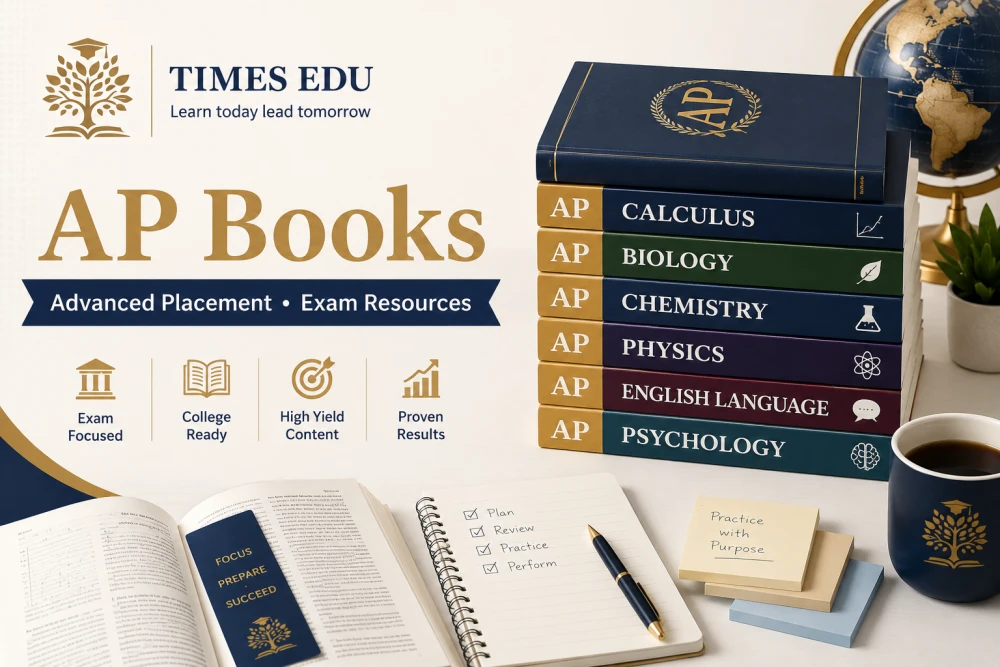
No single AP study guide dominates every subject equally. Publishers have clear strengths and weaknesses across disciplines, and knowing those patterns saves you money and study time.
The table below summarises the strongest AP books by subject, based on content accuracy, question quality, and alignment with current College Board exam formats.
| AP Subject | Top Pick | Runner-Up | Key Reason |
|---|---|---|---|
| AP Calculus AB/BC | Princeton Review AP | Barron’s AP | Princeton’s strategy breakdowns suit international learners |
| AP Chemistry | Barron’s AP | Kaplan AP | Barron’s AP Chemistry prep covers lab reasoning in depth |
| AP US History | Princeton Review AP | Kaplan AP | Narrative-driven explanations suit non-US students |
| AP English Language | Princeton Review AP | Barron’s AP | Strong rhetorical analysis frameworks |
| AP Biology | Barron’s AP | Princeton Review AP | Comprehensive content coverage with detailed diagrams |
| AP Physics 1 | Kaplan AP | Princeton Review AP | Kaplan’s Physics explanations are unusually clear |
| AP Statistics | Barron’s AP | Princeton Review AP | Barron’s AP Statistics is considered the gold standard |
| AP Psychology | Princeton Review AP | Kaplan AP | Concise, well-organised for high-volume memorisation |
| AP World History | Kaplan AP | Princeton Review AP | Efficient thematic framing helps non-US curriculum students |
One critical detail often overlooked is that subject rankings shift when a new exam format is introduced. Always verify that the edition you purchase reflects the current College Board [1] exam framework, not a version from two or three years ago.
>>> Read more: AP 4 Week Study Plan 2026: How to Structure Your Revision for Maximum Score Improvement
Barron’s vs Princeton Review vs Kaplan AP books: which is best?
This is the most common question students and parents ask at the start of AP prep season. The honest answer is that no single publisher wins across every category. Each has a distinct pedagogical philosophy, and the right choice depends on your learning style and your target score.
Barron’s AP
Barron’s AP books are widely regarded as the most content-heavy option on the market. They go deep into subject matter, often covering material that exceeds what appears on the actual exam.
This depth is a double-edged sword. For students who want to build true subject mastery, particularly in AP Chemistry prep and AP Biology, Barron’s is exceptional. For students who are time-poor or who struggle with dense academic reading, the sheer volume of Barron’s content can become counterproductive.
Barron’s strengths:
- Comprehensive content coverage, often the most thorough available
- Strong for science and mathematics subjects
- Practice questions tend to be harder than real exam questions, which builds resilience
Barron’s weaknesses:
- Writing style can feel dense and textbook-like
- Less exam-strategy coaching compared to competitors
- Some editions lag behind College Board format updates
Princeton Review AP
Princeton Review AP books strike a balance between content instruction and test-taking strategy. They are particularly well-suited for international students who may have strong subject knowledge but less familiarity with how College Board structures its questions.
In our experience working with international students at Times Edu, Princeton Review consistently produces the clearest explanations for AP US History and AP English prep, two subjects where understanding the style of the exam is just as important as knowing the content.
Princeton Review strengths:
- Strong exam strategy coaching embedded throughout
- Clear, accessible writing that suits non-native English speakers
- Good full-length practice tests that mirror real exam conditions
Princeton Review weaknesses:
- Content coverage is sometimes shallower than Barron’s
- Less suitable for students who need extreme depth in sciences
Kaplan AP
Kaplan AP occupies a middle ground. Its books are professionally produced, consistently updated, and particularly strong in subjects like AP Physics and AP World History, where clear thematic organisation matters.
A common mistake we see is students dismissing Kaplan as a third-choice publisher simply because it has less brand recognition than Barron’s or Princeton Review. In specific subjects, Kaplan’s AP self-study resources are genuinely superior.
Kaplan strengths:
- Well-structured and easy to navigate
- Strong for AP Physics and AP World History
- Reliable question quality that aligns closely with real exam difficulty
Kaplan weaknesses:
- Content explanations can feel formulaic
- Fewer full-length practice tests than competitors
Head-to-head comparison
| Criterion | Barron’s | Princeton Review | Kaplan |
|---|---|---|---|
| Content depth | Excellent | Good | Good |
| Exam strategy coaching | Moderate | Excellent | Good |
| Accessibility for international students | Moderate | Excellent | Good |
| Practice test quality | High (harder than real exam) | High (near real exam difficulty) | Moderate |
| Best for score 5 target | Sciences and maths | Humanities and languages | Physics and World History |
| Typical price range (USD) | $18-$25 | $20-$28 | $18-$25 |
>>> Read more: AP Calculus AB & BC 2026 Study Plan: A Practical Way to Review and Improve Your Score
How to use AP books alongside official College Board practice tests
This is where most students get their strategy wrong. They treat their AP prep book as the primary resource and College Board official practice as a secondary afterthought. The logic should run in exactly the opposite direction.
College Board official practice is the gold standard. It represents the actual exam, written by the people who write the exam. Every free released exam, every sample question, every scoring guideline published on the College Board website is the most accurate reflection of what you will face on test day.
The correct approach is to use AP books as your instruction layer and official College Board practice as your performance measurement layer.
A structured integration approach:
- Begin with your AP review book to build content knowledge and understand the exam format.
- Complete chapter-level practice questions in your AP prep book to consolidate each topic.
- Take a timed full-length official College Board practice test every three to four weeks.
- Analyse your score report and identify weak areas by question type and content unit.
- Return to your AP book and focus specifically on the chapters that address those weak areas.
- Repeat the cycle until you have worked through all available official practice materials.
One critical detail often overlooked is that College Board does not release a new full-length official exam every year for every subject. For subjects with limited official materials available, a strong AP practice tests book from Princeton Review or Barron’s becomes significantly more valuable because it extends your available timed practice volume.
>>> Read more: AP Calculus AB Exam Guide 2026: Topics, Format, and Smart Practice Tips
AP study guides vs full-length practice test books: what you need
Not every AP book is structured the same way. There is an important distinction between AP study guides, which prioritise content instruction and concept explanation, and AP practice test books, which prioritise timed full-length exam simulation.
Understanding which type you need at which stage of your preparation prevents wasted study hours.
When to prioritise an AP study guide:
- You are beginning AP prep more than four months before the exam
- You have significant content gaps in the subject
- You are self-studying a subject without a teacher or classroom
- You are preparing for a subject outside your core curriculum strength
When to prioritise an AP practice tests book:
- You are within eight weeks of the exam
- Your content knowledge is solid but your timed performance is inconsistent
- You have already exhausted available official College Board practice materials
- You are targeting a score of 5 and need high-volume practice at exam difficulty
Drawing on years of experience at Times Edu, we typically advise students to purchase one strong AP study guide and supplement it with official College Board materials. A dedicated AP practice tests book becomes a worthwhile investment only after official materials are fully used.
For subjects like AP Calculus, where procedural fluency requires high repetition volume, buying a separate AP Calculus book focused on practice problems is a justifiable addition to your stack, not an extravagance.
>>> Read more: The Ultimate 12-Week AP Study Plan 2026: How to Score a 5
Where to buy AP prep books at the best price online
When it comes to where to buy AP books, students and parents have several reliable options that balance cost, delivery speed, and edition reliability.
New AP books: recommended platforms
| Platform | Notes |
|---|---|
| Amazon (amazon.com or amazon.co.uk) | Widest selection, competitive pricing, fast delivery |
| Book Depository | Often cheaper for international shipping; now operates under Amazon |
| Publisher websites (barronseducation.com, princetonreview.com) | Occasionally offer bundle discounts |
| Kinokuniya (Asia) | Strong selection in Singapore, Malaysia, Thailand |
| Times Bookshop (Singapore) | Reliable local option for AP prep materials |
Second-hand AP books: where to find affordable options
- AbeBooks and ThriftBooks are the two most reliable global platforms for affordable second-hand AP prep books.
- Facebook Marketplace and local school community groups often list lightly used editions at significant discounts.
- Student forums on Reddit (r/APStudents) regularly have students selling books after their exams.
A common mistake we see when students buy AP books second-hand is purchasing an outdated edition without checking whether the exam format has changed. Always cross-reference the edition year with the current College Board course description before completing a second-hand purchase.
>>> Read more: What are AP Course? The Ultimate Times Edu Guide 2026
Free AP resources vs investing in dedicated AP prep books
With the College Board offering free released exams, Khan Academy providing AP-aligned content, and YouTube channels covering virtually every AP topic, the case for spending $20 to $25 on an AP prep book deserves honest scrutiny.
Free AP resources are genuinely valuable. Khan Academy’s AP courses are rigorous, well-structured, and closely aligned with College Board frameworks. The College Board’s own AP Classroom platform provides teachers and students with official question banks and progress tracking.
The limitations of free resources, however, are real:
- Coherence: Free resources are scattered across platforms. An AP score 5 book from a reputable publisher integrates content, strategy, and practice into a single, structured learning path.
- Explanation depth: Video explanations on YouTube vary enormously in accuracy and depth. A well-edited AP study guide has been reviewed by subject experts and vetted for accuracy.
- Exam strategy: College Board materials teach you the content but rarely teach you how to approach specific question types strategically. Publishers like Princeton Review dedicate substantial page space to this.
In our experience working with international students preparing for US university admissions, the students who score 5s almost always use a combination: official College Board practice tests for realism, and one strong AP prep book for structured instruction and strategy.
Investing in the right AP books is not about replacing free resources. It is about giving yourself a coherent framework that free resources, by their nature, cannot provide.
>>> Read more: AP Tutor 2026: How to Choose the Right Tutor and Improve Your AP Score
Frequently asked questions
Which AP prep book is considered the best for each subject?
Is Barron’s or Princeton Review better for AP exam preparation?
Do I need a separate AP prep book for each subject I am taking?
Are AP prep books from previous years still valid for current exams?
Where can I buy affordable second-hand AP prep books?
Can AP books alone help you score a 5 without a teacher or tutor?
How do I use an AP book alongside official College Board practice tests?
Conclusion
Choosing the right AP books is a strategic decision, not just a shopping one. The strongest approach combines a subject-specific AP prep book from a reputable publisher, such as Barron’s, Princeton Review, or Kaplan, with consistent use of official College Board practice materials. Neither resource alone is sufficient for students who are serious about scoring a 5.
This guide has covered the key variables: publisher strengths by subject, the distinction between study guides and practice test books, how to integrate commercial and official materials, where to buy AP books at the best price, and when free resources are sufficient versus when dedicated materials are worth the investment.
At Times Edu, we work with international students across IGCSE, A Level, IB, and AP programmes, and one pattern holds across all of them: students who approach exam preparation with a structured, expert-guided plan consistently outperform those who rely on trial and error. If you are unsure which AP subjects to take, how to sequence your preparation, or which combination of AP books and tutoring will give your university application the strongest possible foundation, a personalised academic roadmap consultation with our team is the most efficient next step you can take.
Resources: