IGCSE Combined Science 0653 book 2026: Complete guide for students and teachers
Choosing the right IGCSE Combined Science book shapes the entire quality of a student’s 0653 preparation. This guide will walk you through the three main Cambridge-endorsed titles from Cambridge University Press, Collins, and Hodder Education, compared revision guides against full coursebooks, outlined how to integrate textbook study with past paper practice, and addressed the most common questions students and parents ask when starting this process.
The core takeaway is straightforward: Start with an endorsed, up-to-date textbook that matches the learner’s style and language level, introduce a revision guide only in the final weeks, and always connect textbook learning to real exam questions through structured past paper practice.
- Official Cambridge-endorsed IGCSE Combined Science textbooks reviewed
- IGCSE Combined Science revision guides vs full textbooks: Which do you need?
- Top IGCSE Combined Science books covering biology, chemistry and physics
- How to use an IGCSE Combined Science book effectively with past papers
- Where to buy IGCSE Combined Science books at the best price
- Free IGCSE Combined Science resources vs a dedicated study book
- Frequently asked questions
Official Cambridge-endorsed IGCSE Combined Science textbooks reviewed
When teachers and consultants at Times Edu advise families on the best place to start, the first filter is always endorsement status. A Cambridge-endorsed resource has been reviewed against the official 0653 syllabus, meaning every topic is accounted for and the language used in questions mirrors what students will see in the real exam.
Three publishers lead the endorsed market for Cambridge IGCSE Combined Science [1], and each serves a slightly different learner profile.
Cambridge IGCSE Combined and Co-ordinated Sciences Coursebook (Cambridge University Press)
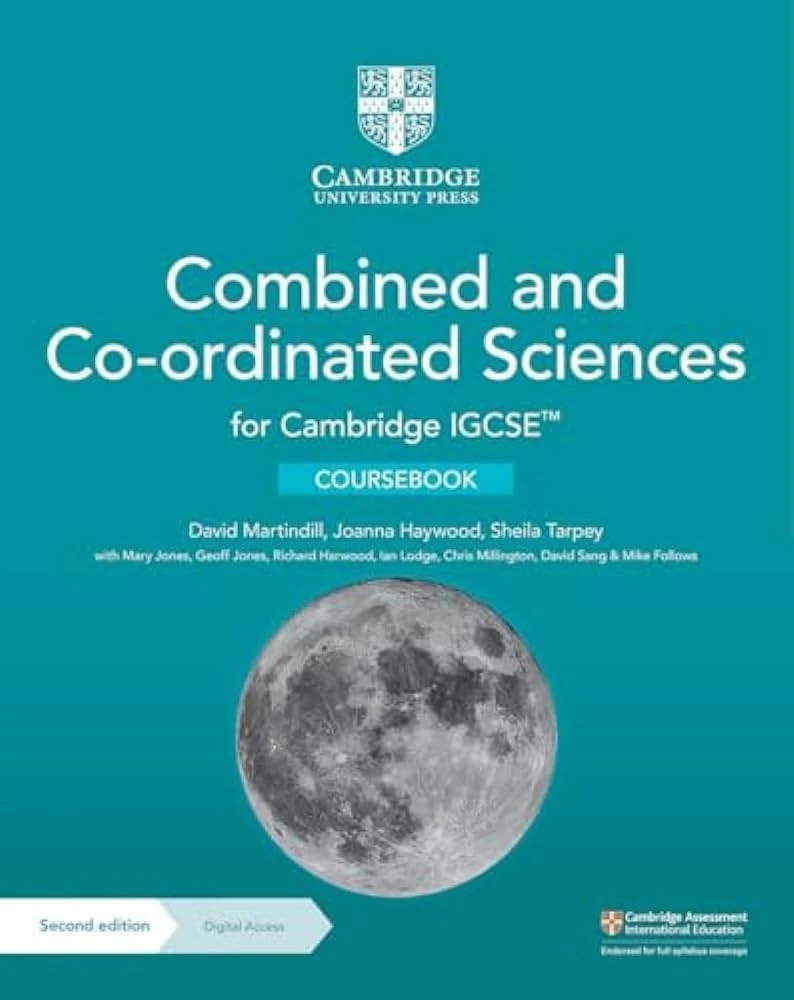
This is the most widely used Cambridge IGCSE Combined Science coursebook globally. Written by David Martindill, Joanna Haywood, and Sheila Tarpey, it has been updated for the 2025 syllabus revision and is the benchmark against which other books are measured.
The structure separates Biology, Chemistry, and Physics into clearly labelled chapters, which makes weekly planning straightforward. One detail that sets this Cambridge University Press 0653 title apart is its built-in language support: vocabulary boxes and simplified explanations are woven throughout, making it genuinely accessible for ESL learners studying in international schools across Asia, the Middle East, and Latin America.
Digital access through the Cambridge GO platform adds auto-marked practice quizzes and short video recaps. For students who learn better through mixed media, this integration reduces the need to hunt for supplementary online content.
Collins Cambridge IGCSE Combined Science Student’s Book (Collins)
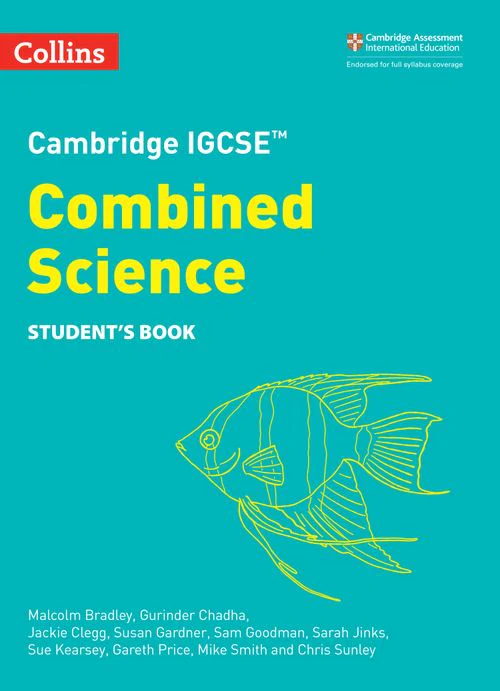
Collins IGCSE science occupies a strong second position in the endorsed market. Its coverage of the core learning objectives is thorough and, in several chapters, more detailed than the Cambridge University Press equivalent.
The distinguishing feature of this book is its treatment of investigative tasks. Practical skills are laid out in a step-by-step format that mirrors the structure of the Alternative to Practical paper, which is a component many students underestimate until it is too late. End-of-chapter questions are closely mapped to real exam command words, including “describe,” “explain,” and “evaluate,” so students build command-word literacy naturally over time.
A common mistake we see among students using Collins is skipping the worked investigation sections because they appear time-consuming. Those sections are, in fact, the fastest route to marks on the practical paper.
Cambridge IGCSE Combined and Co-ordinated Sciences Student Book (Hodder Education)
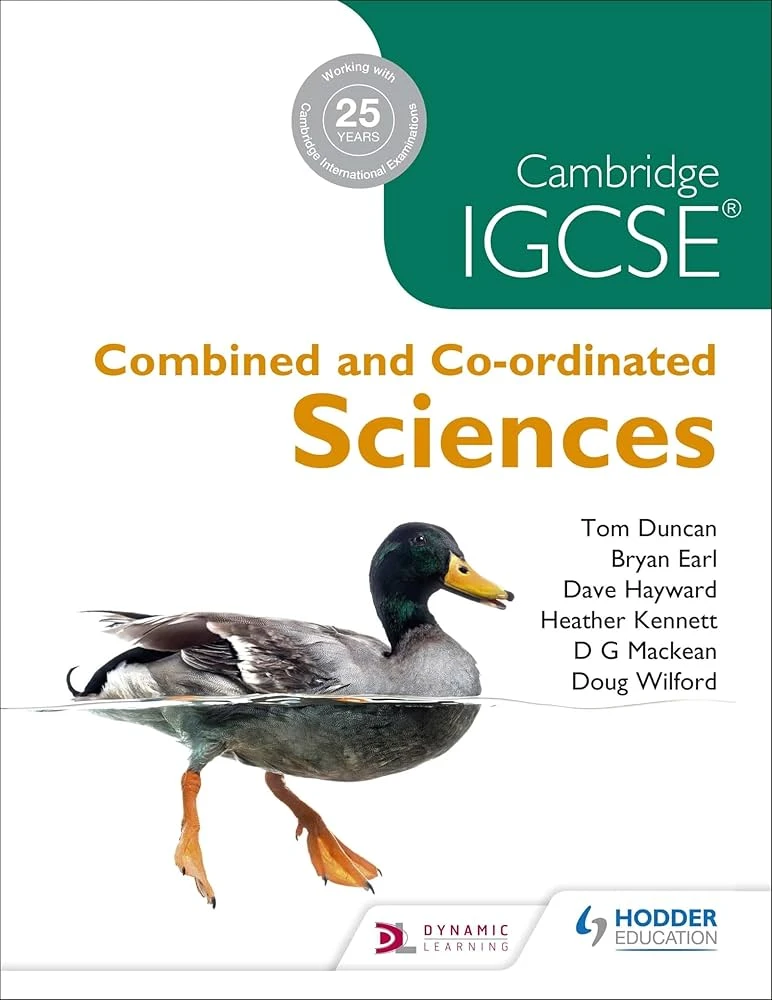
The Hodder Combined Science IGCSE title, co-authored by D.G. Mackean and Tom Duncan, takes a slightly different editorial approach. Rather than separating the three sciences rigidly, certain chapters draw connections across disciplines, which reflects how real scientific problems work.
This book functions as a highly efficient all-in-one resource. Students who intend to transition from Combined Science (0653) to Co-ordinated Sciences later in their academic career will find the Hodder edition particularly useful because its structure anticipates that progression. The explanations are concise, which benefits stronger independent learners but may require supplementary notes for students who need more contextual scaffolding.
| Feature | Cambridge University Press | Collins | Hodder Education |
|---|---|---|---|
| Cambridge endorsement | Yes | Yes | Yes |
| 2025 syllabus alignment | Yes | Yes | Yes |
| Digital platform access | Cambridge GO | Limited | Limited |
| ESL language support | Strong | Moderate | Moderate |
| Practical skills coverage | Moderate | Strong | Moderate |
| Best for | ESL learners, mixed-ability classes | Practical paper focus | Independent, transitioning students |
>>> Read more: IGCSE Timed Practice Sets : How to Build Exam Stamina for A* in 2026
IGCSE Combined Science revision guides vs full textbooks: Which do you need?
This is one of the most frequently debated questions among students approaching the 0653 exam, and the answer depends entirely on where a student sits in their revision cycle.
A full IGCSE Combined Science textbook is a teaching tool. It introduces concepts, builds understanding progressively, and provides the foundational knowledge base from which exam technique is developed. A revision guide, by contrast, assumes that foundational knowledge already exists and compresses the syllabus into rapid-recall summaries.
One critical detail often overlooked is that using a revision guide as a primary resource, rather than a supplement, leads to surface-level understanding. Cambridge examiners frequently reward students who can apply concepts to unfamiliar scenarios, and that skill is built through deep reading, not bullet-point summaries.
The recommended approach is to use the full textbook during the learning phase (typically Year 10 or equivalent), then introduce a dedicated IGCSE Combined Science revision guide in the final eight to ten weeks before the exam. This sequencing allows students to consolidate without overloading during the critical pre-exam period.
When a revision guide adds genuine value:
- Summarising Biology, Chemistry, and Physics key definitions before each mock exam
- Cross-referencing topics that appear weak after past paper analysis
- Providing quick-check question sets on specific syllabus points
- Travelling light: revision guides are far more portable than full coursebooks
>>> Read more: IGCSE Mixed Past Paper Sets: Why Random Topic Mixing Beats Linear for A*
Top IGCSE Combined Science books covering biology, chemistry and physics
Because Combined Science compresses three full disciplines into one qualification, a well-designed biology chemistry physics combined book must be both comprehensive and navigable. Below is a structured look at how the major titles handle the core syllabus sections.
Biology topics to verify in any IGCSE Combined Science textbook:
- Cell structures and cell division
- Plant nutrition and photosynthesis variables
- Human transport and circulatory systems
- Respiration (aerobic and anaerobic)
- Basic ecosystems and food chains
Chemistry topics to verify:
- Atomic structure and the periodic table
- Chemical bonding (ionic, covalent, metallic)
- Acids, bases, and neutralisation
- Rates of reaction and factors affecting them
- Introduction to organic chemistry
Physics topics to verify:
- States of matter and particle models
- Energy resources and efficiency
- Electricity, circuits, and magnetism
- Wave properties (sound and light)
- Radioactivity and basic nuclear physics
In our experience working with international students across Vietnam, Singapore, and the UAE, the Physics section is consistently where Combined Science students lose the most marks. A common mistake we see is underweighting Physics revision because students perceive Biology as “easier to memorise.” The reality is that Physics questions demand precise numerical answers, and a single conceptual gap can cost multiple marks across different question types.
Drawing on years of experience at Times Edu, we recommend verifying that whichever best Combined Science textbook a student chooses dedicates proportional chapter length to all three sciences. An imbalanced book will produce an imbalanced student.
>>> Read more: Switching IGCSE Boards 2026: A Step-by-Step Guide for Students and Parents
How to use an IGCSE Combined Science book effectively with past papers
Owning the right IGCSE Combined Science book is only half the equation. The other half is a deliberate study method that connects textbook learning to exam performance.
The most effective approach follows a three-phase cycle that Times Edu tutors use with every 0653 student.
Phase 1: Concept acquisition (textbook-led)
Read one topic section in the coursebook actively, not passively. This means annotating definitions, drawing diagrams from memory immediately after reading, and answering the in-text questions before checking answers. Do not move to the next topic until the current one can be explained aloud in simple language.
Phase 2: Application testing (past paper-led)
Once a topic is understood, retrieve the most recent Cambridge past papers from the official Cambridge Assessment International Education website. Isolate questions that relate specifically to the topic just studied and attempt them under timed conditions. Mark using the official mark scheme, not personal judgment.
Phase 3: Error analysis (textbook return)
Every incorrect or partially correct answer should trigger a return to the relevant textbook section. Identify whether the error was a knowledge gap, a misread command word, or a calculation mistake. Each error type requires a different correction strategy.
This cycle, repeated consistently across all syllabus topics, produces measurable grade improvement. Students who skip Phase 3 and simply move on after marking are the ones who repeat the same mistakes in the final exam.
| Study phase | Primary resource | Time allocation |
|---|---|---|
| Concept acquisition | IGCSE Combined Science textbook | 60% of study time |
| Application testing | Cambridge past papers | 25% of study time |
| Error analysis | Textbook plus mark scheme | 15% of study time |
>>> Read more: IGCSE Additional Mathematics 0606 book 2026: Complete guide for students and parents
Where to buy IGCSE Combined Science books at the best price
For families looking to buy IGCSE science books, the most reliable channels are the official publisher websites, major international booksellers, and school-approved suppliers.
Recommended purchasing channels:
- Cambridge University Press bookshop (cambridge.org/shop): Provides direct access to the endorsed Cambridge IGCSE Combined Science coursebook with the most current edition guaranteed.
- Collins online store (collins.co.uk): Offers bundle deals that include the student book alongside digital resources.
- Hodder Education website (hoddereducation.com): Often lists inspection copies for teachers at reduced rates.
- Amazon: Competitive pricing for all three major titles, with international shipping available to most countries where Cambridge programmes are offered.
- School bookshops and local academic suppliers: In countries with strong Cambridge school networks (Malaysia, Singapore, India, Nigeria, UAE), local suppliers often stock endorsed titles at regional price points.
One practical caution: second-hand editions sold through third-party platforms may be outdated. The 2025 syllabus update for Cambridge 0653 introduced changes to several Biology and Chemistry topics. Purchasing a pre-2023 edition means working from an incomplete or misaligned content base, which is a risk not worth taking for a high-stakes qualification.
>>> Read more: Best IGCSE Accounting 0452 books 2026: Complete guide for students
Free IGCSE Combined Science resources vs a dedicated study book
With the volume of free content available online, it is reasonable to ask whether a paid IGCSE Combined Science book is strictly necessary. The honest answer is nuanced.
Free IGCSE Combined Science resources, including past papers, examiner reports, and YouTube revision channels, provide genuine supplementary value. Cambridge Assessment International Education publishes past papers and mark schemes at no cost, and these are essential tools regardless of which textbook a student uses.
However, free resources have structural limitations. They are fragmented, inconsistent in quality, and rarely sequenced in a way that builds understanding progressively. A student relying entirely on free online content will develop patchy knowledge, strong in areas that happen to be well-covered on YouTube, weak in areas that are less popular but still examinable.
A dedicated practical skills science book or endorsed coursebook provides the coherent structure that free resources cannot replicate. It ensures no syllabus point is accidentally overlooked, and it calibrates the depth of coverage appropriately so students are not over-preparing some topics while neglecting others.
The cost of one endorsed textbook is a modest investment relative to the cost of resitting an IGCSE exam or losing a grade band on a university application. From a purely strategic standpoint, the book is non-negotiable.
>>> Read more: IGCSE Combined Science 0653 : Exam Structure & Roadmap to an A* in 2026
Frequently asked questions
Which IGCSE Combined Science textbook is officially endorsed by Cambridge?
Does the IGCSE Combined Science coursebook cover all three sciences adequately?
Is there a separate IGCSE Combined Science revision guide available?
Do I need a workbook in addition to the main IGCSE Combined Science textbook?
Which IGCSE Combined Science book covers the practical skills paper best?
Are older editions of IGCSE Combined Science books valid for the current syllabus?
Which IGCSE Combined Science book is best for independent self-study?
Conclusion
At Times Edu, our consultants and subject specialists work with IGCSE Combined Science students across all levels, from students building their foundational understanding in Year 10 to those conducting intensive exam preparation in the final weeks before sitting Cambridge papers. If your child’s science preparation needs a clearer structure, a stronger strategy, or expert 1-on-1 guidance through the 0653 syllabus, our team is ready to design a personalised academic roadmap that matches their current level and target grade.