IGCSE English as a Second Language ESL 0510 books: Complete guide for students and parents
Choosing the right IGCSE English as a Second Language book is one of the most consequential academic decisions a student can make before sitting Cambridge exams. The wrong textbook wastes months of preparation time. The right one builds every skill the examiner tests, in the exact format the syllabus demands.
This guide reviews every major title on the market, explains how each book maps to the Cambridge 0510 and 0511 syllabuses, and gives you a clear framework for building a winning study plan. Whether you are self-studying, attending school, or working with a private tutor, this resource will help you invest your time and money wisely.
- Best IGCSE English as a Second Language books: Complete guide for students
- Official Cambridge-endorsed IGCSE English as a Second Language coursebooks reviewed
- IGCSE ESL revision guides vs full coursebooks: which do you need?
- Top IGCSE English as a Second Language books by Hodder and Cambridge University Press
- How to use an IGCSE ESL book to develop reading, writing and listening skills
- Where to buy IGCSE English as a Second Language books at the best price
- Free IGCSE ESL resources vs investing in a dedicated coursebook
- Frequently asked questions
Best IGCSE English as a Second Language books: Complete guide for students
The Cambridge IGCSE ESL [1] qualification sits under syllabus codes 0510, 0511, 0991, and 0993. It assesses candidates across three core assessment components: Reading and Writing (worth 50% of the final grade), Listening (worth 25%), and a mandatory Speaking assessment. Understanding this weighting from the start should directly influence which books you buy and how much time you allocate to each skill.
Drawing on years of experience at Times Edu, one consistent observation stands out: students who purchase a single general English textbook and expect it to cover everything almost always underperform. A dedicated Cambridge IGCSE ESL coursebook is built around the exact task types in the exam, not generic English communication skills.
The three publishers whose titles dominate classrooms globally are Cambridge University Press (CUP), Collins, and a specialist imprint called Jarndyce and Jarvis. Each serves a slightly different learning profile, which the sections below break down in detail.
>>> Read more: IGCSE ESL Reading Trap Answers: 7 Patterns That Steal Points 2026
Official Cambridge-endorsed IGCSE English as a Second Language coursebooks reviewed
Cambridge IGCSE English as a Second Language Coursebook (Cambridge University Press)
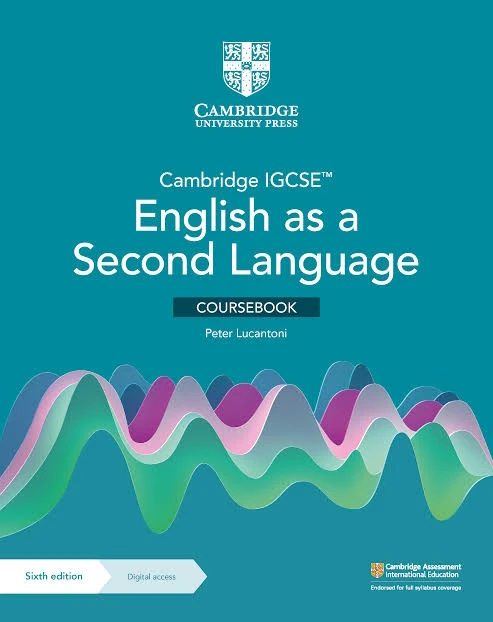
Written by Peter Lucantoni and Lydia Kellas, this is the most widely recognised Cambridge University Press ESL title in international schools. It organises content into four themed units: Leisure and travel; Education and work; People and achievements; and Ideas and the modern world. These themes mirror the kinds of topics that appear in real exam reading passages and listening tracks.
The book integrates “Language Focus” and “Word Tips” sidebars on virtually every page, which address common grammatical errors and help students build topic-specific vocabulary organically. The physical book also provides digital access to embedded audio tracks and video clips that replicate the authentic listening exam environment.
One critical detail often overlooked is the edition. For any examination session from 2023 onwards, students must use the 6th Edition (published 2022 or later). Earlier editions do not reflect the structural overhaul Cambridge introduced to unify the Core and Extended pathways into a single grading scale.
Cambridge IGCSE English as a Second Language Student’s Book (Collins)
The Collins IGCSE English student book, authored by Susan Anstey, takes a more visual and thematically diverse approach. International contexts keep the reading passages fresh and culturally representative, which is particularly helpful for non-native speakers who study in multilingual households.
Every unit in this title integrates all four skills: listening, speaking, reading, and writing. This matters because students who drill each skill in isolation often struggle when the exam combines tasks within a single extended paper. The Collins approach prevents that disconnect.
The book also features a tiered practice structure, scaling exercises from foundational difficulty up to advanced challenge level. In our experience working with international students, this tiered format is especially effective for learners who are sitting the exam one year ahead of their predicted schedule.
The Ultimate Guide to Cambridge IGCSE ESL: Strategies for Writing (Jarndyce and Jarvis)
Written by Emile Armanious, this specialist title deserves its own category. It is not a full IGCSE English Second Language textbook in the traditional sense. Instead, it is a deep-dive resource focused exclusively on the writing paper, which makes sense given that writing tasks carry significant weight within the Reading and Writing component.
The guide breaks down the step-by-step construction of formal emails, informal emails, articles, reports, book and film reviews, and discursive essays. It includes over 500 annotated sample answers paired with genuine examiner commentary, which teaches students how to identify what separates a Band 4 response from a Band 5 response.
A common mistake we see is students treating writing as the skill they can “wing” because they have decent general English. The examiner marks very specifically: register, coherence, task fulfilment, and range of vocabulary all contribute to the final band. This book makes those distinctions visible.
>>> Read more: IGCSE ESL Grammar Improvement 2026: Practical Ways to Write More Accurately and Confidently
IGCSE ESL revision guides vs full coursebooks: which do you need?
Many students ask whether they need both a coursebook and a revision guide, or whether one can substitute for the other. The answer depends almost entirely on where you are in your study timeline.
| Resource type | Best used when | Key purpose |
|---|---|---|
| Full coursebook (CUP or Collins) | Year 1 or 2 of IGCSE study | Building foundational skills across all components |
| Writing strategy guide (Jarndyce) | Final 3 to 6 months before exams | Mastering exam-specific writing tasks |
| Official CUP Workbook | Throughout the course | Vocabulary drilling and structured exam practice |
| Exam Preparation and Practice Guide | Final 6 to 8 weeks | Simulated exam conditions with full timed practice |
The IGCSE ESL revision guide format, typically a slim paperback with condensed notes and practice questions, serves best as a supplement rather than a primary resource. It helps students consolidate knowledge they already possess. It cannot build foundational comprehension skills from scratch.
In our experience working with international students, the most effective approach is a three-layer system: a full coursebook as the spine, a writing-focused specialist guide for the final push, and a dedicated workbook for weekly skills drilling. Students who attempt to skip the coursebook and rely solely on revision notes tend to struggle with extended reading tasks, because they have not developed the stamina for processing long unseen texts under timed conditions.
>>> Read more: IGCSE ESL Coherence: 6 Linking Devices Examiners Reward for A*
Top IGCSE English as a Second Language books by Hodder and Cambridge University Press
Hodder IGCSE ESL titles are frequently requested by students whose schools use the Hodder Education ecosystem. While Hodder is primarily known for its strong A Level English Language and Literature range, its IGCSE ESL materials offer solid skills-based practice with clear exam-task alignment.
Cambridge University Press remains the gold standard for the simple reason that it is the same organisation that writes and marks the exam. The alignment between a Cambridge 0510 0511 book published by CUP and the actual examination paper is not coincidental. The task types, rubric language, and marking band descriptors all speak the same vocabulary.
The companion IGCSE ESL workbook published by CUP acts as the practical partner to the main coursebook. Each unit in the workbook is split into three discrete sections: Vocabulary, Language, and Exam Practice. This structure ensures that students are not just reading about skills but applying them under realistic constraints. The workbook is not optional for serious exam candidates.
>>> Read more: ESL vs First Language English IGCSE 2026: Which One Should You Take?
How to use an IGCSE ESL book to develop reading, writing and listening skills
Owning the right IGCSE English as a Second Language book is only the first step. How a student uses that book determines the actual exam outcome. Below is the structured approach Times Edu recommends to students who study independently.
For reading skills:
- Read each passage twice: once for global understanding and once to identify the specific information each question targets.
- Mark unfamiliar vocabulary but resist looking it up immediately. Practise inferring meaning from context first, then verify.
- Time every reading task. The exam allows roughly 1.5 minutes per mark in the reading section.
For writing skills:
- Complete every writing task in the coursebook under timed conditions, even during early study phases.
- Use the Jarndyce writing guide to identify the structural template for each text type, then apply that template to coursebook prompts.
- Seek feedback on register precision, not just grammatical accuracy. An email that uses informal vocabulary when the prompt requires a formal tone will lose marks regardless of fluency.
For listening skills:
Drawing on years of experience at Times Edu, the single biggest gap we observe in reading writing listening IGCSE preparation is consistent audio practice. Students read and write daily but listen to exam-format audio only occasionally. The CUP coursebook and workbook include embedded audio tracks that replicate real exam conditions. Use them every week without exception.
>>> Read more: IGCSE ESL Writing Self-Edit 2026: How to Check Your Work and Improve Before Submission
Where to buy IGCSE English as a Second Language books at the best price
When you decide to buy IGCSE English language book titles, there are several reliable channels to consider.
| Retailer | Strengths | Considerations |
|---|---|---|
| Cambridge University Press website | Guaranteed correct edition, digital bundles | Higher price point |
| Amazon (international shipping) | Competitive pricing, fast delivery | Verify edition number before purchasing |
| Book Depository (now Amazon-owned) | Free worldwide shipping | Delivery times vary by region |
| Local international school bookshops | Immediate availability, advice on edition | Limited stock, may mark up price |
| Digital platforms (Cambridge GO) | Instant access, audio and video embedded | Requires stable internet for use |
One critical detail often overlooked is the edition number. When purchasing on Amazon or through resellers, always check the copyright page for the publication year. A 4th Edition Cambridge IGCSE ESL coursebook may appear identical on the cover but will not contain the updated task formats reflecting the current unified grading system.
For students based in Vietnam, the Times Edu academic team can advise on local distribution partners that carry authorised, current-edition textbooks at competitive prices. Reach out directly for a personalised recommendation.
>>> Read more: IGCSE ESL Reading Practice : How to Improve Comprehension and Answer More Accurately in 2026
Free IGCSE ESL resources vs investing in a dedicated coursebook
The internet carries a substantial volume of free IGCSE ESL materials: past papers from the Cambridge Assessment website, teacher-created worksheets on platforms like TES, and YouTube channels covering exam techniques. These resources have genuine value, particularly for supplementary practice.
However, they cannot replace a structured best ESL textbook IGCSE experience for several reasons. First, free resources are rarely sequenced. A student who works through random past papers without the scaffolded skills-building of a coursebook often plateaus early, because they keep making the same structural errors without understanding why. Second, past papers alone do not build vocabulary or grammatical range in a systematic way.
A common mistake we see in self-study ESL IGCSE situations is students spending 80% of their preparation time on past papers and 20% on actual skills development. The ratio should be closer to 50/50 in the first year and shift toward more timed practice only in the final two to three months. A dedicated coursebook ensures the foundational 50% is covered coherently.
The question of Oxford IGCSE ESL resources also comes up frequently. Oxford University Press does produce solid general English learning materials, but its IGCSE-specific ESL range is less developed than CUP or Collins. For syllabus-aligned preparation, staying within the CUP and Collins ecosystem is the safer choice.
>>> Read more: IGCSE ESL Speaking Tips 2026: How to Sound Fluent and Score Higher
Frequently asked questions
Which IGCSE English as a Second Language textbook is officially endorsed by Cambridge?
Is the Cambridge IGCSE English as a Second Language coursebook enough for exam prep?
What is the best revision guide for IGCSE English as a Second Language?
Which IGCSE ESL book focuses most on reading and writing skills for the exam?
Do I need a separate listening practice book for IGCSE English as a Second Language?
Are older editions of IGCSE ESL books valid for the current 0510 or 0511 syllabus?
Which IGCSE ESL book is best for non-native English speakers studying independently?
Conclusion
At Times Edu, our academic consultants work with IGCSE students across Asia, the Middle East, and Europe to build personalised study roadmaps that go beyond book selection. We match students with the right resources, the right tutors, and the right exam strategy based on their current English level, learning profile, and target university requirements. If you or your child is preparing for the Cambridge IGCSE ESL examination and you want a clear, expert-guided plan, book a free academic consultation with our team today.