IGCSE Economics 0455 books 2026: complete guide for students and teachers
Choosing the right IGCSE Economics book can significantly improve how effectively students understand the syllabus and prepare for the Cambridge 0455 examination. This guide compares the leading textbooks from Cambridge University Press, Hodder Education, and Collins, highlighting the strengths and ideal learner profile of each option. It also explains how to combine textbooks, revision guides, workbooks, and past papers within a structured study plan. Students and parents will also find practical advice on selecting the correct edition, using free resources wisely, and choosing the best book for self-study or A* preparation.
- Best IGCSE Economics books: Complete guide for students and teachers
- Official Cambridge-endorsed IGCSE Economics textbooks reviewed
- IGCSE Economics revision guides vs full textbooks: What do you actually need?
- Top IGCSE Economics books by Hodder, Oxford and Cambridge University Press
- How to use an IGCSE Economics book effectively alongside past papers
- Where to buy IGCSE Economics books at the best price online
- Free IGCSE Economics resources vs investing in a dedicated study book
- Frequently asked questions
Best IGCSE Economics books: Complete guide for students and teachers
The Cambridge IGCSE Economics syllabus (code 0455) [1] and its sister qualification O Level Economics (2281) share identical content coverage, which means textbooks endorsed for one are almost always valid for the other. Three publishers dominate this space: Cambridge University Press, Hodder Education, and Collins.
Each publisher takes a noticeably different pedagogical approach. Cambridge University Press prioritises conceptual clarity and global case studies. Hodder Education leans toward structured exam technique and visual learning. Collins focuses on data interpretation and mathematical economics. Understanding these differences before you spend money is essential.
Drawing on years of experience at Times Edu, the single most frequent mistake we observe is students purchasing whichever book appears first in a Google search, rather than matching the book’s style to their own learning profile. That mismatch costs weeks of effective study time.
>>> Read more: IGCSE Economics Diagram Mistakes: 7 Errors That Cost A* Marks
Official Cambridge-endorsed IGCSE Economics textbooks reviewed
Only a small number of resources carry the official Cambridge endorsement stamp, which confirms that the content has been checked against the current 0455 syllabus requirements. Below is a structured comparison of the three primary endorsed options.
| Book Title | Author(s) | Publisher | Best Suited For |
|---|---|---|---|
| Cambridge IGCSE and O Level Economics Coursebook | Susan Grant | Cambridge University Press | Conceptual learners, self-study students |
| Cambridge IGCSE and O Level Economics Student’s Book | Paul Hoang & Margaret Ducie | Hodder Education | Visual learners, exam-technique builders |
| Cambridge IGCSE Economics Student Book | Multiple contributors | Collins | Data analysts, students strong in maths |
Cambridge IGCSE and O Level Economics Coursebook (Cambridge University Press)
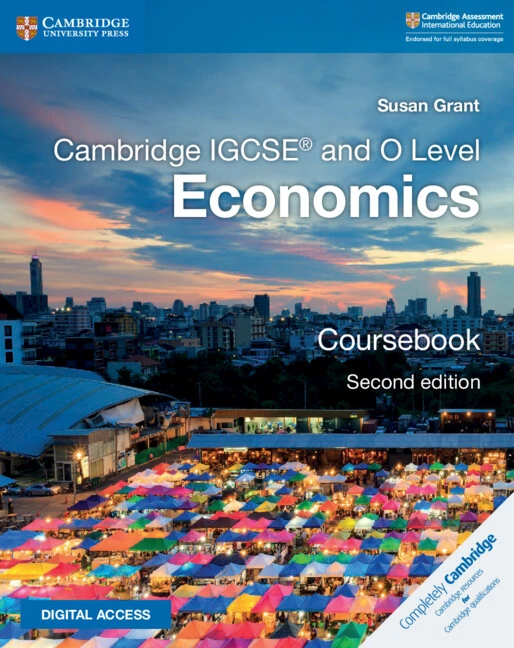
Written by Susan Grant, this is the benchmark Cambridge IGCSE Economics coursebook against which all others are measured. The language is deliberately accessible, making it the preferred choice for students who are not studying in their first language. Every chapter introduces theory through real-world international scenarios, which helps students write the contextualised answers that Cambridge examiners reward.
The latest edition includes digital access via the Cambridge GO platform, providing interactive quizzes, self-assessment progress trackers, and a built-in glossary. One critical detail often overlooked is that the Cambridge GO access code is only usable once, so purchasing a second-hand copy does not guarantee digital access.
Cambridge IGCSE and O Level Economics Student’s Book (Hodder IGCSE Economics)
Paul Hoang and Margaret Ducie have built a reputation across multiple Cambridge subjects, and their Hodder IGCSE Economics title delivers the same disciplined, structured approach that teachers appreciate. Each unit closes with detailed summary mind maps that compress an entire topic into a single revision diagram.
The question bank inside this book is particularly impressive. It includes structured data-response questions and longer essay prompts that mirror the actual format of Paper 2, making it an excellent companion for timed practice sessions.
Cambridge IGCSE Economics Student Book (Collins IGCSE Economics)
The Collins IGCSE Economics book stands out for its step-by-step breakdown of quantitative skills. Calculating price elasticity of demand, interpreting index numbers, and reading balance of payments tables are all handled with clear worked examples. For students who find the mathematical elements of economics challenging, Collins provides a level of scaffolding that the other two publishers do not match.
Key terms appear in the page margins throughout, making the Collins edition particularly practical during revision when a student needs a fast definition without navigating to a separate glossary section.
>>> Read more: Best IGCSE Co-ordinated Sciences 0654 books 2026: Complete guide for students
IGCSE Economics revision guides vs full textbooks: What do you actually need?
A full IGCSE Economics textbook and an IGCSE Economics revision guide serve fundamentally different functions in a study programme. Conflating the two, or relying exclusively on one, is a mistake that limits a student’s ceiling grade.
A full textbook builds understanding from the ground up. It introduces concepts, explains mechanisms, and uses extended case studies to deepen comprehension. A revision guide compresses that understanding into condensed notes, key definitions, and targeted exam tips. Neither can fully replace the other.
In our experience working with international students across multiple time zones, the optimal approach is to use a full textbook as the primary learning tool during the academic year, then introduce a dedicated IGCSE Economics revision guide in the final eight to ten weeks before the examination. This sequencing ensures that revision consolidates genuine understanding rather than substituting for it.
Students who rely solely on revision guides from the beginning of their course frequently struggle with Paper 2 essay questions, where examiners are specifically rewarding depth of analysis and supported evaluation rather than surface-level recall.
>>> Read more: IGCSE Combined Science 0653 book 2026: Complete guide for students and teachers
Top IGCSE Economics books by Hodder, Oxford and Cambridge University Press
Beyond the three flagship titles, a small ecosystem of supplementary books supports the 0455 syllabus. Oxford University Press publishes supporting materials for economics at this level, although their primary Cambridge-aligned titles are more prominent at A Level than at IGCSE.
For the IGCSE level specifically, the Hodder IGCSE Economics workbook is worth highlighting as a standalone purchase. It provides additional structured questions mapped directly to each syllabus section, making it ideal for weekly formative practice alongside whichever main textbook a student is using.
| Resource Type | Recommended Option | Purpose |
|---|---|---|
| Primary textbook | Cambridge Coursebook (Susan Grant) | Concept building and case study learning |
| Structured exam practice | Hodder Student’s Book (Hoang & Ducie) | Essay and data-response technique |
| Quantitative skills | Collins IGCSE Economics Student Book | Maths-heavy economics topics |
| Weekly practice | Hodder IGCSE Economics Workbook | Chapter-by-chapter question sets |
| Final revision | Cambridge Revision Guide (CUP) | Condensed notes and exam tips |
A common mistake we see at Times Edu is students purchasing both a full textbook and a workbook from the same publisher without considering whether the combination creates genuine variety in question style. Mixing publishers deliberately, for example using the Susan Grant coursebook alongside the Hodder workbook, exposes students to a broader range of question formats before the actual examination.
>>> Read more: IGCSE Additional Mathematics 0606 book 2026: Complete guide for students and parents
How to use an IGCSE Economics book effectively alongside past papers
Owning the best IGCSE Economics textbook on the market is meaningless without a structured plan for how to use it. The book itself is a tool; the study method is what produces the grade.
A practical six-stage study framework:
- Read the relevant chapter in your primary textbook before your class or self-study session, not after. Arriving with background knowledge allows you to engage critically rather than passively.
- After reading, close the book and write a one-page summary in your own words. This retrieval practice technique has stronger memory retention evidence behind it than re-reading does.
- Complete the end-of-chapter questions in your textbook under timed conditions. Do not look up answers during the attempt.
- Cross-reference your answers with the mark scheme logic, paying attention to the command words: “explain,” “analyse,” and “evaluate” require progressively more sophisticated responses.
- Pull one related past paper question from the Cambridge 0455 past paper archive (available free on the Cambridge Assessment website) and attempt it using only your handwritten notes, not the textbook.
- Review your past paper response against the examiner’s mark scheme, identify the specific points you missed, and annotate your notes accordingly.
One critical detail often overlooked is that past papers from 2020 onward reflect the most recent syllabus revision, while older papers, particularly those from 2014 and earlier, may contain question formats that no longer appear. Always check the syllabus year before using a past paper as practice material.
The Cambridge University Press 0455 coursebook aligns its chapter structure to the current syllabus sections, which makes cross-referencing between the book and past papers considerably more efficient than with non-endorsed resources.
>>> Read more: Best IGCSE Accounting 0452 books 2026: Complete guide for students
Where to buy IGCSE Economics books at the best price online
For students and parents looking to buy IGCSE Economics books, the landscape has expanded significantly since 2018. Digital, print, and hybrid options now exist across multiple platforms and price points.
Purchasing options by platform:
- Cambridge GO (Cambridge University Press official store): Sells both print and digital editions directly. Digital-only licences are available at a lower price point and are particularly practical for students who travel frequently or prefer studying on a tablet.
- Amazon (global and regional): Carries all three primary endorsed titles in new and used conditions. Used copies are substantially cheaper but, as noted earlier, may lack valid digital access codes.
- Kinokuniya, Popular Bookstore (Southeast Asia): Physical bookstores across Singapore, Malaysia, and Thailand stock the major Cambridge-endorsed titles. Availability varies by branch.
- Times Edu partner suppliers: For students enrolled in Times Edu tutoring programmes, our academic coordinators can advise on sourcing current-edition books through verified regional distributors, including for students in Vietnam, Indonesia, and the Philippines.
A common trap parents fall into is purchasing the cheapest available edition without verifying which syllabus year it covers. The current Cambridge IGCSE Economics syllabus runs from 2023 onward. Books written for the pre-2020 syllabus may omit updated content areas or include obsolete case study frameworks.
>>> Read more: IGCSE Economics 0455 : Exam Structure & Roadmap to an A* in 2026
Free IGCSE Economics resources vs investing in a dedicated study book
The internet provides a large volume of free IGCSE Economics content, ranging from YouTube explanation videos to downloaded PDF summaries. These resources have genuine value when used correctly, but they carry a structural limitation that many students underestimate.
Free resources are almost never systematically aligned to the current 0455 syllabus in the same depth that an endorsed IGCSE Economics textbook is. A YouTube video explaining demand and supply may be conceptually accurate but omit the specific evaluation angles that Cambridge Paper 2 mark schemes reward. A downloaded revision note PDF may use different terminology to what appears in the official Cambridge syllabus glossary, which creates confusion under exam conditions.
Drawing on years of experience at Times Edu working with self-study Economics IGCSE students in particular, we recommend using free resources as supplementary explanation tools when a textbook section is unclear, not as a replacement for the structured learning progression a proper book provides.
The best Economics textbook IGCSE students can choose will always be an officially endorsed, current-edition title. The cost difference between a quality textbook and a free online resource is minimal compared to the cost of re-sitting an examination or missing a university conditional offer by one grade boundary.
>>> Read more: IGCSE Tutor 2026: How to Choose the Right One
Frequently asked questions
Which IGCSE Economics textbook is officially endorsed by Cambridge?
Three titles currently carry Cambridge endorsement for the 0455 syllabus: the Susan Grant Coursebook from Cambridge University Press, the Paul Hoang and Margaret Ducie Student’s Book from Hodder Education, and the Collins IGCSE Economics Student Book. All three are valid for examination preparation.
Is the Cambridge IGCSE Economics coursebook enough to pass with a high grade?
The Susan Grant coursebook provides complete syllabus coverage and is sufficient as a primary learning resource. Students targeting Grade A* should supplement it with targeted past paper practice and, ideally, a revision guide in the final weeks before the examination.
What is the best IGCSE Economics revision guide for exam preparation?
Cambridge University Press publishes a dedicated revision guide for the 0455 syllabus that condenses the core coursebook content into examination-focused summaries. Hodder also publishes revision support materials. Neither should be used as a substitute for a full textbook during the main study period.
Does the IGCSE Economics textbook cover both microeconomics and macroeconomics?
Yes. All endorsed IGCSE Economics books cover both microeconomics and macroeconomics as defined by the 0455 syllabus. This includes demand and supply analysis, price elasticity, market failure, government intervention, monetary and fiscal policy, inflation, unemployment, international trade, and exchange rates.
Do I need a workbook as well as a textbook for IGCSE Economics?
A workbook is not strictly required but is highly beneficial. The IGCSE Economics workbook from Hodder Education, in particular, provides structured practice questions that reinforce each syllabus section methodically. Students with limited access to a subject teacher benefit most from having both a textbook and a workbook.
Are older editions of IGCSE Economics books still valid for the current syllabus?
Editions published before 2020 may not fully reflect the current 0455 syllabus structure. Some topic areas and assessment objectives were revised in the 2023 syllabus update. Students using pre-2020 books should cross-reference their content against the current official Cambridge 0455 syllabus document, available free from the Cambridge Assessment International Education website.
Which IGCSE Economics book is best for self-study students?
For self-study Economics IGCSE students, the Susan Grant Cambridge Coursebook is the strongest starting point because of its clear language, integrated digital platform, and structured chapter progression. Students who need additional exam technique support should add the Hodder Student’s Book as a secondary reference. Collins works particularly well for students who struggle with the data and calculation elements of the paper.
Resources: