Best IGCSE Co-ordinated Sciences 0654 books 2026: Complete guide for students
Selecting the right IGCSE Co-ordinated Sciences book is a strategic decision that affects every stage of a student’s preparation, from first encountering a biology concept to writing a timed chemistry response under exam pressure. This guide will walk you through three of the most popular options: the Cambridge University Press coursebook, the Collins Cambridge IGCSE series, and the Hodder Co-ordinated Sciences volume. Each is designed for a different type of learner, and the right choice will depend on your study environment, the level of teacher support available, and your preferred learning style.
The guide has also addressed the critical importance of edition currency, the correct integration of textbooks with past papers, the meaningful academic differences between Co-ordinated Sciences and Combined Science, and practical purchasing advice for students across different regions.
- Official Cambridge-endorsed IGCSE Co-ordinated Sciences textbooks reviewed
- IGCSE Co-ordinated Sciences revision guides vs full textbooks: what to choose
- Top IGCSE Co-ordinated Sciences books covering double award content
- How to use an IGCSE Co-ordinated Sciences book alongside past papers
- Where to buy IGCSE Co-ordinated Sciences books at the best price
- IGCSE Co-ordinated Sciences book vs IGCSE Combined Science book: key differences
- Frequently asked questions
Official Cambridge-endorsed IGCSE Co-ordinated Sciences textbooks reviewed
The Cambridge IGCSE Co-ordinated Sciences syllabus [1] (0654 for core and extended, 0973 for the international variant) demands a textbook that integrates biology, chemistry, and physics into a coherent double award framework. Not every book on the market meets this standard.
Below is a structured comparison of the three most authoritative Cambridge-endorsed options currently available.
| Textbook | Publisher | Author(s) | Format | Syllabus Alignment | Best For |
|---|---|---|---|---|---|
| Cambridge IGCSE Combined and Co-ordinated Sciences Coursebook | Cambridge University Press | Martindill, Haywood, Tarpey | Single volume | 2025-2027 syllabus | Self-study, ESL learners |
| Collins Cambridge IGCSE Co-ordinated Sciences Student’s Books | Collins | Collins editorial team | Separate volumes per subject | 2023 onwards | Classroom use, specialist teachers |
| Cambridge IGCSE Combined and Co-ordinated Sciences | Hodder Education | Mackean, Duncan, and contributors | Single volume | 2023 onwards | Conceptual depth, real-world links |
Cambridge University Press Coursebook (0654)
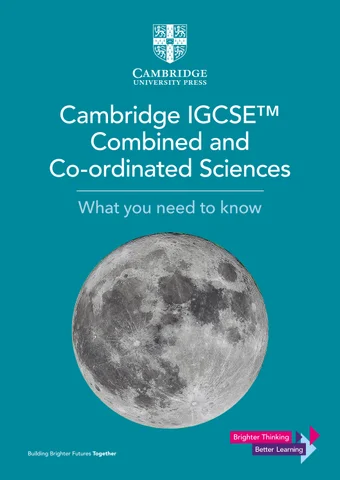
The Cambridge IGCSE Co-ordinated Sciences Coursebook published by Cambridge University Press is the most widely adopted endorsed sciences book IGCSE students use globally. Written by David Martindill, Joanna Haywood, and Sheila Tarpey, it is precisely aligned with the 2025-2027 syllabus, making it the safest investment for any student sitting exams through 2027.
The book presents biology, chemistry, and physics in clearly separated sections, which makes navigation efficient when a student needs to locate a specific topic quickly. A particularly strong feature is its “Experimental Skills” content, which directly prepares candidates for the practical assessment component that many students underestimate.
One critical detail often overlooked is that purchasing this Cambridge University Press 0654 book grants access to the Cambridge GO digital platform. This platform provides interactive self-assessments and digital resources that complement the printed content significantly.
Collins Sciences IGCSE
Collins sciences IGCSE materials take a different structural approach by splitting the coursework into individual volumes for biology, chemistry, and physics. This approach suits schools where separate specialist teachers manage each science independently, because each teacher can assign the relevant standalone volume without requiring students to carry a large combined text.
The Collins series is particularly strong on exam-readiness features. Realistic past-paper-style questions and detailed syllabus checklists are embedded throughout each volume, making it a practical tool for systematic revision.
Hodder Co-ordinated Sciences
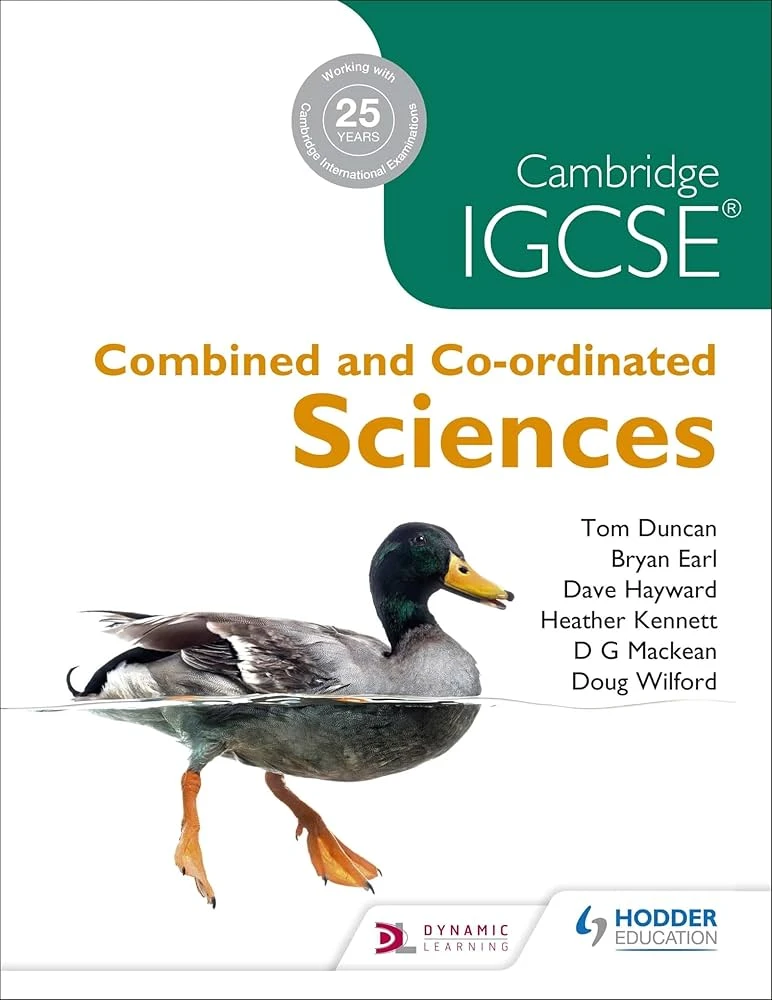
The Hodder Co-ordinated Sciences textbook, co-authored by established science educators including D.G. Mackean and Tom Duncan, operates as a comprehensive all-in-one resource. Its distinguishing quality is the way it connects scientific concepts across disciplines, showing students how a principle in chemistry relates to a biological process or a physical phenomenon.
This cross-disciplinary approach builds the kind of integrative thinking that Cambridge examiners reward in extended response questions. In our experience working with international students, candidates who use the Hodder text alongside past papers tend to write stronger analytical answers because they understand the broader context of each concept.
>>> Read more: How to Use IGCSE Mark Scheme 2026: 7-Step Marking System for A*
IGCSE Co-ordinated Sciences revision guides vs full textbooks: what to choose
A common mistake we see is students purchasing only a revision guide and treating it as their primary resource. Revision guides are condensed summaries, and while they are excellent for the final six to eight weeks before examinations, they cannot replace a full-length IGCSE Co-ordinated Sciences textbook for building genuine understanding.
The distinction matters because Cambridge IGCSE Co-ordinated Sciences assessment includes not just factual recall but also data analysis, experimental interpretation, and extended writing. A revision guide cannot develop these skills on its own.
When to use a full textbook:
- During the first study phase, from the start of the course through the end of teaching
- When encountering a concept for the first time
- When completing workbook exercises and experimental skill activities
When to use a revision guide:
- In the six to eight weeks before the final examination
- For rapid topic checks during timed practice sessions
- For memorising key definitions and equations efficiently
The IGCSE sciences revision guide from Cambridge University Press works particularly well as a companion to the main coursebook. It condenses the 0654 content into accessible summaries and provides targeted practice questions. Used in the correct sequence, the combination of a full double award science textbook followed by a focused revision guide is the most effective preparation strategy.
>>> Read more: IGCSE Combined Science 0653 book 2026: Complete guide for students and teachers
Top IGCSE Co-ordinated Sciences books covering double award content
Because Co-ordinated Sciences is a double award qualification, it yields two separate grades on a student’s certificate. This means the scope of content is genuinely wider and more demanding than Combined Science at the same level. Every biology chemistry physics IGCSE book a student selects must cover this extended scope completely.
The 2025-2027 syllabus update introduced material that older editions do not contain. Students who purchase books published before 2023 risk preparing for topics that have been removed while missing entirely new content areas.
Critical new content areas in the updated syllabus:
- Space Physics: a completely new topic covering Earth, the Solar System, stars, and the universe
- Updated electrochemistry content including fuel cells
- Expanded human environmental impact modules in biology
- Revised terminology across chemistry and physics sections
The Cambridge IGCSE Co-ordinated Sciences Coursebook from Cambridge University Press is the only single-volume endorsed sciences book IGCSE candidates can rely on to cover all these updates comprehensively. Both the Hodder Co-ordinated Sciences volume and the Collins sciences IGCSE series have updated editions, but students must verify the publication year on any edition they purchase.
A practical skills Co-ordinated Sciences workbook is also worth considering as a supplementary resource. Cambridge University Press publishes a dedicated science workbook IGCSE edition that pairs with the coursebook, providing additional data analysis exercises and experimental design tasks that directly mirror Paper 6 requirements.
>>> Read more: IGCSE Additional Mathematics 0606 book 2026: Complete guide for students and parents
How to use an IGCSE Co-ordinated Sciences book alongside past papers
Owning the right Cambridge 0654 book is only half the strategy. The other half is knowing how to integrate that textbook with past examination papers in a structured, progressive way.
Drawing on years of experience at Times Edu, the most effective approach follows a three-phase cycle that prevents the common trap of passive reading without active retrieval practice.
Phase 1: Concept acquisition (weeks 1 to topic completion)
- Read the relevant chapter in the Cambridge IGCSE Co-ordinated Sciences Coursebook before each lesson.
- Complete all in-text questions and workbook exercises within 48 hours of the lesson.
- Write summary notes using the syllabus learning objectives as headings, not the textbook chapter titles.
Phase 2: Application and exam technique (six to ten weeks before exams)
- Attempt one past paper per week under timed conditions.
- After marking, identify every question where you lost marks and return to the relevant section of the textbook, not just the mark scheme.
- Use the IGCSE sciences revision guide to compress your notes into one-page topic summaries.
Phase 3: Consolidation (final four weeks)
- Complete full paper sets from the last four examination series under strict exam conditions.
- Focus specifically on Section B extended responses and data analysis questions, as these carry the highest differentiating marks.
- Use the practical skills Co-ordinated Sciences section of the coursebook to review experimental methodology one final time.
One critical detail often overlooked is that mark schemes for Cambridge IGCSE Co-ordinated Sciences use precise command words: “state,” “describe,” “explain,” and “evaluate” carry entirely different expectations. The Cambridge IGCSE Co-ordinated Sciences Coursebook contains guidance on these command words, but many students skip these sections. This is a costly error.
>>> Read more: Best IGCSE Accounting 0452 books 2026: Complete guide for students
Where to buy IGCSE Co-ordinated Sciences books at the best price
When students or parents decide to buy IGCSE Co-ordinated Sciences books, the primary concern should be edition verification before price comparison. Purchasing a discounted older edition to save money is counterproductive if that edition predates the 2025-2027 syllabus updates.
Reliable purchasing channels:
| Channel | Advantage | Risk to watch |
|---|---|---|
| Cambridge University Press website | Latest editions guaranteed | Shipping time varies by region |
| Amazon (international) | Competitive pricing | Verify edition and publication year carefully |
| Local authorised bookshops | Immediate availability | Stock may be limited to older editions |
| School bookshop | Pre-verified edition | Usually standard retail pricing |
| Cambridge GO digital access | Instant access, no shipping | Requires initial purchase of print book |
For students in Vietnam and Southeast Asia, authorised Cambridge resource distributors stock the Cambridge IGCSE Co-ordinated Sciences Coursebook and associated workbooks. Times Edu advisors can provide current regional availability guidance as part of the initial consultation process.
A common mistake we see is purchasing the Combined Science textbook instead of the Co-ordinated Sciences edition. Although the two share significant content overlap, the Co-ordinated Sciences double award scope requires additional material that the Combined Science book does not include. Always confirm “Co-ordinated Sciences” or “0654” appears explicitly on the cover before purchasing.
>>> Read more: IGCSE to IB Skills: 7 Skills You Must Build Before DP1 (Bridge Plan)
IGCSE Co-ordinated Sciences book vs IGCSE Combined Science book: key differences
Students frequently confuse these two qualifications, and the distinction has real consequences for university applications and A Level progression.
| Feature | Co-ordinated Sciences (0654) | Combined Science (0653) |
|---|---|---|
| Award type | Double award (two grades) | Single award (one grade) |
| Content scope | Broader, more extended material | Core content across three sciences |
| Textbook depth | Greater depth per topic | Accessible overview |
| University perception | Closer to taking two separate sciences | Equivalent to approximately one science |
| Recommended for | Students targeting science A Levels or medicine | Students with science as a secondary focus |
The double award science textbook for Co-ordinated Sciences is longer, denser, and requires a greater time commitment than a Combined Science equivalent. This is not a disadvantage; it is a feature that reflects the greater academic weight the qualification carries on a student’s IGCSE certificate.
In our experience working with international students applying to UK universities, admissions departments at competitive institutions view the double award in Co-ordinated Sciences more favourably when combined with A Level sciences. A student who completes Co-ordinated Sciences at IGCSE and then takes A Level Biology, Chemistry, or Physics arrives at A Level with a stronger conceptual foundation.
One critical detail often overlooked is that the Cambridge IGCSE Co-ordinated Sciences Coursebook by Cambridge University Press is designed to serve both the 0654 and the Combined Science syllabuses to a significant degree, but the extended content sections are specifically required for 0654 candidates. Students studying 0654 must ensure they cover all extended content pages and not skip them under the mistaken assumption that those sections are optional.
>>> Read more: IGCSE books 2026: The complete guide to choosing the right study materials
Frequently asked questions
Which IGCSE Co-ordinated Sciences textbook is officially endorsed by Cambridge?
Is there one book that covers the full IGCSE Co-ordinated Sciences double award?
What is the best revision guide for IGCSE Co-ordinated Sciences?
Do I need separate books for biology, chemistry and physics within Co-ordinated Sciences?
How does the Co-ordinated Sciences textbook differ from the Combined Science book?
Are older editions of IGCSE Co-ordinated Sciences books valid for current exams?
Which IGCSE Co-ordinated Sciences book works best for self-study?
Conclusion
At Times Edu, we support IGCSE Co-ordinated Sciences students through every stage of this journey, from resource selection and curriculum mapping to 1-on-1 tutoring aligned precisely with the Cambridge 0654 assessment framework. If you are unsure which textbook combination is right for your child’s current level, examination timeline, or future study-abroad goals, a personalised academic roadmap consultation with a Times Edu specialist is the most efficient next step. The right book, used the right way, with the right support, transforms Co-ordinated Sciences from a challenging double award into a confident academic achievement.