IGCSE Chemistry 0620 books 2026: Complete guide for students and teachers
A high-quality IGCSE Chemistry book provides the structure students need to understand the Cambridge 0620 syllabus, strengthen calculation skills, and connect theory with practical work. This guide compares the endorsed textbooks from Cambridge University Press, Hodder Education, and Oxford University Press, highlights their suitability for different learning styles, and explains how to combine a coursebook with workbooks, revision guides, and past papers for complete exam preparation.
- Best IGCSE Chemistry books: Complete guide for students and teachers
- Official Cambridge-endorsed IGCSE Chemistry textbooks reviewed
- IGCSE Chemistry revision guides vs full textbooks: which do you need?
- Top IGCSE Chemistry books by Hodder, Oxford and Cambridge University Press
- How to use an IGCSE Chemistry book alongside past papers and practicals
- Where to buy IGCSE Chemistry books at the best price online
- Free IGCSE Chemistry resources vs investing in a dedicated study book
- Frequently asked questions
Best IGCSE Chemistry books: Complete guide for students and teachers
The Cambridge IGCSE Chemistry [1] syllabus (code 0620 for international students, 0971 for the UK-regulated version) is one of the most widely sat science qualifications in the world. It is assessed across Paper 1 (Multiple Choice), Paper 2 or 3 (Core or Extended Theory), and Paper 4 or 6 (Practical or Alternative to Practical).
Each paper tests a distinct skill set, which means a single IGCSE Chemistry book cannot do all the work alone. Students need a main coursebook for concept building, a revision guide for consolidation, and a workbook or past paper bank for exam practice. Understanding this three-layer system from the start prevents the single biggest mistake we see at Times Edu: students who read their textbook cover to cover but never practice under timed, exam-realistic conditions.
The table below gives a quick orientation across the three official resource types:
| Resource type | Primary purpose | Best used at |
|---|---|---|
| Endorsed coursebook | Full syllabus coverage and concept depth | Start of course |
| Revision guide | Condensed summaries and quick recall | 6 to 8 weeks before exams |
| Workbook / past papers | Exam technique and mark-scheme familiarity | Throughout the course |
>>> Read more: IGCSE Chemistry Mock Improvement Plan for 2026: Practical Steps to Improve After Every Mock Exam
Official Cambridge-endorsed IGCSE Chemistry textbooks reviewed
Not every IGCSE Chemistry textbook on the market carries official Cambridge endorsement. Endorsed books have been reviewed by Cambridge Assessment International Education and confirmed to align with the current syllabus framework. Using a non-endorsed book risks covering content that is no longer assessed, or missing topics that have been added in recent syllabus revisions.
The three major endorsed publishers are Cambridge University Press, Hodder Education, and Oxford University Press. Each takes a different pedagogical approach, and the best choice depends on the student’s learning style, English proficiency, and target grade tier.
Cambridge IGCSE Chemistry Coursebook (Cambridge University Press)
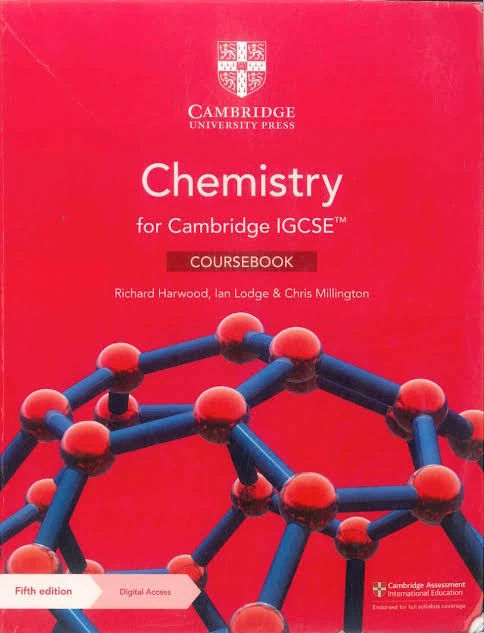
Written by Richard Harwood, Ian Lodge, and Chris Millington, the Cambridge IGCSE Chemistry Coursebook is the most widely recommended primary text for the 0620 syllabus. It features exceptionally detailed 3D molecular models, full-color laboratory apparatus diagrams, and clearly annotated chemical reaction sequences.
One feature that sets this Cambridge University Press 0620 resource apart is the dedicated “Experimental Skills” sections embedded throughout each chapter. These sections give students step-by-step guidance on laboratory technique, variable measurement, and safety protocol, which directly prepares them for Paper 4 and Paper 6. Digital access through the Cambridge GO platform adds interactive particle animations, calculation walkthroughs, and auto-marked self-assessment quizzes that provide instant feedback.
Ideal for: Students who learn best through visual content and who want the most direct alignment with Cambridge’s own assessment language.
Cambridge IGCSE Chemistry Student’s Book (Hodder Education)
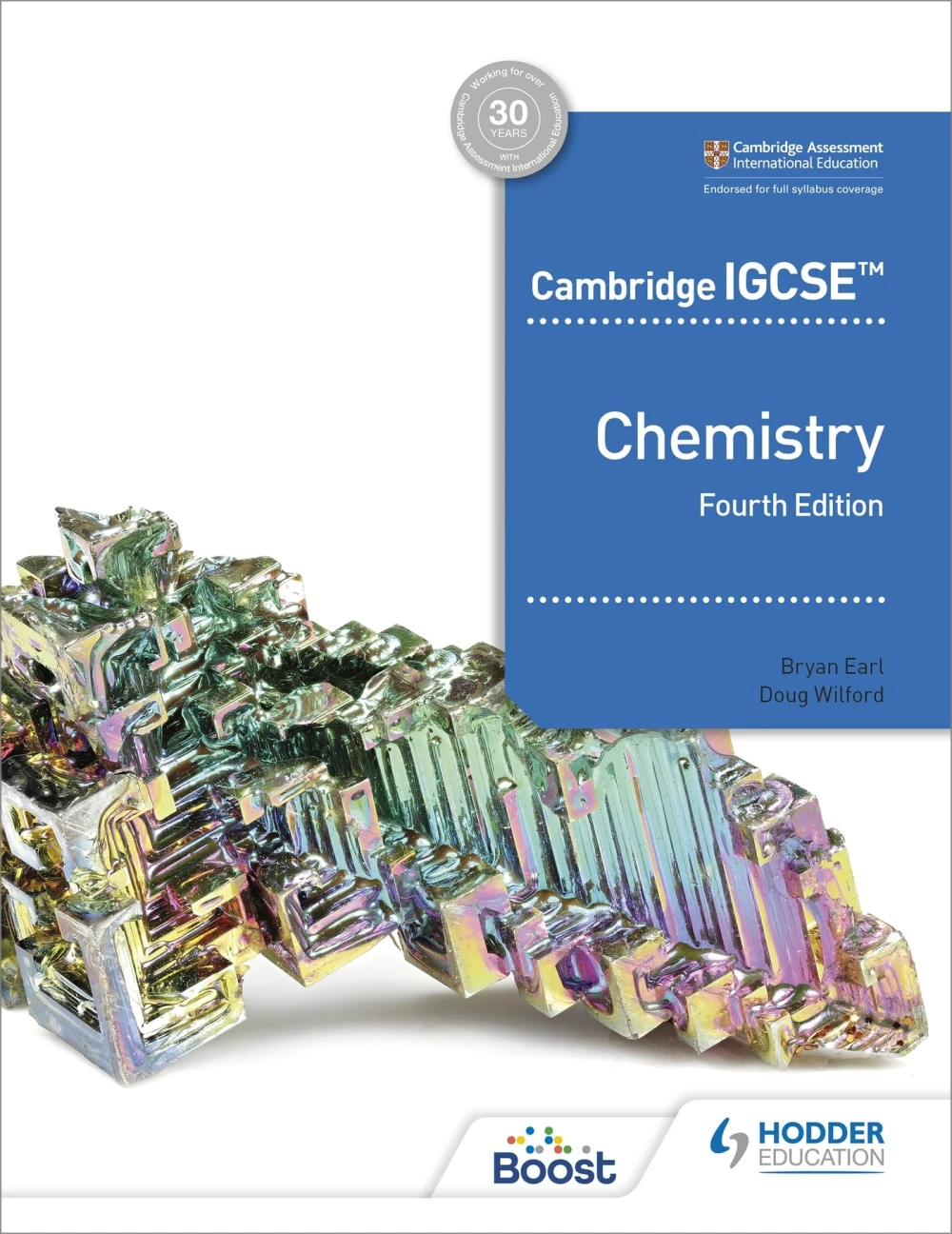
The Hodder IGCSE Chemistry student’s book, written by Bryan Earl and Doug Wilford, takes a more analytical approach. Its strength lies in mathematical chemistry: balancing complex equations, calculating moles from mass and volume, determining empirical formulas from combustion data, and working through percentage yield problems step by step.
A common mistake we see is Extended tier students picking up the Cambridge Coursebook and then struggling with the calculation-heavy papers because they never built a systematic approach to stoichiometry. The Hodder book addresses this gap directly, with entire sections dedicated to equations and calculations in Chemistry IGCSE, structured from first principles. Each chapter ends with a large bank of real past paper questions sorted by difficulty, which is excellent for self-assessment.
Ideal for: Students targeting Grade 7 to 9 on the Extended tier who need strong mathematical grounding in Chemistry.
Complete Chemistry for Cambridge IGCSE (Oxford University Press)
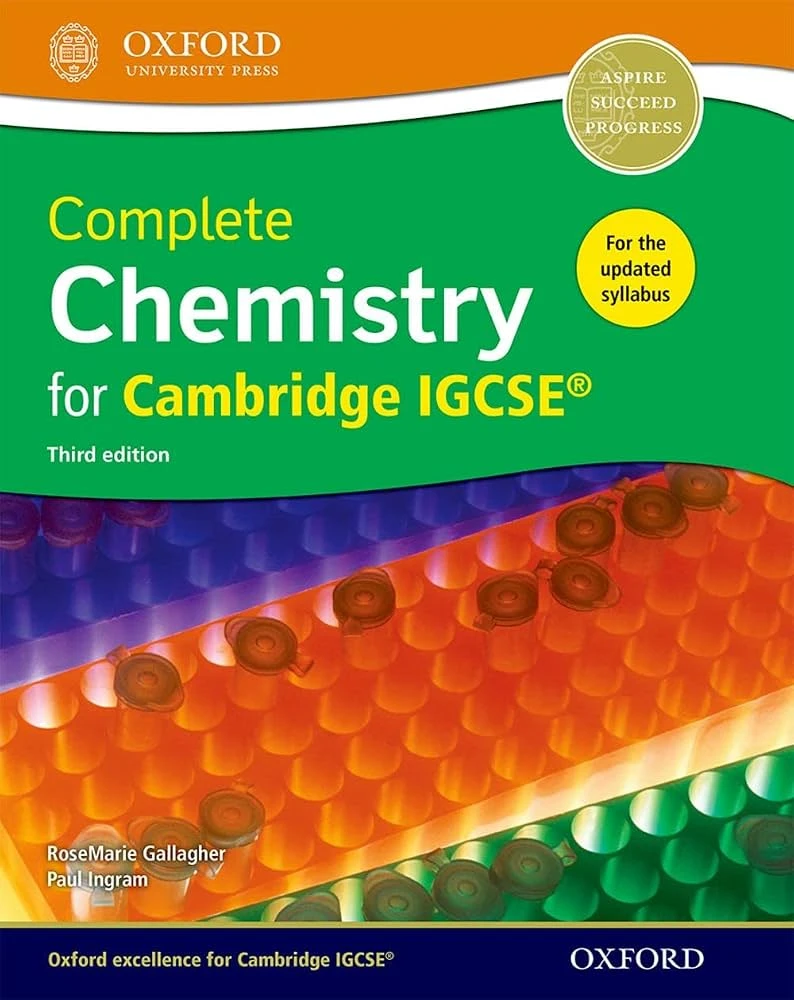
The Oxford IGCSE Chemistry book, written by RoseMarie Gallagher and Paul Ingram, is arguably the most accessible of the three. RoseMarie Gallagher Chemistry texts are known for their crisp, scannable page layout: concise summary boxes, color-coded flowcharts, and vocabulary explanations that make this resource particularly effective for English as an Additional Language (EAL) learners.
One critical detail often overlooked is that the Oxford book also contains “stretch” questions designed specifically for Extended tier students tackling advanced topics such as equilibrium constants, organic synthesis mechanisms, and electrochemical cell calculations. This makes it a strong all-in-one option for students who want both accessibility and academic depth without purchasing separate supplementary materials.
Ideal for: EAL learners, self-study students, and any student who values visual clarity and rapid topic summaries during revision.
>>> Read more: IGCSE Chemistry Past Paper Strategy for 2026: Smart Ways to Practice for Better Results
IGCSE Chemistry revision guides vs full textbooks: which do you need?
A full IGCSE Chemistry textbook typically runs between 400 and 600 pages. A revision guide compresses the same syllabus into 150 to 200 pages of high-density summaries, key equation tables, and practice questions. They serve entirely different functions and should not be treated as interchangeable.
The IGCSE Chemistry revision guide is not a substitute for a full coursebook during the learning phase. Students who rely solely on a revision guide from September often find that their understanding of mechanisms, such as why electrolysis produces specific products at specific electrodes, is superficial and easily destabilized by unfamiliar question phrasing. The revision guide becomes powerful only when it is used to consolidate knowledge that has already been built through a full textbook.
The recommended sequence at Times Edu looks like this:
- Months 1 to 6: Use a full endorsed coursebook as your primary resource. Read chapters actively, complete end-of-chapter questions, and flag areas of weakness.
- Months 6 to 8: Introduce the revision guide. Use it to identify which topics you can recall confidently and which need a second pass with the coursebook.
- Final 6 to 8 weeks: Work exclusively through past papers, mark schemes, and the revision guide for rapid recall practice.
>>> Read more: IGCSE Chemistry “Explain” Questions 2026: How to Write Clear, High-Scoring Answers
Top IGCSE Chemistry books by Hodder, Oxford and Cambridge University Press
Beyond the three flagship textbooks, each publisher offers companion resources that significantly strengthen a student’s preparation.
| Publisher | Main coursebook | Companion workbook | Revision guide |
|---|---|---|---|
| Cambridge University Press | IGCSE Chemistry Coursebook (Harwood et al.) | IGCSE Chemistry Workbook | IGCSE Chemistry Revision Guide |
| Hodder Education | IGCSE Chemistry Student’s Book (Earl & Wilford) | IGCSE Chemistry Practical Workbook | Cambridge Checkpoints / Boost resources |
| Oxford University Press | Complete Chemistry for Cambridge IGCSE (Gallagher & Ingram) | Complete Chemistry Workbook | Complete Chemistry Revision Guide |
The IGCSE Chemistry workbook from Cambridge University Press is particularly valuable for Paper 6 (Alternative to Practical) preparation. It contains structured practice questions that mirror the exact format of planning, analysis, and evaluation tasks that examiners use. In our experience working with international students who attend schools without proper laboratory access, this practical skills Chemistry book is an essential purchase, not an optional one.
Collins IGCSE Chemistry materials also appear regularly in school booklists, particularly in South and Southeast Asia. While Collins IGCSE Chemistry resources are not always directly endorsed, they are well-structured and provide solid supplementary practice, particularly for Core tier students.
>>> Read more: IGCSE Chemistry Mistakes 2026: Common Errors Students Make and How to Avoid Them
How to use an IGCSE Chemistry book alongside past papers and practicals
Owning the right IGCSE Chemistry book is only step one. The way a student interacts with that book across 18 to 24 months of study determines whether it becomes a genuine learning tool or an expensive shelf ornament.
One approach that consistently produces strong results in our Times Edu tutoring sessions is the “read, recall, retrieve” method:
- Read one topic section in your coursebook (for example, the mole concept in the Hodder book, pages on stoichiometry).
- Close the book and write out everything you remember: definitions, equations, worked examples, and potential exam traps.
- Retrieve using past paper questions on that specific topic from the Cambridge 0620 question bank, then compare your answers to the official mark scheme.
This three-step cycle is more effective than passive re-reading because it trains the retrieval pathways that examiners actually test. A common mistake we see is students who highlight their textbooks extensively but never attempt to reproduce information from memory. Highlighting creates an illusion of learning without the cognitive effort that actually builds long-term retention.
For practical skills, students should pair their coursebook with the Cambridge IGCSE Chemistry Workbook and spend at least one session per fortnight on planning investigations, drawing results tables, plotting graphs with correct error bars, and writing conclusion statements that directly address the hypothesis. These skills are explicitly marked in Paper 4 and Paper 6 and are frequently under-practiced even by otherwise strong students.
>>> Read more: IGCSE Chemistry Study Plan for 2026: A Simple Revision Guide for Better Exam Preparation
Where to buy IGCSE Chemistry books at the best price online
When parents and students decide to buy IGCSE Chemistry books, the first instinct is often to search for the cheapest available option. This approach carries a real academic risk that is worth understanding before making a purchase.
The Cambridge 0620 syllabus was substantially updated for examinations from 2023 onwards. Books published before 2021 may contain outdated content, deprecated terminology, or assessment guidance that no longer matches current mark scheme expectations. Always verify the edition year before purchasing.
Reliable sources for purchasing endorsed resources include:
- Cambridge University Press website: Direct purchase guarantees the correct edition and includes digital access codes for the Cambridge GO platform.
- Hodder Education website: The official source for Hodder IGCSE Chemistry materials, often bundled with digital Boost access.
- Amazon (verified seller listings): Generally reliable for new books, but check the edition year carefully in the product description.
- Book Depository: Offers free international shipping to most countries, which is valuable for students in markets where physical bookstores do not stock IGCSE materials.
- Local school bookstores: Many international schools in Vietnam, Indonesia, Thailand, and Malaysia stock endorsed Cambridge materials directly. Price comparison is advisable.
One critical detail often overlooked is the digital access code included with new copies. The Cambridge GO platform, for example, provides interactive content that is not available in the physical book alone. Purchasing a secondhand copy may save money upfront, but the digital code is typically single-use and will already have been activated.
>>> Read more: Ace IGCSE Chemistry 2026: Master Stoichiometry
Free IGCSE Chemistry resources vs investing in a dedicated study book
A wide range of free IGCSE Chemistry resources exists online, and students understandably wonder whether purchasing a full IGCSE Chemistry textbook is necessary. The honest answer requires some nuance.
Free resources that are genuinely valuable include:
- Cambridge 0620 past papers and mark schemes: Available directly from the Cambridge website at no cost. These are non-negotiable revision tools regardless of which textbook a student uses.
- Cambridge syllabus document: The 2023 to 2025 Cambridge IGCSE Chemistry syllabus is a free PDF that defines exactly what is and is not assessed. Every student should read the syllabus document at least once.
- YouTube channels: Channels such as Richard Thornley, Andrew Waller, and similar educators provide well-structured video explanations that complement textbook study effectively.
Free resources that are unreliable include unverified revision websites, PDF copies of textbooks shared without authorization (which are often outdated editions and also constitute copyright infringement), and social media study groups where misinformation spreads quickly.
In our experience working with international students across multiple exam sessions, self-study Chemistry IGCSE students who invest in at least one endorsed coursebook and one official revision guide consistently outperform those who rely solely on free online material. The difference shows most clearly in questions that require precise scientific language, as examiners award marks for specific terminology that casual online resources rarely teach systematically.
The cost of a quality IGCSE Chemistry book, typically between USD 30 and USD 60, is a small fraction of examination fees and tuition costs. Treating it as an unnecessary expense is a false economy.
>>> Read more: IGCSE Tutor 2026: How to Choose the Right One
Frequently asked questions
Which IGCSE Chemistry textbook is officially endorsed by Cambridge?
Is the Cambridge IGCSE Chemistry coursebook enough to achieve a high grade?
What is the best IGCSE Chemistry revision guide for last-minute exam preparation?
Which IGCSE Chemistry book covers equations and stoichiometry calculations most clearly?
Do I need a separate workbook for IGCSE Chemistry exam practice?
Are older editions of IGCSE Chemistry books still valid for the current 0620 syllabus?
Which IGCSE Chemistry book is best for self-study students without a tutor?
Conclusion
At Times Edu, we have worked with IGCSE Chemistry students across Asia, Europe, and the Middle East since 2018. Our 1-on-1 tutoring model is built around diagnosing each student’s specific conceptual gaps and exam technique weaknesses, then building a resource plan tailored to their timeline, learning style, and target university profile. If you are unsure which IGCSE Chemistry book combination is right for your student, or how to structure the next 6 to 12 months of Chemistry preparation, book a personalized academic roadmap consultation with our team. The right plan, started at the right time, makes every study hour count.