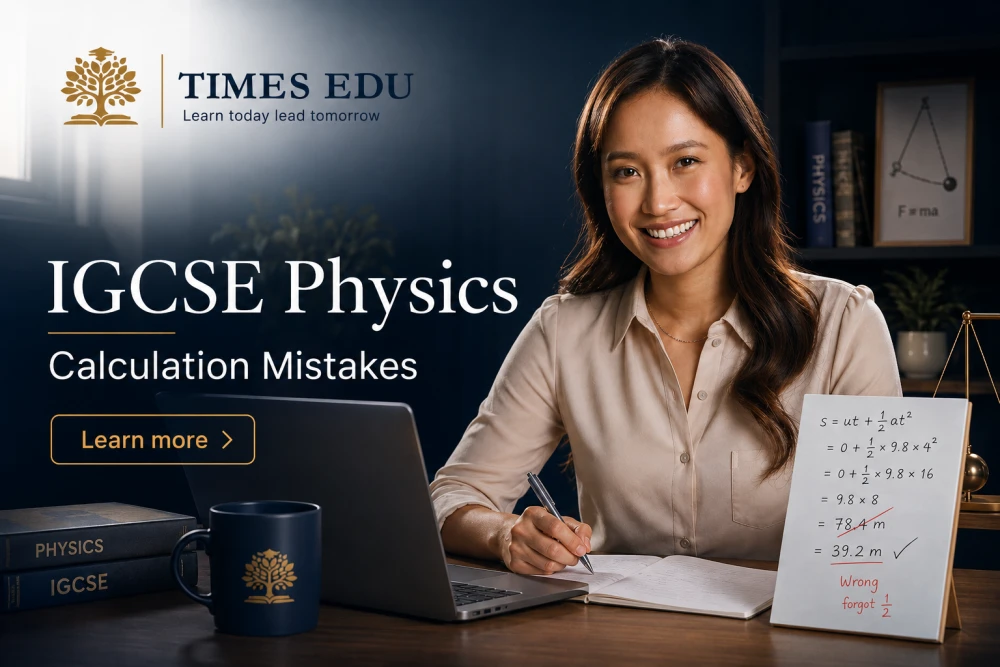
IGCSE Physics how to get full marks 2026: The complete strategy guide
To get full marks in IGCSE Physics, students need to combine strong subject knowledge with precise exam technique across Papers 2, 4, and 6. This means showing complete calculation working, responding accurately to command words, using correct units and significant figures, and applying clear scientific reasoning in written and practical questions. Students also need to understand how Cambridge awards method marks and avoid common errors in graphs, unit conversions, and experimental evaluation.
This guide explains the key strategies for maximising marks across Cambridge IGCSE Physics 0625 and building more consistent exam performance.
- Understanding where full marks are available across IGCSE Physics papers
- Paper-by-paper strategy for full marks IGCSE Physics
- Topics where full marks are most achievable in IGCSE Physics
- How to secure method marks even when your final answer is wrong in IGCSE Physics
- How to eliminate avoidable errors that prevent full marks in IGCSE Physics
- Revision strategies that maximise full-mark potential in IGCSE Physics
- The final checklist before submitting your IGCSE Physics paper
- Frequently asked questions
Understanding where full marks are available across IGCSE Physics papers

Before you can build a strategy for a perfect score in IGCSE Physics [1] , you need to understand exactly how marks are distributed. Cambridge IGCSE Physics (0625) is assessed across three papers at the Extended tier, and each paper rewards a different set of skills.
| Paper | Name | Weighting | Total Marks | Skills Tested |
|---|---|---|---|---|
| Paper 2 | Multiple Choice | 30% | 40 marks | Conceptual accuracy, unit awareness |
| Paper 4 | Extended Theory | 50% | 80 marks | Calculation, explanation, analysis |
| Paper 6 | Alternative to Practical | 20% | 40 marks | Experimental reasoning, graphing |
One critical detail often overlooked is that Paper 4 carries the heaviest weighting at 50% of your total grade. This means that every single mark dropped on Paper 4 has the greatest impact on your final grade. Students who focus all their revision energy on memorising facts but neglect exam technique on Paper 4 are the most common casualty we see at Times Edu when grade boundaries are released.
Understanding this distribution is the first step toward a genuine 0625 full marks strategy. You must allocate your preparation time in rough proportion to each paper’s weighting, while sharpening a different skill set for each one.
>>> Read more: IGCSE Physics 0625 books 2026: Complete guide for students and teachers
Paper-by-paper strategy for full marks IGCSE Physics
Paper 2: The multiplier effect
Paper 2 is 40 multiple-choice questions, each worth one mark. Because there is no partial credit, every question carries equal weight, and a careless error on an easy question costs exactly the same as missing a hard one.
The elimination method is the single most reliable technique for Paper 2. Rather than scanning the four options and selecting the one that looks correct, you cross out the two options that violate a fundamental physical law first. A vector pointing in the wrong direction, an efficiency value above 100%, or a speed exceeding the speed of light are all immediate eliminations. This narrows every question to a binary choice and reduces the chance of being misled by convincing but incorrect distractors.
Unit traps are the most common source of dropped marks on Paper 2. Cambridge examiners deliberately include the result of a common unit conversion error as one of the answer options. If a question asks for power but gives time in minutes, one of the four options will always be the answer a student gets if they forget to convert minutes to seconds. The counter-strategy is simple: Before you begin any calculation, circle every unit in the question and write the converted value next to it. This single habit is worth several marks across the paper.
Paper 4: The F-S-S-U method for top score Physics Cambridge
Paper 4 is where A* IGCSE Physics grades are won or lost. In our experience working with international students, the most damaging error on this paper is not making a mathematical mistake; it is failing to write the formula before substituting numbers.
Cambridge mark schemes award method marks for showing a correct formula, even when the final numerical answer is wrong. If you write only the final answer and it contains an arithmetic slip, you receive zero marks for that calculation. If you write the formula first (for example, writing p = mv before substituting values), you receive the method mark even if your arithmetic is off. This is the single most important rule for securing method marks in IGCSE Physics calculations.
Significant figures are another consistent mark-loss point. Cambridge’s mark scheme penalises any final answer given to one significant figure unless the data in the question itself is given to one significant figure. If your calculator displays 3.3333, write 3.3 or 3.33. Writing the answer as 3 will trigger an immediate accuracy-mark penalty, even if your method was completely correct.
Command words on Paper 4 follow strict patterns that the mark scheme enforces rigidly:
- State: One concise factual sentence, no explanation required or rewarded
- Explain: A full cause-and-effect chain, written as a logical sequence (for example, “temperature rises, so particles gain kinetic energy, so the rate of collisions with the container walls increases”)
- Calculate: Formula first, substitution second, answer with unit third
- Describe: A sequence of observable events, not causes
A common mistake we see is that students write full explanations for “state” questions and waste time, or write only a single sentence for “explain” questions and miss the cause-and-effect marks entirely.
Paper 6: Graph and control for Cambridge Physics excellence
Paper 6 tests experimental reasoning, not memory. The two highest-yield skills for this paper are drawing gradients correctly and describing limitations with technical precision.
The gradient triangle rule is non-negotiable for full marks. When Cambridge asks you to calculate the gradient of a line of best fit, your drawn triangle must span at least 50% of the total length of the plotted line. Triangles drawn over a small portion of the line introduce proportionally larger reading errors and lose marks. Draw large, label the coordinates of both triangle corners clearly, and show the rise-over-run calculation explicitly.
Experimental limitations are a section where students throw away marks by using vague language. Writing “human error” or “I may have made a mistake” receives zero marks from the Cambridge mark scheme, without exception. Every limitation must be a specific, named technical flaw. Acceptable answers include parallax error when reading a meniscus, zero error on an ammeter before calibration, or heat loss to the surroundings affecting a thermal experiment. One critical detail often overlooked is that each limitation should also be paired with an improvement, because many mark schemes award one mark for identifying the problem and one mark for suggesting how to fix it.
>>> Read more: IGCSE Physics Time Management: How to Use Your Exam Time More Effectively in 2026
Topics where full marks are most achievable in IGCSE Physics
Some topics in IGCSE Physics reward students with very structured, predictable mark schemes. If you know exactly what the mark scheme expects, these topics become reliable sources of full marks in IGCSE Physics without requiring advanced analytical thinking.
| Topic | Key Trigger Words for Full Marks | Most Common Miss |
|---|---|---|
| Mechanics (terminal velocity) | “Weight equals drag, resultant force is zero” | Saying “forces are balanced” without specifying which forces |
| Thermal (evaporation) | “Most energetic molecules escape, average kinetic energy of remaining molecules decreases” | Mentioning only “molecules escape” without the energy reasoning |
| Electricity (parallel circuits) | “Potential difference across each branch is identical” | Stating only that current splits |
| Waves (total internal reflection) | “Light travels from a denser to a less dense medium, angle of incidence exceeds the critical angle” | Omitting the medium direction or the critical angle condition |
| Pressure (liquids) | “Pressure acts equally in all directions at the same depth” | Describing only downward pressure |
This topic-by-topic marks approach for IGCSE Physics is something we train every student on at Times Edu. Learning the trigger words is not about memorising answers; it is about understanding which specific piece of physics Cambridge needs to see in order to award the mark.
>>> Read more: IGCSE Physics Mock Improvement Plan for 2026: Practical Steps to Improve After Every Mock Exam
How to secure method marks even when your final answer is wrong in IGCSE Physics
The method marks system in Cambridge IGCSE Physics is genuinely generous, but only if you know how to use it. A student who understands method marks full marks Physics can recover two or three marks per calculation question even after making an arithmetic error.
The three rules for securing every available method mark are as follows. First, always write the raw algebraic formula before any substitution. Second, substitute the correct values with correct units into the formula on a separate line. Third, if you make an error in step two but carry it forward consistently, Cambridge awards “carried forward” marks on subsequent parts of the question. Never leave a blank answer; always write your working even if you are uncertain, because a partially correct method is always worth more than an empty space.
In our experience working with international students, the students who score the highest on Paper 4 are not necessarily the strongest mathematicians. They are the students who have the best habits around showing structured working. This is a habit that can be built in four to six weeks of focused practice.
>>> Read more: IGCSE Physics Past Paper Strategy for 2026: Smart Ways to Practice for Better Exam Results
How to eliminate avoidable errors that prevent full marks in IGCSE Physics
Avoidable errors in IGCSE Physics fall into three categories: Unit errors, vocabulary errors, and reading errors. Each one can be systematically eliminated with the right habits.
Unit errors occur most frequently when time is given in minutes and must be in seconds, when energy is given in kilojoules instead of joules, or when distance is given in centimetres instead of metres. The fix is to build a unit-conversion checklist at the top of every calculation question before you begin.
Vocabulary errors occur when students use approximate physics language rather than the precise terms the mark scheme requires. Saying “the ball slows down because of friction” is not wrong, but it will not earn full marks if the mark scheme requires “the ball decelerates because the frictional force acts in the direction opposite to the motion.” Precise language is a learnable skill.
Reading errors occur when students misread what a question is actually asking. A question that says “explain why the reading on the voltmeter decreases” is asking for a reason, not a description of what happens next. Underlining the command word and the key variable in every question before you write anything is a simple discipline that prevents this category of error entirely.
>>> Read more: IGCSE Physics Explain Questions: PEE Framework for Full Marks
Revision strategies that maximise full-mark potential in IGCSE Physics
A revision strategy 0625 that is genuinely designed for full marks looks different from standard revision. Passive re-reading of notes does not build the exam technique skills that Cambridge rewards.
The most effective revision structure for achieving a perfect score in IGCSE Physics combines three types of practice in rotation. The first type is mark scheme training, where you write an answer, then compare it word-for-word with the official Cambridge mark scheme and identify every specific phrase you missed. The second type is timed paper practice, where you simulate exam conditions strictly, including time pressure and no notes. The third type is error log analysis, where you keep a written record of every mark you drop and categorise it as a unit error, vocabulary error, reading error, or knowledge gap.
Drawing on years of experience at Times Edu, we have found that students who maintain an active error log and revisit it weekly before their exam improve their scores by an average of 8 to 12 marks on Paper 4 alone. The log transforms vague feelings of “I need to do better” into specific, targeted practice.
Spaced repetition of the topic-specific trigger word tables shown earlier in this guide is also highly effective. Review each topic’s trigger words three days after first learning them, then seven days later, then fourteen days later. This encoding pattern maximises retention for the exam.
>>> Read more: IGCSE Physics 0625 Mistakes: 10 Errors That Cost A* in 2026
The final checklist before submitting your IGCSE Physics paper
A checking routine in IGCSE Physics is not about re-reading your answers hoping to feel confident. It is a structured, systematic scan of specific error categories in the final ten minutes.
Use this checklist in the last ten minutes of every paper:
- Scan every calculation for units: Have you included a unit on every final numerical answer?
- Scan every formula line: Did you write the raw equation before substituting?
- Scan every explanation answer: Does each “explain” answer contain a cause-and-effect chain of at least two logical steps?
- Scan every significant figure: Have you rounded to the appropriate number of significant figures as guided by the question data?
- Scan every blank space: Is there any question you left empty that you could attempt for partial method marks?
- On Paper 6, check every graph: Does your gradient triangle cover at least half the line? Are both axes labelled with units?
This checking routine for IGCSE Physics takes approximately eight minutes when practised regularly. Leaving two minutes to re-read the question paper for any misread questions completes the ten-minute window.
>>> Read more: IGCSE Physics Study Plan for 2026: A Simple Revision Guide for Better Exam Preparation
Frequently asked questions
Is it possible to get full marks in IGCSE Physics Paper 4?
Yes. Cambridge publishes examiner reports confirming that full marks on Paper 4 are achieved every session. The students who achieve it combine complete topic knowledge with disciplined exam technique, particularly around showing formula-first working and using precise vocabulary. It is genuinely attainable with structured preparation.
Which topics in IGCSE Physics offer the easiest full marks?
Electricity (parallel circuit voltage rules), waves (total internal reflection conditions), and mechanics (terminal velocity explanation) are the three most predictable topics because Cambridge’s mark scheme has used near-identical trigger words for over a decade. Students who memorise the exact phrasing for these topics can secure the marks reliably under exam pressure.
How do you secure method marks even when your calculation answer is wrong in 0625?
Write the correct algebraic formula on line one, substitute the correct values on line two, and show all arithmetic on line three. If your arithmetic is wrong but your formula and substitution are correct, Cambridge awards the method mark. If a later part of the question uses your wrong answer as a starting value, Cambridge also awards “carried forward” marks, provided your subsequent working is consistent with your earlier value.
What are the most common reasons students miss full marks in IGCSE Physics?
The four most common reasons are: Failing to convert units before calculating, writing one-sentence answers to “explain” questions that require a cause-and-effect chain, using vague experimental limitation language such as “human error,” and writing final answers to only one significant figure. All four are entirely avoidable with deliberate practice.
How does showing all working help you get full marks in IGCSE Physics?
Cambridge’s mark scheme awards marks at each logical step of a calculation, not only at the final answer. Showing all working means that even if your final answer contains an error, you can still receive marks for the correct formula, the correct substitution, and correct unit conversion. A student who shows full working and makes one arithmetic error might score 3 out of 4 marks. A student who writes only the final answer receives 0 out of 4 marks if that answer is wrong.
What should you check in the last ten minutes of the IGCSE Physics exam?
Focus the final ten minutes on the six-point checklist described earlier in this guide: Units on answers, formulas written before substitution, cause-and-effect chains in explanations, significant figures, blank spaces, and graph quality on Paper 6. This is a targeted scan, not a general re-read.
How do the highest-scoring students approach IGCSE Physics papers?
In our experience, the highest-scoring students treat the mark scheme as a second language. They read every question through the lens of what a Cambridge examiner needs to see in order to award the mark, rather than what they personally know about the topic. They write for the examiner, not for themselves. This mindset shift, combined with technical habits around working, units, and vocabulary, is what consistently separates A* IGCSE Physics candidates from strong but imperfect performers.
Conclusion
If you are a student or parent looking to build a personalised academic roadmap that takes you from your current score to the grade you need for your target university or programme, the Times Edu team is ready to help. A single consultation can identify exactly which of the error categories in this guide are costing you the most marks and build a targeted plan to close them before exam day.
Resources: