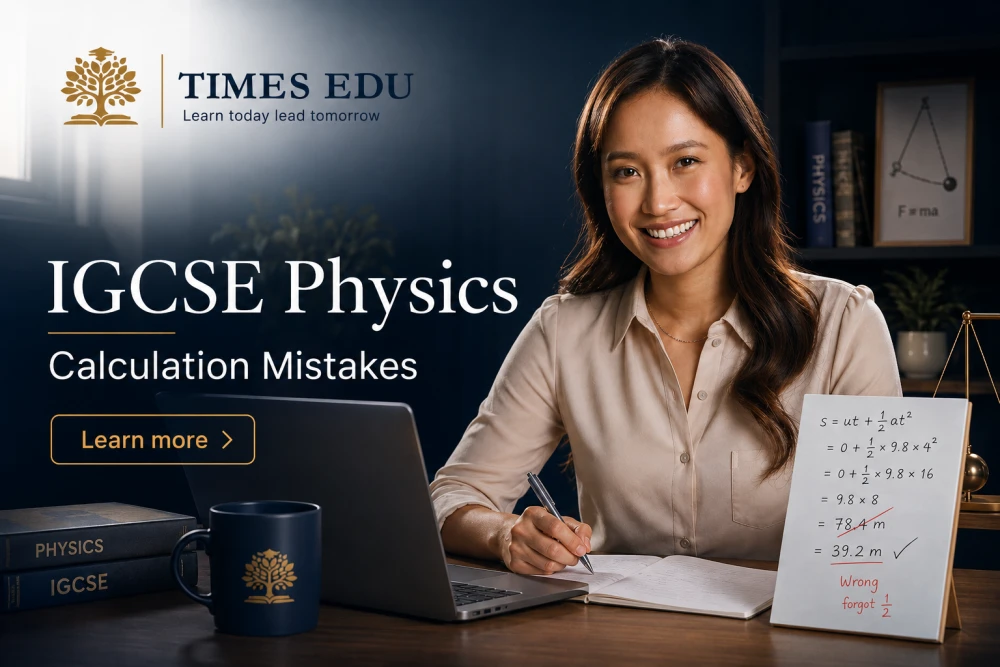
IGCSE Physics Past Paper Strategy for 2026: Smart Ways to Practice for Better Exam Results
An effective IGCSE physics past paper strategy is to use specimen papers and recent past papers to learn current question styles, then switch to classified papers for topic-wise revision of weak areas.
Study mark schemes to copy the exact phrasing that earns marks, especially for definitions and explanations in Paper 4 Extended. Build a reliable MCQ strategy for Paper 2 using elimination, unit checks, and timed two-pass practice.
Track mistakes in an error log and use grade boundaries and thresholds to set realistic score targets and prioritize the topics that deliver the most marks fastest.
- A Strategic Approach To IGCSE Physics Past Paper Practice (IGCSE physics past paper strategy)
- How To Analyze Mark Schemes For Model Physics Answers (IGCSE physics past paper strategy)
- Mastering The Use Of Data And Formulae In Paper 4
- A Practical “Error Log” System That Raises Grades Fast
- Improving Speed And Accuracy For The Paper 2 MCQ
- Using Examiner Reports To Avoid National Average Errors
- How This Connects to Subject Choice for a Strong University Profile
- Frequently Asked Questions
A Strategic Approach To IGCSE Physics Past Paper Practice (IGCSE physics past paper strategy)

Based on our years of practical tutoring at Times Edu, the fastest improvements in IGCSE Physics come from how you use past papers, not how many you complete. Past papers are not a homework set; they are a diagnostic system for identifying predictable marks, recurring traps, and time pressure points. When students treat past paper practice as “just do and check,” they often plateau one grade below their potential.
A strong IGCSE physics past paper strategy uses Classified papers, Specimen papers, and full past paper sets to build three capabilities: (1) mark-scoring phrasing aligned to mark schemes, (2) formula and data fluency for Paper 4 Extended, and (3) a repeatable MCQ strategy under time constraints.
You then map these skills against Grade boundaries and Thresholds to decide what you must secure, what you can risk, and where your revision time generates the highest score return.
Build Your Past Paper Stack With Purpose (Classified papers, Specimen papers, and full papers)
Most students collect papers randomly from platforms like Spires Online Tutors, Save My Exams, Senpai Corner, TutorsPlus, Quora, Scribd, YouTube, and Reddit.
That can work, but only if your practice sequence is structured and you verify that papers match your syllabus code and component (for many students, this is the Cambridge IGCSE Physics pathway with Paper 4 Extended). Random practice tends to over-train your strengths and hide your weaknesses.
Use this three-layer paper stack:
- Layer A: Specimen papers. Use these early to calibrate what the board considers “standard” difficulty and how command words are rewarded.
- Layer B: Classified papers (topic-sorted). Use these to run Topic-wise revision before full mocks. This is where your biggest grade jump happens.
- Layer C: Full timed papers (past papers). Use these to master pacing, stress management, and real exam decision-making.
A critical detail most students overlook in the 2026 exam cycle is that small shifts in phrasing can change what earns a mark, even when the physics content feels “the same.”
Your method must be flexible enough to adapt to evolving examiner expectations, not just repeat old patterns.
Use Grade Boundaries and Thresholds to Set a Rational Target
Students often say, “I want an A*,” but they do not translate that into a required mark per component. High-achievers do this immediately, because it changes how they revise. Grade boundaries and Thresholds are not a prediction of your result; they are a scoring map that tells you what margin of error you can afford.
Practical implications:
- If your Paper 2 is unstable, you cannot “hope” Paper 4 will rescue you. You must engineer reliability in MCQ marks.
- If you are consistently losing 10–15 marks in Paper 4 due to method and units, your revision should prioritise mark-scheme language and calculation structure.
- If your goal is a top grade for selective university pathways later (IB HL Physics, A-Level Physics, or engineering admissions), you should treat IGCSE as a foundation exam and aim above the minimum threshold.
From our direct experience with international school curricula, the best students use thresholds to choose what to perfect and what to accept as “controlled risk.” That prevents panic revision and protects mental stamina.
A High-Yield Weekly Schedule for Topic-wise Revision
You should not begin with full papers unless you already know the syllabus well. The pedagogical approach we recommend for high-achievers is: Topic blocks first, then full-paper integration.
A proven 4-week cycle:
- Week 1–2: Topic-wise revision with classified papers
- Mechanics and motion
- Forces, momentum, pressure
- Energy, power, efficiency
- Thermal physics
- Week 3: Electricity and waves (high mark density)
- Circuits, resistance, power
- Electromagnetism basics
- Waves, ray diagrams, sound
- Week 4: Full papers and examiner correction
- 2× Paper 2 timed
- 2× Paper 4 Extended timed
- 1× Paper 6 (or Paper 5) timed depending on your route
Keep each session short and sharp. One paper without analysis is low value; one paper with forensic correction changes your score trajectory.
Table: Paper Planning Framework (timing, purpose, and common mark leaks)
| Component | Focus | Timing goal | What typically loses marks | What fixes it |
|---|---|---|---|---|
| Paper 2 (MCQ) | MCQ strategy, speed, elimination | ~1 minute/question average | Guessing without logic, misreading, weak unit sense | Elimination rules, “unit-first” checks, controlled second pass |
| Paper 4 Extended | Paper 4 Extended structure, explanations, calculations | Plan before you write | Missing method marks, rounding, units, vague explanations | Mark-scheme phrasing bank, formula discipline, show working |
| Paper 6 (Alt to Practical) | Experimental design, variables, graphs, evaluation | Calm precision | Weak variable control, graph scale/labels, vague improvements | Standard experiment templates, graph checklist, evaluation sentence stems |
| Paper 5 (Practical) | Hands-on skills (if applicable) | Efficiency + accuracy | Recording errors, unit errors, weak planning | Drill planning questions, practise tables/graphs |
>>> Read more: IGCSE Physics Mistakes 2026: Common Errors Students Make and How to Avoid Them
How To Analyze Mark Schemes For Model Physics Answers (IGCSE physics past paper strategy)

Mark schemes are not answer keys; they are scoring contracts. Your job is to learn what the examiner can award quickly and consistently. Students lose marks not because they “don’t know physics,” but because they do not express physics in mark-awardable form.
Train your “mark-scheme language” for definitions and explanations
Definitions in IGCSE Physics are highly pattern-based. If you write an academically correct sentence that does not match the expected phrasing, you can still lose marks.
Build a “definition bank” for:
- Momentum, acceleration, resultant force
- Work done, power, efficiency
- Specific heat capacity, latent heat
- Potential difference, resistance
- Electromagnetic induction (basic statements depending on syllabus)
Practice method:
- Write your definition in one line.
- Compared to the mark scheme.
- Rewrite using mark-scheme wording.
- Repeat after 48 hours from memory.
Decode command words and match answer shape
Many students know content but answer the wrong question type. Use these command word rules:
- State: One short fact, no story.
- Describe: What happens, observable changes, often sequential.
- Explain: Link cause to effect using physics principle.
- Calculate: Show formula, substitution, working, unit.
- Suggest: Plausible physics-based reasoning, not random ideas.
Learn the difference between “method marks” and “final answer marks”
Paper 4 Extended rewards process. If you only write the final number, you often lose method marks even if it is correct. You must make your working visible.
A disciplined calculation layout:
- Identify known values with units.
- Write the formula.
- Substitute with correct units.
- Calculate with sensible rounding.
- State the final answer with a unit.
Common misconception warning (high frequency):
Students believe “correct answer = full marks.”
In extended structured questions, correct answers can still score poorly if working is missing, units are absent, or reasoning is vague.
Table: A Mark Scheme Analysis Checklist
| What to extract | Why it matters | What you write in your notebook |
|---|---|---|
| Mark allocation per line | Shows how many points the examiner expects | “2 marks = two distinct ideas” |
| Required keywords | Certain words trigger marks | A short keyword list |
| Typical wrong answers | Reveals traps | “Trap: Confuse weight and mass” |
| Diagram expectations | Diagrams are mark-bearing | “Ray direction arrows needed” |
| Unit and significant figure patterns | Repeated mark leaks | “Always J, W, N, Pa” |
| Alternative phrasing allowed | Flexibility in wording | “Accept: ‘rate of energy transfer’ for power” |
>>> Read more: IGCSE Physics Study Plan for 2026: A Simple Revision Guide for Better Exam Preparation
Mastering The Use Of Data And Formulae In Paper 4
Paper 4 Extended is where strong students separate from the pack. The content is not the only issue; execution under time pressure is.
Formula mastery is not memorisation; it is selection
Most students can remember formulas but pick the wrong one when the question is disguised. Fix this by linking formulas to “triggers.”
Examples of triggers:
- “Rate” often signals per time (power, speed, current).
- “Opposes motion” suggests friction or resultant force thinking.
- “Area under graph” suggests work, energy, distance, or charge depending on axes.
Make a formula sheet, but do not stop there. Drill selection with mixed questions so you stop relying on pattern recognition alone.
Data interpretation is a scoring opportunity, not a side task
Students rush graphs and tables, then lose easy marks. Your process must be mechanical:
Graph checklist:
- Axis labels include quantity and unit.
- Scale uses most of the graph.
- Points plotted accurately.
- Line of best fit (when required).
- Gradient calculation steps shown.
- Intercept meaning explained if asked.
Precision habits that protect marks
High frequency mark losses:
- Missing or incorrect units
- Rounding too early
- Mixing up prefixes (milli, kilo, micro)
- Ignoring significant figures when the question cues precision
- Copying numbers incorrectly under stress
Times Edu correction rule: Every time you lose a mark for a preventable habit, you must add a “prevention rule” to your error log.
A critical detail most students overlook in the 2026 exam cycle is that many Paper 4 questions reward clarity over length. Examiners do not award marks for extra writing. They award marks for correct physics statements aligned to the mark scheme.
>>> Read more: A Level Physics Problem Solving 2026: A Step-by-Step Method to Boost Your Marks
A Practical “Error Log” System That Raises Grades Fast
Your error log is a performance tool. Without it, you will repeat the same mistakes and call it “more practice.”
Each entry should include:
- Topic
- Question type (definition, calculation, explanation, graph)
- What you did wrong
- The correction rule
- A micro-drill task (5 minutes) to fix it
Example entries:
- “Forgot unit in power calculation → rule: Final line must include unit.”
- “Explained current as ‘speed of electrons’ → rule: Current is rate of flow of charge.”
>>> Read more: Ultimate IGCSE Physics 0625 Revision Guide
Improving Speed And Accuracy For The Paper 2 MCQ
Paper 2 is often underestimated. It looks quick, so students practise it casually. That is a mistake, because Paper 2 reliability strongly stabilises your total score against tougher Paper 4 moments.
Two-pass MCQ strategy (used by top scorers)
Pass 1 (fast certainty):
- Answer questions you can do confidently.
- Mark uncertain questions and move on.
- Do not overthink early.
Pass 2 (logic and elimination):
- Eliminate options using units, extremes, and conservation laws.
- Re-check the question stem for hidden conditions.
- Use approximate numbers to sanity-check.
Pass 3 (final control):
- Revisit only the highest-value uncertain items.
- Avoid changing correct answers without a clear reason.
Elimination rules that work in IGCSE Physics
- Unit-first rule: If the unit does not match, the option is wrong.
- Limiting case rule: Test extreme values (zero friction, very large resistance) to see what must happen.
- Conservation rule: Energy, charge, momentum cues often eliminate two options instantly.
- Direction rule: For fields and forces, draw arrows. Do not “imagine.”
Speed training without sacrificing accuracy
Timed training method:
- Do 10 MCQs in 10 minutes.
- Check, log errors, redo the same 10 after 48 hours.
- Scale up to full papers only after your accuracy holds.
This is where grade boundaries matter. If your target grade requires a stable total score, Paper 2 is the component where you engineer consistency.
>>> Read more: IGCSE Tutor 2026: How to Choose the Right One
Using Examiner Reports To Avoid National Average Errors
Examiner reports expose patterns of mistakes across thousands of students. If you learn them, you avoid “national average errors” before they happen.
What to extract from examiner reports:
- Topics with repeated misconceptions (mass vs weight, current vs voltage, heat vs temperature).
- Frequent diagram and graph errors (missing units, poor scale choice).
- Common reasoning gaps in explanations (not linking cause and effect).
- Calculation structure failures (no working, incorrect rearrangement).
Common misconceptions Times Edu sees repeatedly
- Confusing weight (force, N) with mass (kg).
- Treating current as “energy,” rather than rate of charge flow.
- Saying “voltage flows,” rather than using potential difference correctly.
- Mixing “heat” and “temperature” in thermal explanations.
- Forgetting that power is rate, not total energy.
From our direct experience with international school curricula, students in bilingual or international settings often use correct everyday English but incorrect physics language. That is why mark-scheme phrasing training is not optional.
How This Connects to Subject Choice for a Strong University Profile
Parents and students frequently ask whether taking Physics is “worth it” for the future. The correct answer depends on the pathway.
Physics is highly valued for:
- Engineering, computer science, data science, economics (quantitative), architecture (depending on route)
- Competitive STEM admissions where academic rigor is assessed
- IB HL and A-Level progression where foundations matter
Physics can be a strategic risk if:
- The student has weak maths foundations and no support plan
- The subject is chosen for prestige rather than fit
- The time cost crowds out stronger scoring subjects that matter for overall profile
Based on our years of practical tutoring at Times Edu, the best approach is not to avoid hard subjects. It is to build a support plan early, align it to grade thresholds, and prevent last-minute panic that damages both grades and wellbeing.
If your family is using IGCSE results as part of a longer study-abroad plan, a personalised academic roadmap matters. Your IGCSE performance affects confidence, course selection later (IB/A-Level/AP), and the credibility of your trajectory.
Frequently Asked Questions
How many years of IGCSE Physics past papers should I do?
Where can I find topical Physics past papers with mark schemes?
Use classified papers and topic-wise collections from reputable tutoring and revision platforms, then cross-check against official past papers and mark schemes.If you use community sources (forums or shared drives), verify syllabus code, paper variant, and that the mark scheme matches the exact paper. Your strategy fails if your resources are mismatched.
Is it better to do Paper 4 or Paper 2 first during revision?
How do I use the IGCSE Physics mark scheme effectively?
What are the hardest years for IGCSE Physics papers?
How can I simulate exam conditions at home for Physics?
How often should I practice the Alternative to Practical paper?
Conclusion
An effective IGCSE physics past paper strategy is a system: Classified papers for Topic-wise revision, specimen papers to calibrate expectations, full timed papers to harden execution, and mark-scheme analysis to convert knowledge into marks.
When this is done correctly, students typically see their scores stabilize quickly and their confidence rise in a measurable way.
Based on our years of practical tutoring at Times Edu, the fastest route to top performance is a personalized plan that targets your mark leaks and matches your study time to grade thresholds.
If you want, share your exam board route, target grade, and your last two Paper 2 and Paper 4 scores, and we will outline a tailored 4–6 week revision roadmap that prioritises the highest-yield improvements.