IGCSE Geography 0460 books 2026: Complete guide for students and teachers
Choosing the right IGCSE Geography book can make a major difference in how confidently students understand the syllabus and prepare for the Cambridge 0460, 0976, or O Level 2217 examinations.
This guide compares the leading textbooks from Cambridge University Press, Collins, and Hodder Education, highlighting their strengths for case studies, map skills, exam technique, and independent study. It also explains how to combine coursebooks, revision guides, workbooks, digital resources, and past papers effectively. Students and parents will gain practical advice on selecting the correct edition, avoiding outdated materials, and choosing resources that match individual learning needs and target grades.
- Best IGCSE Geography books: Complete guide for students and teachers
- Official Cambridge-endorsed IGCSE Geography textbooks and resources reviewed
- IGCSE Geography revision guides vs full coursebooks: what should you buy?
- Top IGCSE Geography books by Hodder, Oxford and Cambridge University Press
- How to use an IGCSE Geography book alongside case studies and past papers
- Where to buy IGCSE Geography books at the best price online
- Free IGCSE Geography resources vs investing in a dedicated study book
- Frequently asked questions
Best IGCSE Geography books: Complete guide for students and teachers
The Cambridge IGCSE Geography [1] syllabus is built around three compulsory themes: Population and Settlement, the Natural Environment, and Economic Development. Every endorsed IGCSE Geography textbook must cover all three themes in sufficient depth to prepare students for Papers 1, 2, and 4.
A common mistake we see at Times Edu is students purchasing a book based on price alone, without checking whether it is specifically endorsed for the current Cambridge 0460 syllabus version. An outdated edition may omit key case study requirements or present assessment guidance that no longer reflects the marking scheme.
The three publishers that dominate the endorsed market are Cambridge University Press (CUP), Collins, and Hodder Education. Each takes a distinctly different pedagogical approach, and the best choice genuinely depends on how an individual student learns.
>>> Read more: Best IGCSE Co-ordinated Sciences 0654 books 2026: Complete guide for students
Official Cambridge-endorsed IGCSE Geography textbooks and resources reviewed
Cambridge endorses textbooks that have been evaluated by its subject experts and confirmed to support the syllabus accurately. Below is a structured comparison of the three leading endorsed options for the Cambridge IGCSE Geography coursebook market.
| Book Title | Publisher | Authors | Key Strength | Best For |
|---|---|---|---|---|
| Cambridge IGCSE and O Level Geography Coursebook | Cambridge University Press | Gary Cambers, Steve Sibley | 50+ global case studies, Cambridge GO digital access | Students wanting depth and visual learning |
| Collins Cambridge IGCSE Geography Student Book | Collins | John Belfield, Jack Gillett | Practical map skills, Paper 4 guidance | Students needing skills-focused support |
| Cambridge IGCSE and O Level Geography Student’s Book | Hodder Education | Paul Guinness, Garrett Nagle | Clear layout, concise case studies | Students preparing independently or under time pressure |
Cambridge University Press (CUP) Coursebook
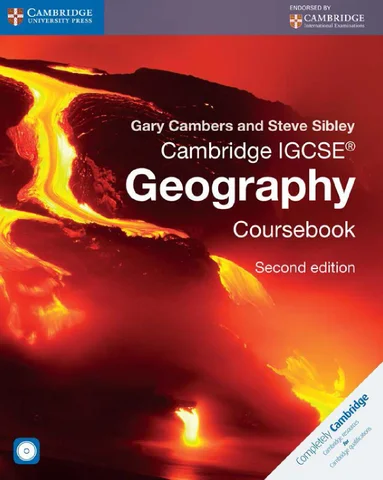
The CUP Cambridge IGCSE Geography coursebook, written by Gary Cambers and Steve Sibley, is widely regarded as the standard reference text for this course. It contains more than 50 global case studies covering both LEDCs and MEDCs, which gives students the breadth of geographical knowledge expected at the highest grade boundaries.
Digital access through Cambridge GO is a significant advantage. Students can interact with mapping tools and review sample exam answers with examiner commentary, which is something no printed revision guide alone can replicate. One critical detail often overlooked is that the Cambridge GO platform also provides teachers with structured lesson materials, making the CUP book a strong choice for students working alongside a tutor.
Collins IGCSE Geography Student Book
The Collins IGCSE Geography Student Book takes a noticeably practical angle. Written by John Belfield and Jack Gillett, it dedicates substantial attention to geographical skills including topographic map reading, grid references, contour interpretation, and the construction of cross-sections.
Its dedicated Paper 4 (Alternative to Coursework) guidance is one of the most thorough available in any single IGCSE Geography book. Students are walked through hypothesis formulation, field data collection methodology, and the production of conclusion graphs, all of which are assessed components that many students underestimate.
Hodder IGCSE Geography Student’s Book
Paul Guinness and Garrett Nagle have written a textbook praised for its scannable layout and punchy case studies. Where the CUP coursebook prioritizes depth, the Hodder IGCSE Geography book prioritizes retrieval-friendly design.
Each chapter closes with review questions mapped explicitly to the core assessment objectives, making it particularly efficient for exam-oriented revision. In our experience working with international students who have limited study time, the Hodder book tends to produce faster gains during the final six to eight weeks before the examination.
>>> Read more: IGCSE Combined Science 0653 book 2026: Complete guide for students and teachers
IGCSE Geography revision guides vs full coursebooks: what should you buy?
This is one of the most frequently asked questions at Times Edu consultations, and the answer is not binary. A full coursebook and a revision guide serve fundamentally different functions in a student’s study toolkit.
A full Cambridge IGCSE Geography coursebook, such as those from CUP or Hodder, is designed to build knowledge from the ground up. It introduces concepts, explains geographical processes, and provides the case study content needed to answer both structured and extended writing questions.
An IGCSE Geography revision guide, by contrast, assumes the student already has foundational knowledge. It condenses information, provides exam tips, and presents content in formats that support short-burst revision sessions.
When to use each resource:
- Use a full coursebook during the primary learning phase, typically from the beginning of Year 10 through to approximately three months before the exam.
- Switch to a dedicated IGCSE Geography revision guide for the consolidation phase, using it alongside past papers to identify and address knowledge gaps.
- A workbook or practice book can supplement both, providing question practice without requiring the student to move between separate past paper PDFs.
A common mistake we see is students buying only a revision guide and attempting to use it as their primary learning resource. This leads to surface-level understanding that collapses under the pressure of extended response questions worth six to eight marks.
>>> Read more: IGCSE Additional Mathematics 0606 book 2026: Complete guide for students and parents
Top IGCSE Geography books by Hodder, Oxford and Cambridge University Press
Beyond the three core endorsed textbooks, several additional resources are worth considering depending on a student’s specific weak areas.
Oxford IGCSE Geography Resources
Oxford University Press produces Geography materials that are frequently referenced in international school libraries. While Oxford IGCSE Geography resources are not always the first recommendation for the 0460 syllabus specifically, their thematic atlases and geographical skills workbooks are highly regarded by teachers for supplementary use.
Students who struggle with map skills in particular may find that an Oxford map skills Geography book, used alongside their primary coursebook, provides the additional practice needed to perform confidently on Paper 2.
IGCSE Geography Workbooks
Both Hodder and Cambridge University Press offer dedicated IGCSE Geography workbooks. These are structured sets of exercises that mirror the style and command word conventions used in the actual examination. Drawing on years of experience at Times Edu, we consistently recommend pairing a workbook with a main coursebook rather than relying on past papers alone during the early stages of revision.
Cambridge University Press 0460 Digital Resources
The Cambridge University Press 0460 resource ecosystem extends beyond the printed book. School and individual subscriptions to Cambridge GO unlock additional teacher-authored resources, interactive activities, and mark schemes that students cannot access through a standard textbook purchase.
>>> Read more: Best IGCSE Accounting 0452 books 2026: Complete guide for students
How to use an IGCSE Geography book alongside case studies and past papers
Owning the right IGCSE Geography book is only the first step. The way a student actively engages with the material determines whether that investment translates into exam marks.
Step 1: Build a case study bank from your coursebook
Case studies in IGCSE Geography are not optional extras. They are the evidence base that distinguishes a Grade 6 answer from a Grade 8 or Grade 9 answer. The CUP Cambridge IGCSE Geography coursebook contains more than 50 global case studies, and students should extract and memorize specific data points, place names, dates, and outcomes from at least eight to ten of these.
Step 2: Cross-reference case studies with the question paper
Past papers from Cambridge’s official resources page reveal which types of case studies appear most frequently. One critical detail often overlooked is that examiners reward specificity. A student who writes “a city in a developing country” will lose marks compared to a student who writes “Dhaka, Bangladesh, where the population grew from 6.6 million in 1990 to over 21 million by 2020.”
Step 3: Use your book’s review questions before attempting past papers
The Hodder IGCSE Geography book’s end-of-chapter questions are calibrated to the assessment objectives. Working through these before attempting full past papers allows students to identify conceptual gaps at the topic level rather than discovering them mid-paper under timed conditions.
Step 4: Practice map skills weekly
Map skills questions appear on Paper 1 and can be worth a significant portion of total marks. The Collins IGCSE Geography book contains the most structured guidance on reading topographic maps, identifying drainage patterns, and calculating gradients. Students should treat this as a technical skill requiring regular weekly practice rather than occasional review.
Step 5: Simulate Paper 4 with your coursebook guidance
Alternative to Coursework questions require students to demonstrate fieldwork methodology skills in a written examination setting. The Collins book’s Paper 4 chapters are the most comprehensive preparation tool available in a single IGCSE Geography book, and students should complete at least two full timed Paper 4 practice sessions before the actual examination.
>>> Read more: IGCSE Geography Case Study Questions: 5-Step Answer Framework for A*
Where to buy IGCSE Geography books at the best price online
For students and parents looking to buy IGCSE Geography books, several purchasing routes are available depending on location and budget.
| Purchasing Channel | Advantage | Consideration |
|---|---|---|
| Cambridge University Press website | Direct access to latest editions | Higher retail price |
| Amazon (local marketplace) | Competitive pricing, fast delivery | Verify edition matches current syllabus |
| Book Depository | Free international shipping | Delivery times vary by region |
| Local international school bookshop | In-person verification of edition | Often limited stock |
| Second-hand platforms (eBay, Facebook Groups) | Significantly lower cost | Risk of outdated edition or missing digital access codes |
One critical detail often overlooked when purchasing second-hand is that Cambridge GO digital access codes are single-use. A used CUP Cambridge IGCSE Geography coursebook may not include working digital access, which removes one of the most valuable features of that particular book.
Students in Southeast Asia, the Middle East, and Africa should also check whether regional editions are available, as CUP and Hodder occasionally publish adapted versions with locally relevant case studies.
>>> Read more: IGCSE books 2026: The complete guide to choosing the right study materials
Free IGCSE Geography resources vs investing in a dedicated study book
The internet provides an enormous volume of free Geography content. YouTube channels, student-made notes, and unofficial revision websites can supplement formal study, but they carry real risks that parents and students should understand before relying on them heavily.
What free resources do well:
- Providing quick topic overviews for initial orientation
- Offering video explanations of complex processes such as plate tectonics or hydrological cycles
- Supplementing case study knowledge with updated real-world statistics
Where free resources fall short:
- They rarely mirror the exact command word conventions and mark allocation logic of the Cambridge 0460 examination
- Case studies sourced from unofficial websites may contain factual inaccuracies or be insufficient in the specific detail examiners reward
- Without structured progression, students using only free resources often develop uneven topic coverage
In our experience working with international students who attempted self-study using free resources alone, the most common outcome was strong performance on familiar topics and significant mark loss on less-revised areas. A dedicated best Geography textbook IGCSE provides the structured syllabus coverage that prevents these blind spots.
At Times Edu, our tutors integrate selected free resources strategically within a structured study plan built around an endorsed primary textbook. This approach combines the depth of formal materials with the flexibility and accessibility of digital supplements.
>>> Read more: IGCSE Tutor 2026: How to Choose the Right One
Frequently asked questions
Which IGCSE Geography textbook is officially endorsed by Cambridge?
The Cambridge University Press Cambridge IGCSE and O Level Geography Coursebook, the Collins Cambridge IGCSE Geography Student Book, and the Hodder Education Cambridge IGCSE and O Level Geography Student’s Book are all officially endorsed for the 0460 / 0976 and 2217 syllabuses. Always verify endorsement on the Cambridge website before purchasing.
Is the Cambridge IGCSE Geography coursebook enough to prepare for the exam?
The CUP coursebook is comprehensive enough to serve as a primary resource, but most students benefit from supplementing it with past papers, a skills-focused workbook, and an IGCSE Geography revision guide during the final revision phase. Relying on a single resource without timed practice is a common strategic error.
What is the best IGCSE Geography revision guide for exam preparation?
For students who have completed their foundational study, a dedicated IGCSE Geography revision guide from Hodder or Collins provides condensed, exam-aligned content. The best choice depends on which aspects of the syllabus the student finds most challenging. A tutor at Times Edu can help identify this through a targeted diagnostic assessment.
Which IGCSE Geography book has the best case studies for the exam?
The CUP Cambridge IGCSE Geography coursebook leads in case study breadth, with more than 50 global examples covering both LEDC and MEDC contexts. The Hodder IGCSE Geography book offers more concise case studies that are easier to memorize under exam conditions. Both approaches are valid depending on a student’s learning style.
Do I need a separate map skills workbook for IGCSE Geography?
Students who find map reading, contour interpretation, or spatial analysis challenging should invest in a dedicated map skills Geography book or workbook. The Collins IGCSE Geography Student Book contains the strongest integrated map skills guidance of the three main endorsed texts, but a standalone Oxford map skills resource can provide additional practice if required.
Are older editions of IGCSE Geography books still valid for the current syllabus?
This depends on when Cambridge last revised the syllabus. Older editions may cover different case study requirements or exclude assessment guidance relevant to the current mark scheme. Students should verify that the edition they purchase explicitly states compatibility with the current 0460 syllabus version. When in doubt, contact the publisher directly or consult a specialist at Times Edu.
Which IGCSE Geography book is best for independent self-study?
The Hodder IGCSE Geography Student’s Book by Paul Guinness and Garrett Nagle is consistently rated highly by self-study students due to its scannable layout, concise case studies, and end-of-chapter review questions. The Collins book is also strong for independent learners who need structured skills guidance. For students combining self-study with a Times Edu tutor, the CUP coursebook paired with Cambridge GO digital access provides the richest learning environment.
Conclusion
At Times Edu, our consultants and subject tutors work with each student individually to assess which combination of resources matches their learning profile, timeline, and target grade. If you are unsure whether your current IGCSE Geography book strategy is giving you the best possible foundation for examination success, we invite you to book a personalized academic roadmap consultation with our team. A single session can clarify your resource gaps, restructure your revision plan, and give both students and parents a clear path forward.
Resources: