A Level Economics 9708: Syllabus, Exam Structure & Roadmap to an A* in 2026
A Level Economics is a subject that rewards students who learn to think rigorously, argue precisely, and evaluate honestly. It covers a vast range of content from price elasticity and externalities at the microeconomic level to fiscal policy, monetary policy, aggregate demand supply dynamics, and development economics at the macroeconomic level. Whether a student is sitting Cambridge A Level Economics 9708 or Edexcel A Level Economics 9EC0, the core demands are the same: Demonstrate depth of understanding, construct well-evidenced arguments, and evaluate with genuine analytical maturity.
The students who perform best are not necessarily the ones who know the most content. They are the ones who have been trained to deploy that content effectively in high-pressure essay conditions, particularly in the 25-mark essay formats that determine the majority of final grades.
- What is A Level Economics and what does it cover?
- Core topics in the A Level Economics syllabus
- Microeconomics vs Macroeconomics in A Level Economics
- How is A Level Economics assessed and graded?
- How to write high-scoring essays in A Level Economics
- A Level Economics vs GCSE economics: key differences
- Best textbooks and resources for A Level Economics
- Frequently asked questions
What is A Level Economics and what does it cover?
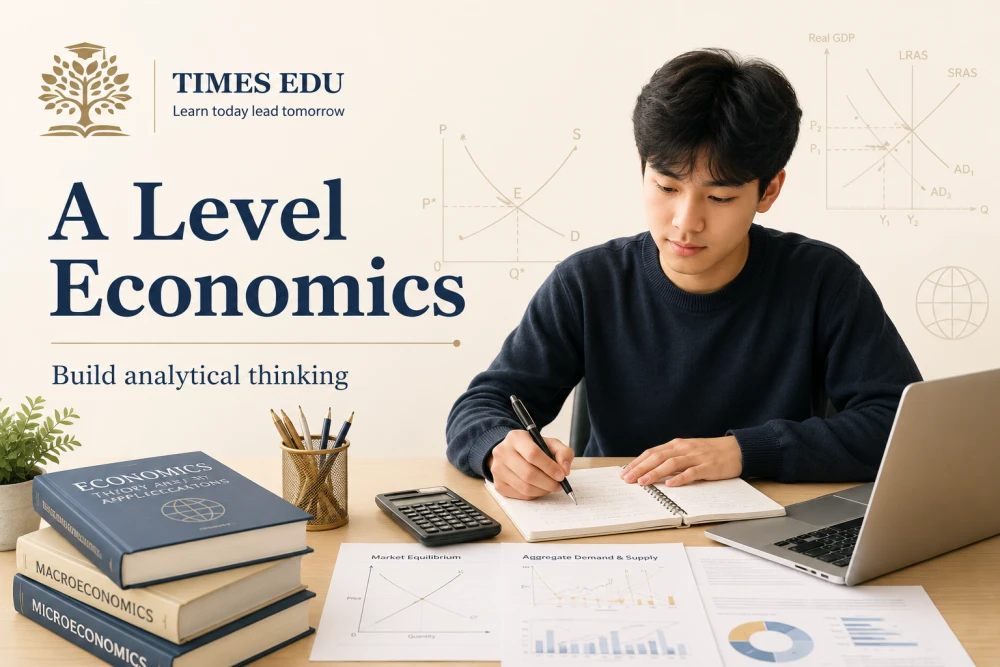
A Level Economics [1] is a two-year qualification offered primarily through Cambridge International (Cambridge A Level Economics 9708) and Edexcel (Edexcel A Level Economics 9EC0), though it is also available through AQA and OCR for UK-based students. The subject introduces students to how economies function at both the individual and national level, and trains them to analyse real-world issues using structured economic reasoning.
The course is built around two central pillars: Microeconomics , which examines individual markets, firms, and consumer behaviour, and Macroeconomics, which covers national and global economic performance. Students who approach the course expecting rote memorisation are consistently surprised by how much analytical writing is required.
A common mistake we see at Times Edu is students treating A Level Economics like a humanities subject where opinions are enough, or like a pure maths subject where numerical answers tell the whole story. In reality, it sits at the intersection of both, requiring precise terminology, logical argument construction, and evidence-based evaluation.
>>> Read more: A Level Economics Real-World Examples 2026: Context & Case Studies for Top Grades
Core topics in the A Level Economics syllabus
Regardless of which exam board a student follows, the core content areas are broadly consistent. The table below outlines the major topics covered across both Cambridge A Level Economics 9708 and Edexcel A Level Economics 9EC0.
| Topic area | Key concepts covered |
|---|---|
| Basic economic problem | Scarcity, opportunity cost, production possibility curves |
| Price mechanism | Supply and demand, price elasticity, consumer and producer surplus |
| Market failure | Externalities, public goods, information failure, merit and demerit goods |
| Theory of the firm | Market structures, profit maximisation, oligopoly, monopoly |
| Labour markets | Wage determination, trade unions, monopsony |
| Macroeconomic performance | GDP, inflation, unemployment, economic growth |
| Aggregate demand and supply | AD/AS model, shifts in aggregate demand supply, output gaps |
| Fiscal policy | Government spending, taxation, budget deficits and surpluses |
| Monetary policy | Interest rates, money supply, central bank independence |
| International trade | Comparative advantage, trade barriers, balance of payments |
| Development economics | Measures of development, poverty traps, aid and trade debates |
| Exchange rates | Fixed vs floating systems, purchasing power parity |
One critical detail often overlooked is that Cambridge A Level Economics 9708 places a notably stronger emphasis on development economics and international trade compared to Edexcel. Students preparing for 9708 should allocate significant revision time to development economics, as it frequently appears in higher-mark essay questions.
>>> Read more: A Level Economics Evaluation 2026: A Complete Guide
Microeconomics vs Macroeconomics in A Level Economics
Understanding the distinction between Microeconomics and Macroeconomics is not just an academic formality. It directly shapes how students structure their answers, select their examples, and apply theoretical models.
Microeconomics focuses on individual decision-making units: consumers, firms, and specific markets. Topics like price elasticity of demand, externalities, and market failure all fall within this domain. A student discussing whether a sugar tax is an effective policy tool is working within Microeconomics , even if the policy has national implications.
Macroeconomics operates at the level of entire economies. Aggregate demand supply analysis, fiscal policy, monetary policy, and international trade are all macroeconomic concerns. A student analysing the impact of rising interest rates on inflation is applying macroeconomic reasoning.
A common mistake we see is students blending micro and macro frameworks within a single analytical paragraph without signalling the shift. Examiners expect students to clearly situate their analysis within the correct framework before building their argument.
>>> Read more: A Level Economics Diagram Use for 2026: How to Apply the Right Diagrams Effectively in Exam Answers
How is A Level Economics assessed and graded?
The assessment structure differs slightly between exam boards, but the general pattern is consistent: a combination of multiple-choice or data-response questions in earlier papers and extended essay writing in the final paper.
Cambridge A Level Economics 9708 assessment structure
| Paper | Format | Weighting |
|---|---|---|
| Paper 1 | Multiple choice (30 questions) | 15% |
| Paper 2 | Data response (AS level content) | 25% |
| Paper 3 | Multiple choice (30 questions) | 15% |
| Paper 4 | Essay paper (A level content) | 45% |
Edexcel A Level Economics 9EC0 assessment structure
| Paper | Focus area | Weighting |
|---|---|---|
| Paper 1 | Markets and business behaviour (Microeconomics ) | 35% |
| Paper 2 | The national and global economy (Macroeconomics) | 35% |
| Paper 3 | Microeconomics and Macroeconomics synoptic | 30% |
In our experience working with international students, the Edexcel structure feels more thematically segmented and is sometimes easier for students who prefer knowing which domain each paper targets. Cambridge’s structure, by contrast, rewards students who can draw connections across topics with greater fluency.
Grading follows the standard A level scale: A*, A, B, C, D, E, with U being ungraded. For university applications, particularly in the UK, grades of A or above in economics significantly strengthen applications for economics, PPE, finance, and business programmes at competitive institutions.
>>> Read more: A Level Economics Evaluation Conditions : 4 Key Tests for A* Essays
How to write high-scoring essays in A Level Economics
Essay writing is where the majority of marks are won or lost in A Level Economics. For Cambridge Paper 4 and Edexcel Paper 3, students face 25-mark essay questions that demand not just knowledge, but the ability to evaluate conflicting arguments and reach a substantiated conclusion.
The structure of a high-scoring 25-mark essay
A well-structured economics essay follows this sequence:
- Define key terms in the question precisely and concisely
- Identify the theoretical framework relevant to the question (e.g., AD/AS model for macroeconomic questions)
- Develop two to three analytical points using the chain of reasoning: Point, Explanation, Diagram reference, Application to context
- Introduce counterarguments or limitations to each point where possible
- Evaluate throughout rather than saving all evaluation for the conclusion
- Conclude with a substantiated judgement that directly addresses the question
One critical detail often overlooked is the difference between description and analysis. Many students describe what fiscal policy is rather than analysing its effects in the context of the question. Examiners at both Cambridge and Edexcel are explicitly trained to reward chains of reasoning, not lists of facts.
What evaluation marks actually require
Evaluation marks, which are typically worth 12 to 15 marks in a 25-mark essay, require students to assess the validity, conditions, and limitations of their own arguments. Strong evaluative language sounds like this:
- “The effectiveness of monetary policy in reducing inflation depends significantly on the degree of central bank independence…”
- “While the AD/AS model suggests that fiscal expansion increases output, this assumes spare capacity in the economy, which may not hold during a supply-side shock…”
- “The extent to which price elasticity of demand affects the incidence of a tax burden depends on the relative elasticities of both supply and demand…”
A common mistake we see is students writing a brief paragraph at the end of their essay labelled “evaluation” that simply lists one or two limitations. This approach earns minimal evaluation marks. Evaluation must be integrated throughout the essay and must be specific to the argument being made.
>>> Read more: How Many A Level Past Papers Should You Do? Optimal Number for A*
A Level Economics vs GCSE economics: key differences
Students transitioning from GCSE economics to A Level Economics frequently underestimate how significant the step-up is. The table below captures the most important distinctions.
| Dimension | GCSE economics | A Level Economics |
|---|---|---|
| Depth of theory | Introductory concepts only | Full microeconomic and macroeconomic theory |
| Essay requirement | Short structured answers | Extended 25-mark essays with evaluation |
| Mathematical content | Basic calculations | Elasticity calculations, Lorenz curves, index numbers |
| Diagram complexity | Simple supply and demand | AD/AS, Keynesian cross, Laffer curve, monopsony models |
| Evaluation expectation | Minimal | Central to achieving top grades |
| Volume of content | Limited | Extensive across two years |
In our experience working with international students who completed GCSE economics before transitioning to A level, the single biggest adjustment is learning to evaluate rather than simply describe. Students who develop this habit early in Year 12 consistently perform better in their final examinations.
>>> Read more: How to Choose A Level Subjects 2026: Ultimate Decision Guide for Top Unis
Best textbooks and resources for A Level Economics
Choosing the right resources matters more than most students realise. Using a textbook designed for the wrong exam board, or relying on YouTube videos that mix up Cambridge and Edexcel content, is a significant time cost.
Recommended textbooks by exam board
| Exam board | Recommended textbook |
|---|---|
| Cambridge A Level Economics 9708 | Cambridge International AS & A Level Economics by Colin Bamford and Susan Grant |
| Edexcel A Level Economics 9EC0 | Edexcel A Level Economics by Peter Smith (Hodder Education) |
| General reference | Economics by Paul Samuelson and William Nordhaus (for deeper conceptual grounding) |
Beyond textbooks, A Level Economics past papers are the single most valuable revision tool available. Working through past papers under timed conditions, then reviewing mark schemes critically, teaches students how examiners think and what specific language triggers high marks.
Drawing on years of experience at Times Edu, our tutors have found that students who complete a minimum of five to seven timed essay questions under exam conditions before their final papers perform significantly more consistently than those who only review notes. Practice under pressure is not optional for high-grade performance.
Other reliable resources include:
- Tutor2u for topic summaries and essay plans
- Economics Online for concise explanations of theory
- The Economist and Financial Times for real-world case studies applicable to both Cambridge and Edexcel essays
- Official examiner reports published after each sitting, which identify recurring mistakes at the cohort level
>>> Read more: A-Level Tutor 2026: How to Choose the Right Tutor and Improve Grades Faster
Frequently asked questions
How hard is A Level Economics compared to other A levels?
Do you need maths for A Level Economics?
What careers can A Level Economics lead to?
What are the most important topics in A Level Economics?
How many papers does A Level Economics have?
How do you get an A* in A Level Economics?
Which exam board is best for A Level Economics?
At Times Edu, our 1-on-1 tutoring approach is built specifically around the needs of international curriculum students. Our economics tutors are experienced in both Cambridge and Edexcel examination logic, and our sessions are structured to develop the essay technique, evaluation skills, and past paper fluency that translate directly into better grades. If your child is beginning A Level Economics or is midway through the course and needs a clearer path forward, a personalised academic roadmap consultation with the Times Edu team is the most effective first step. Reach out today to discuss your student’s specific goals, timeline, and target universities.