AP Calculus BC: Syllabus, Exam Structure & Roadmap to an 5 in 2026
AP Calculus BC is one of the most respected and academically demanding courses in the Advanced Placement program. For students pursuing admission to top universities in the United States, the United Kingdom, or other competitive destinations, a strong score in AP Calculus BC sends a clear signal: this student can handle rigorous, university-level quantitative reasoning before they even step onto a campus.
At Times Edu, we have guided hundreds of international students through the AP program since 2018, and AP Calculus BC consistently stands out as both a high-reward and high-risk choice. Done well, it opens doors. Done without proper preparation, it can become a serious drag on a student’s overall application profile.
This guide breaks down everything you need to know, from what the course covers, to how the exam is structured, to exactly how to prepare for a score of 5.
- AP Calculus BC: What it covers and how it differs from Calculus AB
- Core topics unique to AP Calculus BC beyond Calculus AB
- Sequences and series in AP Calculus BC explained
- Parametric, polar and vector functions in AP Calculus BC
- How AP Calculus BC is assessed: exam structure and AB subscore
- Who should take AP Calculus BC instead of AP Calculus AB?
- How to prepare effectively and score a 5 in AP Calculus BC
- Frequently asked questions
AP Calculus BC: What it covers and how it differs from Calculus AB
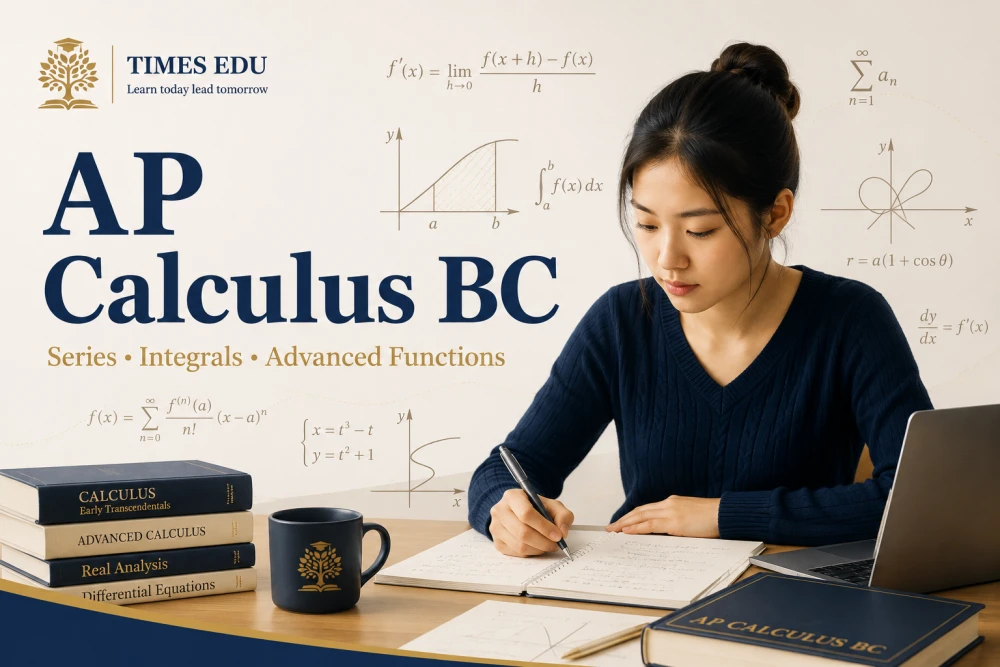
AP Calculus BC [1] is a college-level mathematics course equivalent to two full semesters of university calculus, specifically Calculus I and Calculus II. AP Calculus AB, by comparison, covers only Calculus I.
Both courses share Units 1 through 8, which include limits, derivatives, integrals, and the Fundamental Theorem of Calculus. The critical difference is that AP Calculus BC covers those shared units in greater depth and adds several entirely new topic areas that AB students never encounter.
Students who complete AP Calculus BC and score well can potentially skip two semesters of university mathematics, depending on the institution’s credit policy. That is a significant academic and financial advantage that should not be underestimated.
| Feature | AP Calculus AB | AP Calculus BC |
|---|---|---|
| University equivalent | Calculus I (1 semester) | Calculus I + II (2 semesters) |
| Units covered | Units 1 to 8 | Units 1 to 10 |
| Depth of shared content | Standard | Greater depth |
| AB Subscore available | No | Yes |
| Additional topics | None | Series, parametric, polar, vector, Euler’s Method |
| Exam duration | 3 hours 15 minutes | 3 hours 15 minutes |
One detail that often catches students off guard is this: The exam duration is identical for both courses, yet BC students are responsible for significantly more content. That means preparation time and pacing strategy must be adjusted accordingly.
>>> Read more: AP Calculus Weekly FRQ Routine 2026: A Simple Plan to Practice Consistently and Improve Faster
Core topics unique to AP Calculus BC beyond Calculus AB
Drawing on years of experience at Times Edu working with AP students across Asia, the Middle East, and Europe, the BC-only content is where most students lose points. Knowing what these topics are, and taking them seriously early, is the first step toward a strong score.
Advanced integration techniques include integration by parts, partial fractions decomposition, and improper integrals. Students who have only practiced substitution-based integration will find these methods require a different kind of logical discipline.
Euler’s Method is a numerical technique used to approximate solutions to differential equations. It is conceptually straightforward but frequently tested in ways that require students to interpret and communicate their work carefully, not just compute answers.
Logistic growth models appear as an extension of differential equations in BC. The logistic differential equation describes real-world phenomena such as population growth under resource constraints, and the AP exam tests both its derivation and its practical interpretation.
Here is a concise breakdown of the BC-only content categories:
- Integration by parts (using the formula derived from the product rule)
- Partial fractions (decomposing rational functions before integrating)
- Improper integrals (integrals with infinite bounds or discontinuities)
- Euler’s Method for differential equations
- Logistic growth and carrying capacity
- Arc length of curves in Cartesian form
- Parametric, polar, and vector functions
- Infinite sequences and series, including convergence tests
- Taylor and Maclaurin series, including Lagrange error bounds
A common mistake we see at Times Edu is students treating BC-only topics as supplementary material to review at the end. In reality, series and sequences alone account for a substantial portion of the exam and require weeks of focused practice.
>>> Read more: AP Calculus AB & BC Mistakes: 10 Errors That Cost Score 5 in 2026
Sequences and series in AP Calculus BC explained
Of all the BC-only topics, infinite sequences and series demand the most attention. Students consistently underestimate how conceptually layered this unit is, and how much the exam tests both procedural accuracy and theoretical understanding.
A sequence is simply an ordered list of numbers. A series is the sum of the terms in a sequence. The central question in this unit is: does this series converge to a finite value, or does it diverge to infinity?
To answer that question, students must master a toolkit of convergence tests:
| Convergence Test | When to Use It |
|---|---|
| Geometric Series Test | When the series has a constant ratio between terms |
| p-Series Test | When the series is in the form 1/n^p |
| Integral Test | When the series can be matched to an integrable function |
| Comparison Test | When the series can be bounded above or below by a known series |
| Limit Comparison Test | When direct comparison is inconclusive |
| Ratio Test | When the series involves factorials or exponentials |
| Alternating Series Test | When terms alternate in sign |
Beyond convergence, students must understand Taylor and Maclaurin series, which allow complex functions like sin(x), e^x, and ln(1+x) to be expressed as infinite polynomials. The exam regularly asks students to construct these series, determine their radius of convergence, and calculate the Lagrange error bound, which measures how accurate a partial sum approximation is.
One critical detail often overlooked is that the Lagrange error bound is not just a formula to memorize. It requires students to find the maximum value of the next derivative term over a specific interval, which demands careful reasoning rather than mechanical calculation.
>>> Read more: AP Calculus AB & BC FRQ Strategy: 7-Step Framework for Score 5
Parametric, polar and vector functions in AP Calculus BC
This topic area introduces students to entirely different ways of describing curves and motion in a plane. While standard Cartesian functions express y in terms of x, parametric and polar forms allow curves to be described in ways that Cartesian coordinates cannot capture efficiently.
Parametric functions define both x and y as separate functions of a third variable, typically t for time. Students must learn how to find dy/dx, d²y/dx², arc length, and the area enclosed by parametric curves using integration.
Polar functions express curves using a radius r as a function of an angle θ. The most tested skills include finding the area enclosed by polar curves and the slope of a tangent line at a given angle. A point students frequently miss is how to correctly set up the limits of integration when regions overlap in polar coordinates.
Vector-valued functions describe motion by expressing position, velocity, and acceleration as vectors. Students need to be comfortable calculating speed (the magnitude of the velocity vector), total distance traveled, and using integration to find displacement.
In our experience working with international students preparing for AP Calculus BC, this unit rewards students who develop strong geometric intuition. Sketching curves before diving into calculations often prevents errors that pure algebraic approaches miss.
>>> Read more: AP Calculus AB & BC 2026 Study Plan: A Practical Way to Review and Improve Your Score
How AP Calculus BC is assessed: exam structure and AB subscore
The AP Calculus BC exam runs for 3 hours and 15 minutes and is divided into two main sections, each contributing equally to the final score.
Section I: Multiple Choice (50% of total score)
- Part A: 30 questions, 60 minutes, no calculator permitted
- Part B: 15 questions, 45 minutes, graphing calculator required
Section II: Free Response (50% of total score)
- Part A: 2 questions, 30 minutes, graphing calculator required
- Part B: 4 questions, 60 minutes, no calculator permitted
The free-response section is where scores are often won or lost. Each question is graded on a detailed rubric, and partial credit is awarded for correct reasoning even when the final answer is wrong. Students who write clear, mathematically complete solutions earn more points than those who produce a correct numerical answer with no justification.
The AB Subscore is a unique feature of the BC exam. Because roughly 60% of the BC exam covers AB-level content, the College Board calculates a separate AB Subscore on a scale of 1 to 5. This means a student who performs strongly on the AB-equivalent portions can still receive credit for Calculus I at many universities, even if their overall BC score is lower than expected.
This subscore functions as a safety net, and it is strategically useful for students who are strong in differential and integral calculus but still developing their mastery of series and parametric content.
>>> Read more: AP Calculus AB Exam Guide 2026: Topics, Format, and Smart Practice Tips
Who should take AP Calculus BC instead of AP Calculus AB?
This is one of the most common questions families ask at Times Edu, and the answer depends on three factors: the student’s current mathematical foundation, their intended university major, and their overall AP course load.
AP Calculus BC is the right choice when:
- The student has completed Pre-Calculus and ideally some introductory calculus with strong results
- The intended major is in mathematics, engineering, physics, computer science, economics, or any field requiring two or more semesters of university calculus
- The student has the bandwidth to commit serious preparation time without compromising performance in other AP or academic subjects
- The student’s target universities are highly selective, where demonstrating academic challenge matters significantly
AP Calculus AB may be more appropriate when:
- The student’s algebra and pre-calculus foundations need reinforcement before tackling the full BC curriculum
- The intended major has lighter mathematics requirements (humanities, social sciences, pre-medicine without a quantitative focus)
- The student’s schedule is already packed with multiple demanding AP courses
- The goal is to earn college credit for Calculus I without the added complexity of Calculus II content
A common mistake we see at Times Edu is a student choosing BC simply because it sounds more impressive, without the foundational preparation to perform well. A score of 3 in BC is far less useful than a score of 5 in AB, and universities do pay attention to the strength of grades within a challenging course, not just course selection alone.
>>> Read more: AP Tutor 2026: How to Choose the Right Tutor and Improve Your AP Score
How to prepare effectively and score a 5 in AP Calculus BC
Scoring a 5 in AP Calculus BC requires a structured, long-term approach. Students who start preparation late, rely only on classroom instruction, or skip free-response practice consistently fall short of their potential.
Step 1: Build a strong foundation early
Before tackling BC-only content, ensure that all shared AB topics are thoroughly understood. Derivatives, integrals, the Fundamental Theorem of Calculus, and basic differential equations must be second nature before adding series and parametric functions on top.
Step 2: Master BC-only topics systematically
Dedicate focused blocks of study time to each BC-only topic. Do not attempt to learn Taylor series and polar functions simultaneously. Depth before breadth is the guiding principle here.
Step 3: Practice free-response questions under exam conditions
The College Board releases past free-response questions annually on their official AP Calculus BC page. Practicing these questions under timed, no-calculator conditions (for Part B) and with a graphing calculator (for Part A) is irreplaceable preparation.
Step 4: Review grading rubrics carefully
Reading the official scoring guidelines for past free-response questions teaches students exactly what language and reasoning structure earn full credit. One critical detail often overlooked is that stating justifications in correct mathematical language is worth specific points, even when the arithmetic is correct.
Step 5: Use high-quality resources
- College Board’s official AP Calculus BC course page: access past free-response questions, course frameworks, and scoring guidelines directly from the source
- Khan Academy AP Calculus BC: structured video lessons with practice exercises, particularly strong for sequences and series
- Advanced Placement YouTube Channel: targeted videos on BC-specific concepts and calculator technique
Step 6: Work with an expert tutor for targeted gap-filling
Classroom instruction covers curriculum, but it rarely addresses the specific conceptual gaps individual students carry into exam season. At Times Edu, our 1-on-1 AP Calculus BC tutors identify exactly where a student’s understanding breaks down and build a targeted plan to close those gaps before exam day.
Frequently asked questions
What is the difference between AP Calculus AB and AP Calculus BC?
Is AP Calculus BC harder than AP Calculus AB?
What is the AB subscore in AP Calculus BC?
What extra topics does AP Calculus BC cover that AB does not?
Is a calculator allowed in AP Calculus BC?
How do you score a 5 in AP Calculus BC?
Does AP Calculus BC give more college credit than AP Calculus AB?
Conclusion
AP Calculus BC is among the most rigorous and rewarding courses in the AP program. It covers the equivalent of two full semesters of university-level calculus, including advanced integration, infinite series, parametric and polar functions, and vector calculus. Its exam structure rewards both procedural accuracy and mathematical reasoning, and its AB Subscore provides a meaningful fallback that gives students credit for Calculus I content even when overall BC performance falls short.
Choosing between AP Calculus AB and BC is not simply a question of ambition. It is a strategic academic decision that depends on a student’s mathematical foundation, intended university major, and realistic preparation capacity. Students who choose BC without adequate preparation risk underperforming in a course that could otherwise significantly strengthen their university application.
At Times Edu, we help international students make these decisions clearly and confidently. Our 1-on-1 AP Calculus BC tutoring program is built around each student’s specific gaps, not generic curriculum coverage. Whether a student is just beginning to explore the AP program or is weeks away from exam day and needs targeted support, our consultants and specialist tutors are ready to build a plan that works.
If you are ready to map out your AP academic roadmap with expert guidance, reach out to the Times Edu team today for a personalized consultation.