IB English Language and Literature (IB Lang Lit): Syllabus, Exam Structure & Roadmap to an 7 2026
IB English Language and Literature is one of the most intellectually demanding courses in the IB Diploma Programme, and also one of the most rewarding. It asks students to do something genuinely difficult: Read a Shakespeare play and a political advertisement with the same analytical precision, then explain how both shape what audiences think and feel.
This guide breaks down exactly what the course covers, how it is assessed, what separates high scorers from average performers, and how to build a study strategy that works. Whether you are a student just starting the IB Diploma or a parent trying to understand what your child is walking into, this is the reference point you need.
- IB English Language and Literature: What it covers and what students can expect
- The difference between IB English Language and Literature SL and HL
- Texts and language material studied in IB English Language and Literature
- How IB English Language and Literature is assessed across all components
- Paper 1 in IB English Language and Literature: How to approach unseen texts
- The Individual Oral in IB English Language and Literature explained
- Best resources and study strategies for IB English Language and Literature
- Frequently asked questions
IB English Language and Literature: What it covers and what students can expect
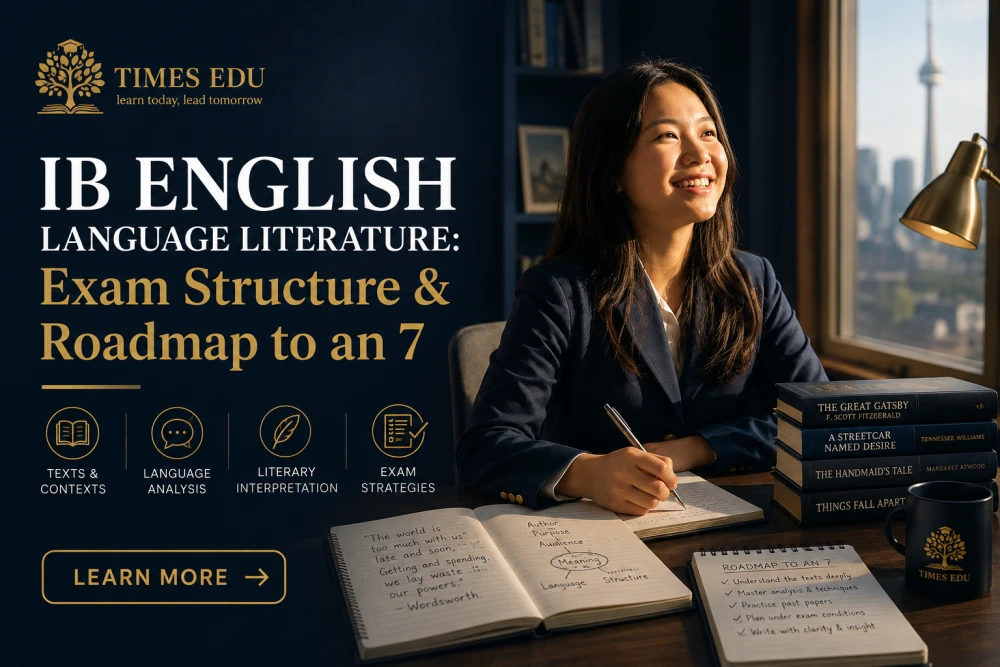
IB English Language and Literature [1] sits within Group 1 of the IB Diploma Programme [2], formally called Studies in Language and Literature. It is a compulsory subject, which means every IB Diploma student must complete a Group 1 course. Most native or near-native English speakers choose this course, though it is open to any student whose primary language of instruction is English.
The course is built around three conceptual frameworks: Readers, writers, and texts; time and space; and intertextuality. These frameworks encourage students to ask not just what a text says, but how it says it and why it was constructed that way in a specific cultural or historical moment.
What makes this course distinct from a traditional English literature class is its deliberate pairing of literary and non-literary material. Students are expected to analyze a novel with the same rigor they apply to a news article or a social media campaign. This is not an accident of design; it reflects the IBO’s belief that media language IB students encounter daily deserves the same critical attention as a canonical poem.
>>> Read more: IB English A Language & Literature books 2026: Complete guide for students and teachers
The difference between IB English Language and Literature SL and HL
Every IB subject is available at Standard Level (SL) or Higher Level (HL), and IB English Lang Lit SL HL differ in meaningful ways beyond just the number of texts.
| Feature | Standard Level (SL) | Higher Level (HL) |
|---|---|---|
| Number of texts studied | Typically 4 | Typically 6 |
| Paper 1 | Analyze 1 unseen text | Analyze 2 unseen texts |
| Paper 2 weighting | 35% | 25% |
| HL Essay | Not required | Required (20%) |
| Individual Oral weighting | 30% | 20% |
| Overall workload | Moderate | Significant |
HL students carry a heavier analytical load across every component. They study more texts, face a more demanding Paper 1, and must independently produce a formal essay called the HL Essay that SL students are not required to complete.
One detail that surprises many families: Choosing HL does not automatically lead to a higher grade. In our experience working with international students across Asia, the Middle East, and Europe, students who choose HL without strong independent reading habits and analytical writing skills often score lower than they would have at SL. The decision should be strategic, not aspirational.
If a student is genuinely passionate about language, literature, and argument, HL is a powerful choice. If they are selecting it only because it looks impressive on a university application, that logic deserves a second look.
>>> Read more: IB books 2026: The complete guide to study materials for the IB Diploma
Texts and language material studied in IB English Language and Literature
The texts in this course fall into two categories, and understanding the distinction between them is essential for effective revision.
Literary works include novels, plays, and poetry collections. These are selected by the school within IBO guidelines, which require diversity across time periods, cultures, and geographical regions. A student might study Nineteen Eighty-Four by George Orwell alongside Persepolis by Marjane Satrapi, or a collection of poems by Seamus Heaney paired with a contemporary African novel.
Non-literary bodies of work cover a wide range of everyday texts: Advertisements, political cartoons, opinion columns, documentary films, infographics, podcasts, street art, and social media campaigns. These are grouped thematically or by media type and studied as bodies of work rather than isolated texts.
A common mistake we see at Times Edu is students treating non-literary texts as “easier” material that requires less preparation. In practice, the reverse is often true. Analyzing the visual rhetoric of an advertisement or the editorial choices in a news broadcast requires a precise, specialized vocabulary that students need to build deliberately.
Literary and non-literary texts IB students study are always discussed in relation to the three course concepts. This means every text analysis should eventually connect back to questions of how meaning is made, how context shapes interpretation, and how different texts speak to or against each other.
>>> Read more: IB English Paper 2 Comparative Structure 2026: The Framework for Writing High-Scoring Essays
How IB English Language and Literature is assessed across all components
IB English assessment criteria reward the same core skills across all components: The ability to identify specific stylistic features, explain their intended effect on an audience, and connect them to a broader argument or global context.
Here is a clear summary of the four assessment components:
| Component | SL Weighting | HL Weighting | Format |
|---|---|---|---|
| Paper 1: Guided Textual Analysis | 35% | 35% | Written exam, unseen texts |
| Paper 2: Comparative Essay | 35% | 25% | Written exam, studied texts |
| HL Essay | Not applicable | 20% | Independent written essay |
| Individual Oral | 30% | 20% | Recorded spoken presentation |
Each component tests a slightly different skill set, and top students build distinct preparation strategies for each one rather than treating revision as a single undifferentiated activity.
One critical detail often overlooked is that Paper 1 and Paper 2 are marked by external IB examiners, while the Individual Oral is marked internally by the teacher and then moderated externally. This means the Internal Oral mark can shift during moderation, and students should not assume the mark their teacher gives them is final.
>>> Read more: IB English Paper 1 Evidence Selection 2026: How to Pick Quotes That Prove Your Argument
Paper 1 in IB English Language and Literature: How to approach unseen texts
Paper 1 unseen text IB is the component that generates the most anxiety, and understandably so. Students receive one text (SL) or two texts (HL) they have never seen before and must produce a structured analytical essay within a set time period.
The texts in Paper 1 are always non-literary. They might include a newspaper opinion piece, a product advertisement, a public health campaign poster, or a speech transcript. The task is not to summarize the text but to explain how it works: How the language, visual elements, tone, and structure combine to create meaning and influence an audience.
A strong Paper 1 response follows a clear structure:
- Open with a brief identification of the text’s context, purpose, and intended audience.
- Build the body of the essay around two or three analytical focuses, each linked to specific textual evidence.
- Explain the effect of each feature, not just its name. Identifying a metaphor earns no marks; explaining what that metaphor does to the reader’s understanding earns significant marks.
- Conclude by connecting the analysis to a broader observation about how the text positions its audience.
Drawing on years of experience at Times Edu guiding students through IB English Language Literature past papers, the most consistent weakness in Paper 1 responses is what examiners call “feature spotting”: Listing stylistic devices without explaining their function. A student who writes “the writer uses alliteration” has said almost nothing. A student who writes “the repetition of hard consonant sounds creates urgency, reinforcing the campaign’s call to immediate action” has demonstrated genuine analytical thinking.
HL students must analyze two texts in the same time window as SL students analyze one. The practical implication is that HL students need faster analytical processing and the ability to quickly identify which features are most worth analyzing rather than cataloguing everything they notice.
>>> Read more: IB English Paper 2 Essay Structure 2026: How to Build a Clear and Comparative Essay
The Individual Oral in IB English Language and Literature explained
The Individual Oral IB English component is a 15-minute recorded presentation in which the student analyzes how a global issue of their choice is presented in two texts: One literary and one non-literary. The teacher then asks follow-up questions based on the presentation.
This component requires genuine intellectual ownership. The student selects the global issue and chooses which two texts to analyze. This freedom is also a source of confusion, and a common mistake we see is students selecting a global issue that is either too broad (such as “inequality” with no further specification) or too narrow to generate substantive analysis across two different texts.
A strong global issue for the Individual Oral sits at the intersection of the texts studied and something the student can speak about with specificity and authority. Examples of effective global issue framing include:
- How political propaganda manipulates national identity through selective historical narrative
- The commodification of female beauty in consumer culture
- Environmental anxiety and its expression in post-colonial literature and contemporary media
The 15-minute format breaks into a roughly 10-minute prepared presentation followed by a 5-minute discussion with the examiner. Students should practice the timing precisely. Many students over-prepare the presentation section and have nothing substantive left to say when the teacher asks probing questions.
One strategic note for HL students: The Individual Oral carries 20% of the final grade at HL, compared to 30% at SL. At HL, the HL Essay absorbs a significant portion of the internal component weighting, so students cannot afford to treat the oral as less important but should calibrate their preparation effort accordingly.
>>> Read more: IB English Paper 1 Planning: 4-Step Pre-Write Method for Score 7
Best resources and study strategies for IB English Language and Literature
Effective IB English revision is not about reading more texts. It is about developing specific analytical habits and building the vocabulary to express those habits precisely under timed conditions.
For Paper 1 preparation:
- Practice with IB English Language Literature past papers under timed conditions at least once a week in the months before the exam.
- Build a personal glossary of analytical terms organized by effect (terms that describe tone, terms that describe structure, terms that describe visual language, etc.).
- After each practice essay, score your own work against the official IB English assessment criteria before looking at any model answer.
For Paper 2 and the comparative essay IB English component:
- Create a comparative text grid for each pair of works you might write about, mapping shared themes, contrasting authorial approaches, and relevant contextual details.
- Practice writing thesis statements that make a genuine comparative argument rather than alternating between two texts without connecting them.
- Study the question bank from past papers to identify recurring thematic prompts.
For the HL Essay:
The Higher Level Essay IB component rewards independent intellectual curiosity. Students should choose a line of inquiry that genuinely interests them and that generates a real question, not a topic that is simply descriptive. “How does Orwell use imagery in Nineteen Eighty-Four” is a description; “How does Orwell’s use of sensory deprivation as imagery construct the psychological architecture of totalitarian submission” is a line of inquiry.
For the Individual Oral:
- Record practice runs and listen back critically, noting where the argument becomes circular or where the analysis stays at the level of observation rather than interpretation.
- Get feedback from a teacher or tutor who knows the IB Language A English criteria specifically, not just general presentation feedback.
- Have three or four different global issue angles prepared and select the one that gives the richest analytical contrast between your two chosen texts.
>>> Read more: IB Tutor 2026: How to Choose the Right Tutor for Better Grades and Less Stress
Frequently asked questions
What is the difference between IB English Language and Literature and IB English Literature?
How many texts do you study in IB English Language and Literature?
What is the Higher Level Essay in IB English Language and Literature?
How is Paper 1 assessed in IB English Language and Literature?
What is the Individual Oral in IB English Language and Literature?
How do you score a 7 in IB English Language and Literature?
Is IB English Language and Literature harder than IB English Literature?
Conclusion
At Times Edu, we work with IB students on a 1-on-1 basis across all four components, from building analytical writing skills for Paper 1 to developing a compelling global issue for the Individual Oral. If your child is beginning the IB Diploma or needs to strengthen their performance in IB English Language and Literature, reach out to our team to book a personalized academic roadmap consultation. The earlier a student builds the right habits, the more time those habits have to translate into marks.
Resources: