A Level Further Mathematics 9231 books 2026: Complete guide for students and teachers
A Level Further Mathematics is widely recognized as one of the most intellectually demanding qualifications available to pre-university students worldwide. Choosing the right A level Further Mathematics book is not a small decision. The textbook you work from will shape your understanding of abstract proof, complex algebra, and applied mathematics across every paper you sit.
This guide is written by the curriculum team at Times Edu, drawing on years of experience supporting international students through Cambridge 9231, Edexcel, AQA, and OCR Further Mathematics programmes. Whether you are a student selecting your first resource or a teacher building a departmental reading list, you will find clear, honest recommendations here.
- Best A level Further Mathematics books: Complete guide for students and teachers
- Cambridge and Edexcel endorsed A level Further Mathematics textbooks reviewed
- A level Further Mathematics revision guides vs full textbooks: What do you need?
- Top A level Further Mathematics books for AQA, Cambridge, Edexcel and OCR
- How to use an A level Further Mathematics book alongside past papers effectively
- Where to buy A level Further Mathematics books at the best price online
- Free A level Further Mathematics resources vs investing in a quality study book
- Frequently asked questions
Best A level Further Mathematics books: Complete guide for students and teachers
The A level Further Mathematics [1] textbook market is more fragmented than most students expect. Unlike standard A Level Mathematics, where one or two titles dominate each exam board, Further Mathematics spans multiple specialist volumes covering pure content, mechanics, statistics, and proof-based theory separately.
The single most important rule when choosing an A level Further Mathematics book is this: Always verify that the edition you are purchasing is endorsed for your specific exam board and the current syllabus year. Older textbooks, particularly pre-2017 editions, frequently omit content added during major specification reforms, and using them as your primary resource is one of the most common mistakes we see at Times Edu.
For Cambridge International AS and A Level Further Mathematics (9231), the two principal publishers are Cambridge University Press and Hodder Education. Both produce officially endorsed series, and both have distinct pedagogical strengths that suit different types of learners.
>>> Read more: A Level Further Maths Mock Improvement Plan : 4-Week Recovery from Bad Mock
Cambridge and Edexcel endorsed A level Further Mathematics textbooks reviewed
Cambridge University Press Further Maths series (Cambridge 9231)
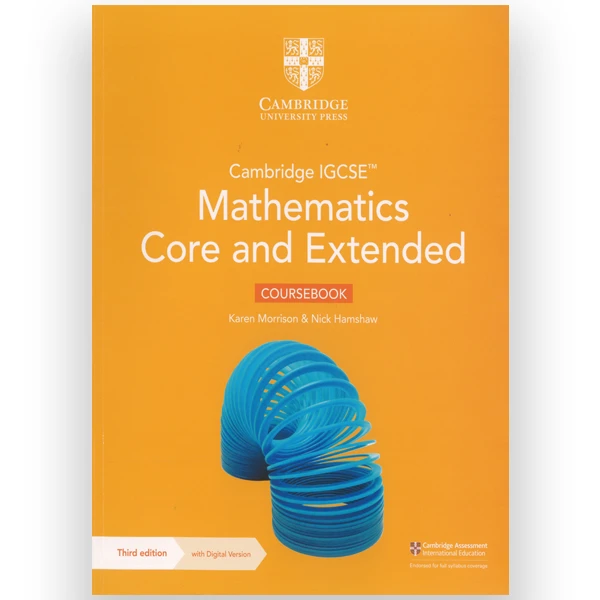
The Cambridge University Press series for Cambridge A level Further Maths 9231 is structured around four separate coursebooks: Further Pure Mathematics 1, Further Pure Mathematics 2, Further Mechanics, and Further Probability and Statistics. Each volume is authored by a specialist team including Jean-Paul Muscat, Sophie Goldie, and Rose Jewell.
The defining strength of this series is its commitment to step-by-step mathematical proof. Every major theorem is derived, not simply stated, which means students build genuine understanding rather than rote formula recall. The books also include “Explore” tasks, which are particularly useful for visualizing abstract topics such as polar coordinates and complex number loci.
One critical detail often overlooked by students using the Cambridge University Press Further Maths series is the Cambridge GO digital platform access included with each book. This platform provides interactive geometry modules and full algebraic solution walkthroughs, which are invaluable when self-checking multi-stage calculus problems.
Hodder Further Mathematics series
The Hodder Further Mathematics series, authored by Tom Andrews, Ric Pimentel, and Terry Wall, takes a different structural approach. Rather than isolating each paper into a separate volume, the Hodder series builds content in a linear progression designed to mirror how a classroom teacher would sequence topics across the academic year.
In our experience working with international students who are studying partly independently, the Hodder series tends to build confidence faster. Its explanations are conversational without sacrificing mathematical rigour, and the end-of-module past-paper style question banks are among the most comprehensive available for Cambridge 9231 candidates.
The Hodder endorsed Further Maths book is especially praised for its mathematical reasoning sections, which teach students how to structure formal proofs under timed exam conditions, a skill that accounts for a significant share of marks at this level.
Edexcel A level Further Mathematics textbooks
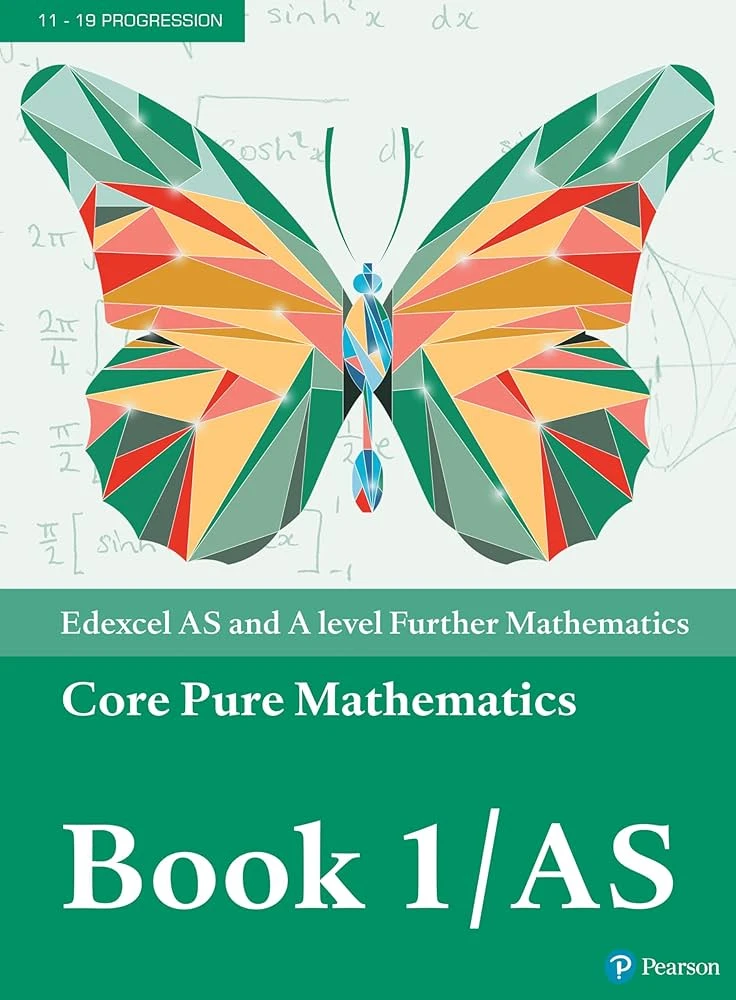
For students sitting Edexcel A level Further Mathematics, Pearson’s own endorsed series remains the most reliable choice. The Pearson series covers the Edexcel specification across Year 1 and Year 2 combined volumes, with separate books for Core Pure Mathematics, Further Statistics, and Further Mechanics.
A common mistake we see with Edexcel students is purchasing only the Core Pure volumes and neglecting the applied options. Your choice of applied modules, whether Further Statistics 1 or Further Mechanics 1, must match the specific papers your school or centre has entered you for.
>>> Read more: A Level Further Maths Past Paper Strategy for 2026: How to Practice Effectively for Better Results
A level Further Mathematics revision guides vs full textbooks: What do you need?
The distinction between a full A level Further Mathematics textbook and an A level Further Maths revision guide is critical and frequently misunderstood. A full textbook is a teaching resource. A revision guide is a compression tool, designed to help you recall and rehearse material you already understand.
Using only a revision guide from the start of your course is one of the most damaging strategic errors a Further Mathematics student can make. The content at this level, particularly hyperbolic functions, eigenvalues and eigenvectors, and probability generating functions, requires the kind of worked-example depth that only a full coursebook can provide.
The recommended approach, based on our curriculum consultants’ experience at Times Edu, is to use a full endorsed textbook as your primary learning resource throughout the course, then layer in a dedicated revision guide during the three to four months before your exam series. CGP and Oxford Revise produce well-structured A level Further Maths revision guide options compatible with major UK exam boards.
>>> Read more: A Level Further Maths Topic Order for 2026: What to Study First for Smarter Revision
Top A level Further Mathematics books for AQA, Cambridge, Edexcel and OCR
The table below provides a structured comparison of the primary endorsed textbooks across the four major exam boards, to help students and teachers match resources to their specific qualification.
| Exam board | Primary endorsed publisher | Series structure | Best suited for |
|---|---|---|---|
| Cambridge 9231 | Cambridge University Press | 4 separate volumes by paper | Students needing rigorous proof development |
| Cambridge 9231 | Hodder Education | Linear modular progression | Students self-studying or in smaller schools |
| Edexcel A level | Pearson Education | Core Pure + applied option books | Students in UK sixth forms with teacher guidance |
| AQA Further Mathematics A level | Hodder Education | Year 1 and Year 2 combined | Students prioritising exam-style practice |
| OCR Further Maths A level | Oxford University Press | Modular by component | Students strong in pure theory, weaker in applied |
One critical detail often overlooked by students selecting OCR Further Maths A level resources is that Oxford Further Mathematics titles must be matched to either OCR A or OCR B (MEI), as these are structurally different specifications with different applied content requirements.
For AQA Further Mathematics A level candidates, the Hodder series is consistently the strongest available option, particularly for topics in proof, complex numbers, and matrices, which form a significant portion of the AQA pure papers.
>>> Read more: A Level Further Maths Mark Scheme Tips for 2026: How to Pick Up More Marks in Every Paper
How to use an A level Further Mathematics book alongside past papers effectively
Owning the right A level Further Mathematics textbook is only half of the preparation equation. How you use it in conjunction with past papers determines whether that resource investment translates into exam performance.
The most effective study sequence, refined through our consultants’ work with students across multiple international curriculum programmes, follows a three-phase model:
- Phase 1: Concept construction. Read and work through each textbook chapter in full, completing all worked examples independently before checking. Do not skip the proof sections, even if they appear in chapters that feel familiar.
- Phase 2: Textbook exercise consolidation. Complete every graded exercise within the chapter, starting from the foundational questions and progressing to the extension problems. Flag any question type you cannot solve without referring back to the worked example.
- Phase 3: Past paper application. Attempt past paper questions that correspond specifically to the topic just covered. For Cambridge 9231 students, this means targeting the relevant paper (Paper 1, 2, 3, or 4) question by question, not sitting full mock papers until at least 70% of the syllabus is consolidated.
A common mistake we see is students jumping to past papers before completing Phase 1 and 2 properly. Past papers without concept understanding create the illusion of practice while reinforcing incorrect methods.
One additional note specific to Cambridge 9231 candidates: the syllabus prohibits graphing or algebraic calculators in examinations. This means your further statistics mechanics book work and your pure algebra practice must be conducted manually throughout the course. Using a CAS calculator during textbook practice will leave you unprepared for the manual manipulation demands of the actual papers.
>>> Read more: A Level Further Maths Start Guide for 2026: What to Do First for a Stronger Start
Where to buy A level Further Mathematics books at the best price online
When students and parents decide to buy A level Further Maths books, price comparison across platforms is worthwhile, as retail prices for endorsed coursebooks can vary by 20 to 40 percent depending on the supplier and the format chosen.
The following platforms offer reliable access to current editions:
- Cambridge University Press bookshop (direct). The most reliable source for CUP Further Maths books, with guaranteed current editions and access codes for Cambridge GO.
- Amazon UK and international marketplace. Competitive pricing on physical copies, though students should verify the ISBN matches the current specification edition before purchasing.
- Hodder Education direct website. Frequently offers school bundle pricing for teachers purchasing class sets, and occasionally provides student discount codes.
- Book Depository (now integrated with Amazon). Historically offered free international shipping, making it a popular choice for students studying at international schools outside the UK.
- AbeBooks and second-hand sellers. Suitable for budget-conscious buyers, but require careful edition verification. A textbook that is one edition out of date may be missing entire topic sections.
The digital-only versions of most Cambridge University Press Further Maths titles are available at a lower price point and provide full Cambridge GO access, making them a practical choice for students who study primarily on a screen.
>>> Read more: A Level Further Maths Study Plan : 12-Month Schedule for A* in 2026
Free A level Further Mathematics resources vs investing in a quality study book
The internet offers a substantial volume of free Further Mathematics content, including video lectures, formula compilations, and topic summaries from providers such as ExamSolutions, MathsGenie, and various university outreach programmes. These resources have genuine value as supplementary tools.
However, drawing on years of experience at Times Edu supporting students through high-stakes international examinations, the consensus among our consultants is clear: free resources cannot replace a systematically structured, endorsed A level Further Mathematics textbook for a subject at this level of complexity.
The core limitations of relying solely on free content are:
- Topic coverage is inconsistent and often does not follow the specific sequence or depth required by your exam board’s mark scheme.
- Proof-based content, which constitutes a significant portion of Further Pure Mathematics papers, is rarely presented with the rigour needed to score full marks in a formal examination.
- Students using only video resources frequently develop passive understanding, where they can follow a solution when watching it but cannot reproduce it independently under exam conditions.
A full pure applied Further Maths textbook forces active engagement. Working through exercises, writing out proofs, and correcting errors builds the cognitive muscle memory that examination success depends on.
For students who are genuinely price-constrained, the optimal strategy is to purchase the core pure volume for their exam board in full, and supplement the applied components (further statistics mechanics book content) with structured free resources and past papers, under guidance from a qualified tutor.
>>> Read more: Should I Take Further Maths? The Complete Guide 2026
Frequently asked questions
Which A level Further Mathematics textbook is best for AQA, Cambridge or Edexcel?
Do I need separate books for pure and applied content in A level Further Mathematics?
What is the best A level Further Mathematics revision guide for exam preparation?
Which A level Further Mathematics book covers complex numbers and matrices most clearly?
Do I need to finish A level Mathematics before buying A level Further Mathematics books?
Are older editions of A level Further Mathematics textbooks valid for current specifications?
Which A level Further Mathematics book is best suited for self-study students?
Conclusion
At Times Edu, our consultants have helped hundreds of students across Asia and internationally build structured, board-specific study plans around the right combination of textbooks, past papers, and personalised tutoring. If you are unsure which resources to prioritise, or if you want a personalised academic roadmap that aligns your Further Mathematics preparation with your broader university application strategy, our team is ready to support you. A single consultation can save months of misdirected effort and give you the strategic clarity that high-stakes examinations demand.