OCR exam board 2026: The complete guide for international students and parents
If you are researching UK qualifications for your child, you have almost certainly come across the term OCR. It appears on school websites, university entry guides, and tutoring platforms alike, yet many parents and students outside the UK are not entirely sure what it means or how it compares to other options. This guide breaks down everything you need to know about OCR as an exam board, from the qualifications it offers to the strategies that help students perform at the highest level.
- OCR exam board: Who they are and what qualifications they offer
- Full range of OCR GCSE qualifications and subject list
- OCR A level qualifications: Complete subject range explained
- How OCR differs from AQA, Edexcel and Cambridge International
- OCR vocational and technical qualifications: Cambridge Nationals and Technicals
- How to access OCR past papers, mark schemes and examiner reports
- Why schools and colleges choose OCR for their students
- Frequently asked questions
OCR exam board: Who they are and what qualifications they offer
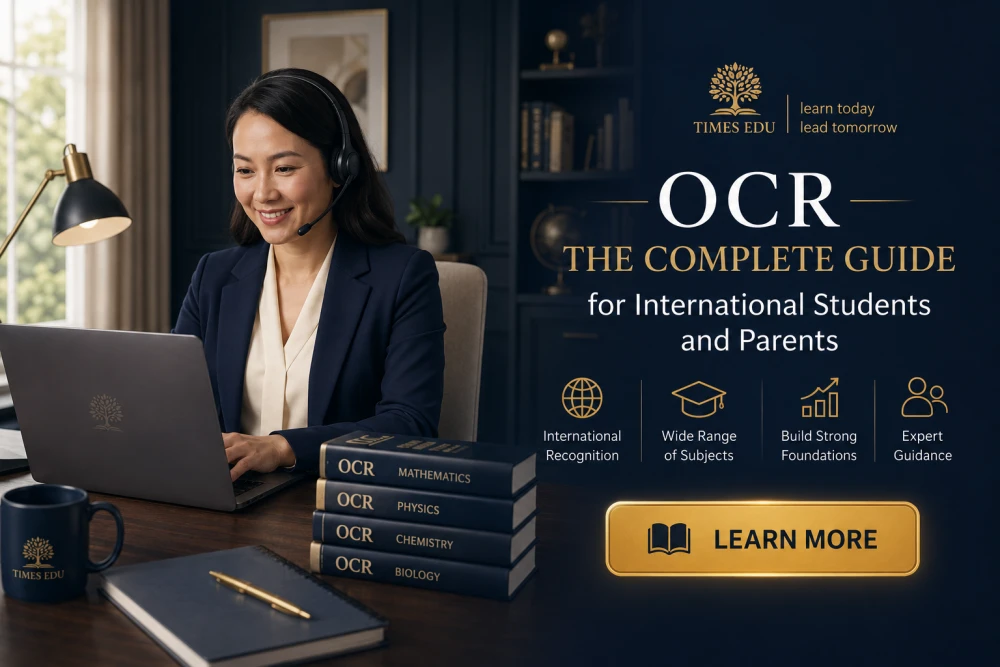
OCR [1] stands for Oxford Cambridge and RSA, making it one of the most academically prestigious exam boards operating in England, Wales, and internationally. Founded through the merger of the University of Oxford Delegacy of Local Examinations, the University of Cambridge Local Examinations Syndicate’s non-international division, and the RSA Examinations Board, OCR carries institutional credibility that dates back well over a century.
Today, OCR operates under Cambridge Assessment, the same umbrella group that oversees Cambridge International Examinations (CIE). This shared heritage means OCR qualifications are built on rigorous academic traditions and are widely respected by universities in the United Kingdom and abroad.
OCR offers qualifications across four broad categories: General academic qualifications (GCSE and A level), vocational and technical qualifications (Cambridge Nationals and Cambridge Technicals), Entry Level Certificates, and a range of professional and functional skills awards. For most international students targeting UK university entry or building a competitive global academic profile, the GCSE and A level pathways are the primary focus.
>>> Read more: SAT Tutor 2026: How to Choose the Right One and Improve Your Score Faster
Full range of OCR GCSE qualifications and subject list
OCR GCSE qualifications cover the full range of subjects required by the national curriculum in England, plus a number of additional options. Students and schools can choose from subjects across the humanities, sciences, languages, arts, and technology.
The OCR subject list at GCSE level includes, but is not limited to:
| Subject Area | Example GCSE Subjects |
|---|---|
| Sciences | Biology, Chemistry, Physics, Combined Science |
| Mathematics | Mathematics, Statistics |
| Humanities | History, Geography, Religious Studies |
| Languages | French, German, Spanish, Latin, Classical Greek |
| Arts and Design | Art and Design, Drama, Music |
| Technology | Design and Technology, Computer Science |
| English | English Language, English Literature |
| Business and Social | Business Studies, Sociology, Psychology |
OCR Biology, Chemistry, and Physics are available as separate sciences, which is the preferred route for students targeting competitive university courses such as medicine, engineering, or natural sciences. OCR Computer Science at GCSE is also one of the most popular choices, particularly given the exam board’s strong technical specification that integrates programming and computational thinking in a structured, assessable way.
One critical detail often overlooked by international families is that OCR GCSE subjects are almost entirely assessed through written examinations at the end of Year 11, with controlled assessment or coursework only appearing in specific subjects like art or design. This linear assessment model requires students to retain and apply knowledge across two academic years, which demands a different preparation strategy compared to modular systems.
>>> Read more: AP Tutor 2026: How to Choose the Right Tutor and Improve Your AP Score
OCR A level qualifications: Complete subject range explained
At A level, OCR offers one of the broadest and most respected subject ranges of any UK exam board. Students typically choose three or four subjects to study in depth over two years, with final examinations sat at the end of Year 13.
The OCR A level subject list spans the following areas:
| Subject Area | Example A Level Subjects |
|---|---|
| Sciences | Biology A, Biology B, Chemistry A, Chemistry B (Salters), Physics A, Physics B |
| Mathematics | Mathematics, Further Mathematics |
| Humanities | History, Geography, Classical Civilisation, Ancient History |
| Social Sciences | Psychology, Sociology, Economics, Law |
| Languages | French, German, Spanish, Latin, Classical Greek |
| Arts | Art and Design, Drama and Theatre, Music, Music Technology |
| Technology | Computer Science, Design and Technology, Media Studies |
| Business | Business |
A particularly important feature of OCR A level Chemistry is the dual-pathway structure. OCR Chemistry A follows a traditional, topic-led approach, covering physical, inorganic, and organic chemistry in clearly defined modules. OCR Chemistry B, known as the Salters course, takes a context-led approach where concepts are introduced through real-world applications such as atmospheric chemistry, medicines, and industrial processes.
Drawing on years of experience at Times Edu advising students on A level subject selection, we consistently find that high-achieving students with strong conceptual ability tend to excel in Chemistry A, while students who learn better through application and narrative often find Chemistry B more engaging. Neither pathway is easier than the other; the difference is in learning style, not difficulty.
A common mistake we see among families new to the UK system is assuming that OCR A level Biology or Physics is interchangeable with the same subject offered by AQA or Edexcel. While the content overlaps significantly, assessment styles, question formats, and depth of application vary in ways that matter enormously at the top grade boundaries.
>>> Read more: IB Tutor 2026: How to Choose the Right Tutor for Better Grades and Less Stress
How OCR differs from AQA, Edexcel and Cambridge International
Understanding the differences between exam boards is essential for any school or family making a strategic choice. The three major GCSE and A level boards in England are OCR, AQA (Assessment and Qualifications Alliance), and Edexcel (now owned by Pearson). Cambridge International (CIE) operates separately and caters primarily to international schools worldwide.
| Feature | OCR | AQA | Edexcel | Cambridge International |
|---|---|---|---|---|
| Primary market | England, some international | England, some international | England and international | International schools globally |
| Qualification style | Linear, exam-led | Linear, exam-led | Linear, exam-led | Linear, exam-led |
| Vocational options | Strong (Cambridge Nationals, Technicals) | Limited | Strong (BTECs) | Limited |
| Subject pathways | Dual-pathway in some sciences | Single pathway per subject | Single pathway per subject | Single pathway per subject |
| Examiner reports | Publicly available | Publicly available | Publicly available | Publicly available |
| Grade boundary transparency | Published post-examination | Published post-examination | Published post-examination | Published post-examination |
In our experience working with international students across Vietnam, Southeast Asia, and the Middle East, OCR tends to attract students whose schools prioritize critical application over recall-heavy testing. AQA is often considered more mainstream and has the highest volume of entries in England, which means a larger bank of past papers and community resources. Edexcel is frequently chosen by international schools because of its global recognition and the availability of Edexcel International GCSEs.
OCR’s connection to the Cambridge Assessment group gives it a unique credibility in academic circles. However, that same heritage means OCR specifications can be more demanding in terms of analytical depth, particularly in subjects like History, English Literature, and the sciences.
>>> Read more: IGCSE Maths 0580 A* Strategy 2026: 8 Tips From Top Tutors
OCR vocational and technical qualifications: Cambridge Nationals and Technicals
Not every student’s academic path leads through traditional GCSE and A level examinations. OCR has invested significantly in vocational and technical qualifications that offer alternative routes to higher education and employment.
Cambridge Nationals OCR are designed for students aged 14 to 16, typically studied alongside GCSEs. They are assessed through a combination of written examinations and internally assessed coursework units, making them more suitable for students who perform better with ongoing assessment rather than high-stakes end-of-year exams. Popular Cambridge Nationals subjects include IT, Health and Social Care, Sport Studies, and Creative iMedia.
OCR Cambridge Technicals are Level 3 qualifications designed for post-16 students as an alternative to A levels. They are broadly equivalent to A levels in terms of UCAS points and are accepted by many UK universities for a wide range of degree programmes. Cambridge Technicals are available in areas such as Business, Engineering, Health and Social Care, IT, and Science.
One critical detail often missed by parents is that Cambridge Nationals and Cambridge Technicals are not the same as Cambridge International qualifications like the Cambridge IGCSE or Cambridge A levels. Cambridge Nationals and Technicals are OCR products delivered in English schools, while Cambridge IGCSE and Cambridge A level are CIE products delivered internationally. The naming overlap causes significant confusion among families researching UK curriculum options.
>>> Read more: A Level Tutor 2026: How to Choose the Right Tutor and Improve Grades Faster
How to access OCR past papers, mark schemes and examiner reports
Consistent practice with authentic materials is one of the highest-leverage activities any student can do before OCR examinations. OCR makes a substantial archive of resources publicly available through its official website.
Step-by-step guide to accessing OCR past papers:
- Visit the official OCR website at ocr.org.uk.
- Use the search bar or subject hub navigation to find your specific subject and qualification level.
- Select “Past papers, mark schemes and examiner reports” from the subject page.
- Filter by examination series (for example, June 2023 or November 2022).
- Download the question papers, OCR mark schemes, and any available examiner reports as PDF files.
OCR mark schemes are essential reading, not just for checking answers, but for understanding the exact language and structure that examiners reward. A well-written mark scheme tells you precisely what an acceptable answer looks like, what alternative phrasings are credited, and where students most often lose marks.
OCR examiner reports go one step further. Published after each examination series, these reports contain direct commentary from the examiners who marked the papers. They identify the most common errors, the questions students found hardest, and the qualities that separated high-scoring responses from average ones. In our experience working with international students, those who read examiner reports as part of their revision consistently outperform those who only practice questions.
OCR grade boundaries are also published after each examination series. These tell you the minimum raw mark required to achieve each grade on a given paper. Because boundaries shift based on the difficulty of that year’s paper and the performance of the cohort, they are a more accurate measure of difficulty than fixed percentage targets.
>>> Read more: IGCSE Tutor 2026: How to Choose the Right One
Why schools and colleges choose OCR for their students
Schools and colleges that pursue OCR school accreditation do so for a number of reasons beyond subject availability. OCR invests heavily in teacher support, providing detailed specifications, scheme of work guidance, training events, and regular updates from the exam board to registered centres.
OCR qualifications are particularly valued by schools that want to offer vocational pathways alongside traditional academic routes. The ability to combine GCSEs with Cambridge Nationals, or A levels with Cambridge Technicals, allows schools to serve a broader range of student needs within a coherent qualification framework.
From a student outcomes perspective, OCR’s emphasis on analytical and applied thinking means that students who succeed under OCR tend to develop transferable academic skills that serve them well at university. This is particularly evident in OCR Computer Science, where the programming and problem-solving components require genuine understanding rather than surface memorization.
One critical detail often overlooked by international families considering UK boarding schools is that different schools use different exam boards, and students cannot always choose. If a school uses OCR exclusively for sciences but a student wants AQA-style preparation, that mismatch can cause significant problems during revision. This is exactly the kind of strategic detail that a specialist tutor or academic consultant can identify early, saving families considerable time and stress.
Frequently asked questions
What qualifications does OCR offer at GCSE and A level?
How does OCR differ from AQA and Edexcel as an exam board?
Where can I download OCR past papers and mark schemes for free?
Is OCR harder or easier than AQA or Edexcel for the same subject?
What are Cambridge Nationals and how do they differ from GCSEs?
Are OCR qualifications accepted by UK universities?
How do OCR grade boundaries work and where can I find them?
Resources: