A Level Chemistry 9701 books 2026: Complete guide for students and teachers
A comprehensive A Level Chemistry textbook helps students understand complex concepts, strengthen calculation and organic chemistry skills, and prepare effectively for both written examinations and practical assessments. This guide compares the leading Cambridge International 9701 books from Cambridge University Press, Hodder Education, and Oxford University Press, clarifies their suitability for different learning styles and examination boards, and explains how to combine a specification-aligned coursebook with workbooks, revision guides, practical preparation, and past papers.
- Cambridge and Edexcel endorsed A level Chemistry textbooks reviewed
- A level Chemistry revision guides vs full textbooks: which do you actually need?
- Top A level Chemistry books for AQA, Cambridge, Edexcel and OCR specifications
- How to use an A level Chemistry book alongside past papers and required practicals
- Where to buy A level Chemistry books at the best price online
- Free A level Chemistry resources vs investing in a quality study book
- Frequently asked questions
Cambridge and Edexcel endorsed A level Chemistry textbooks reviewed
The three publishers that dominate the endorsed A level Chemistry [1] textbook market are Cambridge University Press, Hodder Education, and Oxford University Press. Each takes a meaningfully different pedagogical approach, and understanding those differences matters.
Cambridge International AS & A Level Chemistry Coursebook (Cambridge University Press)
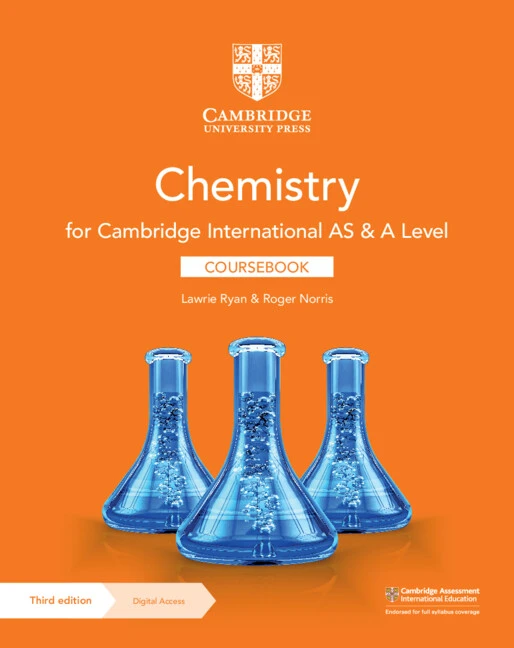
Written by Lawrie Ryan and Roger Norris, this is the most globally recognized A level Chemistry textbook for the Cambridge 9701 specification. Its depth of content coverage is exceptional, and its visual presentation sets a high standard.
The coursebook features detailed 3D stereochemical drawings, clearly annotated reaction mechanism diagrams using curved-arrow notation, and full-colour spectrum charts for analytical chemistry topics. These visual assets are particularly valuable for organic chemistry topics where spatial reasoning is non-negotiable. Students using the Cambridge GO digital platform also gain access to step-by-step guides for physical chemistry calculations, interactive animations, and self-assessment quizzes.
One critical detail often overlooked is that the digital edition of this Cambridge University Press Chemistry resource is bundled with the print version at most authorized retailers. Students who skip the digital activation code are essentially leaving a significant portion of the resource unused.
Cambridge International AS & A Level Chemistry Student’s Book (Hodder Education)
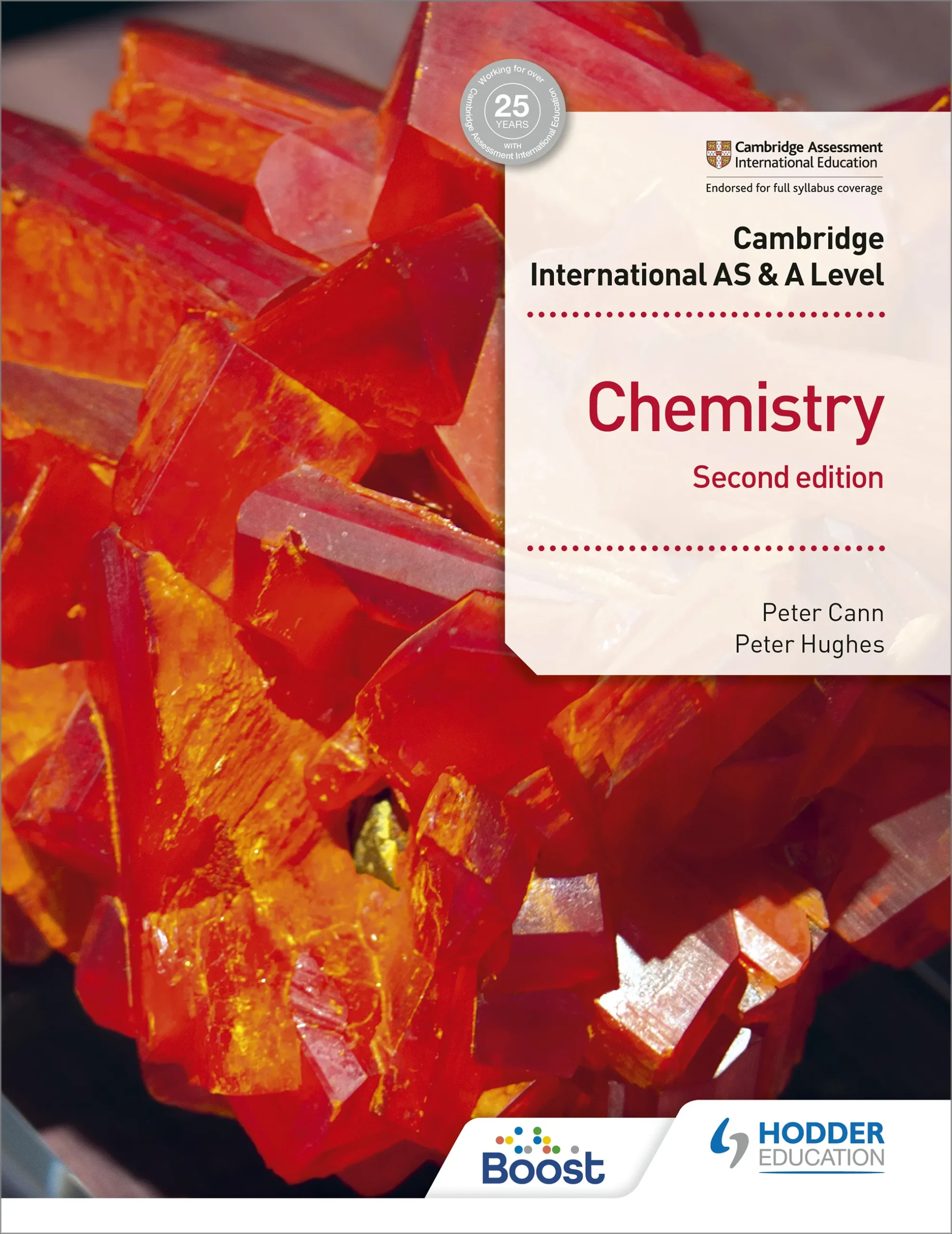
Written by Peter Cann and Peter Hughes, the Hodder A level Chemistry student’s book has built a strong reputation among students who struggle with the quantitative side of chemistry. It is structured for logical progression, with particularly clear walkthroughs for complex physical chemistry problems.
Topics such as Hess’s Law energy cycles, buffer solution equilibria, and rate equation constant derivations are explained with more step-by-step worked examples in this book than in most competing texts. Each chapter closes with a large bank of past-exam-style questions, explicitly divided into AS Level and A2 content blocks. That separation alone is a practical advantage for students planning their study timeline around a staged examination strategy.
The Hodder A level Chemistry book is also available as a standalone workbook, making it a flexible choice for students who already own a primary coursebook and want supplementary question practice without purchasing a second full text.
Oxford University Press Complete Chemistry for Cambridge International AS & A Level
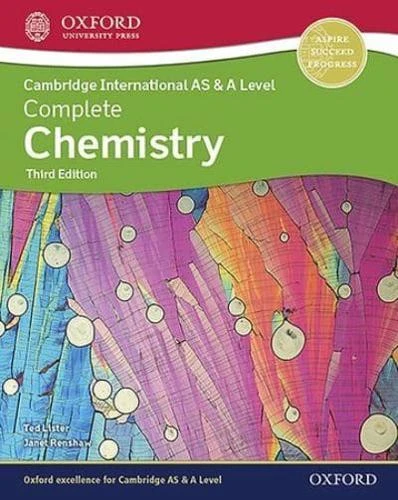
Written by RoseMarie Gallagher and Paul Ingram, this Oxford A level Chemistry text prioritizes conceptual clarity and exam readiness over exhaustive detail. Its layout is deliberately designed for fast, visual revision, with summary boxes, quick-reference formula blocks, and consistently clear diagrams.
In our experience working with international students whose first language is not English, this is often the most accessible of the three primary textbooks. The vocabulary is direct and precise without sacrificing scientific rigour. It is particularly well-suited to students who find dense academic prose a barrier to comprehension during revision periods.
>>> Read more: A Level Burnout Recovery Plan: 4-Week Reset Strategy for Year 12-13 Students
A level Chemistry revision guides vs full textbooks: which do you actually need?
A common mistake we see is students treating a revision guide as a substitute for a full coursebook rather than as a complementary tool. These are structurally different resources with different purposes, and conflating them is a significant strategic error.
A full A level Chemistry textbook delivers the complete conceptual framework, worked examples, and examination-style questions needed to build understanding from the ground up. A revision guide distils that content into condensed summaries, key equations, and examiner tips intended for consolidation during the final weeks before exams.
The table below clarifies when to use each type of resource:
| Resource type | Best used for | Typical page count | Example titles |
|---|---|---|---|
| Full coursebook | Building foundational understanding throughout the course | 500-700 pages | Cambridge UP Coursebook, Hodder Student’s Book |
| Revision guide | Consolidating knowledge in the final 6-8 weeks | 200-300 pages | CGP A Level Chemistry, Philip Allan Revision Guide |
| Workbook | Structured question practice at any stage | 150-250 pages | Hodder A level Chemistry Workbook |
| Past paper compilations | Exam technique and timing practice | Variable | Cambridge International past papers, AQA past papers |
The Philip Allan Chemistry revision guide, published under Hodder’s Philip Allan imprint, is specifically designed for A level students preparing for final examinations. It offers concise topic summaries with examiner commentary on common errors, making it a high-value supplement when used alongside a full textbook rather than instead of one.
>>> Read more: A Level Chemistry Practical Write-Up: 8-Section Template for A*
Top A level Chemistry books for AQA, Cambridge, Edexcel and OCR specifications
Different examination boards require meaningfully different textbooks. A student sitting AQA Chemistry A level examinations should not primarily rely on a Cambridge 9701-aligned coursebook, and vice versa. The table below maps the strongest available resources to each major specification.
| Examination board | Primary recommended textbook | Revision guide recommendation | Workbook option |
|---|---|---|---|
| Cambridge 9701 | Cambridge UP Coursebook (Ryan & Norris) | Oxford Revise A Level Chemistry | Hodder A Level Chemistry Workbook |
| AQA Chemistry A level | AQA Chemistry: A Level (OUP, Elliot & Fairclough) | CGP AQA A Level Chemistry Complete Revision | Kerboodle AQA Digital Workbook |
| Edexcel A level Chemistry | Edexcel A Level Chemistry (Pearson, Hill & Hill) | CGP Edexcel A Level Chemistry Revision Guide | Pearson Edexcel A Level Chemistry Workbook |
| OCR A level Chemistry | OCR A Level Chemistry A (Hodder, Older) | CGP OCR A Level Chemistry Revision Guide | OCR A Level Chemistry Workbook |
One critical detail often overlooked by students switching from Cambridge IGCSE to an AQA or Edexcel A level programme is that the topic sequencing differs substantially between boards. An AQA Chemistry A level textbook will introduce certain organic chemistry mechanisms in a different order than the Cambridge 9701 specification. Using a mismatched book, even partially, creates syllabus blind spots that are genuinely difficult to identify without expert guidance.
>>> Read more: A Level Chemistry Organic Reactions: 30 Reactions Mind Map for A*
How to use an A level Chemistry book alongside past papers and required practicals
Owning the right A level Chemistry book is only half the equation. The way a student integrates that textbook with past paper practice and practical skills development determines actual examination performance.
Drawing on years of experience at Times Edu, we recommend a three-phase approach for structured self-study:
Phase 1: Conceptual foundation (months 1-8 of AS Level)
- Read each chapter of your primary coursebook before attempting any questions.
- Complete all worked examples independently before checking answers.
- Write summary notes using your own words alongside the text.
- Use the Hodder or Oxford A level Chemistry workbook for additional question practice per topic.
Phase 2: Application and past paper integration (months 9-18)
- Begin timed past paper practice using Cambridge International, AQA, or Edexcel past papers from the last five years.
- Diagnose error patterns by categorising wrong answers as conceptual, procedural, or careless.
- Return to the relevant chapters in your coursebook for any conceptual errors, not just your revision notes.
- For practical skills assessed in Paper 3 (Cambridge) or the required practicals framework (AQA), use the dedicated practical chapters in the Cambridge UP coursebook.
Phase 3: Final consolidation (weeks 1-8 before examinations)
- Shift from coursebook reading to revision guide usage.
- Prioritise the Philip Allan Chemistry guide or CGP equivalent for rapid topic summaries.
- Complete full past papers under timed, exam-condition settings.
- Focus additional time on organic chemistry reaction pathways, as these are statistically among the highest-mark-density topics across all major A level Chemistry examinations.
A common mistake we see among self-study A level Chemistry students is completing past papers without systematic error analysis. Past papers completed without structured feedback loops produce marginal gains at best.
>>> Read more: A Level Chemistry Explanations for 2026: How to Write Clear, Accurate Answers That Earn More Marks
Where to buy A level Chemistry books at the best price online
When students and parents ask where to buy A level Chemistry books, the answer depends on their location, the urgency of delivery, and whether digital access is a priority.
Authorized and commonly used purchasing channels:
- Cambridge University Press Bookshop (cambridge.org/education): Sells directly endorsed titles for Cambridge 9701, often with bundled digital access codes for the Cambridge GO platform.
- Amazon (local regional platforms): Offers competitive pricing on all major titles including Hodder, Oxford, and Pearson Edexcel A level Chemistry. Both new and used condition books are available, though used copies may lack digital access codes.
- Book Depository: Offers free international shipping and carries the full range of Cambridge University Press Chemistry, Hodder, and Oxford titles. Useful for students in Southeast Asia, the Middle East, and Africa.
- Booktopia and Fishpond (Australia/New Zealand): Regional alternatives with reliable delivery timelines for students in Oceania.
- Local authorized Cambridge bookshops: In markets such as Singapore, Malaysia, Hong Kong, India, and the UAE, authorized retailers often stock the most current editions of all major endorsed titles.
One critical point for students buying used copies: always verify the edition matches the current specification year. The Cambridge 9701 specification underwent significant updates for the 2022-2024 examination series. An older edition of the Cambridge UP coursebook may omit updated content on fuel cells, the Nernst equation, and certain polymer chemistry sections that are now examinable.
>>> Read more: A Level Chemistry “Explain” vs “Evaluate”: A Complete Guide 2026
Free A level Chemistry resources vs investing in a quality study book
The internet offers a considerable volume of free A level Chemistry content, and it would be misleading to dismiss it entirely. Websites such as ChemGuide (written by Jim Clark), the Royal Society of Chemistry’s education portal, and YouTube channels dedicated to A level Chemistry provide genuinely useful explanations for specific topics.
The practical limitation of free resources is coherence. A curated A level Chemistry textbook builds knowledge systematically, with each chapter referencing prior content and signposting connections to later topics. Free online resources are episodic by nature. A student watching a video on the Arrhenius equation has no guarantee that the same resource covers the necessary prerequisites in the same pedagogical framework their examination board expects.
In our experience working with international students, the most effective approach combines a primary endorsed A level Chemistry textbook, one specification-matched revision guide, and targeted use of free resources to clarify specific points of confusion, not as a replacement for structured study material.
The investment in a quality set of A level Chemistry books, typically ranging from USD 40-90 for a coursebook and USD 15-25 for a revision guide, is modest relative to the cost of resitting examinations or missing university entry requirements. Framing the decision purely around price is a false economy.
>>> Read more: How Many A Level Past Papers Should You Do? Optimal Number for A*
Frequently asked questions
Which A level Chemistry textbook is best for AQA, Cambridge or Edexcel?
For Cambridge 9701, the Cambridge University Press Coursebook by Lawrie Ryan and Roger Norris is the primary recommendation. For AQA Chemistry A level, the Oxford University Press AQA Chemistry A Level by Elliot and Fairclough is the most syllabus-aligned option. For Edexcel A level Chemistry, the Pearson-published textbook by Hill and Hill is the standard endorsed choice.
Do I need both a coursebook and a revision guide for A level Chemistry?
Yes, but at different points in your study cycle. Use a full coursebook for the first 18 months of the course to build understanding. Introduce a revision guide in the final 6-8 weeks before examinations for consolidation. Using only a revision guide throughout the course is one of the most commonly observed self-study errors at Times Edu.
What is the best A level Chemistry revision guide for last-minute exam preparation?
The CGP A Level Chemistry Complete Revision and Practice is widely regarded as the most efficient revision guide for AQA and OCR students. For Cambridge 9701, the Oxford Revise A Level Chemistry guide provides strong coverage with past-exam-style questions. The Philip Allan Chemistry revision guide is particularly valued for its examiner-commentary sections on common student errors.
Which A level Chemistry book covers organic chemistry and calculations most clearly?
For organic chemistry, the Cambridge UP Coursebook has the strongest visual treatment of reaction mechanisms and stereochemistry. For physical chemistry calculations, the Hodder A level Chemistry Student’s Book provides the most detailed step-by-step worked examples, particularly for topics like Gibbs free energy, Ksp calculations, and the Arrhenius equation.
Do I need separate A level Chemistry books for AS and A2 content?
No. All three primary endorsed textbooks, Cambridge UP, Hodder, and Oxford, cover the complete AS and A2 syllabus in a single volume. The Hodder A level Chemistry book explicitly labels chapters as AS or A2, which helps students following a staged examination pathway. Purchasing separate AS-only texts is generally unnecessary and inefficient.
Are older editions of A level Chemistry textbooks valid for current specifications?
This requires careful evaluation. For the Cambridge 9701 specification, books published before 2020 may not reflect the current syllabus structure, particularly for the updated A2 topics. For AQA and Edexcel, textbooks should match the specification version currently being examined, which is listed on each board’s official website. When in doubt, check the ISBN against the endorsed book list published by the examination board directly.
Which A level Chemistry book is best suited for self-study students without a tutor?
For self-study A level Chemistry, the Oxford University Press Complete Chemistry for Cambridge International AS & A Level is often the most accessible starting point due to its clear language and highly structured layout. Pairing it with the Hodder workbook for question practice creates a strong independent study system. That said, self-study Chemistry at A level carries real risks without expert feedback, particularly for practical skills and complex organic synthesis questions where student misconceptions are difficult to self-identify.