A level Chemistry exam technique 2026: The complete guide to scoring higher across all papers
A Level Chemistry exam technique refers to the specific set of strategies students use to read questions accurately, structure answers correctly, manage time under pressure, and convert chemical knowledge into marks on exam day. It covers everything from how you show working in calculations to how you draw curly arrows in organic mechanisms and how you approach 6-mark extended response questions. This guide walks you through the most effective techniques for AQA, Edexcel, and OCR Chemistry papers, including time management, calculation method, mechanism drawing, and extended writing strategy. Whether you are aiming for a B or pushing for an A*, applying the right approach to every question type will make a measurable difference. Let’s get started.
- How to read and interpret A level Chemistry questions correctly before answering
- Time management strategies across A level Chemistry papers
- How to approach calculation questions and show working in A level Chemistry
- How to answer mechanism and structural questions in A level Chemistry
- How to structure extended response answers in A level Chemistry
- Common exam technique mistakes that cost marks in A level Chemistry
- Frequently asked questions
How to read and interpret A level Chemistry questions correctly before answering

Before writing a single word, you need to read the question twice. The first read gives you the overall context. The second read is where you identify the command word, which controls everything about how your answer should be structured.
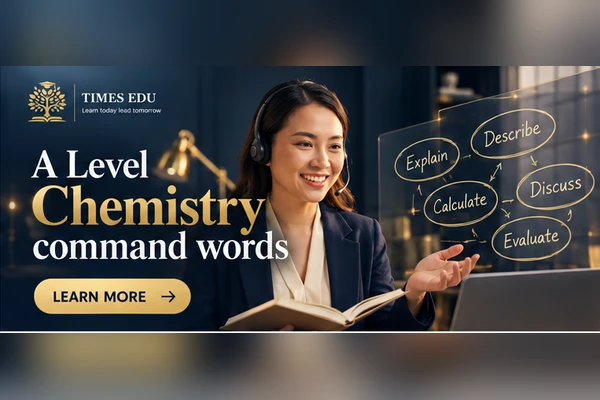
A Level Chemistry [1] papers use a precise vocabulary of command words. Each one signals a specific type of response. Misreading “explain” as “describe” is one of the most common and most damaging errors students make, because the marking scheme will not award marks for a description when an explanation is required.
| Command word | What the examiner expects |
|---|---|
| State | A short factual answer, no explanation needed |
| Describe | Observations or a process, no reasoning required |
| Explain | A cause-and-effect chain with chemical reasoning |
| Suggest | Apply your principles to an unfamiliar context |
| Calculate | A numerical answer with full working shown |
| Deduce | Draw a conclusion logically from given data |
| Outline | A brief account covering the key steps only |
Mark allocations printed alongside questions dictate response structure. A 1-mark ‘state’ question requires a single precise fact, whereas a 4-mark ‘explain’ prompt demands four distinct, logical links. Mapping out bulleted points against the total mark scheme before writing is a defining habit of high-scoring candidates.
If a question gives you a data set, a graph, or a novel skeletal structure, read every piece of information in the stimulus material before you respond. Examiners embed the answer inside the data. Students who skip the stimulus and rely only on memorized content will miss marks that are sitting right in front of them.
>>> Read more: A Level Chemistry 9701 books 2026: Complete guide for students and teachers
Time management strategies across A level Chemistry papers
A Level Chemistry papers are designed to be tight on time. The AQA A Level Chemistry Paper 1 and Paper 2 each carry 105 marks in 120 minutes, giving you roughly 1.1 minutes per mark. Edexcel Advanced Paper 1 runs at a similar ratio. This means there is no room to stall.
The most reliable time management strategy is the two-pass system. On your first pass through the paper, answer every question you can complete with confidence in under a minute per mark. Definition questions, simple calculations, basic dot-and-cross diagrams, and single-step reagent recalls all belong in the first pass. Circle or place a star next to anything that requires deeper thinking, and keep moving.
Your second pass is where you return to starred questions. By this point, you have already secured the straightforward marks, and your brain has often processed the harder questions subconsciously while you were working through other parts of the paper.
A practical time allocation framework looks like this:
| Section type | Time per mark | Example in a 120-minute paper |
|---|---|---|
| Short answer and definitions | 0.8 minutes | ~24 minutes for 30 marks |
| Structured calculation questions | 1.2 minutes | ~30 minutes for 25 marks |
| Mechanism and organic synthesis | 1.2 minutes | ~24 minutes for 20 marks |
| Extended response (6-mark) | 1.5 minutes | ~15 minutes for 10 marks |
| Review and checking | Fixed | 10 minutes at the end |
Reserving the final 10 minutes of an exam purely for review recovers an average of 4 to 6 marks lost to careless errors per sitting. In competitive subjects like Chemistry, a margin of that size routinely shifts a candidate across a grade boundary
>>> Read more: A Level Chemistry Practical Write-Up : 8-Section Template for A*
How to approach calculation questions and show working in A level Chemistry
Calculation questions carry the highest mark density on any A Level Chemistry paper. Born-Haber cycles, Kc and Kp expressions, buffer pH calculations, titration grids, and electrochemical cell potentials are all multi-step problems where the marks are distributed across your method, not just your final answer.
The calculation technique that consistently earns full marks follows four clear steps.
Step 1: List all given variables with units. Write them in a column to the side of your working space. Convert units immediately at this stage: Cm3 divided by 1000 gives dm3, kJ converted to J by multiplying by 1000. Do not carry out any conversions inside the calculation itself, as this is where errors compound.
Step 2: Write the formula explicitly before substituting numbers. State the blank equation first, for example n = c x V or pH = pKa + log([A-]/[HA]). If you substitute incorrectly and arrive at a wrong numerical answer, the examiner can still award marks for stating the correct formula. This is the single most important habit in show working Chemistry A Level.
Step 3: Never round mid-calculation. Use the ANS or memory function on your calculator to carry the full decimal value through every step. Rounding to 3 significant figures at an intermediate step and then continuing from that rounded value introduces cumulative error that can cost you the final accuracy mark.
Step 4: Check significant figures and sign conventions at the end. Your final answer should match the fewest significant figures present in the raw data given by the question. If the question gives you data to 3 significant figures, your answer should be expressed to 3 significant figures. For thermodynamic quantities such as enthalpy, entropy change, or standard electrode potential, always write the explicit positive or negative sign, even if the value is positive.
Executing flawless mathematical working only to omit a sign or misapply significant figures in the final answer forfeits marks unnecessarily. Precision in chemical and biological calculations requires matching the sign and significant figures strictly to the data provided.
>>> Read more: A Level Chemistry Organic Reactions : 30 Reactions Mind Map for A*
How to answer mechanism and structural questions in A level Chemistry
Organic mechanism questions test a very specific set of drawing skills. The curly arrow technique at A Level is non-negotiable: Every curly arrow must start from a bond or a lone pair and must point toward an atom or the space between two atoms where a new bond forms. An arrow that starts from an atom’s nucleus or floats vaguely in a ring structure will not score.
Follow these rules for every mechanism you draw:
- Draw curly arrows from electron-rich sites (lone pairs, pi bonds, C-H bonds in free radical steps) toward electron-poor sites.
- Show all intermediates clearly. In nucleophilic addition to a carbonyl group, for example, you must draw the tetrahedral intermediate before the final product, not skip straight to the product.
- Label charges on intermediates. If a carbocation forms, write the positive charge explicitly on the correct carbon. If a tetrahedral intermediate carries a negative oxygen, write O- Clearly.
- Homolytic fission uses half-headed (fishhook) arrows showing one electron moving. Heterolytic fission uses full curly arrows showing a pair. Using the wrong type for the wrong mechanism is a mark-costing error that appears frequently in student scripts.
For structural and synthesis questions, the organic mechanism technique that works best is pattern recognition. When you see an unfamiliar molecule in a “suggest” question, ignore the overall size of the structure and scan for recognizable functional groups. A carbonyl flanked by two alkyl groups is a ketone and will react like any other ketone, regardless of how complex the rest of the molecule looks. A terminal alkene in a pharmaceutical scaffold will still undergo electrophilic addition with HBr following Markovnikov’s rule.
Isolating the specific reactive site within a complex molecule is significantly more effective than attempting to analyze the entire molecular structure before answering. Successful candidates filter out structural noise to focus immediately on the functional group dictating the reaction pathway.
>>> Read more: A Level Chemistry Explanations for 2026: How to Write Clear, Accurate Answers That Earn More Marks
How to structure extended response answers in A level Chemistry
Extended response questions, typically worth 6 marks on AQA and OCR papers, are marked using a Level of Response matrix. The examiner does not award one mark per point. Instead, they read your entire answer and place it into Level 1 (1-2 marks), Level 2 (3-4 marks), or Level 3 (5-6 marks) based on the coherence, accuracy, and completeness of your response.
The most effective A Level Chemistry strategy for these questions is the two-step approach before you write.
First, underline every specific task in the question prompt. Most 6-mark questions ask you to do two or three distinct things: For example, “Describe a method to prepare a pure sample of copper sulfate crystals, explain the safety precautions involved, and calculate the theoretical yield.” Each of these is a separate assessment target. Missing any one of them, even if your answer is otherwise scientifically accurate, will prevent you from reaching the top mark band.
Second, use a brief planning list (3 to 5 seconds) to ensure your answer covers all three tasks before you begin writing full sentences. Use subheadings in your response that mirror the language of the question. If the question says “describe the method,” write a subheading that says “Method” before that section. Examiners use these structural cues to locate your content efficiently.
Extended response Chemistry questions also reward scientific precision in language. Saying “particles move faster” earns less credit than “molecules have greater kinetic energy.” Saying “bonds break” is weaker than “covalent bonds in the reactant molecules are broken as activation energy is provided.” The language upgrade is not about using longer words: It is about using the correct chemical terminology that matches the mark scheme.
>>> Read more: A Level Chemistry “Explain” vs “Evaluate” : A Complete Guide 2026
Common exam technique mistakes that cost marks in A level Chemistry
Describing instead of explaining. When a question asks you to “explain” why boiling points increase down Group 7, writing “the boiling points get higher because there are more electrons” is a description. An explanation requires the causal chain: More electrons lead to greater polarizability, which leads to stronger London dispersion forces, which require more thermal energy to overcome. Each link in that chain is a mark.
Rounding mid-calculation. As covered earlier, this is one of the top three errors in calculation technique Chemistry. Carrying a rounded intermediate value through a Born-Haber cycle or a Kp calculation can shift your final answer outside the acceptable range and cost you both the accuracy and the consistency marks.
Ignoring the command word. A student who writes a full paragraph of explanation in response to a “state” question has wasted valuable time and scored the same as a student who wrote one line. Conversely, a student who writes one line in response to an “explain” question will miss marks regardless of whether that line is chemically correct.
Incomplete curly arrows. Arrows that do not originate from a specific bond or lone pair, or that do not point clearly to the correct destination, are rejected on the marking scheme. The curly arrow technique A Level demands precision at the level of individual bond pairs.
Omitting units in final answers. A calculated answer without units will frequently lose the final mark, particularly in questions involving molar mass, concentration, enthalpy, or rate constant. Write the unit every time.
The transition from GCSE to A-Level demands a fundamental shift in technical precision. While GCSE specifications frequently award partial credit for incomplete or vaguely phrased answers, A-Level mark schemes operate on strict descriptor alignment: imprecise terminology fails to match any available mark point.
Frequently asked questions
How much working do you need to show in A level Chemistry calculation questions?
Show every step: Variables listed with units, the formula written out before substitution, the substituted expression, and the final answer with units and correct significant figures. Even if your final numerical answer is wrong due to an arithmetic slip, showing correct method earns you working marks across the majority of calculation question types.
How should you allocate time across questions in A level Chemistry Paper 2?
Use the 1.1 minutes per mark guideline as your baseline. Complete short-answer and definition questions first, then return to multi-step calculations and extended response questions. Reserve the final 10 minutes for reviewing answers, checking signs, units, and significant figures.
What should you do if you get stuck on a question in A level Chemistry?
Mark the question clearly, skip it immediately, and continue through the rest of the paper. Return to it during your second pass. Do not spend more than two minutes stalled on any single question, regardless of its mark value, while unattempted questions remain elsewhere in the paper.
How do you draw organic mechanisms correctly in A level Chemistry?
Every curly arrow must originate from a bond or a lone pair. It must point to the atom where the electrons are being donated or to the bond that is forming. Draw all intermediates, label all charges, and use half-headed arrows only for radical (homolytic) mechanisms. Practice on past paper mechanisms until the process becomes automatic.
What is the best strategy for extended response questions in A level Chemistry?
Before writing, underline every task within the question prompt. Write a brief planning list to confirm you will address all parts. Use subheadings in your answer to match the structure of the question. Use precise chemical language throughout. All three tasks must be covered to reach the top mark band.
How do you check your answers effectively in A level Chemistry within the time limit?
Reserve 8 to 10 minutes at the end of the paper. During this time, check that every numerical answer has a unit and the correct number of significant figures, that all signs are written explicitly for thermodynamic values, that curly arrows in mechanisms are complete and correctly directed, and that multi-part questions have been fully answered according to all command words in the prompt.
How does exam technique for A level Chemistry differ from GCSE Chemistry?
At GCSE, partial credit is more generous and marking schemes accept a wider range of acceptable phrasing. At A Level, language precision is strictly assessed. “Explain” questions require a full causal chain. Mechanisms must be drawn to a higher standard of accuracy. Calculations require explicit working and attention to significant figures. Students transitioning from GCSE often underestimate this shift, which is one of the most common performance gaps we address at Times Edu.
Conclusion
At Times Edu, our 1-on-1 A Level Chemistry tutors work through past paper questions with students in real time, identifying exactly where technique is breaking down and building the habits that translate knowledge into marks. If you or your child is preparing for an upcoming A Level Chemistry sitting and wants a personalized academic roadmap, reach out to our team for a consultation. The right technique, applied consistently, is what separates good chemistry students from top-grade chemistry students.