A Level Psychology (9990): Syllabus, Exam Structure & Roadmap to an A* in 2026
A Level Psychology is a rigorous, science-based subject that develops critical thinking, evaluation, and academic writing skills. Students study key topics such as memory, social influence, attachment, psychopathology, and research methods. To achieve a top grade, they must master essay structure, AO3 evaluation, and regular past paper practice. It is also a strong subject choice for university pathways in medicine, psychology, education, and the social sciences.
- What is A level psychology and what does it involve?
- Core topics in the A level psychology syllabus
- Research methods in A level psychology: what you need to know
- How is A level psychology assessed?
- How to evaluate studies and theories in A level psychology
- A level psychology vs A level sociology: key differences
- Best resources and textbooks for A level psychology
- Frequently asked questions
What is A level psychology and what does it involve?
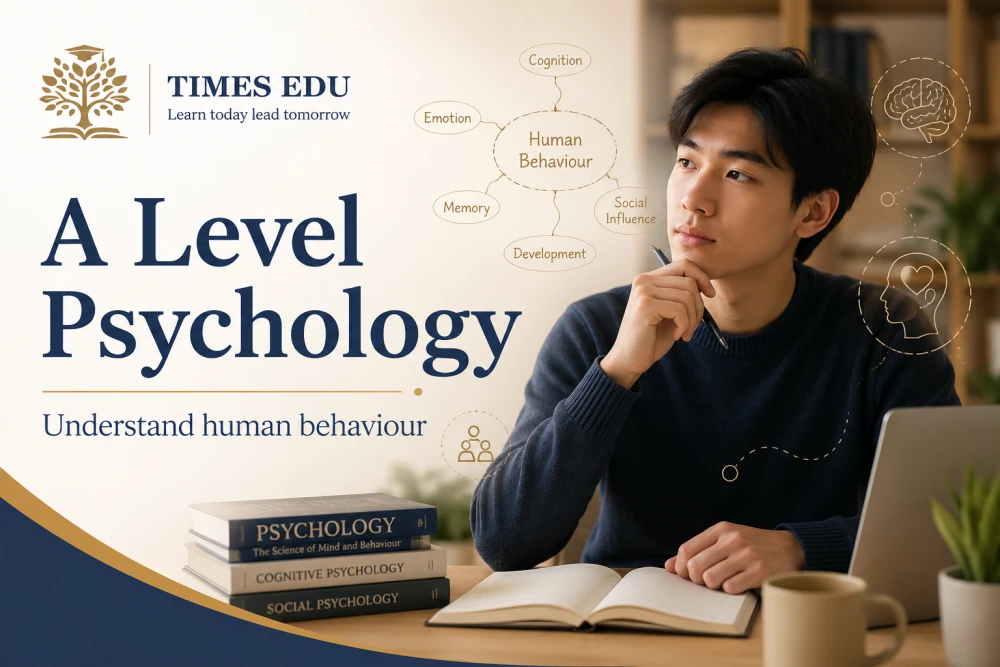
A Level Psychology [1] is a two-year qualification that explores the scientific study of human behaviour and mental processes. It is typically split into an AS Level (Year 1) and a full A Level (Year 2), though most students sit all assessments at the end of the two-year course.
The subject sits at the intersection of science and the humanities. Students learn to read and evaluate empirical research, design their own studies, and construct evidence-based arguments in extended essay form. These skills transfer directly into university disciplines as varied as medicine, law, education, marketing, and neuroscience.
One critical detail often overlooked is that A Level Psychology is not simply about learning what famous psychologists said. The exam boards, particularly AQA Psychology A Level 7182, place enormous weight on evaluation, the ability to challenge, question, and assess the quality of evidence. Students who treat this as a memory test routinely underperform.
>>> Read more: A Level Burnout Recovery Plan : 4-Week Reset Strategy for Year 12-13 Students
Core topics in the A level psychology syllabus
The specific content varies by exam board, but two frameworks dominate the international landscape: AQA (code 7182) and Cambridge International (CIE 9990).
AQA Psychology A Level 7182
AQA is the most widely taken A Level Psychology qualification in the UK and among international school students globally. The syllabus covers the following areas across three papers:
Year 1 topics (Paper 1 — Introductory Topics):
- Social influence (conformity, obedience, minority influence)
- Memory (models of memory, forgetting, eyewitness testimony)
- Attachment (Bowlby’s theory, types of attachment, childcare)
- Psychopathology (definitions of abnormality, phobias, depression, OCD)
Year 2 topics (Paper 2 — Psychology in Context):
- Approaches in psychology (behaviourist, cognitive, biological, psychodynamic, humanistic)
- Biopsychology (the nervous system, brain structure, biological rhythms)
- Research methods psychology (in exceptional depth)
Year 2 optional topics (Paper 3 — Issues and Options):
Students choose one topic from each of four sections, which may include schizophrenia, gender, forensic psychology, addiction, relationships, and cognition and development.
Cambridge International Psychology (CIE 9990)
Cambridge’s approach is structured around four core psychological approaches — biological, cognitive, learning, and social — each examined through specific core studies. In Year 2, students choose two specialist options, such as clinical, consumer, health, or organisational psychology.
| Feature | AQA 7182 | CIE 9990 |
|---|---|---|
| Assessment style | Three written papers, end of Year 2 | Combination of papers and coursework |
| Core Year 1 focus | Social influence, memory, attachment, psychopathology | Four psychological approaches via core studies |
| Year 2 specialisation | One topic per section (e.g. schizophrenia, gender) | Two specialist options chosen from a list |
| Essay style | Heavy 16-mark essay focus with AO3 evaluation | Core study analysis and application questions |
| Popularity | Dominant in UK and international schools | Common in Cambridge-affiliated international schools |
Drawing on years of experience at Times Edu, we consistently find that students choosing between these boards underestimate how different the essay demands are. AQA’s 16-mark essay structure rewards students who can build layered critical arguments, while CIE rewards close familiarity with specific core studies.
>>> Read more: A Level Mock Exam Survival Guide 2026: How to Support Students Through Mock Season
Research methods in A level psychology: what you need to know
Research methods in psychology is the topic that most frequently separates good students from excellent ones. AQA dedicates an entire section of Paper 2 to this area, and questions on research methods can also appear embedded within other topics.
Students must be comfortable with:
- Experimental designs: independent groups, repeated measures, matched pairs
- Types of data: quantitative vs. qualitative, primary vs. secondary
- Sampling methods: random, opportunity, stratified, volunteer
- Statistical tests: knowing when to apply which test, and understanding significance levels
- Ethical guidelines: the BPS code of ethics, issues of consent, deception, and protection from harm
A common mistake we see is students learning the definitions of these concepts without practising how to apply them to novel scenarios. Exam questions frequently present a new study and ask students to identify the design, suggest improvements, or evaluate ethical issues. This requires flexible thinking, not just recall.
One practical strategy: every time you read a study in any topic area, pause and ask yourself — what was the research method, what were the ethical issues, and how could this study be criticised on methodological grounds? This habit builds the cross-topic fluency that examiners reward.
>>> Read more: A Level Essay Paragraph Structure 2026: The PEEL Framework That Guarantees A* Answers
How is A level psychology assessed?
For AQA Psychology A Level 7182, all assessment takes place through three written examinations at the end of Year 2. There is no coursework component.
| Paper | Content | Duration | Marks |
|---|---|---|---|
| Paper 1 | Introductory Topics in Psychology | 2 hours | 96 marks |
| Paper 2 | Psychology in Context | 2 hours | 96 marks |
| Paper 3 | Issues and Options in Psychology | 2 hours | 96 marks |
Each paper contains a mix of short-answer questions, extended writing questions, and the 16-mark essay questions that carry the most weight.
The 16-mark essay in A Level Psychology is the single most important skill to master. These questions require students to demonstrate all three assessment objectives:
- AO1: Knowledge and understanding — accurately describing theories, studies, and concepts
- AO2: Application — applying psychological knowledge to scenarios or examples
- AO3: Evaluation — critically assessing the quality, limitations, and implications of evidence
In our experience working with international students, the most common error in 16-mark essays is writing too descriptively. Students spend ten marks’ worth of effort on AO1 and then rush the AO3 evaluation section. Examiners at AQA explicitly reward depth of evaluation over breadth, three well-developed critical points will outscore six shallow ones every time.
>>> Read more: A Level Write To Mark Scheme 2026: How to Match Examiner Expectations and Score More Marks
How to evaluate studies and theories in A level psychology
Evaluation AO3 is the cornerstone of high achievement in A Level Psychology. To evaluate effectively, students need a reliable framework for analysing any study or theory they encounter.
A robust AO3 evaluation considers the following dimensions:
Validity
Does the study measure what it claims to measure? Internal validity asks whether the result was caused by the independent variable. External validity asks whether findings can be generalised beyond the lab setting.
Reliability
Can the results be replicated consistently? Studies using observational methods or subjective interpretation often suffer from low inter-rater reliability.
Ethics
Were participants protected from harm? Were they deceived? Did they give informed consent? Classic studies by Milgram and Zimbardo are frequently evaluated for their ethical shortcomings.
Cultural and gender bias
Were findings generated from samples that represent the full diversity of human experience? This is particularly relevant when discussing schizophrenia and gender, or when examining Freud, Piaget, and Bowlby’s theories, which were largely built on Western, often male-centric samples.
Reductionism and determinism
Does the approach oversimplify complex behaviour? Biological and behaviourist approaches in psychology are frequently criticised for reducing human experience to physical mechanisms or conditioned responses.
When students apply these lenses consistently, their essays take on the analytical depth that distinguishes an A* response from a B-grade answer.
>>> Read more: How to Get A in A Levels: The Ultimate Guide 2026
A level psychology vs A level sociology: key differences
Many students are uncertain whether to choose A Level Psychology or A Level Sociology. Both subjects examine human behaviour in rigorous ways, but their approaches differ significantly.
| Dimension | A Level Psychology | A Level Sociology |
|---|---|---|
| Core lens | Individual behaviour and mental processes | Social structures, institutions, and inequalities |
| Methods emphasis | Experimental and scientific research methods | Qualitative research, sociological theory |
| Mathematical content | Statistics, probability, data analysis | Minimal quantitative demand |
| Key thinkers | Freud, Piaget, Bowlby, Milgram, Bandura | Marx, Durkheim, Weber, Goffman |
| Career alignment | Medicine, clinical psychology, neuroscience, education | Law, politics, social work, journalism |
| University subject bridge | Strong fit for science-based degrees | Strong fit for humanities and social science degrees |
One critical detail often overlooked is that Psychology’s research methods component gives students a genuine scientific foundation that many universities value highly. If a student is considering a science-adjacent university pathway, A Level Psychology offers a measurable analytical skill set that Sociology does not emphasise to the same degree.
That said, both subjects develop exceptional essay writing and critical thinking abilities. The choice should be driven by the student’s intended university direction and genuine intellectual interest.
>>> Read more: How to Choose A Level Subjects 2026: Ultimate Decision Guide for Top Unis
Best resources and textbooks for A level psychology
Choosing the right materials dramatically affects exam preparation efficiency. Below are the resources we consistently recommend at Times Edu for both AQA and CIE students.
Official and primary resources:
- AQA’s official specification document (freely downloadable) — the single most important reference for understanding exactly what is assessed
- Cambridge International Education’s syllabus guide for CIE 9990 students
- A Level psychology past papers, available through the official AQA and Cambridge portals, and via platforms like PapaCambridge
Textbooks:
- AQA Psychology for A Level Year 1 and 2 by Cara Flanagan et al. (Illuminate Publishing) — widely regarded as the most comprehensive AQA-aligned resource
- Psychology: A Very Short Introduction by Gillian Butler and Freda McManus — useful supplementary reading for broader conceptual grounding
- Simply Psychology by Michael Eysenck — accessible and well-structured for students new to the subject
Online tools:
- Tutor2u’s A Level Psychology resources — excellent free revision notes and essay plans
- Psychteacher — strong on research methods and biopsychology content
- Times Edu’s structured study roadmaps — tailored specifically for international curriculum students who need to balance Psychology with other demanding A Level subjects
A common mistake we see is students relying almost entirely on online notes and neglecting A Level Psychology past papers. Past paper practice is non-negotiable. Mark schemes reveal the exact language examiners reward, and timed practice builds the essay fluency needed under real exam conditions.
>>> Read more: A-Level Tutor 2026: How to Choose the Right Tutor and Improve Grades Faster
Frequently asked questions
Is A level psychology hard compared to other A levels?
Do you need science GCSE to study A level psychology?
What topics are covered in A level psychology?
How many papers does A level psychology have?
What careers can A level psychology lead to?
How do you get an A* in A level psychology?
Which exam board is best for A level psychology: AQA or Edexcel?
If your student is preparing for A Level Psychology and you want a personalised academic roadmap — one that accounts for their specific exam board, subject combination, university goals, and current performance level — the team at Times Edu is ready to help. Our 1-on-1 tutoring and study-abroad consulting programmes have supported students from across Asia, the Middle East, and Europe in achieving the grades and profiles they need to earn offers from the world’s leading universities.