AP Spanish Literature and Culture: Syllabus, Exam Structure & Roadmap to an 5 in 2026
AP Spanish Literature and Culture stands apart from every other AP course on the College Board roster. It is not a language test. It is not a grammar exercise. It is a rigorous, college-level journey through eight centuries of literary history, conducted entirely in Spanish, and demanding the kind of analytical depth most students have never encountered before high school graduation.
Drawing on years of experience at Times Edu preparing students for international curriculum examinations, this guide breaks down everything you need to know: What the course covers, which texts are required, how the exam works, and how to build a strategy that puts a score of 5 within realistic reach.
- AP Spanish literature and culture: What it covers and who it suits
- Required literary works in the AP Spanish literature and culture curriculum
- Literary analysis skills essential for AP Spanish literature and culture
- How AP Spanish literature and culture is assessed: Exam format and scoring
- AP Spanish literature and culture vs AP Spanish language and culture: Key differences
- How to prepare effectively and score a 5 in AP Spanish literature and culture
- Best resources and study materials for AP Spanish literature and culture
- Frequently asked questions
AP Spanish literature and culture: What it covers and who it suits
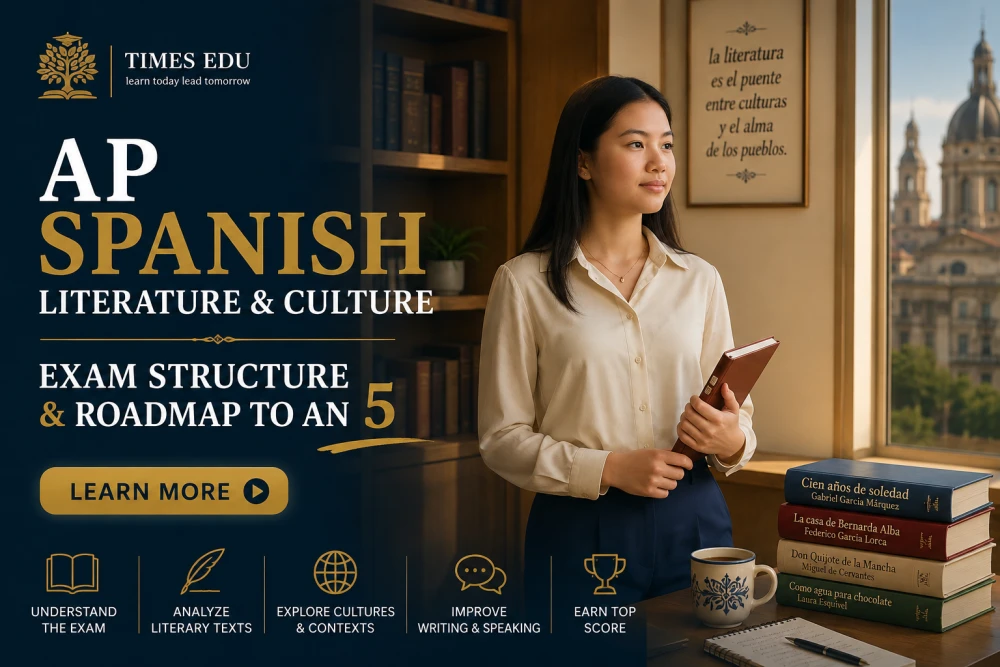
The College Board positions AP Spanish Literature and Culture [1] as the equivalent of a third-year university introduction to literature course. That framing alone should set expectations clearly. Students are not reading simplified adaptations or contemporary news articles. They are reading canonical Peninsular and Latin American texts in their original Spanish, from medieval verse to 20th-century magical realism.
The course traces literary development across six historical periods: The Medieval period, the 16th century, the 17th century (which includes the Siglo de Oro, or Golden Age), the 19th century, the Generation of ’98 and Modernism, and the 20th century. Each period introduces distinct literary movements, ideological contexts, and stylistic conventions that students must internalize before exam day.
This course suits students who already possess strong academic Spanish, who enjoy close reading and argumentation, and who are genuinely curious about the cultural and political forces that shaped Latin America and Spain. It is not recommended as a casual elective. Students who thrive here typically have a CEFR B2 or higher level in Spanish and a genuine appetite for literary analysis.
>>> Read more: AP books 2026: The complete guide to choosing the best AP exam prep materials
Required literary works in the AP Spanish literature and culture curriculum
One of the defining features of AP Spanish Literature and Culture is its fixed required reading list. Unlike many other AP subjects where teachers have curricular flexibility, this course is built around 38 mandatory texts designated by the College Board. Every Free-Response Question on the exam references these texts directly.
The table below organizes the required works by historical period, with key authors highlighted:
| Historical period | Representative works and authors |
|---|---|
| Medieval | El conde Lucanor (Don Juan Manuel), Romance de la pérdida de Alhama (Anonymous) |
| 16th century | Lazarillo de Tormes (Anonymous), Segunda carta de relación (Hernán Cortés) |
| 17th century (Siglo de Oro) | Don Quijote de la Mancha (Cervantes), El burlador de Sevilla (Tirso de Molina), poems by Sor Juana Inés de la Cruz, Góngora, Quevedo |
| 19th century | En una tempestad (Heredia), Las medias rojas (Pardo Bazán), El hijo (Horacio Quiroga) |
| Generation of ’98 and Modernism | San Manuel Bueno, mártir (Unamuno), A Roosevelt (Darío) |
| 20th century | El sur (Borges), La noche boca arriba (Cortázar), Dos palabras (Allende), poems by Neruda, García Márquez’s prose |
A common mistake we see at Times Edu is students approaching these texts as isolated reading assignments rather than as a connected literary conversation across centuries. The exam rewards students who can explain how Sor Juana’s feminist resistance in the 17th century echoes in the narrative voice of Isabel Allende three hundred years later.
The Siglo de Oro (Golden Age) texts deserve particular attention because they represent the highest density of exam questions. Cervantes, Quevedo, Góngora, and Sor Juana Inés de la Cruz all appear consistently across both the multiple-choice and essay sections. Students who invest early in understanding baroque poetic devices will gain a measurable advantage.
García Márquez, Neruda, and Borges are the three 20th-century authors who generate the most comparative essay prompts. Their thematic preoccupations (identity, memory, colonialism, solitude, the nature of reality) make them ideal anchors for cross-period comparisons, which is precisely what AP Spanish Lit FRQ Question 4 demands.
>>> Read more: AP Stress Management Study Routine 2026: How to Stay Consistent Without Burning Out Before Exams
Literary analysis skills essential for AP Spanish literature and culture
Mastering the required texts is only half the work. The other half is developing a set of transferable analytical skills that can be applied to any text, including the unseen passages that appear in the multiple-choice section.
The three core skills the College Board assesses are:
- Textual analysis: Identifying literary devices (metáfora, hipérbole, anáfora, sinestesia), narrative voice, genre conventions, and structural choices, then explaining their effect on meaning.
- Historical contextualization: Situating a text within its socio-political moment. A poem by Neruda cannot be fully analyzed without understanding mid-20th-century Latin American political reality. A chronicle by Hernán Cortés cannot be read neutrally without acknowledging the colonial power dynamic it embeds.
- Comparative analysis: Identifying how two texts, two authors, or a text and an artwork treat a shared theme differently, and arguing for the significance of that difference.
One critical detail often overlooked is the difference between identifying a literary device and analyzing it. Many students lose marks by writing, “The author uses a metaphor in line 3,” without explaining what that metaphor accomplishes thematically or emotionally. Graders at the College Board are trained to reward interpretation, not identification.
The comparative essay section is where students most frequently collapse. A strong comparative essay does not alternate between two texts paragraph by paragraph. It organizes arguments around shared analytical lenses, such as the treatment of power, gender, colonial identity, or death, and uses both texts as simultaneous evidence.
>>> Read more: The Ultimate 12-Week AP Study Plan 2026: How to Score a 5
How AP Spanish literature and culture is assessed: Exam format and scoring
The AP Spanish Lit exam runs for approximately three hours and is divided into two sections of equal weight.
| Section | Format | Time | Weight |
|---|---|---|---|
| Section I: Multiple-Choice | 65 questions | 80 minutes | 50% |
| Part A | Listening comprehension (audio recordings) | Included above | Part of Section I |
| Part B | Reading comprehension (required + unseen texts) | Included above | Part of Section I |
| Section II: Free-Response | 4 written essay questions | 100 minutes | 50% |
| FRQ 1 | Text explanation (single passage or poem) | 25 minutes | Part of Section II |
| FRQ 2 | Text and art comparison | 25 minutes | Part of Section II |
| FRQ 3 | Analysis of a single required text in its historical context | 25 minutes | Part of Section II |
| FRQ 4 | Comparative essay (required text + unlisted text, shared theme) | 25 minutes | Part of Section II |
The listening component catches many students off guard. The audio materials include author interviews, poetry recitations, and literary discussions, all in Spanish. Students must process academic register spoken at native speed and answer analytical questions about content and implication. Regular exposure to authentic spoken Spanish in an academic context is not optional preparation; it is essential.
FRQ scoring uses a 0 to 5 rubric per question. The graders assess three dimensions: Thesis quality, use of evidence from the text, and sophistication of interpretation. A response that summarizes plot rather than argues an interpretive claim will score at most a 2, regardless of how accurate the summary is.
In our experience working with international students, the 100-minute free-response section disproportionately separates 3s from 5s. Students who cannot write four coherent, text-anchored analytical essays in Spanish within that time frame will struggle to break a 4 even with strong multiple-choice performance.
>>> Read more: How to Choose AP Classes : A Strategic Guide 2026
AP Spanish literature and culture vs AP Spanish language and culture: Key differences
Many families arrive at Times Edu unclear on how these two courses differ. The confusion is understandable because both courses are labeled “Spanish” and both count as AP credit. The distinction, however, is fundamental.
| Dimension | AP Spanish Literature and Culture | AP Spanish Language and Culture |
|---|---|---|
| Primary focus | Literary and historical analysis | Communication skills across contexts |
| Texts used | 38 mandatory canonical literary works | Contemporary media, journalism, and diverse texts |
| Exam writing | Literary essays in Spanish | Persuasive and interpersonal writing tasks |
| Historical knowledge required | Yes, across 8 centuries | Minimal |
| Best suited for | Students with strong academic Spanish and literary interest | Students developing Spanish proficiency for real-world use |
| College credit pathway | Literature and humanities departments | Language or general elective credit |
A student aiming for a Spanish literature major or Latin American studies program at a US university gains significantly more from AP Spanish Literature and Culture. A student who wants to demonstrate general Spanish proficiency for business or communication purposes is better served by AP Spanish Language and Culture.
Choosing the wrong course is a costly mistake, not only in terms of exam performance but also in terms of how university admissions offices interpret the course choice within your academic profile.
>>> Read more: What are AP Course? The Ultimate Times Edu Guide 2026
How to prepare effectively and score a 5 in AP Spanish literature and culture
Scoring a 5 on AP Spanish Literature requires a preparation strategy built around three pillars: Text mastery, analytical writing practice, and timed simulation.
Pillar 1: Build a systematic text knowledge base
Do not read through all 38 texts once and consider them done. For each required work, create a structured knowledge card that records: The author’s biographical and historical context, the central themes, the dominant literary devices, the narrative or lyrical voice, and two to three direct quotations in Spanish that can anchor an exam essay.
The texts that demand the deepest investment, based on their frequency in past AP Spanish Lit papers, are Don Quijote, San Manuel Bueno mártir, El sur, La noche boca arriba, and the lyric poetry of Neruda, Darío, and Sor Juana.
Pillar 2: Write analytical essays every week, not only before the exam
The AP Spanish Lit FRQ rubric rewards a very specific type of writing: Claim-driven, evidence-anchored, and historically aware. That writing style must be practiced until it becomes automatic. Students should write at least one timed essay per week from October onward, ideally rotating through all four FRQ formats.
A common mistake we see is students who understand the texts deeply but have never practiced writing about them under time pressure. On exam day, those students run out of time, leave essays incomplete, and score lower than their actual knowledge deserves.
Pillar 3: Use AP Spanish Lit past papers strategically
The College Board releases free-response questions from previous years. These are not supplementary materials. They are the single most valuable preparation tool available. Work through them systematically, compare your responses to the published scoring guidelines, and identify your weakest FRQ type. Then concentrate your essay practice on closing that gap.
For the listening comprehension component, use authentic Spanish-language literary podcasts and recorded author interviews. The Academic Decathlon’s Spanish literary recordings and the Real Academia Española’s audio resources are particularly aligned with the register and content of the exam.
>>> Read more: AP Tutor 2026: How to Choose the Right Tutor and Improve Your AP Score
Best resources and study materials for AP Spanish literature and culture
| Resource | Best used for |
|---|---|
| College Board AP Spanish Lit course description | Understanding required texts and exam format |
| College Board free-response archives | Essay practice and score benchmarking |
| Abriendo puertas: Ampliando perspectivas | Comprehensive textbook aligned to the full reading list |
| SparkNotes en Español | Quick thematic summaries for context building |
| Real Academia Española audio resources | Listening comprehension preparation |
| Times Edu 1-on-1 tutoring sessions | Personalized literary analysis coaching and FRQ feedback |
Drawing on years of experience at Times Edu, the students who achieve AP Spanish Literature score 5 results are almost universally those who received structured, personalized feedback on their essay writing. Generic study guides can explain what the rubric says. A skilled tutor can show you exactly where your argument fails to convince and how to fix it before exam day.
Spanish literature college credit is one of the most academically valuable outcomes a strong AP score can deliver. Many top-tier US universities, including those in the Ivy League and the University of California system, grant course equivalencies for scores of 4 or 5, potentially allowing students to skip introductory literature requirements entirely and enter advanced coursework from their first semester.
Frequently asked questions
What literary works are required in AP Spanish Literature and Culture?
The College Board mandates 38 specific texts spanning the Medieval period through the 20th century. Key authors include Cervantes, Sor Juana Inés de la Cruz, Neruda, Borges, García Márquez, Cortázar, and Isabel Allende. The full list is published in the official AP Spanish Literature and Culture course and exam description.
What proficiency level is needed for AP Spanish Literature and Culture?
Students should have at least a B2 level of Spanish proficiency under the CEFR framework, roughly equivalent to completing AP Spanish Language and Culture or three to four years of advanced high school Spanish. The course and exam are conducted entirely in Spanish, including the listening, reading, and all four written essays.
How is AP Spanish Literature and Culture assessed across its sections?
The exam is divided equally between a 65-question multiple-choice section (80 minutes) and a four-essay free-response section (100 minutes). Each section counts for 50% of the total score. The multiple-choice section includes both listening and reading components.
What authors appear most frequently in AP Spanish Literature exams?
Based on released past papers, the authors with the highest frequency across both multiple-choice and free-response questions are: Cervantes, Sor Juana Inés de la Cruz, Rubén Darío, Pablo Neruda, Jorge Luis Borges, Julio Cortázar, Gabriel García Márquez, and Isabel Allende.
How does AP Spanish Literature differ from AP Spanish Language and Culture?
AP Spanish Literature focuses on literary and historical analysis of 38 canonical texts. AP Spanish Language focuses on contemporary communication skills. Literature requires deeper historical knowledge and advanced essay writing in Spanish. Language is more suitable for students building general proficiency. Both offer college credit, but in different academic departments.
How do you score a 5 in AP Spanish Literature and Culture?
A score of 5 requires three things working together: Deep knowledge of all 38 required texts, the ability to write claim-driven analytical essays in Spanish under timed conditions, and strategic practice using official past papers and scoring rubrics. Weekly essay practice with expert feedback is the single most impactful preparation habit.
Does AP Spanish Literature and Culture give college credit?
Yes, for scores of 4 or 5 at most US universities. Spanish literature college credit typically satisfies introductory literature or humanities requirements. The exact credit awarded varies by institution, so students should check each university’s AP credit policy directly.
Conclusion
At Times Edu, our 1-on-1 international curriculum specialists work with AP Spanish Literature students from the first required text through the final timed essay. If you want a personalized academic roadmap that maps your current Spanish proficiency and analytical skills to a realistic AP exam strategy, we invite you to book a consultation with our team. The earlier you begin, the more time you have to build the depth this course genuinely requires.