IGCSE Biology 0610 books 2026: Complete guide for students and teachers
A reliable IGCSE Biology textbook supports every stage of Cambridge Biology preparation, from understanding core concepts and practical skills to applying knowledge in exam questions.
This guide compares the officially endorsed books from Cambridge University Press, Hodder Education, and Oxford University Press, identifies the best options for visual learners, EAL students, self-study candidates, and practice-focused learners, and explains how to combine a current textbook with revision guides and past papers for effective exam preparation.
- Official Cambridge-endorsed IGCSE Biology textbooks reviewed
- IGCSE Biology revision guides vs full textbooks: what should you buy?
- Top IGCSE Biology books by Hodder, Oxford and Cambridge University Press
- How to use an IGCSE Biology book alongside past papers and practical skills
- Where to buy IGCSE Biology books at the best price online
- Free IGCSE Biology resources vs investing in a dedicated study book
- Frequently asked questions
Official Cambridge-endorsed IGCSE Biology textbooks reviewed
Not every book sold online is officially endorsed by Cambridge Assessment International Education. An endorsed IGCSE Biology [1] textbook has been reviewed against the current syllabus and confirmed to provide accurate, complete coverage. Using a non-endorsed book is a significant risk, particularly after the 2021 syllabus update for the 0610 specification.
The three publishers that hold official endorsement status for Cambridge IGCSE Biology are Cambridge University Press, Hodder Education, and Oxford University Press. Each targets a slightly different learner profile, and understanding those differences is what allows a student to choose strategically rather than simply picking the most popular title.
Cambridge IGCSE Biology coursebook by Mary Jones and Geoff Jones
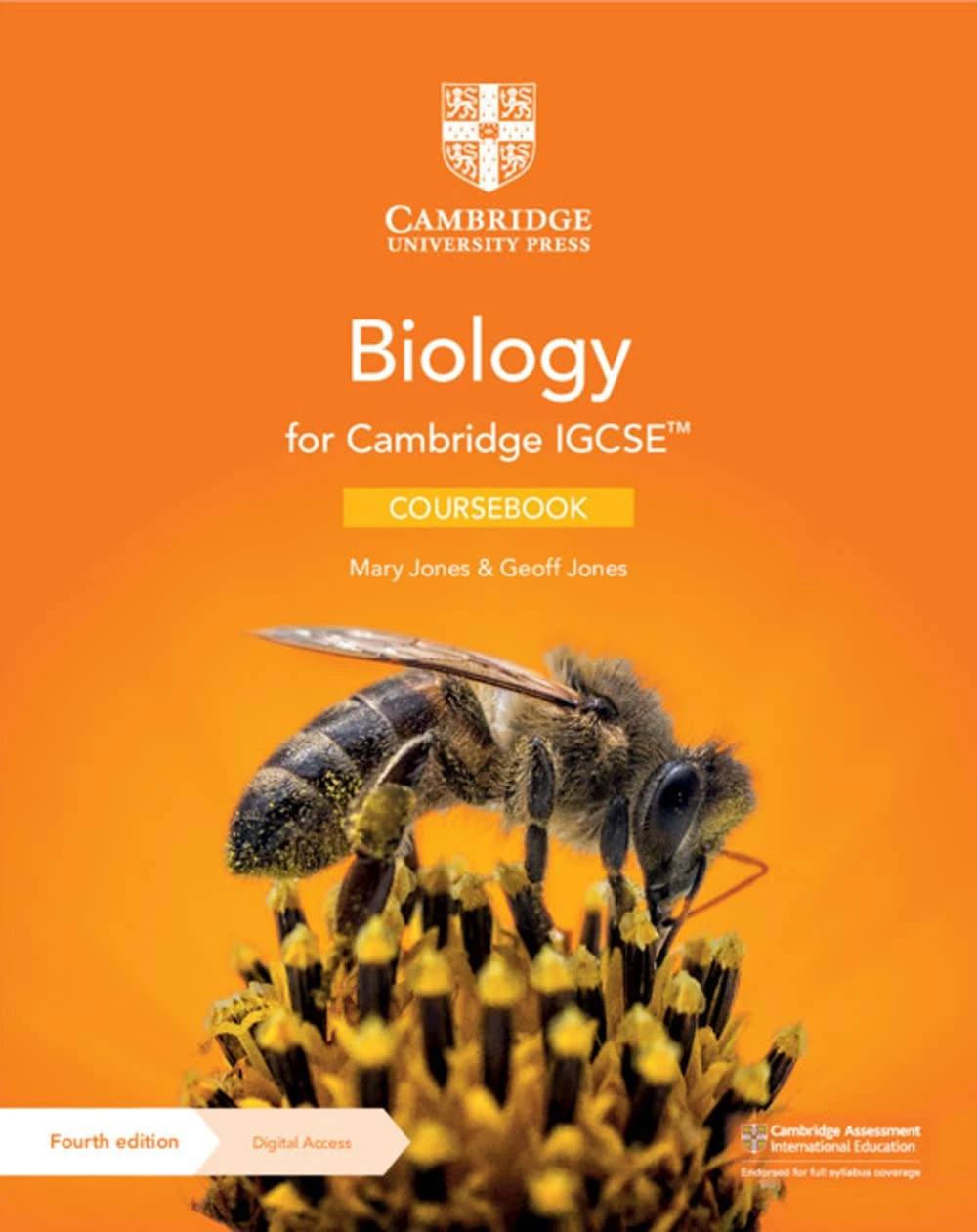
The Cambridge IGCSE Biology coursebook, published by Cambridge University Press, is the most widely recognized title in this category. Written by Mary Jones and Geoff Jones, this book is structured directly around the Cambridge 0610 learning objectives, making syllabus tracking unusually straightforward.
What sets the Mary Jones Biology IGCSE coursebook apart is its visual depth. High-definition microscopic photographs sit alongside full-color anatomical diagrams, and every major system is broken down into digestible sections. The “Experimental Skills” features embedded throughout the chapters cover biological drawing, variable identification, and data interpretation, which are precisely the skills tested in Paper 5 and Paper 6.
Digital access through the Cambridge GO platform unlocks interactive animations and auto-marked self-quizzes, making this the strongest option for students who study with a screen-based workflow. This is the Cambridge University Press 0610 title we recommend most consistently to students aiming for grades 8 and 9.
Hodder IGCSE Biology student’s book by D.G. Mackean and Dave Hayward
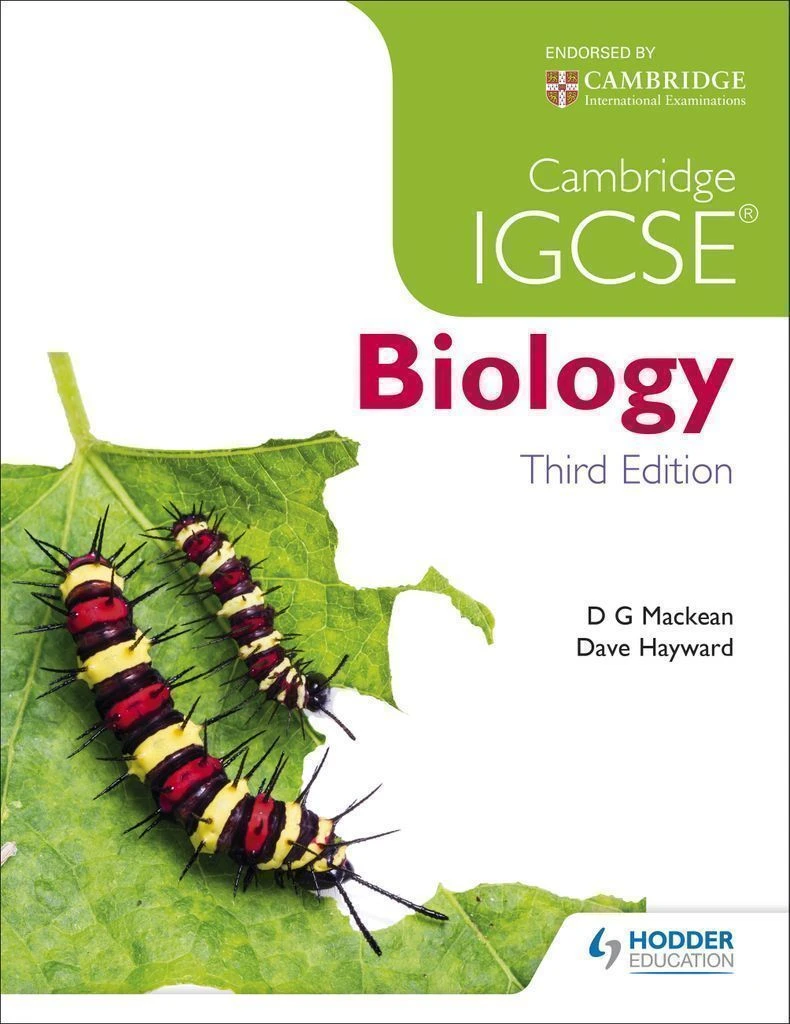
The Hodder IGCSE Biology student’s book is written by D.G. Mackean and Dave Hayward. D.G. Mackean built a reputation across decades for making biology accessible without oversimplifying the science, and that legacy is clearly present in this title.
One critical detail often overlooked is that the Hodder book places unusual emphasis on mathematical skills within a biological context. Calculating magnification, working through percentage change, and interpreting graph gradients are all handled with explicit step-by-step logic rather than assumed as prior knowledge.
The end-of-chapter question banks in the Hodder IGCSE Biology book are exceptionally large and pull directly from real past papers. For students who learn primarily through practice rather than reading, this structure is highly effective. It is also an outstanding choice for teachers who want a resource that maps naturally onto lesson planning.
Oxford IGCSE Biology: Complete Biology for Cambridge IGCSE by Ron Pickering
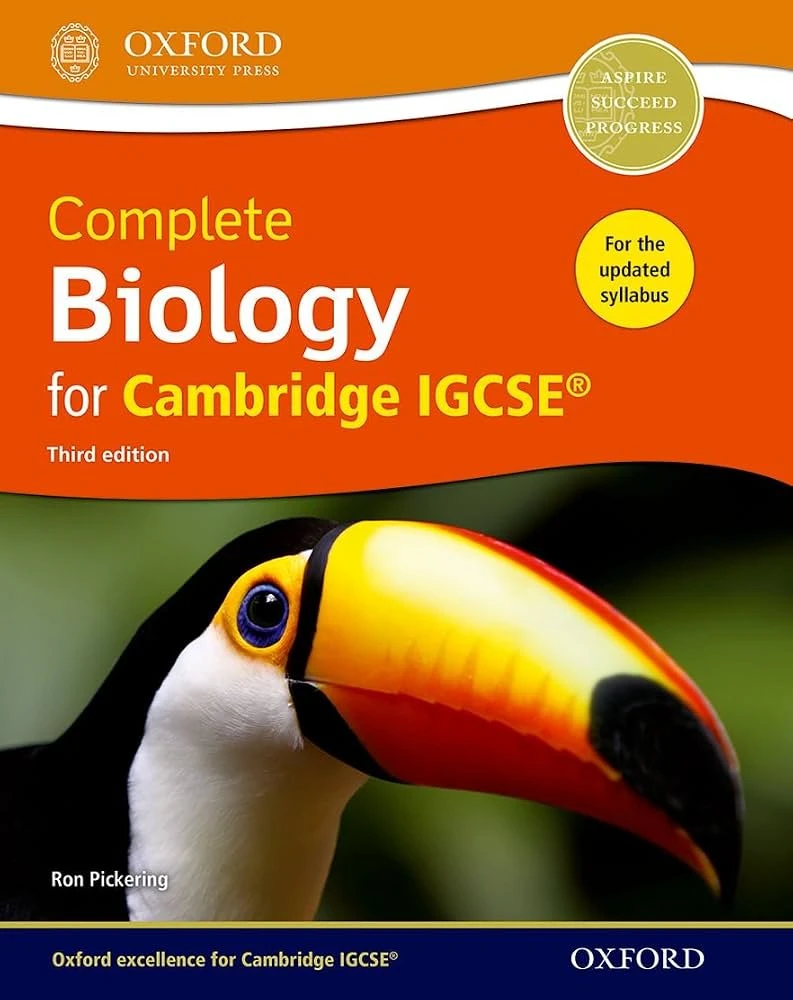
The Oxford IGCSE Biology title, written by Ron Pickering and published by Oxford University Press, takes a distinctly different approach. Its layout is scannable and built around concise summary boxes, which makes it the fastest book to use during rapid revision cycles in the weeks before an exam.
In our experience working with international students who are not native English speakers, the Ron Pickering book consistently earns the highest satisfaction scores. The vocabulary is precise but accessible, never sacrificing scientific accuracy for simplicity. This makes it an ideal primary textbook for EAL learners sitting the IGCSE in schools across Vietnam, China, the Middle East, and Southeast Asia.
The integrated stretch questions in this Oxford IGCSE Biology title are carefully designed to push Extended tier students toward genuine evaluation rather than simple recall. For a student targeting the highest marks, this feature adds significant exam preparation value.
>>> Read more: IGCSE Biology Mock Improvement Plan for 2026: Practical Steps to Improve After Every Mock Exam
IGCSE Biology revision guides vs full textbooks: what should you buy?
A full IGCSE Biology textbook and a revision guide serve fundamentally different purposes. Buying the wrong one at the wrong time in the academic year is one of the most common and avoidable mistakes we see at Times Edu.
A full textbook is your primary learning resource. It introduces concepts, explains mechanisms, provides diagrams, and builds understanding from the ground up. A revision guide condenses those concepts into structured summaries designed for review, not initial learning.
The strategic sequence is clear: use a full endorsed textbook throughout the school year, then layer in a targeted IGCSE Biology revision guide during the six to eight weeks before the exam. Using a revision guide as a substitute for a proper textbook almost always results in surface-level understanding that collapses under the analytical pressure of Paper 4.
Recommended revision guides
The Cambridge IGCSE Biology revision guide published by Cambridge University Press pairs naturally with the Mary Jones coursebook. The Collins IGCSE Biology revision and practice book is also a strong option, particularly for students who want color-coded topic summaries and built-in practice questions. Collins IGCSE Biology is especially popular among students doing self-directed study outside of a formal school timetable.
>>> Read more: IGCSE Biology Past Paper Strategy for 2026: How to Use Past Papers for Better Exam Results
Top IGCSE Biology books by Hodder, Oxford and Cambridge University Press
The table below summarizes the key differences between the three primary endorsed textbooks. Use this as a quick reference when deciding which IGCSE Biology book to prioritize.
| Feature | Cambridge CUP Coursebook | Hodder IGCSE Biology | Oxford IGCSE Biology |
|---|---|---|---|
| Authors | Mary Jones, Geoff Jones | D.G. Mackean, Dave Hayward | Ron Pickering |
| Best for | Visual learners, digital study | Practice-driven learners | EAL learners, rapid revision |
| Diagram quality | Excellent | Good | Very good |
| Past paper integration | Moderate | Extensive | Moderate |
| Mathematical skills focus | Moderate | High | Moderate |
| Digital platform access | Cambridge GO | Limited | Limited |
| EAL accessibility | Good | Good | Excellent |
| Stretch / Extended support | Strong | Strong | Very strong |
Drawing on years of experience at Times Edu, our general recommendation for most students is to use the Cambridge IGCSE Biology coursebook as the primary text and supplement it with the Oxford IGCSE Biology book during revision season. For students who need intensive exam practice throughout the year, the Hodder IGCSE Biology student’s book becomes the stronger primary choice.
>>> Read more: IGCSE Biology Explain Questions: How to Write Clear, Effective Answers in Exams in 2026
How to use an IGCSE Biology book alongside past papers and practical skills
Owning the right IGCSE Biology book is only half the equation. The other half is knowing how to use it in coordination with past papers and practical skills development. A common mistake we see is students reading the textbook passively and then feeling blindsided by the question styles in the actual Cambridge papers.
The most effective study workflow follows a structured sequence:
- Read and annotate: Work through one topic section in your chosen IGCSE Biology textbook, underlining key definitions and marking diagrams you need to redraw independently.
- Redraw without looking: Close the book and reproduce every labelled diagram from memory. This is the single most powerful habit for diagram labelling Biology IGCSE assessments.
- Attempt past paper questions on that topic: Do not wait until you have finished the entire syllabus. Topic-specific past paper practice immediately after learning is far more effective than end-of-year cramming.
- Identify gaps: Return to the textbook only for the specific concepts where your past paper answers were incomplete or incorrect.
- Use the IGCSE Biology workbook: Workbooks from Cambridge University Press and Hodder provide structured exercises that bridge the gap between reading and exam application. These are distinct from revision guides and are worth purchasing alongside the main textbook.
Practical skills Biology book sections deserve special attention. Paper 5 (the alternative to coursework) tests experimental design, safety precautions, variable control, and data analysis. The “Experimental Skills” sections in the Cambridge IGCSE Biology coursebook are among the most thorough in the market for preparing students for this paper. The Hodder book also handles this well, particularly for students who need explicit worked examples before attempting questions independently.
One critical detail often overlooked is that diagram labelling in biology is not just about memorizing names. Cambridge mark schemes require labels to point precisely to the correct structure, and arrows drawn imprecisely across a diagram boundary will often lose the mark. Practising with the high-quality diagrams in the endorsed textbooks, and checking against mark schemes, trains this level of precision over time.
>>> Read more: IGCSE Biology 0610 Mistakes : 10 Errors That Cost A* in 2026
Where to buy IGCSE Biology books at the best price online
For families looking to buy IGCSE Biology books, the primary sources are the publisher websites directly, regional academic bookstores, and international platforms such as Amazon and Book Depository. Publisher websites for Cambridge University Press, Hodder Education, and Oxford University Press all offer the latest editions with verified ISBN numbers, which is critical after the 2021 syllabus update.
When purchasing online, always verify the edition year. Books published before 2021 may not fully align with the current Cambridge 0610 syllabus structure, particularly in the ecology and biotechnology topic areas. A book that is even one edition out of date can leave a student working toward learning objectives that no longer exist, while missing topics that are now assessed.
If budget is a genuine constraint, the Cambridge School Support Hub provides some free downloadable resources, but these do not replace a full endorsed IGCSE Biology textbook. Purchasing at least one fully endorsed title is a non-negotiable investment for any student aiming for Grades 7 to 9.
>>> Read more: IGCSE Biology 0610 Study Plan : 3-6 Month Schedule for A*
Free IGCSE Biology resources vs investing in a dedicated study book
Free resources available online, including YouTube channels, PDF summaries, and revision websites, have real value when used correctly. They work best as supplementary tools for a student who already has a strong textbook foundation. They are not a substitute for an endorsed IGCSE Biology textbook.
The structural risk with free resources is inconsistency. A YouTube video on photosynthesis may explain the mechanism brilliantly but omit the precise Cambridge terminology required to score full marks on a structured question. An endorsed IGCSE Biology textbook uses the exact language of the syllabus because it has been written and reviewed against that syllabus explicitly.
In our experience working with international students, the students who rely primarily on free resources tend to score well on straightforward recall questions but struggle with the analysis and evaluation questions in Paper 4. Those higher-order marks require the depth of understanding that only a well-structured textbook builds systematically over an academic year.
Self-study Biology IGCSE students, in particular, should prioritize a strong textbook investment. Without a teacher to bridge conceptual gaps in real time, the textbook becomes the primary instructor. For self-study Biology IGCSE learners, the Mary Jones Biology IGCSE coursebook with its digital Cambridge GO access provides the most comprehensive independent learning environment available.
>>> Read more: Ace IGCSE Biology 0610 | A* Revision Strategy 2026
Frequently asked questions
Which IGCSE Biology textbook is officially endorsed by Cambridge?
Is the Cambridge IGCSE Biology coursebook enough to achieve a high grade?
What is the best IGCSE Biology revision guide for last-minute exam preparation?
Which IGCSE Biology book covers diagrams and labelling skills best?
Do I need a separate workbook for IGCSE Biology exam practice?
Are older editions of IGCSE Biology books valid for the current 0610 syllabus?
Which IGCSE Biology book is best for independent self-study students?
Conclusion
At Times Edu, our 1-on-1 international curriculum tutors work with students across every major IGCSE Biology topic, helping them move from passive reading to active exam performance. If you are unsure which combination of resources fits your child’s specific learning profile, our academic consultants are available to build a personalized study roadmap that accounts for their current level, target grade, and timeline. Reach out to the Times Edu team today to book an initial consultation and take the guesswork out of your Cambridge Biology preparation.