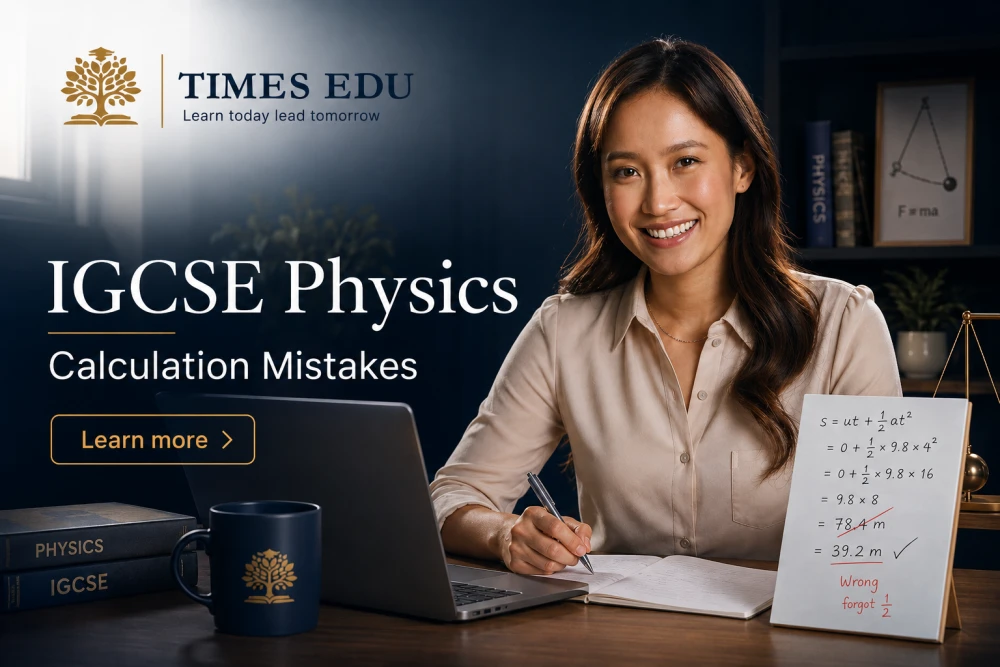
IGCSE Physics Topic Order: What to Study First for Smarter Revision in 2026
The most effective IGCSE Physics topic order for revision is to follow prerequisite topics rather than the textbook syllabus sequence: Start with fundamental units, measurement, and equations, then build mechanics and energy transfers, move into thermal physics and properties of matter, then waves, then electricity and circuits, and only after that study magnetism, electromagnetism, and induction.
Finish with radioactivity/atomic physics and space physics, which become easier once your core modeling skills are stable. This curriculum mapping approach reduces common misconceptions, improves accuracy on Paper 4-style problems, and creates faster score gains under timed conditions.
- The Most Effective IGCSE Physics Topic Order For Revision (IGCSE physics topic order)
- Starting With General Physics Foundations (syllabus sequence + prerequisite topics)
- Connecting Thermal Physics And Properties Of Matter (energy transfers + curriculum mapping)
- Why Electromagnetism Should Be Studied Late In The Cycle (electricity, fields, and prerequisite topics)
- Prioritizing High-Weightage Topics For Maximum Marks (grade boundaries + exam structure)
- Frequently Asked Questions
The Most Effective IGCSE Physics Topic Order For Revision (IGCSE physics topic order)

Based on our years of practical tutoring at Times Edu, the fastest way to raise marks in IGCSE Physics is to stop revising “chapter by chapter” and start revising by prerequisite topics and transferable problem types.
Most students lose grades because they meet a later topic (fields, induction, nuclear) without the mathematical habits and conceptual anchors built earlier.
A critical detail most students overlook in the 2026 exam cycle is that Cambridge released an updated Cambridge IGCSE Physics (0625) syllabus “Version 2” [1] in December 2025, while stating that specimen materials were not updated, so relying on older specimen expectations without cross-checking the current syllabus can create blind spots.
Why “topic order” is not the same as “syllabus sequence”
The syllabus sequence is how an exam board structures content on paper, but the best IGCSE physics topic order for revision is how your brain reduces error under timed conditions. Your revision order should be a curriculum mapping plan that sequences ideas to minimise cognitive overload and maximise cross-topic links.
Cambridge [2] IGCSE Physics (0625) is organised into six broad areas: Motion, forces and energy; Thermal physics; Waves; Electricity and magnetism; Nuclear physics; Space physics.
Edexcel [3] International GCSE Physics (4PH1) is organised into eight areas, beginning with Forces and motion and Electricity, and ending with Astrophysics.
A practical comparison table (Cambridge vs Edexcel)
| Exam board | Official syllabus sequence (high-level) | What this implies for your revision order |
|---|---|---|
| Cambridge IGCSE Physics (0625) | 1 Motion/forces/energy → 2 Thermal → 3 Waves → 4 Electricity & magnetism → 5 Nuclear → 6 Space | Build mechanics + energy language early; use energy transfers as the “bridge” into thermal and electricity. |
| Edexcel International GCSE Physics (4PH1) | 1 Forces & motion → 2 Electricity → 3 Waves → 4 Energy resources & energy transfers → 5 Solids/liquids/gases → 6 Magnetism & electromagnetism → 7 Radioactivity & particles → 8 Astrophysics | Electricity appears earlier, so you must lock fundamental units and equation control before deep circuit work. |
>>> Read more: IGCSE Physics Mistakes 2026: Common Errors Students Make and How to Avoid Them
Starting With General Physics Foundations (syllabus sequence + prerequisite topics)
If you want a revision order that holds up under Paper 4-style problem-solving, your first phase is not “mechanics questions.” It is measurement discipline, fundamental units, and equation grammar.
Phase 1: Measurement, quantities, and the “units-first” advantage
From our direct experience with international school curricula, high achievers treat units as a scoring tool, not background knowledge. Unit control reduces mistakes in almost every chapter: Moments, pressure, power, resistivity, and radioactivity.
Use this checklist as your foundation:
- Convert and manipulate fundamental units quickly (m, kg, s, A, K) and derived units (N, J, W, Pa, C, V, Ω).
- Train “answer plausibility” using orders of magnitude (a common Paper 4 discriminator).
- Rewrite every formula into “triangle forms” and identify proportionality (direct vs inverse).
Common misconception: Students think “units are for memorisation,” then lose marks on correct physics with wrong unit final answers. Examiners reward correct units and penalise unit inconsistency, especially when the method is otherwise sound.
Phase 2: Mechanics as the language of every later topic
Cambridge places “Motion, forces and energy” first in its content overview.
That structure is logical because later chapters recycle mechanics thinking: Gradients, conservation, and force models.
Study mechanics in this internal order (better than textbook order for most students):
- Graphs first: Distance–time, speed/velocity–time, gradient/area interpretation.
- Forces second: Free-body diagrams, resultant force, Newton’s laws, friction, terminal velocity reasoning.
- Energy third: Work, power, efficiency, and energy transfers language used again in electricity and thermal.
Common misconception: Students treat energy as a “formula chapter,” then fail multi-step transfer questions because they do not state the system, store, and transfer pathway clearly.
A targeted curriculum mapping table (what unlocks what)
| Early skill | Later topics it improves | Why it matters in exams |
|---|---|---|
| Graph gradient/area fluency | Waves (v–f–λ graphs), electricity (I–V graphs), decay graphs | Many marks are hidden in graph interpretation under time pressure. |
| Conservation reasoning | Thermal physics, circuits (energy per charge), nuclear | Better structure for extended responses and multi-stage calculations. |
| Proportionality + rearranging | Fields, induction, gas laws, resistivity | Prevents “formula hunting” and speeds up Paper 4 calculations. |
>>> Read more: IGCSE Physics Study Plan for 2026: A Simple Revision Guide for Better Exam Preparation
Connecting Thermal Physics And Properties Of Matter (energy transfers + curriculum mapping)

Thermal physics is where strong students separate from average students because it demands explanation, not just substitution. Cambridge explicitly places Thermal Physics as a major early block.
The most efficient order inside thermal
The pedagogical approach we recommend for high-achievers is to organise thermal revision around one theme: Energy transfers and particle reasoning. This reduces memorization and increases accuracy in explanation questions.
Use this order:
- Particle model first: States of matter, internal energy, temperature vs heat.
- Thermal properties second: Expansion, specific heat capacity, latent heat style thinking (even when not labelled as such).
- Transfer mechanisms last: Conduction, convection, radiation, insulation, and mixed-process scenarios.
Common misconception: Many students write “heat rises” in convection explanations and lose credibility. The correct focus is density change, buoyancy, and bulk fluid motion, not “heat moving upward by itself.”
Examiner scoring logic in thermal questions
Thermal marks often come from precision language. You should practise “two-sentence answers” with keywords, because long paragraphs drift into vague claims.
High-scoring explanation patterns include:
- State the particle-level change (speed/spacing/collisions).
- Link that changes to the macroscopic effect (pressure/volume/temperature).
- If relevant, state the control variable (constant pressure vs constant volume).
How thermal supports university applications (strategic subject positioning)
Parents often ask whether Physics is “worth it” for competitive admissions. Physics is a strong signal for engineering, data science, architecture, economics, and pre-med pathways because it validates mathematical reasoning and modelling.
For profile optimisation, we typically advise:
- Physics + Higher Math pathway for STEM-heavy applications.
- Physics + Chemistry synergy for medicine/biomedical engineering.
- Physics + Computer Science for competitive tech programmes.
The key is coherence: Universities respond well to a subject set that signals a clear academic narrative, not a scattered selection.
>>> Read more: A Level Physics Problem Solving 2026: A Step-by-Step Method to Boost Your Marks
Why Electromagnetism Should Be Studied Late In The Cycle (electricity, fields, and prerequisite topics)
Electricity and magnetism is high-yield, but it is also where students accumulate “small errors” that collapse entire solutions.
Cambridge lists “Electricity and magnetism” as a core area after waves. Edexcel separates Electricity early and Magnetism/Electromagnetism later as distinct topics.
Why studying electromagnetism late is often smarter
Electromagnetism requires three prerequisites that many students do not truly own until later:
- Algebraic rearrangement under pressure.
- Graph fluency (especially I–V and interpretation).
- Energy-transfer thinking (power, efficiency, and “per charge” reasoning).
If you push induction too early, students memorise rules (Fleming’s) without understanding the causal chain. This leads to fragile performance when a question is framed differently.
A high-performance internal order for the electricity block
Use this sequence, regardless of board, because it mirrors how questions are built:
- Charge and current models (microscopic explanation of drift vs conventional current).
- Potential difference as energy per charge (this fixes many misconceptions).
- Resistance and I–V characteristics (graph and reasoning, not just R = V/I).
- Circuit analysis (series/parallel, potential divider logic, power).
- Magnetism basics (fields, force direction, field patterns).
- Electromagnetism and induction (motor effect → generator effect → transformers).
Common misconception: Students believe “current gets used up.” This causes incorrect series reasoning and wrong energy explanations. The correct framing is energy transfer from the supply to components, while current is the rate of charge flow.
A concise “grade saver” checklist for circuit questions
- Write the governing equation before inserting numbers.
- Track units at every step (Ω, V, A, W).
- For power, decide early which form is safest: P = IV, P = I²R, or P = V²/R.
- Use a one-line justification for series/parallel claims (shared current vs shared potential difference).
>>> Read more: Ultimate IGCSE Physics 0625 Revision Guide
Prioritizing High-Weightage Topics For Maximum Marks (grade boundaries + exam structure)
Students often ask which chapters “count most.” The honest answer is that physics is integrated: The exam rewards students who can move across chapters smoothly.
Still, you can prioritise intelligently by aligning revision time with paper weight and common question styles.
Cambridge (0625): Prioritise the theory paper because it carries the largest share
For Cambridge Extended entry, Paper 4 (Theory) is 80 marks and accounts for 50% of the total, while Paper 2 is 30% and the practical paper is 20%.
That means your revision should be anchored around structured problems and explanation quality, not only multiple-choice drills.
What this means in practice:
- Spend the majority of timed practice on multi-step calculations and explanations.
- Use Paper 2 for speed, accuracy, and misconception detection.
- Use practical preparation to secure “easy marks” from graphing, variables, uncertainty, and method critique.
Edexcel (4PH1): Both papers draw from any topic, so your mapping must be complete
Edexcel states that questions may come from any topic area across the specification, and the qualification is assessed through two written examinations. It also specifies Paper 1 as 110 marks (61.1% of total) and Paper 2 as 70 marks (38.9% of total).
That structure rewards students who can switch contexts quickly, so your IGCSE physics topic order must include frequent mixed-topic sets.
How grade boundaries should change your strategy
Many students revise as if the raw mark required for each grade is fixed. Cambridge explicitly explains that grade thresholds are set after papers are taken and marked, and thresholds can change from one series to the next depending on paper difficulty.
This matters because your target should be margin, not perfection. You should aim to build a buffer with dependable marks: Units, graph interpretation, standard calculations, and clean explanations.
A high-impact weekly revision cycle (works across boards)
Based on our years of practical tutoring at Times Edu, the most reliable structure is a repeating loop that forces transfer, not repetition.
- Day 1–2: Concept consolidation (one block, one summary sheet, one misconception list).
- Day 3: Mixed-topic problem set focused on prerequisite overlaps (graphs + energy transfers + algebra).
- Day 4: Timed paper section (strict timing, mark scheme correction, error log).
- Day 5: Practical skills and data questions (planning, variables, graphing, evaluation).
- Weekend: Full timed paper or two half-papers, followed by a targeted re-teach session.
>>> Read more: IGCSE Tutor 2026: How to Choose the Right One
Frequently Asked Questions
What is the best order to study IGCSE Physics?
Which IGCSE Physics topics are the hardest?
For most international-school students, the hardest topics are electromagnetism (induction/transformers), circuit problem-solving under time pressure, and thermal explanations using the particle model.Difficulty usually comes from hidden algebra, weak curriculum mapping, and vague explanation habits, not from the concepts alone.
Should I study Atomic Physics first or last?
What topics appear most in Paper 4?
For Cambridge Extended candidates, Paper 4 is the main structured theory paper and carries 50% of the total assessment weighting, so it heavily rewards multi-step calculations and explanations across the full syllabus.In practice, mechanics/energy, electricity, and waves generate frequent high-mark problems because they combine maths with interpretation.
How to link different Physics topics together?
Is Space Physics a major part of the syllabus?
How long does it take to cover the whole Physics syllabus?
Conclusion
If your goal is a specific grade target, school report improvement, or a strong academic profile for overseas applications, Times Edu can map your syllabus sequence into a personalized revision order, aligned to your exam board and your current diagnostic gaps.
The fastest improvement comes from correcting misconceptions early, training exam-language precision, and drilling the exact problem types that repeatedly appear across series.
Resources: