Best IGCSE English Literature books 2026: Complete guide for students
Choosing the right IGCSE English Literature books is not a single decision but a series of strategic choices that build your study toolkit layer by layer. Begin with an officially endorsed or Cambridge-aligned coursebook to develop your analytical foundation. Pair it immediately with the correct set texts for your examination year. Add a focused revision guide in the final term, and integrate Cambridge past papers from the beginning of your preparation, not just the end.
The three leading publishers, Cambridge University Press, Collins, and Hodder Education, each serve a different student profile. The Cambridge University Press coursebook suits students who want the most thorough methodology and the closest alignment with examiner expectations. Collins suits students who respond to a practical, visual format. Hodder suits those building independence or studying without regular teacher supervision.
What consistently determines whether a student reaches Band 5 or remains in Band 3 is not which book they own but how deliberately they use it: Annotating set texts with precision, practicing timed essays under real conditions, and seeking honest feedback on their analytical writing.
- Official Cambridge-endorsed IGCSE English Literature textbooks and study guides
- Set text companions and literary guides for IGCSE English Literature
- IGCSE English Literature revision guides vs full coursebooks: what to choose
- How to use an IGCSE English Literature book to develop analysis skills
- Where to buy IGCSE English Literature books at the best price online
- Free IGCSE English Literature resources vs investing in dedicated study books
- Frequently asked questions
Official Cambridge-endorsed IGCSE English Literature textbooks and study guides
The starting point for any serious student is an officially endorsed or closely aligned coursebook. Three publishers dominate this space for the Cambridge IGCSE English Literature syllabus.
Cambridge IGCSE and O Level Literature in English Coursebook (Cambridge University Press)
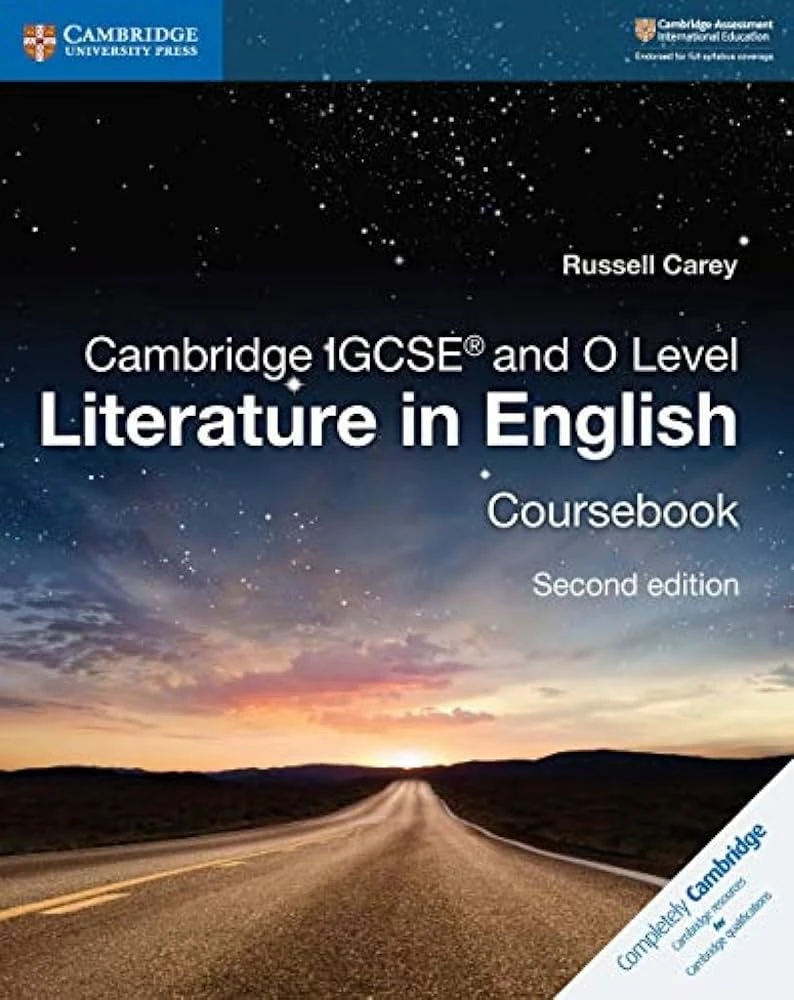
Written by Russell Carey and published directly by Cambridge University Press, this is the most comprehensive Cambridge IGCSE Literature coursebook available. It is structured around the three examination components: poetry, prose, and drama. The book delivers a step-by-step methodology for dissecting literary language, identifying structural choices, and constructing high-scoring analytical essays. Recent editions include digital access to sample student answers with detailed examiner commentary, which is invaluable for understanding exactly what Band 5 and Band 6 responses look like in practice.
Collins Cambridge IGCSE English Literature Student Book
The Collins edition takes a strongly practical approach. Each unit is broken into scannable, bite-sized steps that make close-reading techniques accessible even to students who find literary analysis intimidating. One feature worth highlighting is the vocabulary bank printed alongside every chapter, which gives students the precise literary terminology they need to move beyond basic description into genuine analysis. In our experience working with international students at Times Edu, those who struggle with sophisticated language often respond very well to the Collins format.
Cambridge IGCSE English Literature Student’s Book (Hodder Education)
The Hodder IGCSE Literature guide is structured specifically around building student independence. It places heavy emphasis on tackling unseen texts, which is the component many students fear most. Peer-review checklists and brainstorming templates throughout the book help students learn to draft and self-assess their essay responses without relying on a teacher. For students preparing through self-study or home education, the Hodder IGCSE Literature book is often the strongest standalone option.
| Publisher | Best for | Key strength | Endorsed |
|---|---|---|---|
| Cambridge University Press | Deep methodology, school use | Examiner commentary, full syllabus coverage | Yes (Cambridge) |
| Collins | Accessible, step-by-step learners | Vocabulary banks, visual layout | Cambridge-aligned |
| Hodder Education | Self-study, unseen text practice | Independence-building, brainstorming tools | Cambridge-aligned |
>>> Read more: Best IGCSE Co-ordinated Sciences 0654 books 2026: Complete guide for students
Set text companions and literary guides for IGCSE English Literature
A critical detail often overlooked by students and parents is that no coursebook replaces the actual set texts. The Cambridge IGCSE Literature syllabus requires students to study specific works across three genres: poetry, prose, and drama. These are divided into categories based on the examination components a school enters students for.
Poetry set texts
The most widely studied anthology is Songs of Ourselves, published by Cambridge University Press in two volumes. Volume 1 covers the pre-2025 examination cycle; Volume 2 is increasingly selected by schools entering students from 2025 onward. Every student who sits the poetry component must own this anthology, as the selected poems are drawn directly from it. No study guide substitutes for the primary text itself.
Prose set texts
Cambridge approves a rotating list of novels and short story collections. Stories of Ourselves, also from Cambridge University Press, is the most common anthology choice. Individual novels by authors such as George Orwell, Chimamanda Ngozi Adichie, and others appear regularly. Your school or tutor will confirm which prose text appears on your examination entry, and you should purchase a clean, annotatable copy of that specific edition.
Drama set texts
Plays by William Shakespeare, Arthur Miller, and J.B. Priestley are perennial choices. For Shakespeare, Cambridge University Press produces editions with integrated study notes. For Miller and Priestley, Heinemann and Penguin publish widely used student editions with contextual footnotes.
A common mistake we see at Times Edu is students arriving for their first tutoring session with a complete coursebook but no copies of their actual set texts. The set text is the primary document; the coursebook teaches you how to read it.
>>> Read more: IGCSE Combined Science 0653 book 2026: Complete guide for students and teachers
IGCSE English Literature revision guides vs full coursebooks: what to choose
Many students waste significant money by purchasing both a full coursebook and a revision guide that largely repeat the same content. The distinction is worth understanding clearly.
A full coursebook, such as the Cambridge University Press title by Russell Carey, is designed to be worked through progressively over one to two academic years. It builds analytical skills from the ground up and assumes the student is learning literary analysis for the first time. It is not optimized for rapid exam review.
An IGCSE Literature revision guide is designed for the final four to eight weeks before the examination. It condenses key methods, provides timed essay practice, and reminds students of the command words and mark scheme logic they need. The Philip Allan series and the Revision Notes format from Hodder serve this function well. These are shorter, cheaper, and highly targeted.
The strategic recommendation:
- If you are starting IGCSE Year 1 or Year 10: invest in a full coursebook and your set texts.
- If you are six to eight weeks from your examination: add a focused revision guide to your existing materials.
- If you are self-studying without a teacher: prioritize the Hodder IGCSE Literature book plus a revision guide, and supplement with past papers from the Cambridge resource portal.
Drawing on years of experience at Times Edu, students who use a revision guide without having built foundational analytical skills through a coursebook tend to produce formulaic essays that lack genuine textual engagement. The revision guide should reinforce skills, not introduce them.
>>> Read more: IGCSE Additional Mathematics 0606 book 2026: Complete guide for students and parents
How to use an IGCSE English Literature book to develop analysis skills
Owning the right literary analysis book for IGCSE is only the beginning. The way a student works through that book determines whether they reach Band 5 or stay stuck in Band 3. Here is a structured approach that our consultants at Times Edu recommend for all literature students.
Step 1: Master the analytical framework before applying it to set texts
Begin with the first two to three chapters of your coursebook, which typically introduce the PEEC or PEEL essay structure (Point, Evidence, Explanation, Comment or Link). Do not rush to practice on your set text until you can identify a literary device, quote it accurately, explain its effect on the reader, and connect it to a broader theme in one coherent paragraph.
Step 2: Annotate your set texts systematically
Use your coursebook’s guidance on language, structure, and form to annotate each set text as you study it. Colour-coding by technique (for example, green for imagery, blue for structural choices) helps visual learners process patterns across a long poem or drama act. The Hodder IGCSE Literature workbook format includes templates for exactly this kind of structured annotation.
Step 3: Practice with past paper questions under exam conditions
Cambridge publishes past papers and mark schemes freely on its official resource portal. Once you have annotated a text and practiced essay structures from your coursebook, sit a timed past paper question with no notes. Then compare your response to the mark scheme and the sample student answers in your coursebook. This gap analysis is the fastest way to identify whether your analytical writing is genuinely progressing.
Step 4: Focus intensively on the unseen component
The unseen poetry or prose question is where many students lose marks, because it cannot be prepared through memorisation. The Collins literary analysis book for IGCSE is particularly strong here, with its close-reading frameworks designed for unfamiliar texts. Practice a minimum of one unseen response per week in the final term before your examination.
Step 5: Refine essay introductions and conclusions
One critical detail often overlooked is that examiners at Cambridge read hundreds of essays that open with plot summary. An analytical introduction that immediately addresses the question with a clear argument signals Band 5 thinking from the first sentence. Coursebooks from all three major publishers include model introductions worth studying closely.
>>> Read more: Best IGCSE Accounting 0452 books 2026: Complete guide for students
Where to buy IGCSE English Literature books at the best price online
When students or parents search to buy IGCSE English Literature books, price and edition accuracy are the two main concerns. Purchasing the wrong edition of a set text, or an outdated coursebook that references a superseded syllabus, is a costly mistake.
Verified purchasing channels:
| Platform | Advantage | Caution |
|---|---|---|
| Cambridge University Press (direct) | Always correct edition, guaranteed authentic | Higher list price |
| Amazon (new editions only) | Competitive pricing, fast shipping | Verify edition year before purchase |
| Kinokuniya (Southeast Asia stores) | Strong international curriculum stock | Stock varies by location |
| Times Edu recommended resource list | Pre-vetted editions matched to your syllabus year | Contact Times Edu directly |
| Local school bookshops | Convenient, often school-coordinated | May stock older editions |
Always cross-reference the ISBN on the Cambridge IGCSE English Literature 0475 syllabus page before purchasing any coursebook or set text. Cambridge updates its set text lists on a rolling cycle, and a book that was valid for the 2022 to 2024 examination window may not be approved for 2025 onward.
A common mistake we see is families purchasing second-hand set text companions or literary guides online without checking whether the edition matches the current syllabus. For coursebooks, older editions often remain useful. For set texts, even a slightly different anthology edition can contain different poems or different text selections.
>>> Read more: Master IGCSE English 0500 | Secure Your A
Free IGCSE English Literature resources vs investing in dedicated study books
The internet provides a significant volume of free material for IGCSE Literature students, and it is worth being honest about what those free resources can and cannot do.
What free resources do well:
- Cambridge’s official past papers and mark schemes (freely available on the Cambridge resource portal) are non-negotiable study tools regardless of which books you purchase.
- YouTube channels focused on IGCSE English Literature provide introductory explanations of set texts and literary devices.
- Online forums such as The Student Room offer peer discussion of set texts and essay structures.
Where free resources fall short:
Free resources rarely provide the structured, progressive skill-building that a well-designed coursebook delivers. A YouTube video explaining the themes of An Inspector Calls does not replace the analytical framework training in the Cambridge IGCSE and O Level Literature coursebook. Students who rely entirely on free content tend to develop surface-level knowledge of their texts without the essay-writing discipline the examination actually rewards.
In our experience working with international students across multiple cohorts at Times Edu, the students who perform most consistently in the Band 5 to Band 6 range are those who combine a strong coursebook, clean annotated set texts, and structured past paper practice, supported by a personalized feedback loop from an experienced tutor.
The IGCSE Literature workbook format, available from both Hodder and Collins, is a cost-effective middle ground. These workbooks provide structured practice exercises at a lower price point than full coursebooks, and they integrate well with free past papers as the examination approaches.
>>> Read more: IGCSE Tutor 2026: How to Choose the Right One
Frequently asked questions
Which IGCSE English Literature textbook is officially endorsed by Cambridge?
Do I need to buy the actual set texts as well as a study guide for IGCSE English Literature?
What is the best IGCSE English Literature revision guide for exam preparation?
Are there specific companion books for individual IGCSE English Literature set texts?
Which IGCSE English Literature book helps most with essay writing skills?
Are older editions of IGCSE English Literature books valid for current set texts?
Which IGCSE English Literature book is best suited for self-study students?
Conclusion
At Times Edu, our specialist IGCSE English Literature tutors work one-on-one with students to identify exactly where their analytical writing is underperforming and to build a personalized revision plan around the specific set texts on their examination entry. If you are unsure which books to prioritize, which edition to purchase, or how to structure your preparation timeline, reach out to Times Edu for a personalized academic roadmap consultation. The right guidance at the right stage makes a measurable difference to your final grade.