IB Chemistry IA rubric 2026: Understanding all five criteria and how to maximise each
\
The IB Chemistry IA rubric explains how a student’s scientific investigation is assessed across five areas: personal engagement, exploration, analysis, evaluation, and communication. Each criterion focuses on a different aspect of the investigation, from the quality of the research question and methodology to data processing, uncertainty treatment, scientific evaluation, and the clarity of the final report. Understanding the rubric early helps students design and write their IA around the evidence examiners expect rather than trying to fix weaknesses only at the final draft stage.
This guide explains each IB Chemistry IA rubric criterion and what stronger performance looks like in practice.
- IB Chemistry IA rubric: Understanding all five criteria and how to maximise each
- Criterion A: Personal engagement in the IB Chemistry IA rubric explained
- Criterion B: Exploration in the IB Chemistry IA rubric explained
- Criterion C: Analysis in the IB Chemistry IA rubric explained
- Criterion D: Evaluation in the IB Chemistry IA rubric explained
- Criterion E: Communication in the IB Chemistry IA rubric explained
- How IB Chemistry IA marks are moderated by the IBO
- Frequently asked questions
IB Chemistry IA rubric: Understanding all five criteria and how to maximise each
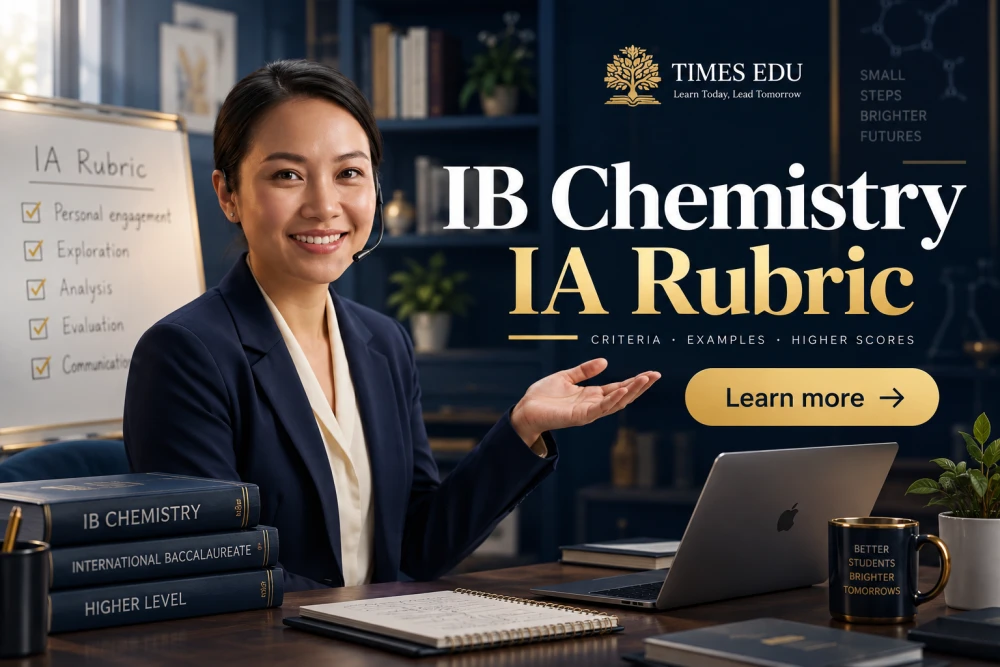
The IB Chemistry IA [1] is assessed against five criteria. Each criterion targets a distinct academic skill, and each is scored independently. A weakness in one criterion does not automatically reduce marks in another, which means a focused improvement plan can shift your total score significantly even in the final weeks before submission.
The table below gives you the complete picture of the IB Chemistry IA rubric at a glance.
| Criterion | Label | Focus Area | Max Marks | Target for a Level 7 |
|---|---|---|---|---|
| A | Personal Engagement | Ownership, curiosity, and individual initiative | 2 | 2 |
| B | Exploration | Research question, variables, method, background theory | 6 | 5 to 6 |
| C | Analysis | Data collection, processing, graphs, uncertainties | 6 | 5 to 6 |
| D | Evaluation | Conclusion, comparison to literature, scientific justification | 6 | 5 to 6 |
| E | Communication | Structure, clarity, use of subject-specific language | 4 | 3 to 4 |
| Total | 24 | 20+ |
One critical detail often overlooked is that Criterion A carries only 2 marks and Criterion E carries 4 marks, yet students consistently spend the most anxiety on these two and neglect Criterion C, which is where the majority of technical marks are actually lost.
>>> Read more: IB Chemistry past papers 2026: The complete guide to finding and using them effectively
Criterion A: Personal engagement in the IB Chemistry IA rubric explained
Personal engagement in the IB Chemistry IA rubric is not about writing a personal story or using the word “I” frequently. It is about demonstrating genuine intellectual ownership of the investigation. The IBO wants to see that the student, not the teacher, drove the research direction.
What the mark levels require:
- 2 Marks: The research question shows clear evidence of personal initiative. The student makes the investigation their own through a unique angle, a real-world connection, or a creative methodological choice that goes beyond a standard textbook experiment.
- 1 Mark: There is some evidence of personal input, but the investigation feels generic or teacher-led.
- 0 Marks: No meaningful evidence of personal engagement is present.
A common mistake we see at Times Edu is students choosing a topic because it sounds impressive rather than because they can connect it to something genuinely personal. An investigation into the effect of temperature on the rate of reaction between sodium thiosulfate and hydrochloric acid is completely valid if the student anchors it to a real context, such as industrial water treatment in their home country or a specific pharmaceutical process they read about independently.
The personal engagement criterion is also assessed through the body of the IA, not just the introduction. Examiners look for moments where the student makes an independent interpretive decision, proposes an unexpected extension, or demonstrates curiosity beyond the minimum required. Injecting one or two moments of genuine intellectual observation throughout the analysis and evaluation sections is a practical way to secure both marks here.
>>> Read more: IB Chemistry high yield topics 2026: Where to focus your revision for maximum marks
Criterion B: Exploration in the IB Chemistry IA rubric explained
Criterion B is the foundation of the entire IA. Examiners assess whether the student has constructed a scientifically sound and clearly scoped investigation before a single data point is collected. The exploration criterion in the IB Chemistry IA is worth 6 marks, and it rewards precision and scientific rigour in equal measure.
Key components assessed under Criterion B:
- Clarity and specificity of the research question
- Quality and relevance of the background scientific theory
- Clear identification of independent, dependent, and controlled variables
- A method that is safe, repeatable, and appropriately detailed
At the 5 to 6 mark level, the research question must be hyper-specific. A weak RQ reads: “How does concentration affect reaction rate?” A strong RQ reads: “How does the concentration of hydrochloric acid (ranging from 0.5 mol/dm³ to 2.5 mol/dm³ in increments of 0.5 mol/dm³) affect the initial rate of reaction with marble chips at 25°C, as measured by the volume of CO₂ produced per unit time using a gas syringe?” Every variable is named, every range is defined, and the measurement technique is specified.
One critical detail often overlooked is the explanation of controlled variables. Students list them correctly but fail to explain how they are kept constant and why failing to do so would compromise the data. For example, stating “temperature was controlled using a water bath set to 25°C ± 0.1°C” is far stronger than simply writing “temperature was kept the same.”
The background theory section should not be a chemistry textbook summary. It should be a targeted explanation of the specific chemical principles that underpin your RQ, written to show that you understand the mechanism, not just the trend.
>>> Read more: IB Chemistry how to get a 7 : The complete strategy guide 2026
Criterion C: Analysis in the IB Chemistry IA rubric explained
The analysis criterion in the IB Chemistry IA rubric is where many students, including strong ones, lose the most marks. This criterion assesses data collection, data processing, uncertainty propagation, and graphical presentation. It is intensely technical and unforgiving of formatting errors.
What examiners require at the 5 to 6 mark level:
- All raw data presented in clearly labelled tables with correct units and appropriate decimal places
- Uncertainties recorded for every piece of equipment used (e.g., ± 0.05 cm³ for a 50 cm³ burette)
- One fully worked sample calculation shown for each type of mathematical processing
- Correct propagation of uncertainties through each calculation step
- A graph with labelled axes, units, a line or curve of best fit, and error bars derived from the uncertainty values
Drawing on years of experience at Times Edu, we find that decimal place errors are the single most common reason students drop from 6 to 4 marks on this criterion. If a burette reads to 0.05 cm³, every reading in the table must show two decimal places. Writing “25” instead of “25.00” signals to the examiner that the student does not understand measurement precision, even if the actual value is correct.
Uncertainty propagation is the second area of consistent weakness. Students often record uncertainties on their raw data table and then never reference them again. The propagation must flow logically from raw data through each calculation step to the final processed value. If your final result is a rate constant, you must show how the percentage uncertainty in volume, time, and concentration combine to produce the overall percentage uncertainty in that constant.
For the graph, error bars are not optional at the top mark level. They must be calculated from your propagated uncertainties and drawn consistently on every data point. The line or curve of best fit should pass through the error bars, and any anomalous points should be identified and discussed.
>>> Read more: IB Chemistry exam technique 2026: The complete guide to scoring higher across all papers
Criterion D: Evaluation in the IB Chemistry IA rubric explained
Criterion D in the IB Chemistry IA rubric assesses conclusion and evaluation together. This is where students demonstrate scientific maturity by interpreting what their data actually means, comparing it to accepted science, and then critically examining the weaknesses of their own investigation.
The conclusion component (within Criterion D) requires:
- A direct answer to the research question using processed data
- A comparison of experimental results to a literature or textbook value, including a calculated percentage error
- A thorough explanation of the trend using relevant chemical theory at the molecular or atomic level
A common mistake we see is students writing descriptive conclusions that restate the data without any scientific explanation. Writing “as concentration increased, the rate increased” scores very low. Writing “as concentration increased, the frequency of effective collisions between reactant particles per unit volume increased, consistent with collision theory, and this produced a proportional increase in the initial rate, as confirmed by our calculated rate constant of 0.043 dm³ mol⁻¹ s⁻¹, compared to the literature value of 0.047 dm³ mol⁻¹ s⁻¹, giving a percentage error of 8.5%” is what the top mark band looks like.
The evaluation component requires:
- Explicit separation of systematic errors from random errors
- An analysis of how each identified error affected the quality and reliability of the data
- A realistic, specific, and technologically grounded improvement for every weakness identified
- A meaningful extension to the investigation that advances the science
The evaluation criterion in the IB Chemistry IA rubric penalises vague, generic errors heavily. Stating “human error could have affected the results” will cost you marks every time. Instead, identify the specific source: “Heat loss to the surroundings during the calorimetry experiment was a systematic error that consistently lowered the recorded temperature change, causing the calculated enthalpy value to be less exothermic than the literature value by approximately 12%. This could be reduced by replacing the polystyrene cup with a Dewar flask, which offers significantly better thermal insulation.”
>>> Read more: IB Chemistry common mistakes 2026: The errors that cost students the most marks
Criterion E: Communication in the IB Chemistry IA rubric explained
The communication criterion in IB Chemistry IA assesses the overall quality of the written report. It is worth 4 marks and is assessed holistically across the entire document. It covers structure, clarity, appropriate use of scientific terminology, correct formatting of chemical equations and SI units, and the quality of citations.
What examiners look for:
- A coherent structure that follows a logical scientific report format
- Correct use of subject-specific chemical language throughout
- Chemical equations that are balanced and correctly formatted with state symbols
- SI units used consistently and correctly
- A bibliography that includes all sources, formatted consistently
In our experience working with international students, communication marks are the easiest to secure with a single focused editing pass before submission. Read through the entire IA and check every chemical formula, every unit, and every equation. Replace vague language like “the substance” with the correct chemical name or formula. Ensure that every claim that draws on external knowledge is supported by a citation.
The report should have a clear title, a structured introduction, a methodology section, a results and analysis section, an evaluation and conclusion section, and a bibliography. Examiners assess communication as a whole, so a beautifully written conclusion cannot compensate for a disorganised methodology section.
One practical tip: Ask someone outside your chemistry class to read your IA and identify any sentence where they do not understand what you mean. Clarity is a core part of this criterion, and students who are close to their own work often overestimate how clearly they have explained their procedures and reasoning.
>>> Read more: IB Chemistry command terms 2026: What they mean and how to respond correctly
How IB Chemistry IA marks are moderated by the IBO
Understanding IBO moderation IA Chemistry is important for both students and parents because it explains why the mark your teacher gives you may not be the mark that appears on your final certificate.
Schools submit a sample of marked IAs to the IBO for external moderation each examination session. The IBO assigns an experienced examiner to review the sample and apply the official IB Chemistry IA rubric independently. If the external examiner consistently awards higher or lower marks than the school teacher across the sample, the IBO applies a scaling adjustment to all marks submitted by that school.
Key points about moderation:
- The IBO does not re-mark every IA. It samples a selection (typically five students per teacher) to calibrate the school’s marking standard.
- If a school is consistently lenient, all students in that cohort may have their marks scaled down.
- If a school is consistently strict, all students may benefit from an upward adjustment.
- The moderation process assesses how well teachers have applied the rubric, not the absolute quality of the IAs.
This has a direct strategic implication for students. You should not rely on your teacher’s mark as a guarantee of your final score. The safest approach is to build an IA that is so clearly aligned with the top mark band descriptors of the IB Chemistry IA rubric that any competent examiner, at the school or IBO level, would award it the same high marks.
Drawing on years of experience at Times Edu, we strongly recommend that students request detailed written feedback from their teachers that explicitly references rubric language. If your teacher says “your conclusion is good,” ask them specifically which mark level within Criterion D your conclusion currently meets and what is missing from the next mark level up.
>>> Read more: IB Chemistry syllabus changes 2026: What is new and what has been removed
Frequently asked questions
What are the five criteria in the IB Chemistry IA rubric?
The five criteria are Personal Engagement (Criterion A), Exploration (Criterion B), Analysis (Criterion C), Evaluation (Criterion D), and Communication (Criterion E). Each is assessed independently against its own mark band descriptors.
How many marks is each criterion worth in the IB Chemistry IA?
Criterion A is worth 2 marks, Criterion B is worth 6 marks, Criterion C is worth 6 marks, Criterion D is worth 6 marks, and Criterion E is worth 4 marks, giving a total of 24 marks.
What does personal engagement mean in the IB Chemistry IA rubric?
Personal engagement refers to evidence that the student drove the investigation independently, chose a genuinely meaningful research direction, and demonstrated intellectual curiosity beyond the minimum requirements. It is not about writing in first person; it is about demonstrating authentic ownership of the work.
What is the difference between analysis and evaluation in the IB Chemistry IA rubric?
Analysis (Criterion C) focuses on data collection, processing, uncertainty propagation, and graphical presentation. Evaluation (Criterion D) focuses on drawing a scientifically justified conclusion and critically assessing the limitations of the methodology. They are distinct skills assessed under separate criteria.
How is communication assessed in the IB Chemistry IA?
Communication (Criterion E) is assessed holistically across the entire report. Examiners look at structure, clarity, correct use of scientific language, accurate formatting of equations and units, and the quality of the bibliography. It is worth 4 marks.
What does a top-scoring IB Chemistry IA look like under each rubric criterion?
A top score IA rubric IB Chemistry submission has a deeply personal and specific research question (A), a rigorous and precisely scoped methodology with full variable control (B), flawless data tables with propagated uncertainties and correctly constructed graphs (C), a molecular-level conclusion with percentage error comparison and systematic error analysis (D), and a clearly structured, precisely written report with consistent citations (E).
How does the IBO moderate IB Chemistry IA marks submitted by schools?
The IBO samples a selection of marked IAs from each school and has them reviewed by an external examiner. If the school’s marking is found to be systematically lenient or strict, the IBO scales the marks for all students at that school accordingly.
Conclusion .
At Times Edu, our IB Chemistry specialists work with students at every stage of the IA process, from choosing a research question that genuinely reflects personal engagement, through to reviewing final drafts against the rubric criterion by criterion. If you want a personalised assessment of where your current IA draft sits against the mark band descriptors and a clear action plan to close the gap, book a consultation with our team today.