A Level Business 9609 books 2026: Complete guide for students and teachers
A strong A Level Business textbook helps students move beyond memorising definitions to applying concepts, analysing case studies, and making well-supported judgements under exam conditions. This guide compares the leading resources for Cambridge 9609, AQA, and Edexcel, explains which books suit different learning profiles, and shows how to combine a specification-aligned coursebook with revision guides, quantitative practice, case studies, and past papers for more effective preparation.
- Best A level Business books: Complete guide for students and teachers
- Cambridge and Edexcel endorsed A level Business textbooks reviewed
- A level Business revision guides vs full textbooks: What do you actually need?
- Top A level Business books for AQA, Cambridge and Edexcel specifications
- How to use an A level Business book alongside case studies and past papers
- Where to buy A level Business books at the best price online
- Free A level Business resources vs investing in a quality study book
- Frequently asked questions
Best A level Business books: Complete guide for students and teachers

Choosing an A Level Business [1] book looks like a small decision. It is not. The book a student opens every night decides how they think, how they write, and how they handle a case study they have never seen before under exam pressure.
Drawing on years of guiding international curriculum students at Times Edu, we can say this plainly: most students do not underperform in Business because they lack intelligence. They underperform because they learned the subject from a resource that rewards memorisation, then met an exam paper that rewards judgement.
The jump from IGCSE Business to A Level is larger than most families expect. At IGCSE, a student who can define terms and describe examples does well. At A Level, definitions earn the smallest share of the marks.
What actually changes between IGCSE and A Level
| Dimension | IGCSE Business | A Level Business |
|---|---|---|
| Core demand | Define, describe, explain | Apply, analyse, evaluate, recommend |
| Typical stimulus | Short scenario, a few lines | Multi-page case study with appendices and data |
| Numerical work | Basic ratios, break-even | Investment appraisal, published accounts, capacity, network analysis |
| Written answer | Short paragraphs | Structured argument with a supported judgement |
| Biggest failure point | Missing content | Content known but not applied to the business in the case |
That final row is the one parents should read twice. A student can know every definition in the syllabus and still land in the middle band, because the marks live in application and judgement.
What the examiner is actually paying for
Every major specification is built on four assessment objectives. For Cambridge International AS & A Level Business (9609), the published weightings are clear, and they explain almost everything about how to study.
| Assessment objective | Weighting at AS | Weighting at A Level | What it means in practice |
|---|---|---|---|
| AO1 Knowledge and understanding | 30% | 25% | Correct terms, theories and techniques |
| AO2 Application | 30% | 25% | Answers tied to the specific business in the case |
| AO3 Analysis | 20% | 25% | Cause and effect chains, use of data |
| AO4 Evaluation | 20% | 25% | Weighing arguments and committing to a judgement |
The component-level picture matters even more. In Cambridge 9609, knowledge carries its heaviest weight on Paper 1 and its lightest on Paper 4, where analysis and evaluation together carry the clear majority of the marks.
Read that as a study instruction, not a statistic. In Year 1, content coverage still pays. In Year 2, a student who keeps revising by rereading notes is optimising for the assessment objective that has shrunk the most.
AQA and Edexcel use the same four-objective logic with their own wording and weightings. The vocabulary differs; the underlying demand does not.
Common thinking traps we flag in the first month
- Treating the textbook as content to finish. The goal is not to reach the last page. The goal is to be able to argue with the material.
- Learning theory without a business attached. A student who cannot name a real company for Ansoff, lean production or globalisation will write generic answers that stall at AO1 and AO2.
- Writing “on the one hand, on the other hand” and stopping. Balance without a decision is not evaluation. Examiners reward a supported judgement, not a fence-sitting summary.
- Avoiding the numbers. Finance and accounting frighten students who came from a humanities background, so they skip investment appraisal and ratio analysis. Those topics carry some of the most reliable marks on the paper because they have right answers.
- Buying a book for the wrong specification. We see this every intake. Cambridge 9609, AQA and Edexcel share topic names but differ in structure, command words and paper format.
>>> Read more: A Level Chemistry 9701books 2026: Complete guide for students and teachers
Cambridge and Edexcel endorsed A level Business textbooks reviewed
An endorsed Business book at A Level is one the awarding body has quality-checked against its own syllabus. Endorsement is not a guarantee of teaching quality, and unendorsed books can be excellent. It does mean the coverage has been matched to the specification, which removes a real risk for self-study students.
Three publishers dominate the Cambridge A Level Business 9609 market, and each suits a different kind of learner.
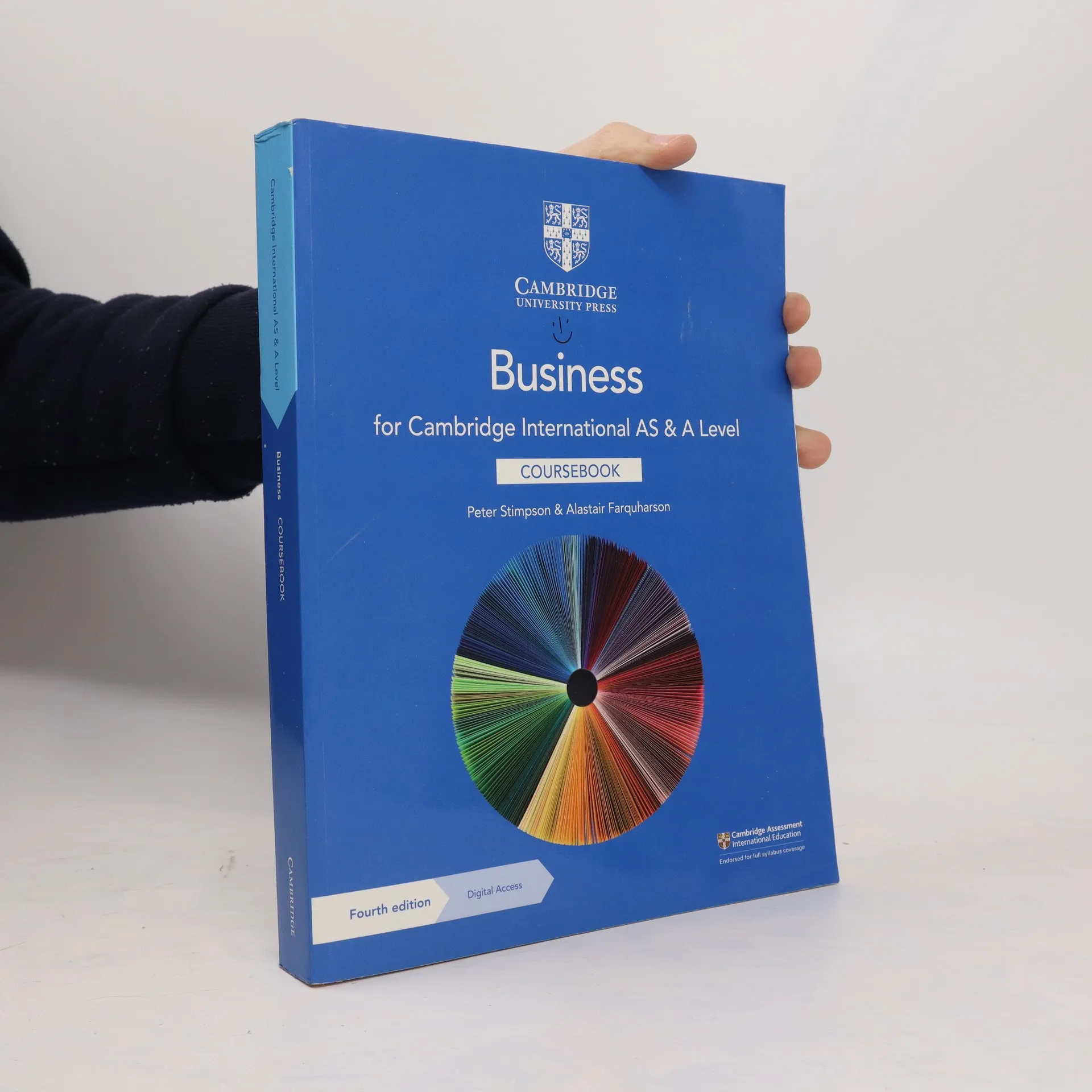
Cambridge International AS & A Level Business Coursebook (Cambridge University Press). Written by Peter Stimpson and Alastair Farquharson, this Cambridge University Press Business title is the closest thing the course has to a default text. Its strength is the extended international case studies, which mirror the demands of Papers 3 and 4 rather than simplifying them.
The current edition pairs with digital access on the Cambridge GO platform, giving students interactive checks and exam-style practice. For a student who wants the exam’s logic modelled directly, this is usually our first recommendation.
Cambridge International AS & A Level Business (Hodder Education). Written by Malcolm Surridge and Andrew Gillespie, the second edition of this Hodder A level Business textbook was written for the 9609 syllabus examined from 2023. Its structure is linear and calm, with end-of-chapter summaries that scan quickly.
Its real advantage is quantitative. The step-by-step handling of investment appraisal, budgeting and critical path analysis is the clearest we have used with students who find the maths intimidating.
Collins Cambridge International AS & A Level Business Student Book. Written by Michael Fardon, Andrew Dean and Denry Machin, this book leans visual and practical. Margin glossaries and a data-led layout make it strong for vocabulary retention and for students working through balance sheets and market statistics on their own.
For Edexcel A level Business, families face a genuine fork in the road. Pearson publishes its own student books for the UK A level, and Hodder publishes an endorsed alternative written by Ian Marcousé, Andrew Hammond and Nigel Watson.
One critical detail often overlooked in Vietnam: many international schools here teach the Edexcel International A Level in Business, which is unit-structured and uses different resources from the UK qualification. Buying the UK book for an International A Level student is one of the most expensive small mistakes we see.
| Book | Publisher | Best specification fit | Strongest for | Watch out for |
|---|---|---|---|---|
| Business Coursebook (Stimpson & Farquharson) | Cambridge University Press | Cambridge 9609 | Long case studies, essay frameworks, digital practice | Density can overwhelm a weak reader |
| Business, 2nd ed. (Surridge & Gillespie) | Hodder Education | Cambridge 9609 | Financial calculations, clean progression, AS/A2 split | Fewer very long case studies |
| Business Student Book (Fardon, Dean, Machin) | Collins | Cambridge 9609 | Visual layout, data interpretation, glossaries | Lighter on extended essay modelling |
| AQA Business (Marcousé, Watson, Hammond) | Hodder Education | AQA A-level Business | Readable chapters, strong real examples | Written for the UK context |
| Pearson Edexcel A level Business (Marcousé, Hammond, Watson) | Hodder Education | Edexcel UK A level | Short chapters, glossary, applied questions | Not the International A Level book |
| Edexcel AS/A level Business Student Book | Pearson | Edexcel UK A level | Board-aligned structure and activities | Check edition against your spec |
Before any purchase, confirm three things on the cover and inside pages: the exam board, the specification code, and the years of examination the resource was written for. Cambridge publishes 9609 syllabuses in multi-year cycles, and a student sitting exams in 2027 should not be revising from a book built around an earlier cycle.
>>> Read more: A Level Biology 9700 books 2026: Complete guide for students and teachers
A level Business revision guides vs full textbooks: What do you actually need?
A common mistake we see is a family buying an A level Business revision guide in September and treating it as the course. Revision guides are compression tools. They work brilliantly on knowledge a student already has and poorly on knowledge they are meeting for the first time.
The two formats answer different questions. A textbook answers “what is this and why does it matter”. A revision guide answers “what do I need in my head by Friday”.
| Resource | Main job | When to buy | When it fails |
|---|---|---|---|
| Full coursebook or textbook | Build understanding, supply case studies, model exam answers | Start of Year 1 | Used only as a reference in the final month |
| A level Business revision guide | Condense, refresh, drill recall | Start of Year 2, or 8 to 12 weeks before exams | Used as the primary teaching text |
| A level Business workbook | Generate volume of practice, build writing stamina | Alongside the textbook, all year | Answers written without marking against a scheme |
| Past papers and mark schemes | Diagnose against real standards | From the first term of Year 1 | Attempted without reading examiner reports |
Cambridge publishes an endorsed AS and A Level Business Revision Guide designed to sit alongside the coursebook, with worked examples and examiner commentary. For UK boards, the Philip Allan Business heritage now sits inside Hodder, and its revision series remains a familiar name to teachers who trained in that tradition. Oxford A level Business resources are also widely used, particularly for UK specifications, so check endorsement status for your exact board before ordering.
Our standard guidance to Times Edu families: one textbook, one revision guide, one source of practice questions. Beyond that, extra books usually create the comfortable feeling of preparation without the discomfort of actually being tested.
>>> Read more: A Level Business 20-Mark Answers : 5-Paragraph Plan for Full Marks
Top A level Business books for AQA, Cambridge and Edexcel specifications
Match the book to the specification first, then to the student’s learning style. The order matters, and reversing it is how students end up revising content that will never appear on their paper.
| Specification | Typical code | Core student book | Sensible companion |
|---|---|---|---|
| Cambridge International AS & A Level Business | 9609 | Cambridge University Press coursebook, or Hodder second edition | Cambridge endorsed revision guide plus past papers |
| AQA Business A level | 7131 (AS), 7132 (A-level) | Hodder AQA Business (Marcousé) | AQA-specific revision notes and workbook |
| Edexcel A level Business (UK) | 8BS0, 9BS0 | Pearson student book, or Hodder endorsed title | Board revision guide plus past paper packs |
| Edexcel International A Level Business | Unit-based (Units 1 to 4) | Pearson International student books | Unit-matched revision notes |
Once the specification is fixed, the student profile decides the edition.
- Strong reader, weak on maths: lead with Hodder for the calculation walkthroughs, and use the Cambridge coursebook for case study exposure.
- Confident with numbers, weak on written judgement: lead with the Cambridge University Press coursebook and its evaluation frameworks.
- Learns visually, revising in a second language: Collins, for the margin glossaries and data-led pages, supported by a revision guide.
- Self-study A level Business candidate with no teacher: an endorsed coursebook is not optional. Endorsement is the only quality control the student has.
In our experience working with international students in Ho Chi Minh City and Hanoi, the marketing finance strategy book that a student enjoys reading is worth more than the technically superior book that stays closed. Fit matters.
>>> Read more: A level books 2026: The complete guide to choosing, using, and getting the most from your study resources
How to use an A level Business book alongside case studies and past papers
Owning the right book changes nothing on its own. Case study skills at A Level are built by a repeatable weekly loop, not by reading.
Here is the cycle we run with Times Edu students, one topic per week:
- Read the chapter once for structure. No highlighting. Close the book and write the four or five ideas you remember.
- Rebuild the theory as a cause and effect chain. For example: lean production reduces waste, which lowers unit costs, which improves margins or allows a price cut, which affects competitiveness in a price-sensitive market.
- Attach two real businesses to the theory. One international, one Vietnamese or regional. Examiners reward specific context, and a local example is often sharper than a generic multinational.
- Do the numbers by hand. Work every calculation in the chapter without a solution in view, then check. Investment appraisal and ratio work must become automatic.
- Answer one exam question under time. Use the real command word, the real mark allocation, and a timer.
- Mark against the mark scheme, then against the examiner report. Ask which assessment objective cost you marks, not just whether the answer was right.
Command words are the instruction manual for the answer. Students who learn to read them stop writing beautiful answers to questions that were never asked.
| Command word | What the examiner wants | Answer shape |
|---|---|---|
| Define, state | Precision, nothing more | One sentence |
| Explain | Knowledge plus a reason | Point, then a because chain |
| Analyse | Developed consequences using the case data | Two or three linked steps, tied to the business |
| Evaluate, assess, discuss | Balance plus a supported judgement | Argument, counter-argument, decision with justification |
| Recommend | A decision and an implementation view | Choose, justify against alternatives, note conditions |
For evaluation answers, we teach a simple four-part structure: state the argument, ground it in the case, develop the consequence, then judge with a stated criterion. The criterion is the part most students skip. Saying “this depends on the size of the business” is weak; saying “this depends on whether the firm’s cash position can absorb an 18-month payback period” is A grade thinking.
One further habit separates strong candidates. They keep a single page of case study evidence per topic, updated all year, so that by March they are revising arguments rather than hunting for examples.
>>> Read more: A Level Business 9609 : Exam Structure & Roadmap to an A* in 2026
Where to buy A level Business books at the best price online
Prices move constantly, so treat this as a checklist of channels rather than a price list. The cheapest listing is not always the cheapest outcome, especially when digital access codes are involved.
| Channel | Best for | Caution |
|---|---|---|
| Publisher direct (Cambridge, Hachette Learning, Collins, Pearson) | Guaranteed current edition, bundled digital access | Usually the highest list price and international shipping |
| Official regional distributors and school suppliers | Correct editions, local delivery, school bulk pricing | Stock cycles can lag new editions |
| Major online retailers | Competitive pricing, fast comparison | Listings frequently mix editions and specifications |
| Ebook and digital platforms | Immediate access, lower cost, searchable text | Licence periods expire; check the term before buying |
| Second-hand copies from senior students | Lowest cost, ideal for a supplementary text | Digital access codes are usually already redeemed |
Steps we recommend before you buy an A level Business book:
- Confirm the exam board and specification code with the school, in writing if possible.
- Check the years of examination printed on the cover or in the front matter.
- Decide whether the digital component matters to you, since it often accounts for much of the price difference.
- Compare the total cost including shipping and any access licence, not the headline price.
- If buying second-hand, assume the online code is used and treat the book as print only.
For families buying for two years, a print coursebook plus a digital revision guide is usually the most economical combination. It keeps the reference text on the desk and the compression tool on the phone.
>>> Read more: A-Level Tutor 2026: How to Choose the Right Tutor and Improve Grades Faster
Free A level Business resources vs investing in a quality study book
Some of the most valuable Business resources cost nothing, and they are consistently underused. Awarding bodies publish the material that defines the standard, and it sits in plain sight on their websites.
| Free resource | What it gives you | How often students actually use it |
|---|---|---|
| The official syllabus or specification PDF | The exact content boundary and AO weightings | Rarely read in full |
| Past papers and mark schemes | The real standard and the real language | Used, but often without marking properly |
| Examiner reports | Why real candidates lost marks last session | Almost never read |
| Specimen and learner guides | Paper structure, command words, worked responses | Occasionally |
| Publisher sample chapters | A genuine preview before purchase | Sometimes |
The examiner report is the single most valuable free document in the subject. It tells you, in the examiner’s own words, which questions were answered badly and why, and that information rarely changes year to year.
What free resources cannot give you is a coherent teaching sequence, curated case studies, and worked explanations of the calculations. That is what you are paying for when you buy a quality A level Business textbook. The book teaches; the free material tests.
Where A Level Business fits in a study-abroad profile
Subject choice is a strategic decision, not a taste decision, and Business is frequently misjudged in both directions. Some families dismiss it as a soft option; others choose it expecting an easier route to a business degree. Both readings cost students.
Competitive undergraduate business, economics and management programmes look at the combination, not the label. A profile that pairs Business with Mathematics reads very differently from one that pairs Business with two other essay subjects, because quantitative evidence is what admissions tutors use to predict success in finance and econometrics modules.
| Target destination and course | Subject combination that reads well | What we advise checking first |
|---|---|---|
| UK business, management, marketing | Business plus Mathematics plus one third subject | Whether the department states a preference between Business and Economics |
| UK economics or finance | Mathematics required, Business as the applied third | Some departments require Maths and prefer Economics |
| US business schools and liberal arts | Broad, rigorous mix plus strong SAT and activities | Course rigour and GPA trend matter more than one subject |
| Australia, Canada, Singapore | Business plus a quantitative subject | Prerequisite lists are published per programme |
Business also carries a practical advantage many families overlook. Its case study work builds the analytical writing and decision-making language that strengthens personal statements, admissions essays and interviews, especially for students applying from a non-native English background.
The mistake is choosing the subject in isolation. The right question is not “is A Level Business a good subject”, but “does this subject, in this combination, build the profile my target universities are actually reading”.
Frequently asked questions
Which A level Business textbook is best for AQA, Cambridge or Edexcel?
Do I need both a coursebook and a revision guide for A level Business?
What is the best A level Business revision guide for last-minute exam preparation?
Which A level Business book covers essay and case study technique most effectively?
Do I need separate A level Business books for AS and A2 content?
Are older editions of A level Business textbooks still valid for current specifications?
Which A level Business book is best suited for self-study students?
Conclusion
At Times Edu, we have supported international curriculum students since 2018 across IGCSE, A Level, IB, AP and SAT, with 1-on-1 teaching at Landmark 81 in Ho Chi Minh City, Times City in Hanoi, and online. Our academic team maps each student’s specification, diagnoses which assessment objective is costing them marks, and builds a term-by-term roadmap around the resources they already own.
If you would like a personalised academic roadmap for A Level Business, including the right book combination for your board and a realistic study plan to your exam session, book a consultation with our academic advisers.