A level Chemistry exam format 2026: A complete guide to papers, timing and structure
A Level Chemistry uses a linear exam format, meaning all written papers are taken at the end of Year 13, with no coursework contributing to your final letter grade. This guide walks you through how each major exam board structures its papers, how marks are divided across Paper 1, Paper 2, and Paper 3, and how understanding the format should directly shape the way you revise. Let’s get started.
- Overview of all A level Chemistry papers across major exam boards
- Paper 1 content and structure in A level Chemistry explained
- Paper 2 content and structure in A level Chemistry explained
- Paper 3 and the practical skills assessment in A level Chemistry
- How marks are distributed across A level Chemistry papers
- How the A level Chemistry exam format should shape your revision strategy
- Frequently asked questions
Overview of all A level Chemistry papers across major exam boards
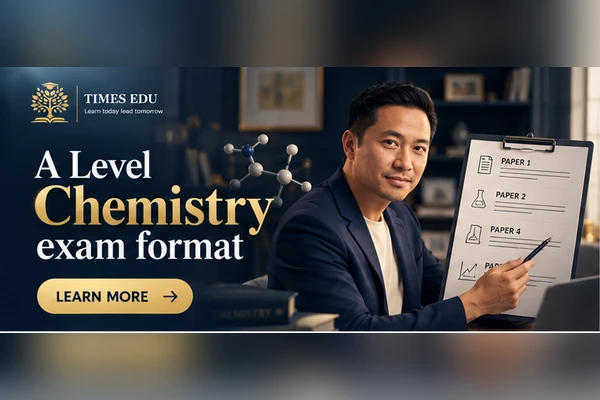
Before studying a single topic, you need to know exactly what you are walking into on exam day. The A level Chemistry exam [1] format is not identical across all exam boards. AQA, OCR A, and Edexcel each have their own paper structure, timing, and mark allocation, and mixing up these details is one of the most common mistakes students make early in Year 12.
All three boards follow a three-paper linear model. Every paper is a written exam, sat at the end of Year 13, with no modular retakes allowed during the course. The table below gives you the full picture at a glance.
| Exam Board | Paper 1 | Paper 2 | Paper 3 |
|---|---|---|---|
| AQA | Inorganic and Physical Chemistry, 2 hrs, 105 marks, 35% | Organic and Physical Chemistry, 2 hrs, 105 marks, 35% | Synoptic and Practicals, 2 hrs, 90 marks, 30% |
| OCR A | Periodic Table and Physical, 2 hrs 15 mins, 100 marks, 37% | Synthesis and Analytical, 2 hrs 15 mins, 100 marks, 37% | Unified Chemistry, 1 hr 30 mins, 70 marks, 26% |
| Edexcel | Advanced Inorganic and Physical, 1 hr 45 mins, 90 marks, 30% | Advanced Organic and Physical, 1 hr 45 mins, 90 marks, 30% | General and Practical Principles, 2 hrs 30 mins, 120 marks, 40% |
One detail worth flagging immediately: Cambridge International (9701) runs a separate A Level Chemistry specification used widely in international schools outside the UK. Its format includes Papers 1, 2, 4, and 5, and it differs significantly from the UK boards listed above. If you are studying Cambridge 9701 Chemistry, you will need a separate breakdown of that specification.
>>> Read more: A Level Chemistry 9701 books 2026: Complete guide for students and teachers
Paper 1 content and structure in A level Chemistry explained
Paper 1 across all three major boards covers physical and inorganic chemistry. The exact topic list varies by board, but the core themes are consistent: Atomic structure, bonding, energetics, kinetics, equilibria, and the periodicity of elements.
Where the boards diverge is in question format and timing. AQA Paper 1 runs for exactly two hours and contains only short-answer and long-answer written questions, with no multiple choice component. OCR A Paper 1 runs slightly longer at two hours and fifteen minutes and opens with fifteen multiple choice questions before moving into structured written responses. Edexcel Paper 1 lasts one hour and forty-five minutes and blends multiple choice items with short and extended written answers within the same paper.
Exam board structures dictate time-management strategies for Paper 1. On AQA, every mark requires a written response, making pacing and writing speed critical under pressure. On OCR A, the opening multiple-choice questions can serve as a strategic confidence-builder, provided candidates avoid overthinking and losing valuable time.
>>> Read more: A Level Chemistry Practical Write-Up : 8-Section Template for A*
Paper 2 content and structure in A level Chemistry explained
Paper 2 shifts the focus to organic chemistry, while continuing to test physical chemistry topics introduced in Year 12. For AQA, this means mechanisms, spectroscopy, and polymer chemistry sit alongside topics like acids and equilibria. For OCR A, the paper is titled Synthesis and Analytical Techniques, reflecting a stronger emphasis on multi-step organic pathways and analytical identification.
The structure of Paper 2 mirrors Paper 1 closely for most boards. AQA Paper 2 carries the same two-hour duration and 105-mark total as Paper 1. OCR A Paper 2 again runs for two hours and fifteen minutes with 100 marks and fifteen MCQs. Edexcel Paper 2 matches its Paper 1 exactly: One hour and forty-five minutes for 90 marks.
One strategic mistake that costs students grades here is treating Paper 2 as purely an organic exam. Physical chemistry topics, particularly those from Year 12, appear consistently in Paper 2 questions across all boards. If you have gaps in your understanding of entropy, electrode potentials, or buffer calculations, those gaps will surface in Paper 2 as much as anywhere else.
>>> Read more: A Level Chemistry Organic Reactions : 30 Reactions Mind Map for A*
Paper 3 and the practical skills assessment in A level Chemistry
Paper 3 is where the A level Chemistry exam format becomes genuinely distinctive. Rather than simply testing another block of content, this final paper is designed to assess how well you can apply everything you have learned across both years simultaneously. This is called synoptic assessment.
For AQA, Paper 3 includes thirty multiple choice questions alongside short and long written answers, all focused on practical techniques and data analysis. Questions may ask you to evaluate an experimental method, identify sources of error, calculate percentage uncertainty, or suggest improvements to an apparatus setup. For OCR A, the Unified Chemistry paper carries no MCQs and instead uses structured questions that draw on any topic from the full specification. For Edexcel, Paper 3 is the longest and heaviest paper in the entire qualification, running for two hours and thirty minutes and worth 40% of the total A Level.
Alongside the written Paper 3, every student on a UK specification also completes a Practical Endorsement. Known formally as CPAC (the Common Practical Assessment Criteria), this is a teacher-assessed component recorded throughout Year 12 and Year 13. It does not affect your letter grade of A* to E. Instead, it appears as a separate Pass or Fail certificate on your results slip. However, a failure to engage seriously with required practicals during the course will show up directly in your Paper 3 performance, because the written exam assumes you have hands-on experience with those techniques.
>>> Read more: A Level Chemistry Explanations for 2026: How to Write Clear, Accurate Answers That Earn More Marks
How marks are distributed across A level Chemistry papers
| Exam Board | Paper 1 Weighting | Paper 2 Weighting | Paper 3 Weighting | Total Marks |
|---|---|---|---|---|
| AQA | 35% (105 marks) | 35% (105 marks) | 30% (90 marks) | 300 marks |
| OCR A | 37% (100 marks) | 37% (100 marks) | 26% (70 marks) | 270 marks |
| Edexcel | 30% (90 marks) | 30% (90 marks) | 40% (120 marks) | 300 marks |
The Edexcel structure is the most unusual of the three. Paper 3 carries 40% of the total grade, which is higher than either Paper 1 or Paper 2 individually. Students who treat Paper 3 revision as an afterthought, or who assume it is a “soft” practical paper, regularly find that this is where their overall grade drops.
Across all boards, at least 20% of the total marks require mathematical skills. These include calculations involving logarithms for pH, rearranging the ideal gas equation (pV = nRT), applying the Arrhenius equation, and quantifying percentage uncertainties in practical measurements. Students who struggle with applied mathematics in Chemistry typically lose marks across all three papers, not just in dedicated calculation questions.
>>> Read more: A Level Chemistry “Explain” vs “Evaluate” : A Complete Guide 2026
How the A level Chemistry exam format should shape your revision strategy
Start with your board’s specification, not a generic textbook. AQA, OCR A, and Edexcel each have topic lists and required practicals that are specific to their qualification. A revision guide written for AQA will not cover OCR A’s analytical techniques paper in the same depth. Use the official specification document as your checklist from the beginning of Year 13.
Weight your revision time by mark allocation. If you are sitting Edexcel, spending equal time on all three papers is a strategic error. Paper 3 accounts for 40% of your grade and demands a different skill set, combining synoptic recall with practical reasoning. Build separate revision blocks dedicated to data analysis and practical interpretation questions.
Practise multiple choice questions differently from written responses. For OCR A and AQA Paper 3, MCQs reward pattern recognition and the ability to eliminate wrong answers quickly. Do not approach them the same way you would approach a six-mark written question. Time yourself on MCQ sets and track which types of questions consistently catch you out.
Treat the mathematical content as its own revision strand. Because 20% of marks across all boards require quantitative skills, mathematical weaknesses compound across every paper. Build a list of every formula and calculation type in your specification and practise them weekly, not just in the final month before exams.
Use past papers by paper, not by subject. Sit Paper 1 past papers under timed conditions as Paper 1 practice, not as a general chemistry revision tool. This trains you for the specific question style, topic emphasis, and time pressure of that individual component.
Thorough content revision is insufficient without familiarity with exam board phrasing. Command words vary across specifications, and mastering the distinct requirements of terms like ‘suggest,’ ‘explain,’ and ‘evaluate’ is as critical as knowing the biological content itself.
Frequently asked questions
How many papers are there in A level Chemistry?
How long is each A level Chemistry exam paper?
Is a calculator allowed in A level Chemistry exams?
How many marks is each A level Chemistry paper worth?
How does the A level Chemistry exam format differ between AQA, Edexcel, OCR and Cambridge?
Is there any coursework in A level Chemistry?
What types of questions appear in A level Chemistry Paper 1?
Conclusion
If you are working through this qualification and want a personalised breakdown of your specific exam board’s requirements, required practicals, and a revision plan built around your actual mark targets, the consultants at Times Edu are available to help. A single session with the right guidance can reframe how you approach the next twelve months of preparation, and that reframing is often what separates a B from an A.