IB Physics extended essay 2026: How to write a high-scoring physics EE
The IB Physics Extended Essay is a 4,000-word independent research paper that requires students to investigate a focused physics question through rigorous theory, data analysis, and critical evaluation. Unlike the Internal Assessment, the EE allows greater theoretical depth and expects students to engage with academic literature, uncertainty analysis, and sustained scientific reasoning. A strong essay also depends on a well-defined research question, a clear methodology, logical structure, and thoughtful reflection throughout the research process.
This guide explains how to choose an effective IB Physics EE topic, structure the essay, understand the assessment criteria, and avoid the common mistakes that limit marks.
- What is the IB extended essay in Physics and how does it differ from the IA?
- How to choose a strong research question for your IB Physics extended essay
- How to structure and write an IB Physics extended essay effectively
- How the IB Physics extended essay is assessed and graded
- Common mistakes students make in IB Physics extended essays
- How an IB Physics extended essay can strengthen your university application
- Frequently asked questions
What is the IB extended essay in Physics and how does it differ from the IA?
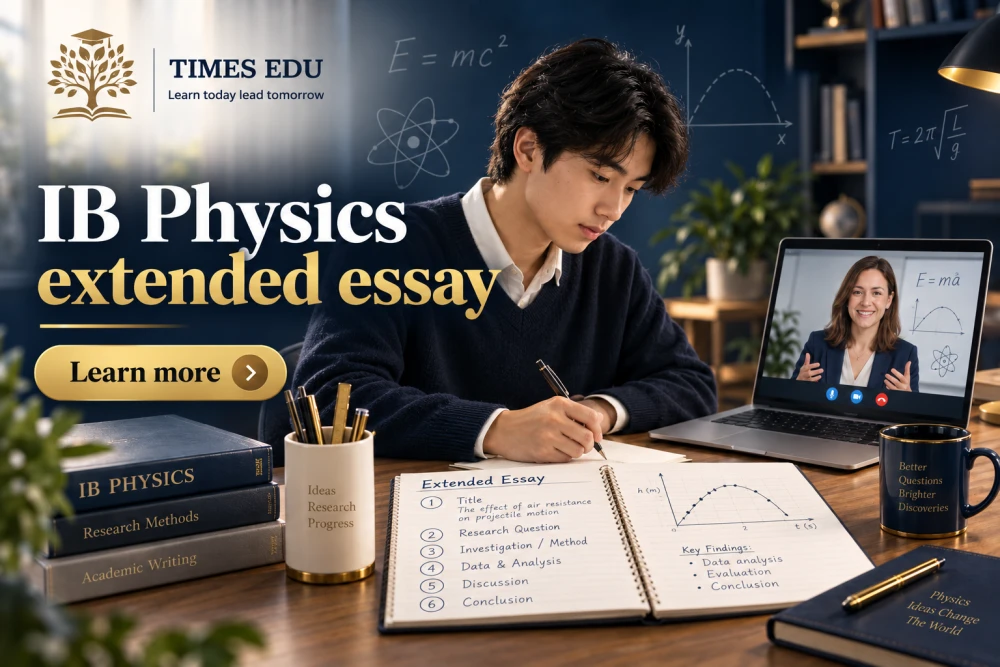
The IB Physics [1] extended essay is a 4,000-word independent research paper submitted as part of the IB Core. Every IB student must complete an EE, and choosing Physics as your subject means you are committing to a project that combines experimental rigor, mathematical depth, and genuine scientific inquiry.
The EE is assessed externally by an IB examiner, which immediately separates it from the Internal Assessment (IA) that your school teacher marks. This distinction matters because external examiners apply the assessment criteria with strict consistency, and there is no room for leniency.
One of the most common points of confusion is treating the IB EE vs IA Physics comparison as simply a difference in word count. The table below clarifies the actual differences across every meaningful dimension.
| Feature | Physics IA | Physics Extended Essay (EE) |
|---|---|---|
| Word count | Max 3,000 words | Max 4,000 words |
| Time invested | Approx. 10 hours | Approx. 40 hours |
| Scope of theory | Must stay within IB syllabus | Can explore advanced concepts beyond the syllabus |
| Grading | Marked out of 24 by your teacher | Marked out of 34 by an external IB examiner |
| Focus | One targeted practical problem | Broad, comprehensive academic research |
| Reflections | Not required | Three RPPF sessions with supervisor mandatory |
The IB Physics EE also demands a higher level of theoretical engagement. You are expected to derive equations, contextualize your findings against published academic literature, and critically evaluate the limitations of your own research design. None of this is optional.
>>> Read more: IB Physics high yield topics 2026: Where to focus your revision for maximum marks
How to choose a strong research question for your IB Physics extended essay
The EE research question in Physics IB is the single most important decision you will make for this project. A poorly scoped question guarantees a poor grade, regardless of how much effort you put into the rest of the essay.
A strong research question must be specific enough to answer fully within 4,000 words, yet rich enough to generate a substantial volume of measurable data. It should clearly identify your independent variable, your dependent variable, and the physical phenomenon you are investigating.
What a weak research question looks like:
- “How does temperature affect resistance?”
- “What is the effect of mass on pendulum motion?”
These are too broad and too close to standard classroom experiments. They will not earn you marks for originality or academic depth.
What a strong research question looks like:
- “How does the surface roughness of a metallic plate affect its rate of radiant thermal energy emission according to the Stefan-Boltzmann law?”
- “Investigating the relationship between the temperature of a neodymium permanent magnet and the terminal velocity of a copper disk falling through its localized magnetic field.”
- “How does the aspect ratio of a rectangular wing section affect its aerodynamic lift coefficient at a constant Reynolds number in a low-speed wind tunnel?”
Notice that every strong EE topic in Physics names a specific physical law or mechanism, includes a clearly measurable variable, and implies a non-trivial experimental or analytical challenge.
A topic area worth exploring includes fluid dynamics, thermodynamics, electromagnetism, acoustics and wave behavior, nuclear decay modeling, and optics. These fields offer rich theoretical frameworks and allow you to work with real data, whether collected experimentally or sourced from simulation tools.
One critical detail often overlooked is the distinction between a lab-based and literature-based EE Physics approach. A lab-based EE means you design and run your own experiment. A literature-based EE means you analyze existing datasets, use computational modeling, or synthesize findings from published research. Both are acceptable, but your methodology must match your question. Choosing a literature-based approach when your question demands primary data is a red flag for examiners.
>>> Read more: IB Physics HL vs SL 2026: How to choose the right level for you
How to structure and write an IB Physics extended essay effectively
The extended essay structure in Physics must read like a peer-reviewed journal article, not a school lab report. Each section has a specific purpose and contributes to your overall mark under the IB’s assessment criteria.
Below is the recommended structure you should follow:
Title page
State your research question clearly in the title. Include your candidate code and word count. Do not include your name.
Introduction
Establish why your topic matters, both in the real world and within the academic field of physics. Introduce the core theories you will be investigating. This section should motivate the reader to continue.
Research question
Write your RQ as a single, precise sentence. It should appear as a standalone, clearly labeled section so the examiner can locate it immediately.
Theoretical framework
This is where you demonstrate your depth of knowledge. Derive the key equations step-by-step. Explain the physical mechanisms driving your experiment. Do not assume the reader knows the theory; demonstrate that you do.
Methodology
Describe your apparatus, your control variables, and your procedural steps in enough detail that another researcher could replicate your study. Justify every design choice. This section should read like a methods section in a scientific journal, not a bullet-point list.
Data collection and processing
Present raw data tables with clearly calculated absolute and percentage uncertainties. Show at least one worked example of every mathematical operation you apply to your data.
Analysis and graphing
Plot high-resolution graphs with individual error bars for each data point. Include both a line of best fit and a line of worst acceptable fit so you can calculate gradient uncertainties. This is where Criterion C marks are earned or lost.
Conclusion
Directly answer your research question using your data. Compare your experimental values against published literature values and discuss what any discrepancy reveals.
Evaluation
Critically examine your methodology. Identify systematic and random errors, explain how they affected your results, and propose specific, realistic modifications that would improve accuracy in future studies.
References and bibliography
List every source you cited, formatted consistently. Use APA, MLA, or Vancouver style as agreed with your supervisor. Do not pad this section with uncited sources.
>>> Read more: IB Physics common mistakes 2026: The errors that cost students the most marks
How the IB Physics extended essay is assessed and graded
Understanding the IBO EE assessment in Physics means understanding what each criterion actually measures. The total mark is out of 34, and the grade awarded depends on which mark band your examiner places you in.
| Criterion | Marks Available | What it assesses |
|---|---|---|
| A: Focus and method | 6 | Clarity of RQ and justification of methodology |
| B: Knowledge and understanding | 6 | Depth of physics theory and correct use of terminology |
| C: Critical thinking | 12 | Data analysis, uncertainty handling, and evaluation quality |
| D: Presentation | 4 | Formal layout, equation formatting, table clarity |
| E: Engagement | 6 | Quality of RPPF reflections and intellectual growth |
The IB EE Physics grade is determined by converting your total mark into a letter grade from A to E. The approximate grade boundaries are:
| Grade | Mark Range | University Bonus Points (with TOK) |
|---|---|---|
| A | 28-34 | Up to 3 bonus points |
| B | 22-27 | Up to 3 bonus points |
| C | 16-21 | Up to 2 bonus points |
| D | 8-15 | Up to 1 bonus point |
| E | 0-7 | No bonus points, possible diploma fail |
The IB Physics EE word count is capped at 4,000 words. Content beyond this limit is not read by the examiner. Your abstract, bibliography, appendices, and table captions are not counted toward this total.
Criterion C, worth 12 of the 34 available marks, is where most students lose the most ground. In our experience working with international students, the failure to properly process uncertainty through graphical analysis, particularly the use of worst-fit lines to calculate gradient uncertainty, is the single most costly technical error a Physics EE student can make.
>>> Read more: IB Physics command terms 2026: What they mean and how to respond correctly
Common mistakes students make in IB Physics extended essays
The EE mistakes in Physics IB fall into predictable patterns. Recognizing them early saves you enormous revision time later.
Mistake 1: Choosing a question that is too broad
A question like “How does force affect motion?” Cannot be answered rigorously in 4,000 words. A broad question forces you to write superficially about everything instead of analytically about something specific.
Mistake 2: Treating the theoretical framework as a textbook summary
A common mistake we see is students copying equations from a textbook and presenting them without derivation or explanation. Examiners expect you to demonstrate understanding, not transcription. You must show how each equation applies to your specific experimental context.
Mistake 3: Ignoring uncertainty analysis
Every measurement has uncertainty. Every calculated value derived from measurements carries propagated uncertainty. If your analysis section contains no error bars, no worst-fit lines, and no discussion of how measurement errors affected your gradient or intercept, your Criterion C mark will be severely limited.
Mistake 4: A conclusion that does not directly answer the research question
Your conclusion must begin by explicitly answering your RQ with a numerical or qualitative statement supported by your data. Students who spend their conclusion summarizing what they did, rather than what the data proves, lose marks under Criterion C.
Mistake 5: Neglecting the RPPF sessions
The RPPF reflections under Criterion E are worth 6 marks. Some students treat these as administrative checkboxes. In reality, examiners use your RPPF entries to assess whether you showed genuine intellectual engagement throughout the research process. Write honest, specific reflections about the challenges you faced and how your thinking evolved.
Mistake 6: Poor bibliography formatting
One critical detail often overlooked is that Criterion D specifically evaluates the accuracy and consistency of your references. An inconsistently formatted or incomplete bibliography is a simple way to lose marks that require no additional physics knowledge to earn.
>>> Read more: IB Physics books 2026: Complete guide for students and teachers
How an IB Physics extended essay can strengthen your university application
Beyond the IB diploma bonus points, a strong IB EE Physics submission sends a powerful signal to university admissions teams. Physics is one of the most analytically demanding subjects in the IB, and producing a well-executed independent research paper demonstrates exactly the kind of intellectual maturity that top universities in the UK, US, Canada, and Australia look for.
When applying to engineering, physics, mathematics, or STEM programs, admissions officers want evidence that you can sustain a high-level academic inquiry over an extended period without supervision. Your EE is direct evidence of that capability.
A student who writes an EE on electromagnetic induction and applies to an Electrical Engineering program at a Russell Group or Ivy League university has a clear narrative linking their academic curiosity to their intended field. Universities value that coherence.
Drawing on years of experience at Times Edu working with students applying to programs at UCL, Imperial, NUS, University of Toronto, and top US universities, we consistently observe that students with strong EE submissions are better prepared for their personal statement, better able to articulate their academic interests in interviews, and more competitive overall. The EE is not just an IB requirement. It is a strategic asset.
>>> Read more: IB Physics : Syllabus, Exam Structure & Roadmap to an 7 in 2026
Frequently asked questions
Can you write an IB extended essay in Physics if you are taking IB Physics SL?
Yes. The IBO does not require you to be enrolled in Physics HL to submit a Physics EE. However, a Physics EE written at an advanced level will naturally require engagement with concepts and mathematics that go beyond the SL syllabus. If you are an SL student choosing Physics as your EE subject, you will need to invest additional time in self-study to meet the theoretical depth expected by examiners.
How is an IB Physics extended essay different from the IA investigation?
The IB EE vs IA Physics comparison comes down to scope, rigor, and assessment. The IA is internally marked, limited to your school’s syllabus, and focuses on a single practical problem. The EE is externally examined, allows exploration beyond the syllabus, requires a full academic paper structure, and expects a deeper engagement with theory, uncertainty analysis, and academic literature.
How long should an IB Physics extended essay be?
The IB Physics EE word count limit is 4,000 words. Content exceeding this limit is not assessed. Most students should aim for between 3,600 and 3,900 words to maximize coverage without exceeding the cap. Footnotes, bibliography, appendices, and figure captions are excluded from the count.
What makes a strong research question for an IB Physics extended essay?
A strong EE research question in Physics IB is specific, measurable, and linked to a named physical law or mechanism. It must be narrow enough to investigate fully within 4,000 words and rich enough to generate a meaningful quantity of data. Avoid questions that replicate standard classroom experiments without adding a novel variable or analytical layer.
How is the IB Physics extended essay graded?
The IB EE Physics grade is based on five criteria totaling 34 marks. Criterion C (Critical Thinking) carries the most weight at 12 marks. Grades range from A to E, and achieving an A or B grade combined with a strong TOK essay can earn up to 3 additional points toward your IB diploma total.
What are the most common mistakes in IB Physics extended essays?
The most frequent EE mistakes in Physics IB include choosing an overly broad research question, failing to propagate measurement uncertainties through graphical analysis, writing a conclusion that summarizes instead of answers, neglecting the RPPF reflection journals, and submitting an incomplete or inconsistently formatted bibliography.
Should you choose a lab-based or literature-based IB Physics extended essay?
Both approaches are valid. A lab-based EE allows you to collect original experimental data, which can be highly rewarding but also risky if your equipment access is limited. A literature-based or simulation-based EE draws on published datasets or computational models and can be equally rigorous if your analysis is critical and mathematically grounded. The choice should depend on your access to resources, your research question, and the type of evidence that best answers your question.
Conclusion
The students who perform best are those who start early, work closely with a knowledgeable supervisor, and approach the project with the mindset of a researcher rather than a student completing an assignment. If you are unsure where to start, which topic will suit your strengths, or how to build your EE into a compelling element of your university application, the team at Times Edu is ready to help. Our specialist IB consultants work one-on-one with students at every stage of the EE process, from topic selection through to final submission. Book a personalized academic roadmap consultation to find out how we can support your IB Physics extended essay and your path to a top international university.