IGCSE Mathematics 0580 books 2026: Complete guide for students and teachers
A well-structured IGCSE Mathematics book helps students master the Cambridge syllabus, build confidence across Core and Extended topics, and prepare effectively for both calculator and non-calculator papers. This guide compares the endorsed textbooks from Cambridge University Press, Hodder Education, and Collins, explains the differences between the two tiers, and shows how to combine a current coursebook with workbooks and early past paper practice for stronger exam performance.
- Best IGCSE Mathematics books: complete guide for students and teachers
- Official Cambridge-endorsed IGCSE Mathematics textbooks reviewed
- IGCSE Mathematics Core vs Extended books: Which do you need?
- Top IGCSE Maths books by Hodder, Oxford, and Cambridge University Press
- How to use an IGCSE Mathematics book alongside past papers for maximum results
- Where to buy IGCSE Mathematics books at the best price online
- Free IGCSE Maths resources vs investing in a dedicated study book
- Frequently asked questions
Best IGCSE Mathematics books: complete guide for students and teachers
The Cambridge IGCSE Mathematics [1] syllabus is assessed under two tiers: Core and Extended. Each tier has its own set of papers, grade targets, and content depth. Any IGCSE Mathematics textbook worth recommending must address this distinction clearly, cover both calculator and non-calculator paper types, and align precisely with the current 0580 or 0980 syllabus framework.
Three publishers currently hold official Cambridge endorsement status: Cambridge University Press, Hodder Education, and Collins. These are not marketing claims. Endorsement means Cambridge has independently reviewed the content and confirmed it maps accurately to the active syllabus. Students using non-endorsed materials risk studying content that is slightly off-spec, which is a risk no one preparing for a high-stakes exam should take.
Before buying any book, check the publication year. For current examination sessions, only editions published in 2021 or later are reliably aligned to the current curriculum framework. Earlier editions may omit updated question styles or revised content weightings.
>>> Read more: IGCSE Maths Mock Improvement Plan 2026: A Practical Strategy to Raise Your Grade
Official Cambridge-endorsed IGCSE Mathematics textbooks reviewed
Cambridge IGCSE Mathematics Coursebook (Cambridge University Press)

Written by Karen Morrison and Nick Hamshaw, this Cambridge IGCSE Maths coursebook is widely regarded as the benchmark text for the 0580 syllabus. The Karen Morrison Maths book is particularly valued for its step-by-step explanations, which work through each concept methodically before introducing complexity.
A distinguishing feature is the “Mathematical Connections” section, which explicitly shows students how topics such as algebra, trigonometry, and statistics link to each other. This is critical for Extended-tier students, who face questions that deliberately blend multiple topic areas in a single problem.
Digital access via the Cambridge GO platform adds interactive geometry tools, supplementary worksheets, and worked solutions. For students studying remotely or working with a tutor online, this digital layer makes the Cambridge University Press 0580 book a strong choice.
Cambridge IGCSE Mathematics Student’s Book (Hodder Education)
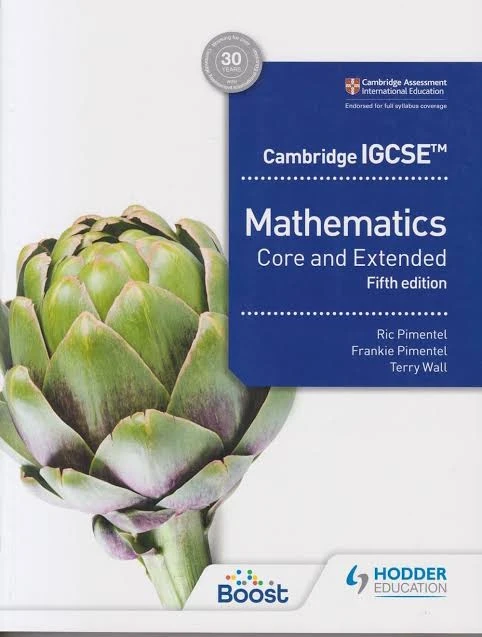
The Hodder IGCSE Mathematics title, written by Ric Pimentel and Terry Wall, is widely respected for its logical, confidence-building progression. Each chapter introduces a concept at a manageable level before steadily increasing demand, which makes this book particularly effective for students who find mathematics anxiety a real obstacle.
One critical detail often overlooked by students who buy this book independently: the past exam question banks at the end of each chapter are genuinely extensive. In our experience working with international students, consistent chapter-end practice is what separates B-grade students from A-grade performers.
The Hodder edition also dedicates specific sections to mathematical reasoning and problem-solving for non-routine questions. Non-routine problems are exactly the type Cambridge uses to differentiate students in the upper grade bands.
Collins Cambridge IGCSE Mathematics Student Book (Collins)
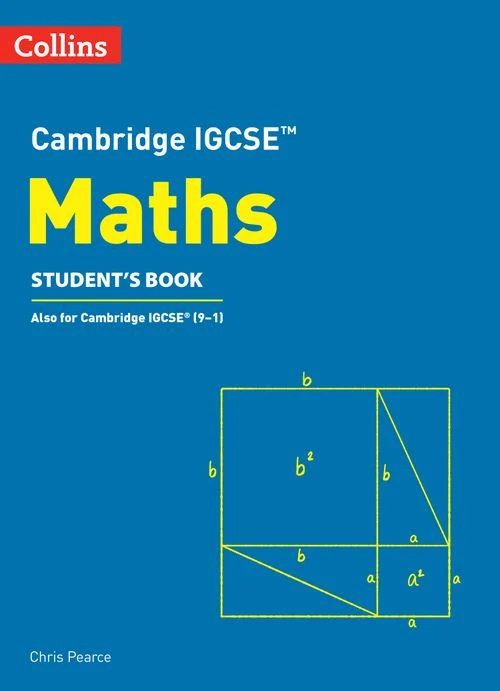
The Collins IGCSE Maths book, written by Chris Pearce, is designed around self-directed learning. Its modular layout means students can move between topic units without losing context, which is especially useful for revision cycles or for students who are self-studying outside a traditional school environment.
The book places significant emphasis on algebraic fluency and numerical calculation, two areas the Cambridge 0580 non-calculator papers test relentlessly. Visual progress trackers and exam-style checklists are built into each unit, helping students maintain their own study accountability.
A common mistake we see among self-study students is choosing a textbook and then working through it cover to cover without any self-testing. The Collins structure is specifically designed to prevent this by embedding assessment checkpoints throughout.
| Book Title | Publisher | Author(s) | Best For | Digital Resources |
|---|---|---|---|---|
| Cambridge IGCSE Mathematics Coursebook | Cambridge University Press | Karen Morrison, Nick Hamshaw | All-round use, conceptual depth | Cambridge GO platform |
| Cambridge IGCSE Mathematics Student’s Book | Hodder Education | Ric Pimentel, Terry Wall | Confidence-building, exam practice | Limited |
| Collins Cambridge IGCSE Mathematics Student Book | Collins | Chris Pearce | Self-study, modular revision | Online extras |
>>> Read more: IGCSE Maths Past Paper Strategy for 2026: How to Practice Smarter and Raise Your Grade
IGCSE Mathematics Core vs Extended books: Which do you need?
This is one of the most frequently misunderstood decisions in the Cambridge IGCSE Maths journey. Core and Extended are not separate subjects. They are different tiers of the same subject, assessed through different paper combinations, and the choice between them has a direct impact on the grades a student can achieve.
Core tier students sit Papers 1 and 3. They can achieve grades C to G. This tier is appropriate for students whose mathematical confidence is still developing or who are targeting a minimum threshold grade for progression purposes.
Extended tier students sit Papers 2 and 4. They can achieve grades A* to E. The Extended tier covers a broader and deeper content range, including topics such as the sine and cosine rules, vector geometry proofs, and cumulative frequency analysis at a higher level of application.
The good news is that all three endorsed books (Cambridge University Press, Hodder, and Collins) cover both tiers within a single volume. Core content is typically presented first in each chapter, with Extended material clearly labelled. Students on the Core tier can use the same book as Extended peers and simply focus on the designated sections.
One critical detail often overlooked is this: if a student is borderline between Core and Extended, defaulting to Extended is almost always the stronger strategic decision. The A* to C grade range available under Extended creates significantly more flexibility for university applications and progression to A Level Mathematics.
>>> Read more: IGCSE Maths “Explain” Questions 2026: What Examiners Want + How to Get Full Marks
Top IGCSE Maths books by Hodder, Oxford, and Cambridge University Press
Beyond the three lead endorsements, students often ask about Oxford IGCSE Mathematics materials. Oxford University Press produces strong supplementary resources, including practice books and revision-focused titles, though its primary coursebook does not carry the same level of official endorsement as the Cambridge University Press or Hodder editions.
The most effective approach, drawing on years of experience at Times Edu, is to use one primary endorsed coursebook and one dedicated revision guide as a secondary resource. The two serve fundamentally different purposes: the coursebook builds conceptual understanding, while the revision guide consolidates and tests that understanding under timed conditions.
For revision, the IGCSE Mathematics revision guide published by Cambridge University Press offers concise topic summaries and quick-check questions. It is not a replacement for full coursebook study but works effectively as a final four-to-six-week preparation tool before exam sessions.
| Resource Type | Recommended Title | Primary Use |
|---|---|---|
| Core textbook | Karen Morrison Maths / Hodder IGCSE Mathematics | Concept building, topic coverage |
| Revision guide | Cambridge IGCSE Mathematics Revision Guide | Final-stage consolidation |
| Workbook | Cambridge IGCSE Maths workbook (CUP) | Structured practice, self-testing |
| Past papers | Cambridge Assessment official website | Exam simulation |
>>> Read more: IGCSE Maths Mistakes 2026: The Most Common Errors and How to Stop Repeating Them
How to use an IGCSE Mathematics book alongside past papers for maximum results
A textbook alone will not produce top grades. In our experience working with international students, the students who achieve A and A* grades are those who integrate textbook study with structured past paper practice from the very beginning of their preparation, not just in the final weeks.
Here is the method we recommend at Times Edu:
- Phase 1 (Content building): Work through each chapter of your chosen IGCSE Mathematics textbook systematically. Do not skip worked examples. Attempt every exercise set independently before checking answers.
- Phase 2 (Chapter consolidation): After completing each chapter, attempt the chapter-end past exam questions from the Hodder book or pull relevant past paper questions from the Cambridge Assessment archive. This bridges the gap between learning and applying.
- Phase 3 (Mixed practice): Once all topics are complete, begin timed full paper sittings. Target at least six to eight past papers before the exam, marking them strictly using the official mark scheme.
- Phase 4 (Error analysis): After each past paper, categorise every lost mark by topic. Use this data to return to the relevant sections of your core textbook for targeted review.
One critical detail about the non-calculator papers: Papers 1 and 3 prohibit calculator use. A common mistake we see is students who practice almost exclusively with a calculator and then underperform on these papers. Your IGCSE Mathematics textbook should include dedicated non-calculator exercises. If it does not highlight this clearly, supplement with the Cambridge IGCSE Maths workbook, which separates calculator and non-calculator practice explicitly.
>>> Read more: IGCSE Maths 0580 Study Plan: 6-Month Schedule for A*
Where to buy IGCSE Mathematics books at the best price online
When students or parents search to buy IGCSE Mathematics books, the key factors to verify before purchasing are: edition year (2021 or later), whether the book explicitly states Cambridge endorsement, and whether it covers both Core and Extended tiers.
Reliable purchase channels include:
- Cambridge University Press online store: The most direct source for the Karen Morrison Maths coursebook and the Cambridge IGCSE Maths workbook. Prices are standard retail but the edition accuracy is guaranteed.
- Hodder Education website: Direct purchase of the Ric Pimentel and Terry Wall edition, often with bundle discounts on workbook and student book combinations.
- Amazon (international): Good availability, though buyers should verify the edition year carefully when purchasing from third-party sellers. Older editions (pre-2021) may appear at lower prices but carry syllabus alignment risks.
- Local educational bookshops: In countries with strong Cambridge school networks (Malaysia, Singapore, the UAE, Kenya, and Sri Lanka), endorsed books are widely stocked and often priced competitively.
For students in Vietnam, China, or other markets where shipping costs inflate prices significantly, digital editions available through the Cambridge GO platform offer a cost-effective and immediately accessible alternative.
>>> Read more: IGCSE Maths 0580 A* Strategy 2026: 8 Tips From Top Tutors
Free IGCSE Maths resources vs investing in a dedicated study book
The internet offers a substantial volume of free IGCSE Maths content: YouTube tutorials, past paper repositories on the Cambridge Assessment website, and topic summary notes from various educational platforms. A reasonable question is whether a student genuinely needs to purchase a dedicated Core Extended Maths book IGCSE.
The answer, based on consistent observation across student cohorts at Times Edu, is yes, and the reasons are structural rather than promotional.
Free resources are almost always fragmented. A YouTube video covers one technique. A downloaded note set covers one topic. What an endorsed IGCSE Mathematics textbook provides is a coherent, logically sequenced learning journey where each chapter builds on the last. This sequential structure is particularly important for topics that carry prerequisite knowledge, such as the connection between coordinate geometry and function plotting, or between basic probability and Venn diagram interpretation.
That said, free resources have a genuine role to play. Past papers from the Cambridge Assessment website are free and essential. Topic explanation videos are useful for students who struggle to understand a concept from text alone. The optimal approach is to use a purchased, endorsed textbook as the structural spine of study, and layer free resources around it as supplementary support.
Students who rely entirely on free resources tend to have significant knowledge gaps that only become visible in a full past paper sitting, typically too late in the preparation cycle to address thoroughly.
>>> Read more: IGCSE Tutor 2026: How to Choose the Right One
Frequently asked questions
Which IGCSE Mathematics textbook is officially endorsed by Cambridge?
Is there a separate IGCSE Maths book for Core and Extended level students?
What is the best IGCSE Mathematics revision guide for last-minute exam preparation?
Which IGCSE Maths book covers algebra, geometry and statistics most clearly?
Do I need a separate workbook for IGCSE Mathematics practice questions?
Are older editions of IGCSE Mathematics books valid for the current 0580 syllabus?
Which IGCSE Mathematics book is best suited for self-study students?
Conclusion
If you are unsure which tier, which textbook, or which study plan is right for your specific situation, the Times Edu team offers personalised academic roadmap consultations for IGCSE, A Level, IB, AP, and SAT students worldwide. A single consultation with one of our experienced curriculum specialists can save months of misaligned effort and give your child a clear, strategic path to the grades they are targeting.