IB Physics calculation questions 2026: How to approach them for full marks
IB Physics calculation questions test more than whether students can select the correct formula; they also assess how clearly and accurately each step of the solution is presented. Strong answers show the formula, substitute values carefully, keep units consistent, use appropriate significant figures, and include enough working to protect method marks if an arithmetic error occurs. Paper 1 calculations often rely on proportional reasoning, while Paper 2 requires more structured, multi-step solutions.
This guide explains how to approach IB Physics calculation questions, avoid common errors, and check answers efficiently under exam conditions.
- Types of calculation questions that appear across IB Physics papers
- How to set out and present physics calculations in IB Physics
- How to handle units and significant figures in IB Physics calculations
- How to earn method marks even when your final answer is wrong in IB Physics
- Common calculation errors in IB Physics and how to avoid them
- How to check calculation answers efficiently in IB Physics
- Frequently asked questions
Types of calculation questions that appear across IB Physics papers
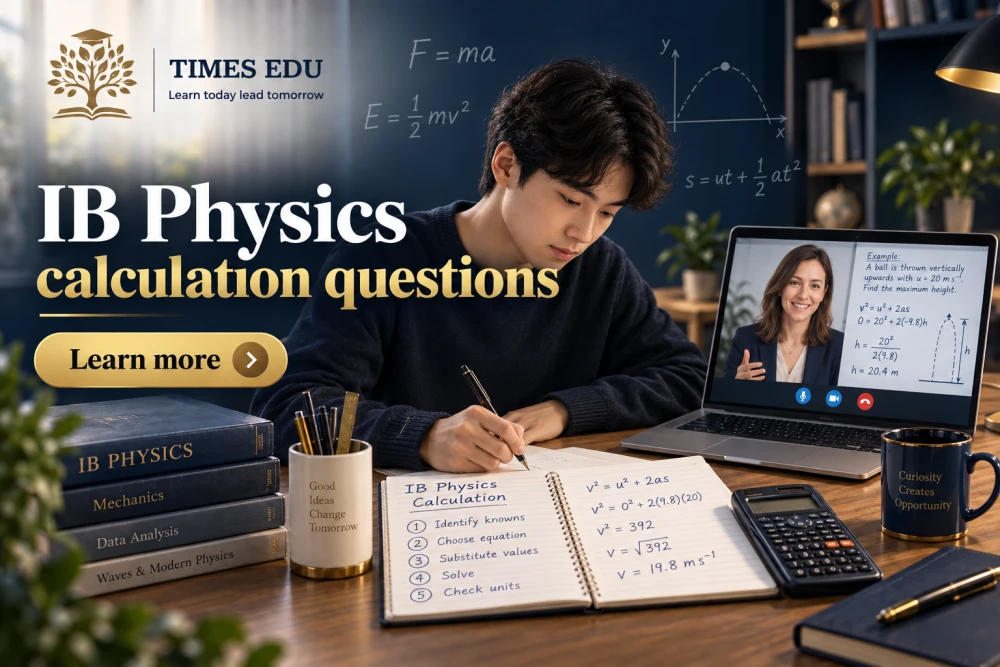
Understanding the format of each paper is the first step in building a smart IB Physics [1] calculation strategy.
Paper 1 is a multiple-choice paper where no calculator is permitted. Calculation questions here rely on proportional reasoning, order-of-magnitude estimates, and algebraic manipulation. A classic example is an inverse-square law question: If the distance between two masses doubles, the gravitational force becomes one-quarter of the original value. You are not crunching numbers; you are manipulating relationships.
Paper 2 is where multi-step calculation questions appear in full. These questions are worth between 2 and 6 marks each, and they require a clearly laid-out solution that shows every step. The themes covered span all major units of the curriculum, including mechanics, thermal physics, waves, electricity, fields, and quantum physics.
| Paper | Calculator | Calculation type | Marks per question |
|---|---|---|---|
| Paper 1 | Not permitted | Proportional reasoning, ratio-based | 1 mark each |
| Paper 2 | Permitted | Multi-step structured calculations | 2 to 6 marks each |
One critical detail often overlooked by students is that Paper 1 calculation questions reward students who understand how quantities scale with each other, not students who can punch numbers into a formula. Drilling Paper 2 calculations alone, while ignoring proportional reasoning, leaves a significant number of marks unprotected.
>>> Read more: IB Physics high yield topics 2026: Where to focus your revision for maximum marks
How to set out and present physics calculations in IB Physics
The way you present a calculation in IB Physics matters as much as the answer itself. Examiners follow a mark scheme that awards marks at specific logical steps, not only at the final line.
A correct layout for any Paper 2 calculation should follow this sequence:
- State the formula you are using, exactly as it appears in the IB Physics Data Booklet.
- Substitute numerical values with units directly into the formula, in the same line.
- Show intermediate working clearly, one step per line where possible.
- State the final answer with the correct unit and appropriate significant figures.
Here is how this looks for a resistance calculation using the formula R = ρL/A:
Formula: R = ρL / A
Substitution: R = (5.6 × 10⁻⁸ × 1.5) / (2.0 × 10⁻⁷)
Working: R = 8.4 × 10⁻⁸ / 2.0 × 10⁻⁷
Answer: R = 0.42 Ω
In our experience working with international students preparing for IB exams, many students skip the substitution step because it feels obvious to them. Skipping it is a gamble: If the final answer is wrong, the examiner cannot award the substitution mark because there is no evidence it was done correctly.
The rule is simple: Every mark on the mark scheme corresponds to a visible step in your working. Show the step, earn the mark.
>>> Read more: IB Physics HL vs SL 2026: How to choose the right level for you
How to handle units and significant figures in IB Physics calculations
Unit conversions and significant figures are two of the most consistent sources of lost marks in IB Physics calculations. They are also entirely preventable with the right habits.
Unit conversions in IB Physics require careful attention at the substitution stage. All values must be in SI base units before you substitute them into any formula. Common prefixes students must convert correctly include:
| Prefix | Symbol | Multiplier | Example |
|---|---|---|---|
| nano | n | × 10⁻⁹ | 450 nm = 4.5 × 10⁻⁷ m |
| micro | μ | × 10⁻⁶ | 2.5 μF = 2.5 × 10⁻⁶ F |
| milli | m | × 10⁻³ | 350 mA = 0.35 A |
| kilo | k | × 10³ | 5.0 kΩ = 5.0 × 10³ Ω |
| mega | M | × 10⁶ | 2.0 MHz = 2.0 × 10⁶ Hz |
| giga | G | × 10⁹ | 1.5 GHz = 1.5 × 10⁹ Hz |
A common mistake we see is students converting the prefix incorrectly under time pressure, for example writing 450 nm as 4.5 × 10⁻⁸ m instead of 4.5 × 10⁻⁷ m. A unit error at the substitution stage corrupts every subsequent line, and the final answer will be wrong by an order of magnitude.
Significant figures in IB Physics calculations follow a specific IB rule: Your final answer should match the lowest number of significant figures given in the question data. If the question provides values to 2 significant figures, your answer should be to 2 significant figures. If values are mixed (some to 2, some to 3), round to the lowest.
The IB mark scheme applies a “±1 sig fig” tolerance rule: An answer that is one significant figure above or below the expected precision will not lose the answer mark in most cases, but giving an answer to 6 decimal places is poor scientific practice and can introduce rounding errors in multi-step problems.
>>> Read more: IB Physics common mistakes 2026: The errors that cost students the most marks
How to earn method marks even when your final answer is wrong in IB Physics
One of the most strategically important concepts for IB Physics calculation questions is the method mark system. Examiners are instructed to award marks for correct physics demonstrated at each step, independent of whether the final answer is correct.
This means a student who writes a fully correct solution except for an arithmetic slip at the last line can still earn the majority of marks for that question. Contrast this with a student who jumps straight to a numerical answer with no working shown: If the answer is wrong, there are no marks to award.
In our experience working with international students, many students from East Asian schooling systems in particular are trained to solve problems mentally and write only the answer. That habit is actively penalised under the IB mark scheme.
How method marks work in practice:
- A 4-mark calculation will typically have 3 method marks and 1 answer mark.
- If you make an error in step 2 but carry that incorrect value through correctly in steps 3 and 4, you will receive what is called an “error carried forward” credit, provided the physics in steps 3 and 4 is correct.
- The formula mark is nearly always the first mark: Write the correct formula at the top of your working, and that mark is already secured.
The strategic takeaway is clear: Even when you are unsure of a calculation, begin by writing the correct formula from the Data Booklet, substitute the values you are given, and show as much logical working as you can. Partial credit in IB Physics Paper 2 calculations is not a consolation prize; it is a deliberate design feature of the assessment.
>>> Read more: IB Physics command terms 2026: What they mean and how to respond correctly
Common calculation errors in IB Physics and how to avoid them
Drawing on years of experience at Times Edu reviewing IB Physics exam scripts, the errors that cost students the most marks are not conceptual misunderstandings. They are procedural habits that can be corrected with targeted practice.
Error 1: Using the wrong formula
The IB Physics Data Booklet contains every formula you are permitted to use. Students who memorise formulas incorrectly and then apply the wrong one lose all marks for that part. The fix: Always open the Data Booklet during practice sessions. Never memorise formulas in isolation from their Data Booklet context.
Error 2: Failing to convert units before substituting
As discussed above, entering values in non-SI units produces a wrong answer that cannot earn the answer mark. The fix: Add a unit-check line before substituting, writing out the converted values explicitly.
Error 3: Dropping the vector sign in momentum and force questions
Momentum is a vector. When an object reverses direction, its momentum changes by 2mv, not zero. A common mistake we see is students calculating Δp = mv – Mv = 0 because they forget the sign of the final velocity changes. The fix: Define a positive direction at the start of every mechanics calculation and apply it consistently.
Error 4: Rounding intermediate values
Rounding to 2 significant figures during working and then rounding again at the final step accumulates rounding error. The fix: Keep at least one extra significant figure in all intermediate steps, then round only at the final answer.
Error 5: Ignoring the principle equation in thermal physics questions
In calorimetry problems, students often jump straight to Q = mcΔT without first writing the conservation principle: Heat lost = heat gained. Without this line, the substitution mark for the principle may not be awarded. The fix: Always state the governing principle in words or as an equation before expanding the formula.
Error 6: Misreading the question’s significant figures
A question that states “a wire of cross-sectional area 2.0 × 10⁻⁷ m²” provides the area to 2 significant figures. Giving a final answer to 4 significant figures contradicts the precision of the data. The fix: Underline or circle the number of significant figures in each given value as you read the question.
>>> Read more: IB Physics books 2026: Complete guide for students and teachers
How to check calculation answers efficiently in IB Physics
Time management is a real constraint in IB Physics Paper 2. Many students either rush through calculations without checking or spend so long on one question that they run out of time for others. A structured checking approach takes under 60 seconds per question and catches the majority of common errors.
Step 1: Check units in the final answer
Does your answer have the correct unit? If you calculated resistance but your answer is in amperes, something went wrong in the formula or substitution. Units tell you immediately whether the formula was applied correctly.
Step 2: Check the order of magnitude
Is your answer physically reasonable? A resistance of 0.42 Ω for a short metal wire is sensible. A resistance of 4.2 × 10⁶ Ω for the same wire would signal a unit conversion error. Developing physical intuition for typical values is one of the most valuable skills in IB Physics calculation strategy.
Step 3: Check significant figures
Count the significant figures in your given data and compare to your answer. If the data has 2 significant figures and your answer has 5, round before moving on.
Step 4: Check sign conventions
In mechanics and fields questions, confirm that your signs are consistent with the positive direction you defined at the start.
Step 5: Check that the formula used matches the physical situation
For example, if a question involves non-uniform acceleration, you cannot apply the constant-acceleration kinematic equations. A quick re-read of the question stem before checking confirms you used the right model.
| Checking step | What it catches | Time required |
|---|---|---|
| Unit check | Formula applied incorrectly | 10 seconds |
| Order of magnitude | Prefix conversion error | 10 seconds |
| Significant figures | Rounding error | 5 seconds |
| Sign convention | Vector direction error | 10 seconds |
| Formula match | Wrong model selected | 15 seconds |
>>> Read more: IB Physics : Syllabus, Exam Structure & Roadmap to an 7 in 2026
Frequently asked questions
What types of calculation questions appear in IB Physics exams?
How much working do you need to show in a calculation question in IB Physics?
How do you handle unit conversions in IB Physics calculation questions?
How do you approach a multi-step calculation in IB Physics Paper 2?
How do significant figures affect marks in IB Physics calculation answers?
What are the most common calculation errors in IB Physics exams?
How do you check a calculation answer quickly without losing time in IB Physics?
Conclusion
At Times Edu, our 1-on-1 IB Physics tutors work directly with students on exactly this kind of exam-ready problem solving, using real past-paper questions, mark schemes, and personalised feedback sessions to close the gap between understanding and execution. If your child is preparing for IB Physics Paper 2 or working to lift their grade from a 5 to a 7, a targeted consultation with our curriculum specialists is the most direct way to identify which calculation skills need the most attention and build a structured plan to address them before exam season.