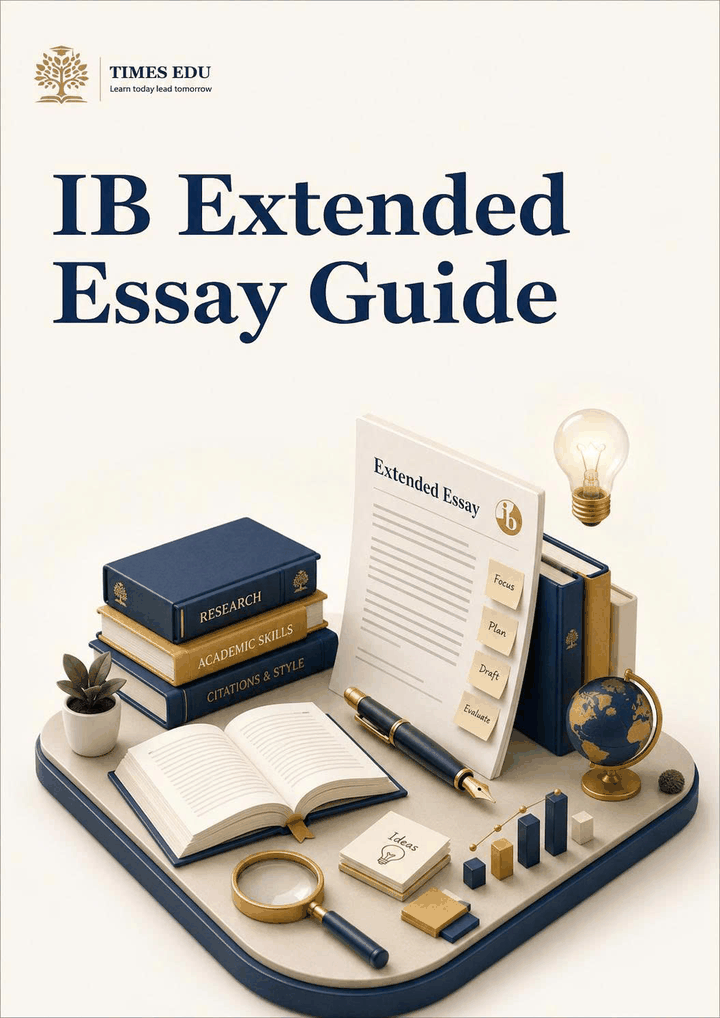
IB Extended Essay Topic Selection for 2026: How to Choose a Focused and Scorable Research Idea
IB Extended Essay Topic Selection is the process of choosing an IB-approved subject area, narrowing it into a feasible, evidence-led Research Question, and designing a clear plan for primary sources, data collection, and analysis.
The best EE topics align with your genuine academic interests while strictly meeting subject-specific guidelines, so you can sustain depth across 4,000 words. A strong selection is always testable: You can access credible primary sources, apply an appropriate theoretical framework, and complete the investigation within realistic time constraints.
At Times Edu, we see the highest-scoring EEs start with feasibility screening and supervisor-style refinement, not brainstorming titles.
How To Master IB Extended Essay Topic Selection

IB Extended Essay Topic Selection is not a “pick something interesting and start writing” exercise. It is the strategic start of a 4,000-word investigation where your Research Question must be narrow, arguable, and evidence-led, while still allowing you to demonstrate analysis against IB criteria.
Based on our years of practical tutoring at Times Edu, the fastest way to lose marks is choosing a topic that sounds impressive but collapses under weak primary sources, vague scope, or unrealistic data collection. A strong EE is built like a small academic paper: A defensible claim, a workable method, and a clear theoretical framework (even in subjects that do not label it that way).
A critical detail most students overlook in the 2026 exam cycle is that supervisors and examiners are increasingly sensitive to “template EEs” that recycle overused angles with shallow evidence. Your topic can be common, but your method and dataset must be specific, justified, and replicable.
A decision rule we teach high-achievers
If you cannot answer these three questions in one sentence each, you are not ready to lock the topic.
- What is the exact Research Question?
- What will count as your core evidence (primary sources or primary data, plus supporting secondary literature)?
- What is your analysis engine (concepts, model, lens, or theoretical framework)?
Common misconceptions that quietly destroy EE scores
Most “bad topic choices” are not bad because the topic is boring. They are bad because the topic design prevents a high-grade response.
- Misconception 1: “Broader topic = more to write.” Broad topics usually become descriptive summaries. Examiners reward focused argument and evaluation, not volume.
- Misconception 2: “If I have many sources, I’m safe.” Many sources are meaningless if they are not the right type. An EE without credible primary sources or clear primary data often struggles to show genuine investigation.
- Misconception 3: “World Studies is easier because it’s flexible.” World Studies is stricter in structure because you must integrate disciplines, align a global issue, and justify methods across subjects.
How topic choice links to grade outcomes (what students call “grade boundaries”)
IB does not reward effort; it rewards criterion performance. Your topic choice determines whether you can meet the EE assessment expectations: Focused question, methodological clarity, sustained analysis, critical evaluation, and coherent argumentation.
From our direct experience with international school curricula, students aiming for an A typically succeed because the topic forces depth. Students stuck at C–D often chose topics that force description, weak evaluation, or untraceable evidence.
>>> Read more: IB IA Topic Selection for 2026: How to Choose a Strong and Manageable Idea
Exploring Subject Areas And Research Feasibility
Feasibility is not a last-minute check. It is the filter that decides whether your EE is a controlled research project or a stressful guessing game.
The Feasibility Triangle
A topic is feasible when all three corners are strong.
- Scope: Can the question be answered in 4,000 words without becoming a Wikipedia overview?
- Evidence: Are primary sources or primary data realistically accessible and ethical?
- Method: Can you run reliable data collection or textual analysis within time and school constraints?
A screening table we use in supervisor-style consultations
| Feasibility Check | What “Good” Looks Like | What “Risky” Looks Like |
|---|---|---|
| Access to evidence | Primary data you can obtain, or primary texts/archives you can cite directly | Evidence behind paywalls, restricted databases, or “I’ll interview famous experts” |
| Time cost | Research + drafting fits a 40-hour independent project | You need months of lab trials, advanced software, or large sample sizes |
| Ethical clearance | Minimal risk to participants, clear consent, anonymized data | Sensitive groups, medical data, or manipulative experiments |
| Analysis depth | Clear variables, framework, or interpretive lens | Only narrative description, no evaluative method |
| Supervisor fit | Supervisor understands the subject-specific approach | Supervisor unfamiliar with your method or resources |
Based on our years of practical tutoring at Times Edu, a topic becomes feasible faster when you design your evidence plan before finalizing your title. Many students do the opposite and later discover the evidence does not exist.
Picking a subject: Strategy for academics and university admissions
Students often ask which subject “looks best” for top universities. The better question is which subject lets you show academic maturity with credible evidence.
- STEM-leaning applicants: A strong Biology/Chemistry/Physics EE can signal research habits, but only if the experiment is controlled and the analysis is statistically sound.
- Humanities applicants: History, English, or Global Politics can be powerful when primary material is rich and you apply a disciplined interpretive method.
- Business/Econ applicants: Economics EEs succeed when the dataset is clean and the evaluation is real, not when the essay becomes a commentary piece.
The pedagogical approach we recommend for high-achievers is to treat the EE as a “mini writing sample” for your intended major. Your topic should align with the academic voice your target universities expect.
Primary sources: What they mean in different subjects
“Primary sources” do not mean the same thing across IB subjects. This confusion causes major topic-selection errors.
- History: Archival documents, speeches, letters, newspaper articles from the time, official statistics.
- English: The literary text itself, author interviews, early editions, contemporaneous reviews (depending on approach).
- Economics: Raw time-series data, government datasets, company financials, survey results you collected.
- Sciences: Your experimental measurements, lab notes, raw observations, instrumentation output.
- World Studies: A blended evidence base, but you must justify how each discipline treats evidence.
If your topic cannot access legitimate primary material, the best fix is usually not “find more sources.” The fix is redesigning the Research Question so the evidence becomes reachable.
>>> Read more: IB Extended Essay 2026 Timeline: A Detail Plan From Research to Final Draft
Narrowing Down Your Research Question For Depth

Your Research Question is the spine of the EE. If it is weak, no amount of writing polish will save the score.
The narrowing process we teach (broad → focused → arguable)
Start with a broad interest area. Then compress it through constraints.
- Area of interest: Climate change
- Angle: Coastal ecosystems
- Context: A local mangrove site you can actually study
- Mechanism: Salinity change and species distribution
- Research Question: “To what extent has increased coastal salinity affected the distribution of mangrove species in [specific site] between [years]?”
This is IB Extended Essay Topic Selection done correctly: A topic anchored to a method and evidence.
What makes a Research Question “focused” in examiner terms
A focused question does three jobs.
- It sets boundaries (time period, location, text corpus, dataset, population).
- It contains an evaluative command (to what extent, how, in what ways, what relationship).
- It implies an analysis method (comparison, causal analysis, thematic analysis, modeling).
A question like “How does social media affect teenagers?” Is not a Research Question. It is a social issue headline.
A practical checklist before you lock your final question
| Design Element | Target Standard | Quick Test |
|---|---|---|
| Specificity | One clear phenomenon, one defined context | Can you highlight the boundaries in a single sentence? |
| Evidence readiness | Primary data or primary texts identified | Do you already have 5–10 solid primary items or a data plan? |
| Analysis method | Clear theoretical lens or model | Can you explain your method without saying “I will discuss”? |
| Depth potential | Allows evaluation and limitations | Can you name 2 likely counterarguments or limitations now? |
| Word-count fit | Answerable in 4,000 words | Can you outline 3–4 chapters without filler? |
From our direct experience with international school curricula, the strongest EEs often start with a question students can test, not just talk about.
Theoretical framework: Yes, even if you think you don’t need one
Many students only associate “theoretical framework” with psychology or social sciences. That assumption blocks top-level analysis.
- Economics: Elasticity, market structures, behavioral models, development indicators.
- Literature: Narratology, postcolonial theory, feminist criticism, reader-response, genre theory.
- History: Historiography, causation frameworks, source provenance evaluation.
- Sciences: Underlying scientific models and variables, error analysis, statistical reasoning.
A critical detail most students overlook in the 2026 exam cycle is that examiners reward explicit methodological control. Naming and applying a framework signals control, not just “knowledge.”
Data collection: Design it before you commit
Data collection failures are a top reason students abandon otherwise good ideas.
Use this sequence:
- Define what you will measure or extract.
- Define how you will measure or extract it.
- Define the sample and sampling logic.
- Define limitations and how you will mitigate them.
If you cannot run your method in a small pilot within one week, your topic is probably too fragile.
>>> Read more: Prepare for IB from IGCSE for 2026: A Practical Transition Plan for a Smooth Start
Matching Your Interests With IB Subject Guidelines
Subject-specific guidelines are not “rules you skim once.” They shape what counts as valid evidence, valid analysis, and valid conclusions.
How to align passion with IB constraints (without losing motivation)
Interest matters because the EE is long and independent. Interest alone is not enough because motivation does not replace a method.
We use a two-layer alignment:
- Layer 1: Intrinsic interest. The topic should be personally engaging so the student sustains effort for months.
- Layer 2: Criterion compatibility. The topic must allow analysis, evaluation, and structured argument under that subject’s expectations.
Based on our years of practical tutoring at Times Edu, the best topics are “personal in choice, academic in execution.”
Subject choice matrix: What tends to work well
| Subject Route | High-Scoring Topic Traits | Common Topic Traps |
|---|---|---|
| Economics | Clean dataset, clear variables, evaluative commentary | Political opinion essays disguised as economics |
| History | Rich primary sources, historiographical awareness | Overly broad wars/eras with no primary base |
| English | Tight text selection, consistent lens, close reading | Plot summary, theme listing, too many texts |
| Biology/Chemistry | Controlled experiment, reliable measurements, error analysis | Uncontrolled variables, small sample, unsafe or unethical methods |
| Global Politics | Case-specific evidence, theory linked to analysis | Generic international relations “overview” writing |
| World Studies | Genuine interdisciplinary integration, clear global issue, balanced methods | Two separate mini-essays stapled together |
Should you choose World Studies?
World Studies [1] can be a strong choice when your real question sits between disciplines. It becomes risky when students use it as an escape from strict subject expectations.
World Studies is appropriate when:
- You have a global issue that genuinely requires two disciplines to explain.
- Your evidence base and method are coherent across both disciplines.
- Your supervisor’s support is strong, because integration is hard to execute cleanly.
World Studies is a poor choice when:
- You cannot define a global issue precisely.
- You plan to “split the essay in half” by subject.
- You lack a credible plan for data collection or primary sources.
The pedagogical approach we recommend for high-achievers is to choose World Studies only when the integration is the academic “value add,” not just a format choice.
Supervisor consultation: Treat it like an academic peer review
Supervisor meetings should not be casual brainstorming. Use them like structured checkpoints.
Bring:
- Your proposed Research Question and 2 alternatives.
- A 10-source shortlist including primary sources.
- A one-paragraph method plan describing data collection or textual analysis.
- A risk list: What might fail and your backup plan.
This turns supervision into targeted refinement, not vague advice.
>>> Read more: How to Write a Perfect IB Extended Essay Research Question 2026
Frequently Asked Questions
How do I choose a good IB EE topic?
Start with a subject where you can do real analysis, not just write elegantly. Then build the topic around a Research Question you can answer using primary sources or credible data collection. Based on our years of practical tutoring at Times Edu, the best topic is the one that is feasible, evidence-rich, and narrow enough to argue in 4,000 words.Use this step sequence:
- Choose one IB subject you can sustain academically.
- List 3 interest areas from your coursework or personal experience.
- For each area, draft one Research Question and identify possible primary sources.
- Run a feasibility check for time, access, ethics, and supervisor support.
- Pilot your method briefly to confirm the topic works.
What are the easiest IB subjects for the Extended Essay?
There is no universally “easy” subject, because difficulty depends on evidence access and methodological fit. Students often find humanities EEs logistically easier because primary sources are more accessible than lab equipment, but humanities marking becomes strict when analysis is shallow.From our direct experience with international school curricula, “easiest” usually means:
- You already understand the subject-specific guidelines.
- Your evidence base is accessible and credible.
- Your method is clear enough that you can repeat it consistently.
If you want the most stable route, pick a subject where you can control data collection or primary-text selection without relying on external gatekeepers.
Can I do my EE in a subject I don't take?
IB rules allow an EE in a subject not taken in the Diploma Programme in some cases, but feasibility and supervision become the real constraints. The bigger risk is not permission; it is whether you can meet subject-specific guidelines without classroom support.Based on our years of practical tutoring at Times Edu, students succeed with this only when:
- They already have strong background knowledge and academic writing skills.
- The supervisor support is available and aligned.
- The evidence and theoretical framework are clearly manageable.
If your university application depends on demonstrating subject strength, writing the EE in that discipline can help, but only if execution quality stays high.
What makes a research question focused?
A focused Research Question has strict boundaries and a built-in analysis method. It is not a topic statement, and it is not a moral debate.A strong focused question typically includes:
- A defined context (place, time, text corpus, dataset).
- A measurable or analyzable relationship.
- A method signal (comparison, evaluation, causal inference, thematic analysis).
- A realistic scale for 4,000 words.
If you cannot sketch your argument in 6–8 bullet points, your question is probably too broad.
How do I check if my topic has enough primary sources?
Define what counts as “primary” for your subject first. Then verify access and quality before committing to the final Research Question.Use this verification routine:
- Identify at least 5–10 primary sources (or a primary-data plan) you can access now.
- Check credibility, provenance, and relevance to your research scope.
- Confirm you can cite them properly and extract analyzable evidence.
- Build a backup set in case access fails.
A critical detail most students overlook in the 2026 exam cycle is that “sources exist online” is not the same as “sources are usable for academic analysis.” Your sources must be reliable, traceable, and directly tied to your method.
What are examples of strong EE topics?
Strong EE topics are not defined by the headline. They are defined by narrow scope, robust evidence, and a defensible analytical framework.Here are sample directions (as models, not templates):
- Economics: Exchange-rate changes and measurable impact on a specific regional tourism sector using time-series data and evaluation of confounders.
- History: A specific policy decision in a narrow time window evaluated through primary documents and competing historiographical interpretations.
- English: A focused lens applied to one text (or a tightly justified pair), using close reading and a consistent theoretical framework.
- Biology: A controlled experiment on one variable with clear measurement protocol, statistical treatment, and error analysis.
- Global Politics: A well-defined case study analyzed through a political theory framework, supported by primary documents and structured evaluation.
Based on our years of practical tutoring at Times Edu, a “strong topic” is usually one you can test early with a mini-outline and a source audit.
Should I choose World Studies for my EE?
Choose World Studies when interdisciplinarity is essential to answer your Research Question. Avoid it when you simply want more freedom.World Studies is a good fit when:
- Your global issue is precisely defined.
- You can integrate two disciplines with a coherent theoretical framework.
- Your data collection plan works across both methods without contradictions.
If you are aiming for top universities, World Studies can signal intellectual ambition, but only if the integration is genuinely analytical. From our direct experience with international school curricula, weak World Studies EEs often read like two separate essays that never truly connect.
Conclusion
IB Extended Essay Topic Selection is a design problem, not a motivation problem. If you pick a topic that forces depth, your writing becomes easier, your supervision becomes clearer, and your final argument becomes defensible.
Based on our years of practical tutoring at Times Edu, the fastest route to a high grade is a structured consultation where we pressure-test your Research Question, audit your primary sources, and build a feasible data collection plan aligned with subject-specific guidelines. If you want a personalized EE roadmap that also strengthens your university application narrative, contact Times Edu to book a tailored academic planning session.
Resources: